
供给侧结构性改革

Search documents
期待中国为世界注入稳定性和正能量——国际社会高度关注中国共产党二十届四中全会举行
Yang Guang Wang· 2025-10-23 04:15
央广网北京10月23日消息 据中央广播电视总台中国之声《新闻和报纸摘要》报道,国际社会高度 关注中国共产党二十届四中全会,认为这一重要会议将进一步促进中国高质量发展,为世界注入更多稳 定性和正能量,为其他国家探索发展道路提供新借鉴,为人类发展进步作出新贡献。 联合国环境规划署执行主任安德森高度赞赏中国生态文明建设取得的成就,期待"十五五"规划使中 国在全球生态环境治理中继续发挥引领者作用。 安德森:我很关注中国正在制定的"十五五"规划,尤其是涉及循环经济和绿色发展的内容。习主席 提出的"绿水青山就是金山银山"理念,不仅饱含诗意,而且意义重大。将生态保护视作创造财富的途 径,已经得到了国际社会的广泛认同。"十五五"规划无疑将让中国开启又一个令人振奋的新篇章。 美国中美研究中心高级研究员古普塔:中国共产党和中国政府与时俱进,作出发展规划,西方和美 国的许多经济学者都认可这种规划的必要性和价值。中国在规划中不断调整策略,走向更具指导性和灵 活性的模式,我认为中国的规划堪称一门艺术。 世界经济论坛中东北非负责人凯鲁兹认为,中国以科技创新推动高质量发展,为全球经济发展注入 新动能。 凯鲁兹:中国已通过高质量发展在众多领 ...
商务部解读促进住宿业高质量发展指导意见
Zhong Guo Xin Wen Wang· 2025-10-20 06:33
Group 1 - The core viewpoint of the article is the issuance of the "Guiding Opinions on Promoting High-Quality Development of the Accommodation Industry" by the Ministry of Commerce and nine other departments, aimed at enhancing the quality of the accommodation sector and supporting service consumption growth [1][2]. Group 2 - The background for the issuance of the "Guiding Opinions" includes the emphasis from the Central Committee and the State Council on promoting service consumption, recognizing the accommodation industry as a vital part of the tertiary sector and a key area for service consumption [2]. - The accommodation industry faces challenges such as insufficient brand development, homogeneous competition, and low levels of green development, necessitating coordinated efforts to support high-quality growth [2]. Group 3 - The overall approach of the "Guiding Opinions" is to align with Xi Jinping's thought, implement the spirit of the 20th National Congress, and promote high-quality development in the accommodation sector through supply-side structural reforms and enhancing service quality [3]. - The "Guiding Opinions" include six major policy measures with a total of 17 specific actions aimed at fostering brand development, enhancing service quality, promoting green development, optimizing the business environment, strengthening support elements, and solidifying the foundation for work [4]. Group 4 - Key features of the "Guiding Opinions" include a problem-oriented approach to systematically improve development quality, focusing on supply-side structural reforms to address industry shortcomings and expand quality accommodation services [5]. - The "Guiding Opinions" emphasize optimizing the environment to stimulate industry growth, proposing measures to enhance market order, regulatory practices, and transparency, thereby fostering a fair and innovative competitive landscape [5]. - Safety is highlighted as a prerequisite for high-quality development, with measures proposed to strengthen personal information protection, security management, and food safety responsibilities, ensuring a safe accommodation environment for consumers [5]. Group 5 - The Ministry of Commerce plans to collaborate with relevant departments to guide local implementation of the policies, promote beneficial local practices, and further the high-quality development of the accommodation industry to meet consumer demands for quality lodging services [6].
“十四五”,中国经济做对了什么
Jing Ji Ri Bao· 2025-10-19 23:32
Core Viewpoint - Despite global economic uncertainties, China's economy has shown a robust upward trend, achieving significant milestones in GDP growth [1] Group 1: Economic Performance - China's total economic output has consistently surpassed 110 trillion, 120 trillion, and 130 trillion yuan, with a five-year economic increment equivalent to creating a third-largest economy in the world [1] - In September, China's total import and export value reached 4.04 trillion yuan, marking an 8% year-on-year increase, the highest monthly growth rate this year [3] - The country's foreign trade has remained stable and resilient, with a record high of 20 trillion yuan in import and export scale in the first half of the year [3] Group 2: Policy and Leadership - The leadership of the Communist Party of China (CPC) is deemed essential for addressing risks and challenges, ensuring social stability, and providing a "stability anchor" for long-term economic development [2][5] - The CPC has effectively broken down overall development goals into specific targets and processes, ensuring strategic continuity and policy stability through the implementation of five-year plans [4] Group 3: Strategic Planning - The "14th Five-Year Plan" emphasizes the importance of expanding domestic demand, technological innovation, and high-level opening up, marking a shift from reliance on investment and exports to a new growth model driven by domestic demand and innovation [8] - The integration of strategic planning with macroeconomic policies enhances resource allocation efficiency and stabilizes market expectations [6] Group 4: Market and Government Interaction - The effective market and proactive government approach is crucial for resource allocation and risk management, aiming to build a high-level socialist market economy [10] - The government plays a vital role in creating favorable conditions for enterprises, particularly in areas like public research and support for small and medium-sized enterprises [12] Group 5: Future Outlook - By 2035, China aims to achieve basic socialist modernization and reach a per capita GDP level comparable to that of developed countries, with the "15th Five-Year Plan" being a critical period for this transition [12]
看图学习・非凡“十四五”丨“努力把各方面积极因素转化为发展实绩”
Sou Hu Cai Jing· 2025-10-19 01:14
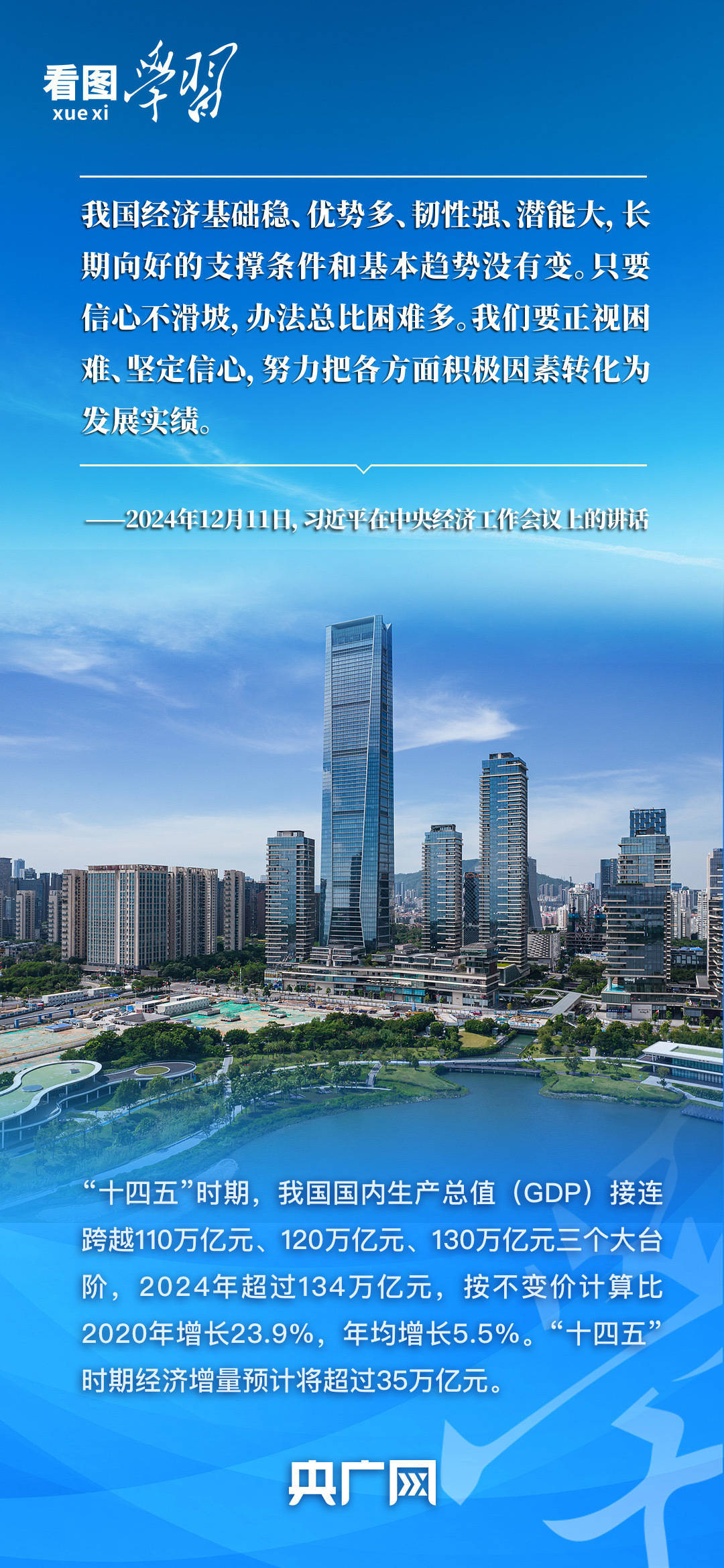
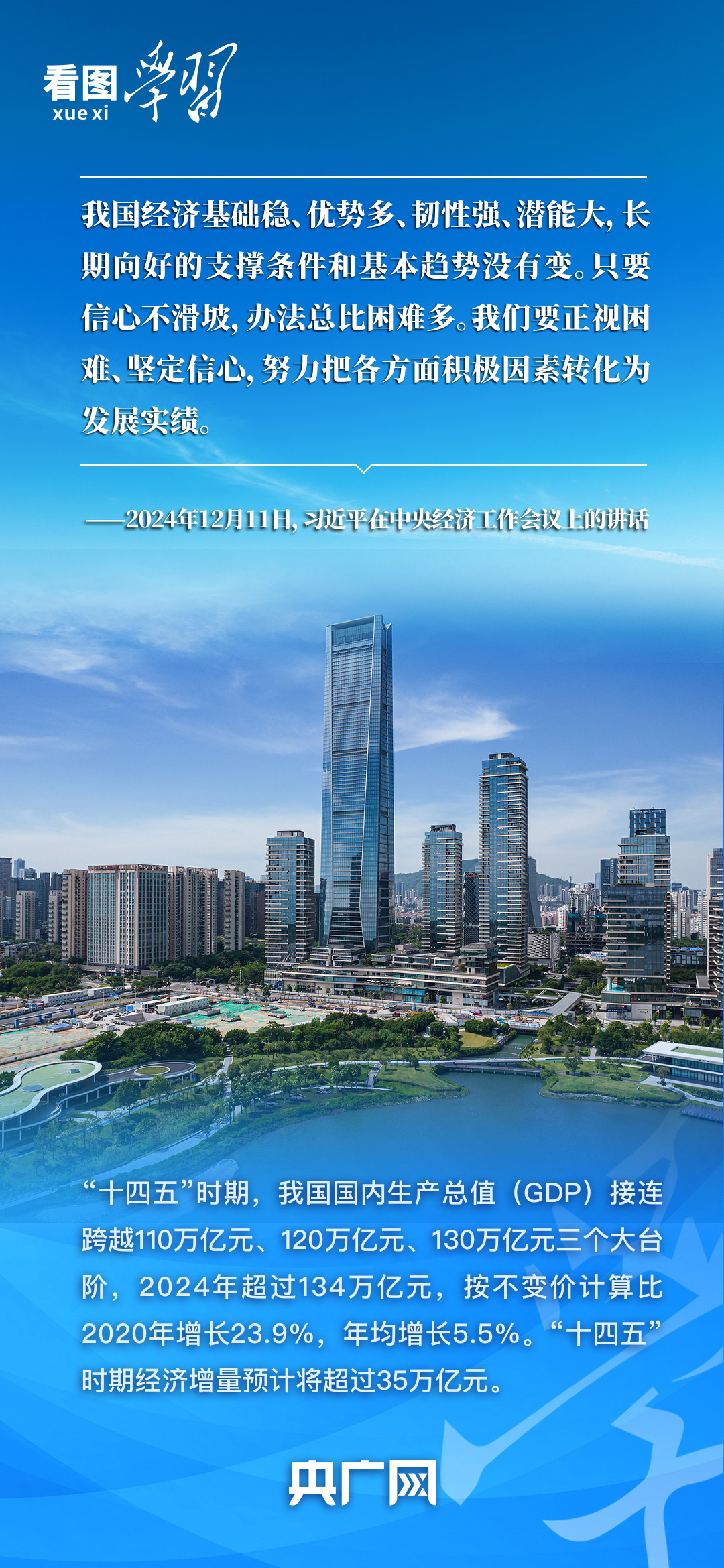
110万亿元、120万亿元、130万亿元……"十四五"期间,我国坚持稳中求进工作总基调,经济总量连续跨越新关口。2025年,中国经济总量预计约140万亿 元。习近平总书记曾多次指出,中国经济具有"基础稳、优势多、韧性强、潜能大"的特点,强调要坚持以推动高质量发展为主题,推动经济实现质的有效 提升和量的合理增长,为我们持续做好经济工作指明方向。 今年是"十四五"规划收官之年,也是"十五五"规划谋篇布局之年。我们要继续锚定奋斗目标,坚定信心、砥砺前行,努力把各方面积极因素转化为发展实 绩,书写经济高质量发展新篇章。 2022年10月16日,习近平在中国共产党第二十次全国 代表大会上的报告 2021-2024年,内需对我国经济增长平均贡献率 达86.8%;其中,最终消费支出平均贡献率为 59.9%,比"十三五"时期提高11.1个百分点。投 资对优化供给结构的关键性作用持续发挥, 2021 -2024年高技术产业投资年均增长13.5%,明显 快于整体投资增速。 要完善国家创新体系,激发各类创新主体 活力,瞄准世界科技前沿,在加强基础研 究、提高原始创新能力上持续用力,在突破 关键核心技术、前沿技术上抓紧攻关。 -20 ...

看图学习·非凡“十四五”丨“努力把各方面积极因素转化为发展实绩”
Yang Guang Wang· 2025-10-19 00:22
Core Insights - During the "14th Five-Year Plan" period, China's GDP has successively crossed the thresholds of 110 trillion yuan, 120 trillion yuan, and 130 trillion yuan, with an expected GDP of approximately 140 trillion yuan by 2025 [1][3] - The focus is on promoting high-quality development, emphasizing effective qualitative improvements and reasonable quantitative growth in the economy [1][6] Economic Growth - By 2024, China's GDP is projected to exceed 134 trillion yuan, representing a 23.9% increase from 2020, with an average annual growth rate of 5.5% [3] - The economic increment during the "14th Five-Year Plan" is expected to exceed 35 trillion yuan [3] Domestic Demand and Investment - From 2021 to 2024, domestic demand is projected to contribute an average of 86.8% to economic growth, with final consumption expenditure contributing 59.9%, an increase of 11.1 percentage points compared to the "13th Five-Year Plan" period [7] - High-tech industry investment is expected to grow at an average annual rate of 13.5% from 2021 to 2024, significantly outpacing overall investment growth [7] Innovation and R&D - By 2024, total R&D expenditure is expected to exceed 3.6 trillion yuan, maintaining China's position as the second-largest in the world [11] - By 2025, China aims to rank 10th in the global innovation index, improving by four positions since 2020, and leading in the number of top 100 innovation clusters globally [11] Market Development - The construction of a unified national market is essential for building a new development pattern and enhancing international competitiveness [14] - By 2024, the ratio of total social logistics costs to GDP is expected to decrease to 14.1%, with market-based electricity transactions accounting for 63% of total electricity consumption [16] International Trade - China has become a major trading partner for over 150 countries and regions, with the proportion of trade with Belt and Road Initiative countries rising from 29.1% in 2020 to 50.3% in 2024 [20] - The China-Europe Railway Express has reached 26 countries and over 200 cities in Europe, with a cumulative operation exceeding 110,000 trains [20] Manufacturing Sector - From 2021 to 2024, the actual growth rate of manufacturing value-added is expected to average 5.4%, maintaining a global share close to 30% and ranking first in the world for 15 consecutive years [26] - The proportion of equipment manufacturing in total industrial value-added is projected to increase from 33.7% in 2020 to 34.6% in 2024 [26]
关键时刻必有关键抉择
Ren Min Ri Bao· 2025-10-16 22:20
Core Viewpoint - The article emphasizes the importance of centralized leadership by the Communist Party of China in navigating the complexities of the economy, highlighting key decisions made during critical moments to ensure steady economic progress and modernization. Group 1: Economic Development and Strategy - The Chinese economy has faced unprecedented challenges, yet it continues to advance towards modernization, guided by Xi Jinping's economic thought [1][4]. - The concept of "new normal" was introduced to address the economic slowdown and environmental issues, emphasizing a shift from rapid growth to sustainable development [2]. - The government has implemented supply-side structural reforms and new development concepts to adapt to changing economic conditions and external pressures [3][4]. Group 2: Policy Responses and Economic Stability - In response to increasing economic pressures, the government has taken decisive actions, including monetary policy adjustments to stabilize the economy and support key sectors [5][6]. - A comprehensive set of policies has been introduced to stimulate investment, enhance consumer confidence, and promote high-quality development [6][7]. - The government's proactive approach has resulted in an average annual economic growth rate of 6% since the 18th National Congress, contributing significantly to global economic growth [7]. Group 3: International Relations and Trade - China maintains a stance of openness and cooperation in international trade, emphasizing mutual benefits in its economic relations with the United States [8][9]. - The government has engaged in multiple rounds of economic talks with the U.S. to strengthen trade ties and address mutual concerns [8]. Group 4: Innovation and Modernization - Technological and industrial innovation are identified as essential pathways for developing new productive forces, with a focus on high-quality development [18][19]. - The government is committed to enhancing self-reliance in technology and promoting the transformation of manufacturing industries [19]. Group 5: Social Welfare and Public Policy - The government prioritizes enhancing people's well-being and happiness through macroeconomic policies that focus on social investment and welfare improvements [23][22]. - Initiatives such as increasing pension standards and healthcare subsidies reflect the commitment to improving living standards for citizens [23]. Group 6: Future Outlook - The upcoming "14th Five-Year Plan" period is seen as crucial for achieving significant progress in socialist modernization [17]. - The government remains focused on maintaining confidence and stability in the face of external challenges, emphasizing the importance of self-reliance and reform [20][21].
关键时刻必有关键抉择——习近平经济思想引领新时代经济工作述评之四
Xin Hua She· 2025-10-16 13:36
Core Viewpoint - The article emphasizes the importance of key decisions made by the Chinese leadership, particularly under Xi Jinping's economic thought, in navigating the complexities of the modern economy and ensuring sustainable growth. Group 1: Economic Strategy and Development - The Chinese economy has faced unprecedented challenges, yet it continues to progress towards modernization, driven by Xi Jinping's economic thought [1][5][8] - The concept of "new normal" was introduced to guide economic development amidst slowing growth and environmental concerns, emphasizing a shift from traditional growth drivers to new ones [3][4] - The focus on supply-side structural reforms and the establishment of a dual circulation economic model highlights the strategic shift towards domestic demand and innovation [5][9] Group 2: Policy Responses and Economic Stability - In response to economic pressures, the Chinese government has implemented a series of macroeconomic policies, including interest rate cuts and measures to stabilize the real estate and stock markets [7][17] - The government's proactive approach during critical times has been recognized as a significant milestone in macroeconomic management, ensuring the achievement of annual economic goals [7][8] - The introduction of new policy financial tools aims to enhance support for the real economy and stimulate effective investment [17][21] Group 3: Innovation and Modernization - Emphasis on technological and industrial innovation is seen as essential for developing new productive forces and achieving high-quality growth [19][20] - The commitment to green development and addressing climate change reflects a strategic focus on sustainable economic practices [11][22] - The ongoing reforms in various sectors, including the establishment of free trade zones and market access improvements, are designed to enhance China's economic openness and competitiveness [21][22]
从“卖保险”到“管健康”,保险公司难在哪儿?
Jin Rong Shi Bao· 2025-10-15 02:22
Core Insights - The insurance industry is transitioning from "selling insurance" to "managing health," driven by both internal demands for breakthroughs and external environmental challenges [1][2] - Major insurance companies are exploring diversified health management strategies, integrating technologies like AI, big data, and blockchain into their services [1][2] Group 1: Challenges in Transformation - Medical resource integration is a significant challenge due to the complexity and personalization of medical services, leading to difficulties in quality control and standardization [1][2] - The sustainability of business models is questioned as health management typically requires substantial upfront investment with delayed returns, making it difficult to transition from a "cost center" to a "profit engine" [2][3] - Compliance with data application regulations poses a challenge, as the collection and use of sensitive health data must adhere to strict legal frameworks, complicating the ability to leverage data effectively [2][4] Group 2: Strategic Recommendations - Companies should focus on enhancing professional capabilities and building high-quality service systems to address resource integration challenges, including establishing specialized medical management teams and monitoring service quality [3][4] - Innovation in business models is essential, with a need to broaden revenue sources and quantify the value of health management services to demonstrate their commercial viability [3][4] - Strengthening technology empowerment and compliance governance is crucial for effective data utilization, requiring the establishment of robust data management systems and partnerships with various stakeholders [4]
赋能智造升级!江阴工行精准助力高能固态电池产业链发展
Yang Zi Wan Bao Wang· 2025-10-14 03:29
在服务过程中,该行紧密跟踪项目进展,主动出击,积极协调,成功为企业争取到2%-2.5%的财政贴 息。这一举措切实降低了企业的融资成本,全方位、全流程的金融保障为项目顺利推进扫清障碍,注入 强劲动能。 (周聪) 工行无锡江阴支行坚守金融服务实体经济的定位,以支持经济转型升级和供给侧结构性改革为主攻方 向,深入了解企业需求,为企业提供精准金融支持。近期,成功落地"高能固态电池极片生产设备关键 部件扩建"3000万元设备购置贷款。 据了解,该项目主体为江阴某机械有限公司,国家级高新技术企业、专精特新中小企业。本次扩建项目 通过引进国外先进生产线,可大幅提升生产效率,满足市场需求,新增高能固态电池极片辊产能30000 吨。设备投产后,产能可大幅增加,生产效率提升20%-30%,良品率提升5%以上,订单生产周期大幅 压缩,生产智能化水平显著提升。本项目设备全部投产达产后,公司年营收将进一步增长。 ...
统筹供需的实践成效与理论创新
Jing Ji Ri Bao· 2025-10-14 01:02
Core Viewpoint - The article emphasizes the importance of balancing total supply and total demand in China's macroeconomic governance to achieve high-quality development and a stable economic cycle [1][3][6]. Summary by Sections Understanding Total Supply and Demand - Total supply refers to the total amount of final products and services that a country or region can provide within a certain period, reflecting optimal production capacity under specific conditions [2]. - Total demand encompasses the overall demand for products and services in society, including domestic and foreign demand, influenced by factors such as consumer spending, investment, net exports, government spending, and monetary and fiscal policies [2]. Historical Context and Policy Evolution - Historically, China has prioritized the balance between total supply and total demand, as seen in various economic plans since the "Eighth Five-Year Plan" [3]. - The focus has shifted towards achieving both short-term stability and long-term growth, with an increasing emphasis on the coordination of supply and demand in response to changing economic conditions [3]. Supply-Side Structural Reform - Supply-side structural reform is identified as a key strategy to optimize total supply and better adapt to changes in total demand, initiated by President Xi Jinping in 2015 [4]. - The goal is to enhance the quality of the supply system, reduce ineffective supply, and increase effective and high-end supply to improve adaptability and flexibility [4]. Demand-Side Management - Demand-side management has been emphasized as a complementary approach to supply-side reforms, particularly in light of insufficient domestic demand and weak consumption [5]. - The strategy includes expanding domestic demand as a critical focus for constructing a new development pattern [5]. Coordinated Efforts for Dynamic Balance - The article highlights the need for coordinated efforts between supply-side and demand-side management to achieve a dynamic balance, with a focus on enhancing the adaptability and balance of supply and demand [6][14]. - It stresses the importance of using various macroeconomic policies, including stability, growth, and structural policies, to achieve this balance [16]. Breakthroughs in Macroeconomic Theory - The article discusses the limitations of Western macroeconomic theories, which primarily focus on demand management, and contrasts this with China's approach of integrating supply and demand considerations [7][10]. - It argues that the new understanding of balancing total supply and total demand provides a theoretical foundation for improving macroeconomic governance and addressing challenges in the digital economy [11][12]. Future Directions - The article calls for a systematic approach to ensure that supply and demand are dynamically balanced at a higher level, emphasizing the need for continuous supply-side structural reforms and the expansion of domestic demand [14][15]. - It also highlights the importance of improving the quality of investments and enhancing the overall investment structure to support sustainable economic growth [15].