
贸易协议

Search documents
特朗普称美加“终将达成贸易协议” 钢铁、铝和能源等关键领域或率先突破
智通财经网· 2025-10-07 23:03
Group 1 - The core viewpoint of the article is that the U.S. and Canada are making significant progress towards a trade agreement, although specific timelines and negotiation paths remain unclear [1][2] - Canadian Prime Minister Carney emphasized that Canada is the largest source of foreign investment in the U.S. and projected that investments could increase to $1 trillion over the next five years if a favorable agreement is reached [2] - The trade relationship between the U.S. and Canada is currently valued at $900 billion, with ongoing tensions due to tariffs imposed by the U.S. on Canadian steel, aluminum, and automotive products [1][2] Group 2 - The U.S. has raised tariffs on goods not meeting USMCA standards from 25% to 35%, contributing to a decline in Canadian manufacturing investment and economic contraction in the second quarter [2] - Discussions also included the review mechanism for the USMCA set for 2026, with Trump indicating a willingness to renegotiate the trilateral agreement or pursue bilateral trade agreements that favor the U.S. [2] - Carney's recent visit to Mexico aimed to strengthen trilateral cooperation, particularly in critical mineral resources, highlighting the importance of a robust North American supply chain [2]
特朗普经济团队“口风转变”:等到明年吧!
Hua Er Jie Jian Wen· 2025-10-05 12:37
Core Insights - The Trump administration's economic team is adjusting its messaging strategy in response to weak employment data and ongoing inflation pressures, advising the president to convey a message of patience until next year [1][2] - Despite the current economic challenges, advisors are optimistic about future improvements, projecting that economic indicators will begin to show positive changes by early 2026 [1][3] - Public perception of Trump's economic leadership has become increasingly negative, with recent polls indicating that only 37% of adults approve of his handling of the economy [5] Group 1: Economic Messaging Strategy - Advisors suggest that Trump should focus on a long-term optimistic outlook, indicating that significant economic improvements are expected by 2026 [1][2] - The administration is emphasizing supply-side reforms and historic trade agreements aimed at revitalizing American manufacturing [3] Group 2: Economic Reality and Public Perception - Key economic indicators remain weak, with monthly job growth slowing and inflation continuing to affect consumers [4] - Public opinion has shifted negatively, with a significant portion of voters believing that Trump's policies have worsened the economy since he took office [5] Group 3: Policy Challenges - Independent economists warn that some of Trump's policies, particularly regarding immigration and tariffs, may hinder growth and increase costs in the short term [7] - There is a concern that ignoring comprehensive economic indicators in policy-making could lead to significant government errors [8]
欧盟拟效仿美国,50%关税突发警告
Zheng Quan Shi Bao· 2025-10-02 23:44
Group 1 - The European Union plans to double the steel import tariff rate to 50%, aligning it with the United States' tariff rate [1][3][4] - Following the announcement, European steel stocks surged, with SSAB rising over 9%, Outokumpu over 8%, and ArcelorMittal over 5% [1][3] - The EU's current temporary mechanism imposes a 25% tariff on most imports once quotas are exhausted, set to expire in June [3][4] Group 2 - The European Automobile Manufacturers Association (ACEA) has warned that the increased tariffs could raise commodity prices and exacerbate inflation, urging for a temporary measure with a re-evaluation [1][5][6] - Recent statistics show that the Eurozone inflation rate rose to 2.2% in September, surpassing the European Central Bank's target of 2% [6] - Concerns have been raised by some EU member states about the potential negative impact on downstream manufacturers due to increased steel prices [6] Group 3 - EU industry officials have indicated that the new regulations will not have a time limit, differing from the current system that is set to expire [4][6] - The proposal requires approval from the European Parliament and a majority of EU member states, with some countries expressing concerns about inflation and competitiveness [6] - The EU's actions are seen as a response to similar measures taken by the United States and Canada regarding steel imports [4][6]
韩国“无力”支付3500亿美元以达成与美国之间的贸易协议
Shang Wu Bu Wang Zhan· 2025-09-29 15:54
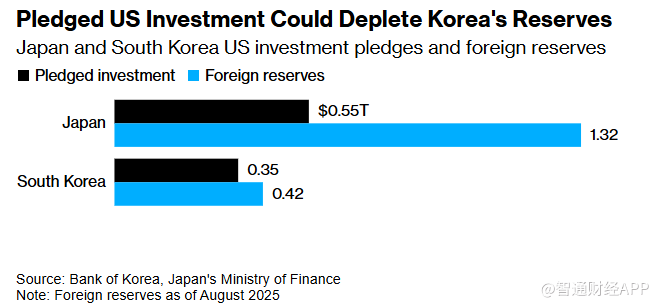
Core Viewpoint - South Korea is unable to meet the U.S. demand for an immediate $350 billion investment payment as part of a tariff reduction agreement, leading to a search for alternative solutions [1] Group 1: Investment and Economic Implications - South Korea's investment of $350 billion will be structured through loans, loan guarantees, and equity investments, rather than an upfront payment [1] - The South Korean government believes that such a large financial commitment could potentially lead to a financial crisis for the country [1] - South Korea's President Lee Jae-myung indicated that without safeguards like currency swaps, the country could face a crisis if forced to make large expenditures, given its $410 billion foreign exchange reserves [1] Group 2: Trade Agreement Negotiations - Negotiations for a formal trade agreement have reached a stalemate, particularly regarding the U.S. proposal for oversight on the $350 billion investment [1] - The initial agreement reached in July to reduce U.S. tariffs on South Korea from 25% to 15% is now complicated by these financial discussions [1]
特朗普9000亿美元投资要求碰壁 日韩持谨慎态度
智通财经网· 2025-09-29 07:03
Group 1 - The investment demands from the U.S. President Donald Trump, totaling $900 billion, face resistance from South Korea and Japan, with South Korea's National Security Advisor stating that the $350 billion cash requirement is unrealistic [1] - South Korea and the U.S. reached a $350 billion investment commitment in July as part of a broader trade agreement aimed at reducing U.S. tariffs from 25% to 15%, but there are still disagreements on the investment plan's arrangement [1][2] - Japan has also made a similar $550 billion investment commitment, but the specifics of implementation remain unclear, raising concerns among South Korean officials [1][3] Group 2 - South Korea's Prime Minister emphasized that without a currency swap agreement with the U.S., the $350 billion investment could severely impact the South Korean economy, representing over 80% of its foreign exchange reserves [1] - Japan's potential reevaluation of the investment agreement is indicated by a leading candidate for the ruling party, who stated that any unfairness in the agreement would necessitate renegotiation [2] - The U.S. prefers cash investments over loans, as communicated by the U.S. Secretary of Commerce to South Korean officials [2] Group 3 - A memorandum of understanding signed earlier this month stipulates that Japan must raise funds within 45 working days once the U.S. selects the investment projects funded by Japan [4] - The funding for Japan's $550 billion investment is primarily expected to come from the Japan Bank for International Cooperation (JBIC) and the Nippon Export and Investment Insurance (NEXI), which will not fund projects that are not beneficial to Japan [4][5] - Only 1-2% of the $550 billion is expected to be actual investments, with the remainder being loans and loan guarantees [5]

突发!韩国无法按贸易协议以现金支付3500亿美元 美韩谈判陷入僵局
Zhong Guo Ji Jin Bao· 2025-09-28 22:00
Group 1 - South Korea is unable to provide $350 billion in cash to the U.S. as part of a trade agreement aimed at reducing tariffs from 25% to 15% [2][3] - The South Korean government is exploring alternative solutions, including loans and bilateral currency swap arrangements, to mitigate economic impacts [2][3] - The $350 billion investment fund is a core component of the trade agreement, but both parties are at an impasse regarding the fund's operational structure [3] Group 2 - South Korea's National Security Advisor stated that the proposed cash payment is beyond the country's capacity [2] - The South Korean government emphasizes the economic disparity between South Korea and Japan, which recently finalized a $550 billion investment commitment [3] - Discussions regarding currency exchange rates have concluded, with details expected to be announced soon, indicating a separation from currency swap negotiations [2]
黑天鹅!韩国,突发!
Zhong Guo Ji Jin Bao· 2025-09-28 16:08
Group 1 - South Korea is unable to provide $350 billion in cash to the U.S. as part of a trade agreement aimed at reducing tariffs from 25% to 15% [3] - The South Korean government is exploring alternative solutions, such as loans and bilateral currency swap arrangements, to mitigate economic impacts [3][5] - The $350 billion investment fund is a core component of the trade agreement, but there are ongoing disagreements regarding its operational structure [5] Group 2 - South Korea's National Security Advisor stated that the proposed cash payment level is not feasible for the country [3] - The South Korean government emphasizes the differences in economic scale between South Korea and Japan, which recently finalized a $550 billion investment commitment [5] - The urgency for South Korea lies in how to raise and manage the $350 billion from the foreign exchange market [5]
黑天鹅!韩国,突发!
中国基金报· 2025-09-28 16:05
Core Viewpoint - South Korea is unable to pay the $350 billion in cash to the U.S. as part of a trade agreement aimed at reducing tariffs, highlighting significant economic constraints and differing expectations between the two nations [2][3]. Group 1: Trade Agreement Details - A South Korean official stated that the country cannot provide $350 billion in cash to the U.S. to lower tariffs from 25% to 15% as previously agreed upon [3]. - The amount requested by the U.S. represents over 80% of South Korea's foreign exchange reserves, making it an unrealistic demand for the Korean economy [3]. - The U.S. Secretary of Commerce has indicated a preference for cash payments rather than loans for the investment, complicating negotiations [3]. Group 2: Negotiation Stalemate - The negotiations between the U.S. and South Korea have reached a deadlock, with South Korea emphasizing that it cannot accept terms similar to Japan's $550 billion investment commitment due to differences in economic scale [4][5]. - South Korea's National Policy Office Director pointed out that the economic environments of South Korea and Japan are fundamentally different, particularly regarding currency swap arrangements and the status of the yen as a reserve currency [5][6]. - The $350 billion fund is a critical component of the trade agreement, yet there are ongoing disagreements about its operational structure and management [6].

韩方坦言:无法按特朗普要求兑现3500亿美元投资款
Xin Jing Bao· 2025-09-28 10:27
Core Viewpoint - South Korea's National Security Office Chief, Wei Shenglu, stated that the country cannot fulfill the $350 billion investment commitment to the U.S. as suggested by Trump, and is currently seeking alternative solutions, with discussions expected in October [1] Group 1 - South Korea is looking for alternative solutions regarding the $350 billion investment to the U.S. [1] - A trade agreement framework was established between South Korea and the U.S. in July 2025, where the U.S. would lower tariffs on South Korean goods in exchange for the investment [1] - Lee Jae-myung warned that if South Korea complies with the U.S. demands, it could face a situation similar to the 1997 financial crisis [1]
能源化工天然橡胶周度报告-20250928
Guo Tai Jun An Qi Huo· 2025-09-28 09:13
1. Report Industry Investment Rating - Not provided in the document 2. Core View of the Report - This week, natural rubber is expected to operate in a weak and volatile manner. Supply is in the peak season with weakening upward momentum of raw materials. Downstream tire factories have basically completed pre - holiday restocking, and it is difficult for the spot inventory of natural rubber to see a significant reduction. Coupled with the increasing risk - aversion sentiment of funds approaching the holiday and the weakening of the macro - commodity sentiment, it is expected that RU will fluctuate weakly [97]. 3. Summary by Relevant Catalogs 3.1 Industry News - In the first eight months of 2025, Thailand's total exports of natural rubber and mixed rubber were 2.906 million tons, a year - on - year increase of 6.3%, and its total exports to China were 1.807 million tons, a year - on - year increase of 27% [5]. - In August 2025, the global light - vehicle sales reached 7.2 million units, a year - on - year increase of 4.1%, and the cumulative sales from January to August increased by 5% to 59 million units [6]. - On September 24, 2025, the US government officially announced the implementation of the US - EU trade agreement, imposing a 15% tariff on EU - imported cars and auto products since August 1 [6]. - In August 2025, EU passenger - car sales increased by 5.3% year - on - year to 677,786 units, but the cumulative sales in the first eight months decreased by 0.1% year - on - year [7]. 3.2 Price - This week, RU was weak, while the futures prices of standard rubber and smoked sheets rose. On September 26, 2025, the closing price of RU2601 was 15,470 yuan/ton, a month - on - month decrease of 0.42%; the closing price of NR2601 was 12,465 yuan/ton, a month - on - month increase of 0.56%; the closing price of Singapore TSR20:2601 was 172.6 cents/kg, a month - on - month increase of 0.52%; the closing price of Tokyo RSS3:2601 was 308.3 yen/kg, a month - on - month increase of 0.49% [10][12]. 3.3 Basis and Spread - **Basis and Calendar Spread**: On September 26, 2025, the basis of whole - milk rubber to RU01 was - 820 yuan/ton, a month - on - month increase of 1.80% and a year - on - year increase of 43.06%; the 01 - 05 calendar spread was 35 yuan/ton, a month - on - month increase of 600.00% and a year - on - year increase of 124.14% [18]. - **Other Spreads**: RU - NR, RU - BR, and RU - JPX RSS3 spreads decreased, while the NR - SGX TSR20 spread increased. The prices of imported rubber in the market decreased this week, and the trading of non - standard basis was light. The spread between whole - milk and Thai - mixed rubber and the spread between 3L and Thai - mixed rubber decreased [19][22][25]. 3.4 Substitute Prices - This week, the overall price of synthetic rubber declined. The supply of butadiene increased, and the cost side lacked driving force. The pre - holiday restocking was coming to an end, and downstream buyers continued to purchase on dips [30]. 3.5 Capital Flows - The virtual - to - physical ratio of RU decreased slightly, and the settled funds decreased significantly. The virtual - to - physical ratio of NR continued to decline, and the settled funds also declined significantly. On September 26, 2025, the virtual - to - physical ratio of RU was 12.10, a month - on - month decrease of 0.65% and a year - on - year increase of 10.54%; the virtual - to - physical ratio of NR was 27.26, a month - on - month decrease of 8.82% and a year - on - year increase of 252.19% [33][35]. 3.6 Fundamental Data 3.6.1 Supply - **Weather in Producing Areas**: In Thailand, the rainfall in the southern part was slightly lower than the same period last year, and the rainfall in the northeastern part was at a seasonal high. In China, affected by typhoons, the precipitation in Hainan increased on the 25th and 26th, but the average precipitation in the past month decreased compared with last week. Yunnan is gradually entering the end of the rainy season [38][40]. - **Raw Material Prices**: Raw material prices were differentiated. The price of Thai cup lump rebounded, while the prices of Thai latex, smoked sheets, and Hainan latex decreased [42]. - **Raw Material Spreads**: The spread between Thai latex and cup lump decreased, and the spread between Hainan latex for concentrated latex production and that for whole - milk rubber production increased [50]. - **Upstream Processing Profits**: The overall rubber processing profit improved [51]. - **Delivery Profits**: The delivery profit of whole - milk rubber in Hainan continued to decline, while that in Yunnan increased marginally [56]. - **Exports**: In August, Thailand's natural rubber exports continued to increase month - on - month, but the exports of standard rubber decreased significantly both year - on - year and month - on - month. The exports of natural rubber from Thailand to China, Indonesia to China, and Vietnam to China all showed different degrees of growth. In August, China imported 520,800 tons of natural rubber (including mixed rubber and compound rubber), a month - on - month increase of 9.68% and a year - on - year increase of 5.39% [62][65][68][72][76][79]. 3.6.2 Demand - **Tire Capacity Utilization and Inventory**: Currently, most tire enterprises maintain their previous operating levels. The overall operating rate is slightly adjusted. The tire inventory continues to rebound slightly. During the "National Day" holiday, some enterprises plan to take a 5 - 8 - day holiday, which will have a greater impact on the capacity utilization rate of sample enterprises in the next period [85]. - **Tire Exports and Heavy - Truck Sales**: In August, the exports of all - steel and semi - steel tires decreased month - on - month but remained at a relatively high level year - on - year. In August, the sales volume of heavy trucks continued to recover both year - on - year and month - on - month, and the sales volume of passenger cars increased both year - on - year and month - on - month [86]. - **Highway Transportation Turnover**: In August, the freight turnover of highway transportation improved slightly both year - on - year and month - on - month, while the passenger turnover decreased year - on - year [89]. 3.6.3 Inventory - **Spot Inventory**: The current natural rubber inventory continues to decline. The inventory in Qingdao continues to decline moderately, the Yunnan rubber inventory shows a slight increase, and the decline in Vietnam is gradually expanding compared with the previous period [91]. - **Futures Inventory**: On September 26, 2025, the futures inventory of natural rubber on the Shanghai Futures Exchange was 149,400 tons, a week - on - week decrease of 3.55% and a year - on - year decrease of 37.78%; the futures inventory of 20 - numbered rubber on the Shanghai International Energy Exchange was 42,900 tons, a week - on - week decrease of 3.62% and a year - on - year decrease of 67.28% [94].