反洗钱

Search documents
存取钱将有新要求!央行等三部门发文
Jing Ji Wang· 2025-08-11 03:37
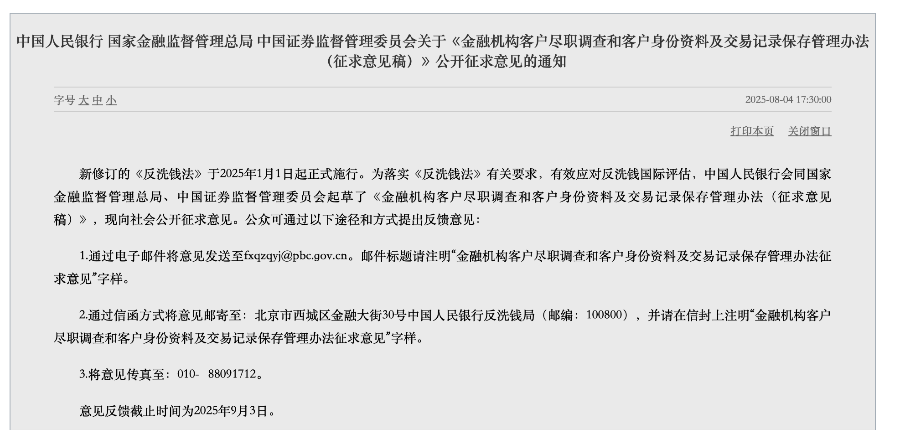
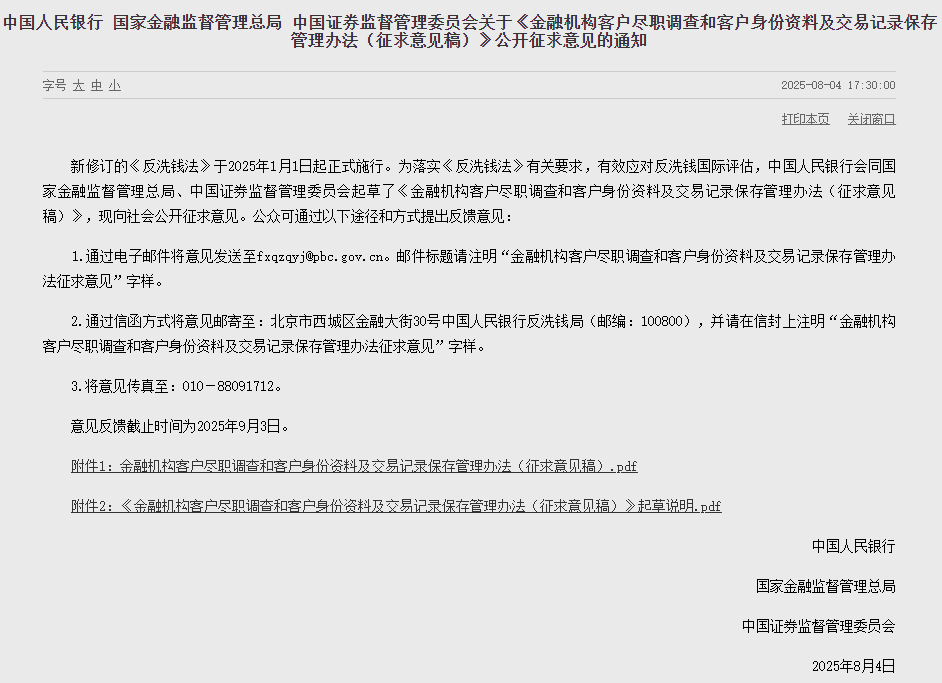
Core Viewpoint - The People's Bank of China, along with the National Financial Regulatory Administration and the China Securities Regulatory Commission, has released a draft management method for customer due diligence and transaction record retention, reflecting a commitment to international anti-money laundering obligations and enhancing financial security and stability [1][3]. Group 1: Regulatory Changes - The new management method provides specific requirements for various financial institutions regarding customer due diligence and transaction record retention, serving as an operational guide to improve risk management and compliance within the industry [3]. - The draft removes the rigid requirement from the 2022 regulations that mandated financial institutions to understand and register the source or purpose of cash transactions exceeding 50,000 RMB [3][4]. Group 2: Risk Management and Compliance - Financial institutions, including policy banks and commercial banks, are required to conduct customer due diligence for transactions over 50,000 RMB or equivalent to 10,000 USD, ensuring the collection of basic customer identity information and retention of identification documents [3]. - The removal of the cash source or purpose registration does not indicate a relaxation of anti-money laundering regulations; instead, it allows for enhanced due diligence in higher-risk scenarios, balancing risk management with the need for efficient financial services [6]. Group 3: Industry Perspectives - Analysts emphasize the need for banks to find a dynamic balance between compliance and customer experience, suggesting the use of technology to improve efficiency and reduce unnecessary disruptions while maintaining anti-money laundering compliance [6][7]. - Recommendations include optimizing processes for low-risk customers, utilizing digital tools for information updates, and strictly protecting customer privacy by adhering to the principle of collecting only necessary information [7].

金融机构客户尽职调查新规征求意见
Jing Ji Ri Bao· 2025-08-11 02:35
对此,北京大学法学院教授王新指出,《管理办法》强调"基于风险"原则,细化不同风险情形下的差异 化措施,正是要促使金融机构走出"机械化"开展客户尽职调查的误区,建立起动态、精准的洗钱风险防 控机制。 具体来看,《管理办法》要求金融机构要结合风险状况开展客户尽职调查,不得采取与风险状况明显不 匹配的措施。专门增加并强调对低风险情形采取简化措施的要求,有助于提高正常金融业务的便利性。 仅在洗钱或恐怖融资高风险情形下,才要求采取强化尽职调查措施。 《管理办法》在防范风险的同时,注重保障公众正常金融服务需求。例如,未要求对5万元以上现金存 取业务一律核查资金来源和用途,而是规定仅对洗钱风险较高的情形强化尽职调查,避免过度干预普通 民众日常金融活动。在跨境汇款领域,《管理办法》重申了执行20余年的国际规则——1000美元以上跨 境汇款需传递真实汇款人信息,旨在确保身份真实准确,防范风险,并非新增要求。 "在全球化背景下,中国积极履行国际反洗钱义务,反映了监管对金融安全与稳定的重视。"博通咨询首 席分析师王蓬博认为,《管理办法》为金融机构提供了操作指南,有助于提升整个行业的风险管理水 平,也有助于加强金融机构的合规性,减少 ...
存取款超5万,需说明“来源”和“用途”?央行等三部门发文
Sou Hu Cai Jing· 2025-08-11 01:16
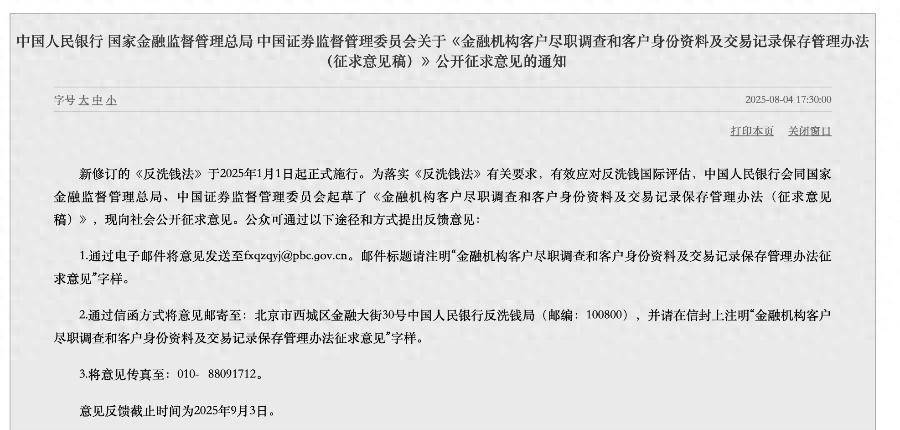
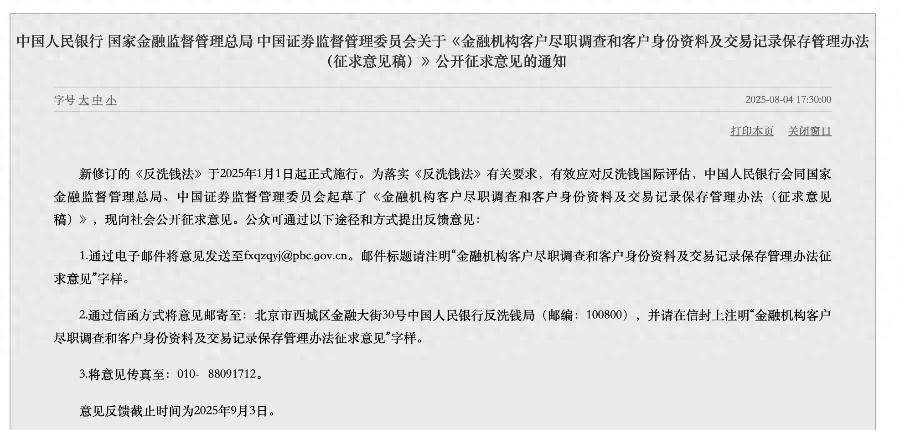
Core Viewpoint - The People's Bank of China, along with the National Financial Regulatory Administration and the China Securities Regulatory Commission, has released a draft regulation for public consultation regarding customer due diligence and the management of customer identity information and transaction records, with the consultation period running from August 4 to September 3 [1]. Group 1 - The most notable change in the new regulation is the removal of the mandatory requirement from the 2022 regulatory rules that required individuals to "understand and register the source or purpose of funds" for cash transactions exceeding 50,000 yuan [2]. - Financial institutions are still required to conduct due diligence and register basic customer identity information for one-time transactions exceeding 50,000 yuan, such as cash remittances and physical precious metal transactions, and to retain copies of valid identification documents [2]. Group 2 - The 2022 regulation regarding cash transactions over 50,000 yuan had sparked widespread social controversy, with public opinions divided on its implications [3][4]. - Some viewed the requirement as cumbersome and a potential invasion of privacy, while supporters argued it was necessary to combat money laundering and maintain financial security [4]. - The regulation was initially set to take effect on March 1, 2022, but was postponed due to "technical reasons," and related transactions continued under previous rules [4]. - The draft regulation is seen as a necessary step to implement the Anti-Money Laundering Law and prepare for an upcoming international assessment in late 2023, which will evaluate China's anti-money laundering efforts [4].
取款超5万要说明用途?三部门发文
Sou Hu Cai Jing· 2025-08-11 00:08
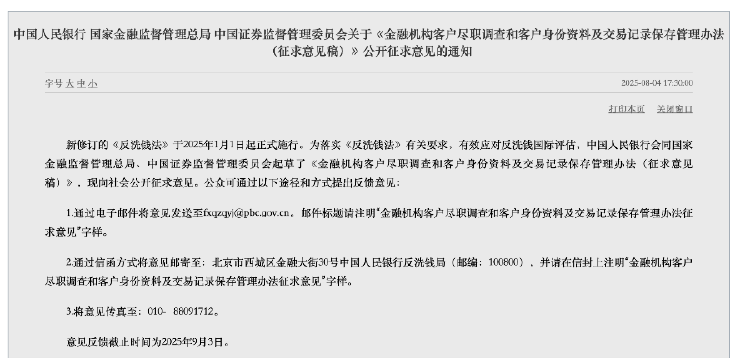
该征求意见稿已于8月4日起向社会公开征集意见,截止日期为9月3日。 近日,中国人民银行、国家金融监督管理总局、中国证监会联合发布《金融机构客户尽职调查和客户身份资料及交易记录保存 管理办法(征求意见稿)》(以下简称《管理办法》),面向社会公开征求意见。 | 中国人民银行 | 国家金融监督管理总局 | 中国证券监督管理委员会 | 征求意见稿 | | --- | --- | --- | --- | | 这份新规中最引人注目的变化是:取消了2022年版监管规则中关于个人办理单笔5万元以上现金存取业务需"了解并登记资金来 | 源或用途"的硬性要求。 | | | | 此外,在为客户提供现金汇款、实物贵金属买卖等等一次性交易金额业务超过5万元的,金融机构仍需开展尽职调查,并登记客 | 户身份基本信息,留存客户有效身份证件或者其他身份证明文件的复印件或者影印件。 | | | 《征求意见稿》第九条 据报道,2022年,针对自然人客户单笔存取5万元以上现金的反洗钱监管规则,曾引发广泛社会争议。 这一规定在当时引发了社会广泛关注,"个人存取现金超5万元需登记资金来源或用途"迅速登上热搜。公众意见呈现分歧:部分 声音认为此举增加了 ...
存取款单笔超5万元,或不用说明“来源”和“用途”
Guang Zhou Ri Bao· 2025-08-10 15:03
Core Viewpoint - The People's Bank of China, along with other regulatory bodies, has released a draft regulation aimed at enhancing customer due diligence and transaction record-keeping in financial institutions, reflecting a commitment to anti-money laundering efforts and international compliance [1][2]. Group 1: Regulatory Changes - The draft regulation, titled "Management Measures for Customer Due Diligence and Customer Identity Information and Transaction Record Keeping," is open for public consultation from August 4 to September 3 [1]. - The new regulation cancels the previous requirement from 2022 that mandated financial institutions to verify the source or purpose of cash transactions exceeding 50,000 RMB [2][3]. Group 2: Impact on Financial Institutions - Financial institutions, including policy banks and commercial banks, are required to conduct customer due diligence for transactions over 50,000 RMB or equivalent to 10,000 USD, ensuring proper identification and documentation of customers [2]. - The previous regulation, which was set to be implemented in March 2022, was postponed due to technical reasons, and the cancellation of the cash source verification is intended to balance anti-money laundering measures with the convenience of financial services [3]. Group 3: Industry Implications - Analysts suggest that the new regulation reflects China's commitment to international anti-money laundering obligations and emphasizes the importance of financial security and stability [3]. - The regulation provides clear guidelines for financial institutions, enhancing risk management and compliance, while also aiming to reduce risks associated with money laundering and terrorist financing [3].
存款取款单笔超5万,还要不要说明来源和用途?三部门发文,口径有变
Mei Ri Jing Ji Xin Wen· 2025-08-10 13:42
Core Viewpoint - The People's Bank of China, the National Financial Regulatory Administration, and the China Securities Regulatory Commission have jointly released a draft regulation for public consultation, which proposes significant changes to the customer due diligence and identity verification processes for financial institutions [1][2]. Regulatory Changes - The new draft regulation removes the mandatory requirement from the 2022 version that required individuals to explain and register the source or purpose of cash transactions exceeding 50,000 yuan [2][3]. - Financial institutions are still required to conduct due diligence and register basic customer identity information for one-time transactions exceeding 50,000 yuan, such as cash remittances and physical precious metal transactions [2]. Background and Public Reaction - The previous regulation, which mandated registration of cash sources for transactions over 50,000 yuan, faced widespread public controversy and was temporarily suspended due to technical reasons [3]. - The initial regulation was intended to combat money laundering but raised concerns about privacy and the complexity of transaction processes [3]. Implementation Challenges - Financial institutions are tasked with balancing anti-money laundering due diligence requirements with customer experience and privacy protection [4]. - Experts suggest that banks should optimize processes for customer experience, apply digital tools to reduce manual steps, and strictly protect customer privacy by adhering to the principle of minimal necessary information collection [4].
多家银行领超百万罚单,反洗钱违规成重灾区,合规之路如何走
Bei Jing Shang Bao· 2025-08-10 12:42
Core Viewpoint - The banking industry is facing intensified anti-money laundering (AML) regulations, with multiple banks receiving significant fines for compliance violations, highlighting the urgent need for improved internal controls and compliance measures [1][3][4]. Group 1: Regulatory Environment - In August alone, eight banks, including Shanghai Bank and several rural commercial banks, were fined over one million yuan for AML violations [1][3]. - The People's Bank of China disclosed that Shanghai Bank was fined a total of 29.22 million yuan for multiple violations, including failure to identify customer identities and report large or suspicious transactions [3][4]. - The regulatory landscape is evolving towards "refined governance," with new measures being introduced to strengthen AML compliance [7][8]. Group 2: Internal Control Shortcomings - Analysts indicate that the fines reflect significant shortcomings in banks' internal control systems, particularly in their AML frameworks [5][6]. - Key issues identified include outdated AML systems and insufficient integration of these systems with actual business operations, leading to inaccuracies in reporting and customer assessments [5][6]. - The dual penalty system, which holds both institutions and individual executives accountable, aims to enhance compliance focus within banks [6]. Group 3: Future Regulatory Trends - The AML regulatory framework is expected to become more comprehensive, with expanded coverage and more detailed operational requirements [8]. - The introduction of the revised AML law in January 2025 and the recent draft regulations emphasize the necessity for financial institutions to conduct thorough customer due diligence [7][8]. - Analysts predict that the trend of stringent AML oversight will persist, driven by both domestic and international pressures [8]. Group 4: Recommendations for Banks - Banks are advised to leverage technologies such as big data and artificial intelligence to enhance risk identification and improve compliance efficiency [8]. - Streamlining processes for low-risk transactions and enhancing employee training in AML practices are also recommended to improve overall compliance [8]. - A shift from a reactive to a proactive approach in AML compliance is essential, with a focus on integrating compliance into core business strategies [8].


多家银行领超百万罚单,反洗钱违规成重灾区 合规之路如何走
Bei Jing Shang Bao· 2025-08-10 12:35
Core Viewpoint - The banking industry is facing intensified anti-money laundering (AML) regulations, with multiple banks receiving significant fines for compliance violations, highlighting the urgent need for improved internal controls and compliance measures [1][2][3]. Group 1: Regulatory Environment - In August alone, eight banks, including Shanghai Bank and several rural commercial banks, were fined over one million yuan for AML violations [2][3]. - The People's Bank of China disclosed that Shanghai Bank faced a total penalty of 29.22 million yuan for multiple violations, including failure to perform customer identity verification and report large or suspicious transactions [2][3]. - The regulatory landscape is shifting towards "refined governance," with new AML laws set to take effect in January 2025, and a draft management method for customer due diligence has been released for public consultation [5][6]. Group 2: Internal Control Shortcomings - The frequency of fines indicates significant internal control weaknesses within banks, particularly in their AML systems [4]. - Key issues identified include outdated AML systems and insufficient integration of these systems with actual business operations, leading to inaccuracies in reporting and customer assessments [4]. - The dual penalty system, which holds both institutions and individual executives accountable, aims to enhance compliance focus among decision-makers [4][7]. Group 3: Future Trends and Recommendations - The AML regulatory framework is expanding in scope, with more detailed requirements and increased penalties for non-compliance [6][7]. - Banks are encouraged to leverage big data and artificial intelligence to better analyze customer behavior and transaction data for risk identification [7]. - A shift from a reactive to a proactive approach in AML compliance is necessary, emphasizing the importance of integrating compliance into core business practices and employee evaluations [7].
湾财周报 大事 证监会开1.6亿天价罚单;透视招行朋友圈
Nan Fang Du Shi Bao· 2025-08-10 11:01
一周财经大事(2025年8月4日-8月10日) 头条 证监会1.6亿罚单:*ST高鸿财务造假,9名董监高被罚 8月8日晚,证监会在官网发布了一则对于上市公司财务造假案件的通报。 据悉,*ST高鸿(即大唐高鸿网络股份有限公司)长期开展无商业实质的笔记本电脑等"空转""走单"业 务,大幅虚增收入和利润,违反证券法律法规。 证监会拟对相关责任主体罚款1.6亿元,对配合造假的第三方罚款700万元。*ST高鸿涉嫌触及重大违法 强制退市情形,深交所将依法启动退市程序。 北京符合条件家庭五环外买房不限购,公积金加码!什么信号? 8月8日,北京市住房和城乡建设委员会、北京住房公积金管理中心发布关于进一步优化调整本市房地产 相关政策的通知(下简称《通知》)。通知指出,符合北京市商品住房购买条件的居民家庭,在五环外 购买商品住房(含新建商品住房和二手住房)不限套数。此外,北京也加大住房公积金贷款支持力度。 通知自2025年8月9日起施行。 酒闻 茅台集团"百元酱酒"上新,新品瞄准宴席渠道 茅台集团旗下"百元酱香"产品上新。 8月6日,南都湾财社-酒水新消费指数课题组记者从茅台保健酒业公司微信公众号上注意到,该公司正 式对外宣布, ...
重大调整!事关个人存取款
Sou Hu Cai Jing· 2025-08-10 10:23
Core Viewpoint - The People's Bank of China, along with the National Financial Regulatory Administration and the China Securities Regulatory Commission, has released a draft regulation for public consultation regarding customer due diligence and the management of customer identity information and transaction records, with the consultation period running from August 4 to September 3 [1] Group 1: Regulatory Changes - The most notable change in the new regulation is the removal of the mandatory requirement for individuals to "understand and register the source or purpose of funds" for cash transactions exceeding 50,000 yuan, as stipulated in the 2022 regulatory rules [2] - Financial institutions are still required to conduct due diligence and register basic customer identity information for one-time transactions exceeding 50,000 yuan, such as cash remittances and physical precious metal transactions [2] Group 2: Public Reaction and Challenges - The previous regulation regarding cash transactions over 50,000 yuan sparked widespread public debate, with concerns about increased complexity in business operations and potential privacy infringements [3][4] - A small percentage (approximately 2%) of cash transactions exceeded 50,000 yuan, indicating that the previous regulation had limited impact on most customers [4] - Balancing anti-money laundering due diligence with customer experience and privacy protection remains a challenge for financial institutions [5] Group 3: Recommendations for Financial Institutions - Financial institutions are encouraged to optimize processes to enhance customer experience while implementing a tiered management strategy, simplifying procedures for low-risk customers and intensifying investigations for high-risk ones [5] - The use of digital tools to replace manual processes is recommended, such as developing mobile banking features for customers to upload verification documents online [5] - Strict privacy protection measures should be adhered to, following the principle of collecting only necessary information related to the business [5]