Workflow
国债收益率
icon
Search documents
公司债ETF(511030)规模逆势增长超1亿,短久期、静态高、贴水少、回撤小
Sou Hu Cai Jing· 2025-10-29 05:50
Market Performance - The Shanghai Composite Index increased by 18.4% from November 2024 to September 2025, reaching a new high of over 3900 points in October, the highest in 10 years [1] - The average daily trading volume of stocks in Shanghai and Shenzhen was approximately 2.3 trillion yuan since August, significantly higher than the average of about 700 billion yuan during the same period last year [1] - The yield on 10-year government bonds remained stable between 1.75% and 1.85%, reversing the rapid decline seen in 2024 [1] Currency and Capital Flow - The onshore and offshore RMB exchange rates against the USD have stabilized around 7.1 to 7.2 since June, indicating balanced cross-border capital flows [1] Bond Market Dynamics - Despite a general outflow from credit bond ETFs, the Ping An Company Bond ETF (511030) saw an increase in scale by 102 million yuan, attributed to its short duration (1.94 years), high static yield (1.95%), minimal discount (weekly average -0.02%), and low drawdown (-0.50% year-to-date) [1] - The Ping An Company Bond ETF (511030) ranked first in controlling drawdown since the bond market adjustment, maintaining a relatively stable net value [1] Recent Market Trends - The bond market experienced fluctuations influenced by expectations surrounding US-China negotiations, anticipated interest rate cuts, delays in new fund redemption regulations, and policy expectations from the Fourth Plenary Session [1] - The credit performance in the bond market outperformed interest rates, with short-term credit spreads compressing to historically low levels [3] Credit Yield and Spread Analysis - As of October 24, 2025, the yield on various credit bonds showed a range of values, with AAA-rated bonds yielding between 1.67% and 2.12% for different maturities [4] - The credit spreads for AAA-rated bonds were recorded at 0.11% for 0.5-year bonds, indicating a very low risk premium [4]
日本30年期国债收益率跌1.5个基点
Mei Ri Jing Ji Xin Wen· 2025-10-29 01:57
Group 1 - The yield on Japan's 30-year government bonds decreased by 1.5 basis points, reaching 3.045% [1]
澳大利亚3年期国债收益率涨8个基点
Mei Ri Jing Ji Xin Wen· 2025-10-29 00:45
Core Insights - Australia's 3-year government bond yield increased by 8 basis points due to higher-than-expected inflation in the third quarter [1] Group 1 - The rise in bond yield indicates market reactions to inflation data [1] - The third quarter inflation exceeded expectations, suggesting potential economic pressures [1]
特朗普说了不算,美国市场的风向标依然是他
凤凰网财经· 2025-10-28 14:08
Core Viewpoint - The article discusses the impact of former President Trump's public statements on monetary policy, highlighting that his calls for interest rate cuts are often underestimated by the market and can even lead to an increase in Treasury yields, contrary to his intentions [1][3]. Group 1: Market Reaction Analysis - Bloomberg's analysis shows that Trump's statements regarding interest rates are frequently undervalued by the market, resulting in rising Treasury yields instead of the desired rate cuts [3][4]. - The analysis employed a rigorous methodology, measuring market reactions based on Treasury yield changes 15 minutes before and one hour after Trump's statements [3][5]. Group 2: Data Analysis Methodology - To isolate market fluctuations unrelated to monetary policy, Bloomberg included stock prices as a reference indicator, establishing that if Treasury yields and stock prices move in opposite directions, it indicates a change in monetary policy expectations [5][6]. - Approximately half of Trump's interest rate-related statements can be considered effective policy signals, with minimal impact on 2-year and 10-year Treasury yields, averaging close to zero [6]. Group 3: Powell's Influence - In contrast, Federal Reserve Chairman Jerome Powell's statements have a significant impact on the market, with data showing that his remarks can cause fluctuations in 2-year Treasury yields of up to 8 basis points and 10-year yields by 5 basis points [7][9]. - Powell's less frequent but more impactful statements are viewed as a clearer indicator of monetary policy direction compared to Trump's [9].
贵金属周报:中美经贸关系缓和预期或使贵金属价格承压-20251028
Hong Yuan Qi Huo· 2025-10-28 06:44
Report Title - Weekly Report on Precious Metals - Gold and Silver [1] Report Date and Author - Date: October 28, 2025 - Author: Wang Wenhu from the Research Institute [2] Investment Rating - Not provided in the report Core Viewpoints - Sino-US economic and trade relations' easing may put pressure on precious metal prices; Fed's possible rate cut and stop of balance sheet reduction in the long term support precious metal prices; some central banks' gold - related actions have mixed impacts on prices. It is expected that precious metal prices may adjust, and investors are advised to wait and see [3] Summary by Sections Part 1: US Fiscal and Monetary Policy - **Fiscal Situation**: US unpaid public debt scale increased by $30.8 billion to $3.80 trillion; 2025 Q3 Treasury net issuance was $964.5 billion, and Q4 may decline. Permanent expansion of additional tax credits may increase fiscal deficits by $23.4 - $43.9 billion from 2026 - 2035; abolition of health insurance - related provisions may increase deficits by $1.4 - $37.5 billion [10] - **Monetary Policy Tools**: Fed's daily overnight reverse repurchase scale was $2.435 billion; bank reserve balance decreased, overnight reverse repurchase agreement scale increased, and Treasury cash account increased. The temporary appropriation bill passed by the House failed in the Senate. Fed's lending to commercial banks showed different trends, and the regular financing plan BTFP expired. The Fed used the standing repurchase facility SRF, with a cumulative use of $30.6 billion [11][13][16][17] - **Inflation and Interest Rates**: US September CPI was 3% year - on - year, core CPI was 3% year - on - year. October consumer inflation expectations were 4.6% (1 - year) and 3.9% (5 - year). Mid - long - term Treasury yields decreased due to Fed's expected rate cuts and stop of balance sheet reduction. The spread between long - and mid - term Treasuries was positive and widened [19][21][26] - **Financial Stress Index**: The US OFR financial stress index decreased to - 2.0930, with some sub - indicators rising. The Fed's use of SRF eased inter - bank liquidity [29] Part 2: US Economic and Employment Performance - **Commercial Bank Loans**: US commercial bank loan and lease volume increased week - on - week, with different trends in various loan types [33][35] - **Retail Sales**: US Redbook commercial retail sales annual rate decreased to 5.0% week - on - week, but consumer spending remained relatively stable [38] - **Mortgage Applications**: US 15 - year and 30 - year mortgage fixed rates decreased, MBA mortgage application activity index decreased, and August new and existing home sales increased [41] - **Employment**: US initial jobless claims were 218,000, lower than expected and previous values; continued claims were 1.926 million, lower than expected but higher than previous values. September ADP private employment decreased by 32,000, indicating concerns about a weakening job market [44] - **International Bond Yield Spreads**: The spreads between US and German (Japanese) mid - long - term Treasury yields decreased due to different central bank policies [47] - **Exchange Rates**: Euro - US dollar exchange rate may bottom out, and US dollar - Chinese yuan exchange rate may weaken [48] - **Market Volatility**: US S&P 500 and gold ETF index volatilities decreased [50] Part 3: Gold - Silver Spread and Inventory Situation - **Gold**: COMEX gold non - commercial long - short position ratio decreased; COMEX and SHFE total gold inventory decreased. Gold futures and spot spreads, basis, and near - far contract spreads were at different levels, with corresponding investment suggestions [56][58][60][67][69][72] - **Silver**: London silver 1 - month lease rate decreased significantly; COMEX silver non - commercial long - short position ratio increased; COMEX, SHFE, and SGE total silver inventory decreased. Silver futures and spot spreads, basis, and near - far contract spreads were at different levels, with corresponding investment suggestions [73][76][79][83][84][85] - **Ratio Analysis**: "Gold - silver ratio" was between the 50 - 75% quantiles of the past five years; "Gold - oil ratio" and "Gold - copper ratio" were much higher than the 90% quantiles of the past five years, with corresponding investment suggestions [87][89]
每日债市速递 | 央行、金融监管总局、证监会、外汇局集体发声
Wind万得· 2025-10-27 23:08
Group 1: Open Market Operations - The central bank conducted a 7-day reverse repurchase operation on October 27, with a fixed rate and a total amount of 337.3 billion yuan, at an interest rate of 1.40% [1] - On the same day, 189 billion yuan of reverse repos matured, resulting in a net injection of 148.3 billion yuan [1] Group 2: Funding Conditions - The interbank market experienced a significant tightening, with overnight repurchase rates for deposit institutions rising over 13 basis points to 1.45% [3] - The overnight quotes in the anonymous click (X-repo) system exceeded 1.50%, indicating limited supply [3] - Despite the central bank's excess MLF rollover of 200 billion yuan and net reverse repo operations, the liquidity situation remains tight due to tax payments and month-end factors [3] Group 3: Interbank Certificates of Deposit - The latest transaction rate for one-year interbank certificates of deposit among major banks is around 1.68%, showing a slight decline from the previous day [6] Group 4: Government Bond Futures - The closing prices for government bond futures showed increases: 30-year contracts rose by 0.32%, 10-year by 0.15%, 5-year by 0.12%, and 2-year by 0.05% [12] Group 5: Economic Data - From January to September, the total profit of industrial enterprises above designated size reached 537.32 billion yuan, a year-on-year increase of 3.2% [14] - In September alone, the profit of these enterprises grew by 21.6% year-on-year [14]
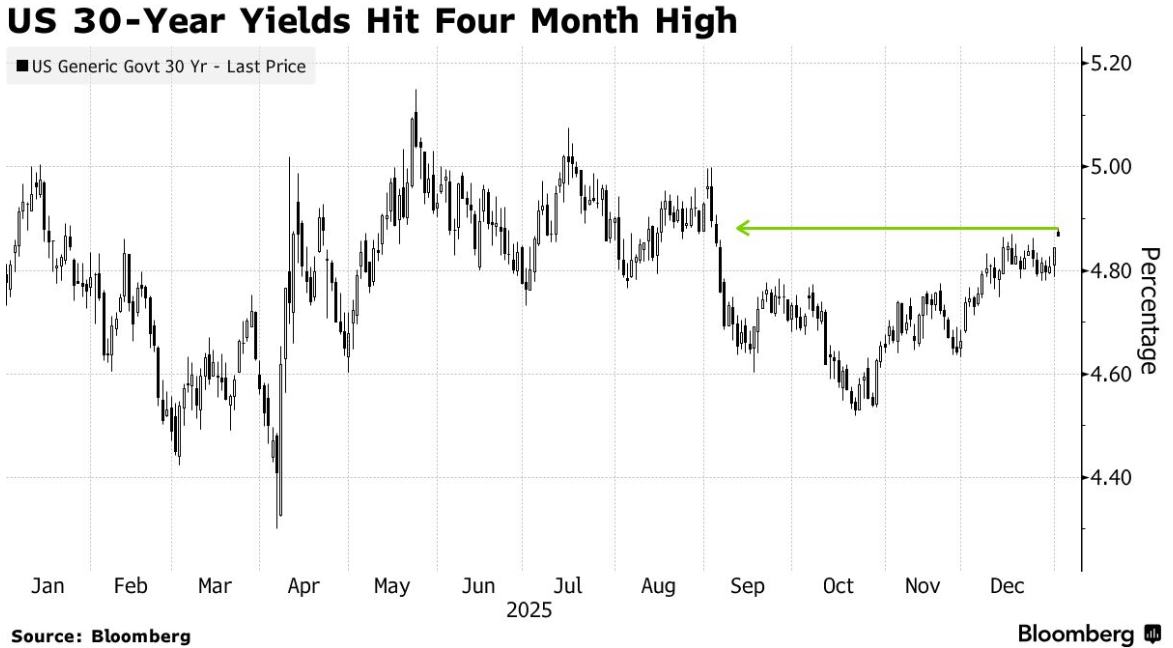
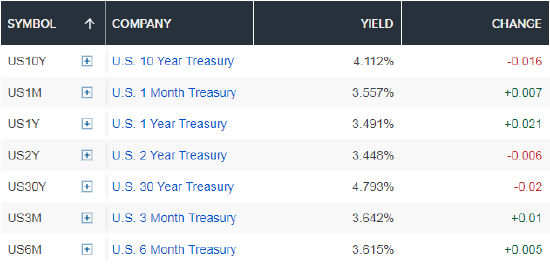
30年期美国国债收益率上涨3.9个基点,至4.625%
Mei Ri Jing Ji Xin Wen· 2025-10-27 05:17
Core Viewpoint - The 30-year U.S. Treasury yield has increased by 3.9 basis points, reaching 4.625% [1] Group 1 - The rise in the 30-year U.S. Treasury yield indicates a shift in investor sentiment and potential implications for long-term borrowing costs [1]
德国10年期国债收益率升至10月14日以来的最高水平,达到2.612%
Mei Ri Jing Ji Xin Wen· 2025-10-24 08:20
每经AI快讯,10月24日,德国10年期国债收益率升至10月14日以来的最高水平,达到2.612%,最新上 涨3.5个基点。 ...
10年期日本国债收益率上涨1个基点,至1.665%
Mei Ri Jing Ji Xin Wen· 2025-10-24 02:35
Core Viewpoint - The 10-year Japanese government bond yield has increased by 1 basis point to 1.665% on October 24 [1] Group 1 - The rise in the 10-year Japanese government bond yield indicates a slight upward trend in interest rates [1]
敏感时刻,今晚美国CPI“姗姗来迟”
Hua Er Jie Jian Wen· 2025-10-23 01:05
Core Insights - Investors are anxiously awaiting the delayed September CPI inflation report, which is the only key economic data available during this data vacuum period [1][2] - The U.S. Bureau of Labor Statistics is set to release the September CPI data, with Goldman Sachs predicting a month-on-month increase of 0.33% and a year-on-year increase of 3.02% [1][3] - The ongoing government shutdown has led to a lack of regular data releases, causing market tension and uncertainty regarding the economic outlook [2] Economic Data Impact - The anticipated CPI data could lead to fluctuations in long-term bond yields, with potential upward pressure if the data exceeds expectations [1][3] - The 10-year U.S. Treasury yield has declined this year, reflecting risk-averse sentiment, partly due to credit concerns related to regional banks [3] - Analysts suggest that if the 10-year Treasury yield falls below 3.75%, it may indicate doubts about the U.S. economy achieving a "soft landing" [3] Market Sentiment - The current lack of hard data has left the market in a state of anxiety, as investors are missing critical economic indicators that typically provide insights into the economic direction [2] - There is a strong potential buying interest in the bond market, driven by increasing economic uncertainty [3]