
澳大利亚3年期国债

Search documents
澳大利亚3年期国债收益率涨10个基点 就业数据推升央行加息预期
Xin Lang Cai Jing· 2026-01-22 03:52
责任编辑:王永生 澳大利亚3年期国债收益率涨势扩大,好于预期的就业数据促使交易员加大对澳大利亚央行的加息押 注。澳元走强。3年期澳债收益率一度涨10个基点至4.27%,为2023年11月以来最高水平。掉期数据显 示,交易员目前预计澳大利亚央行2月加息的概率超过60%。澳元/美元一度涨0.6%至0.6801,为2024年 10月以来最高水平。 澳大利亚3年期国债收益率涨势扩大,好于预期的就业数据促使交易员加大对澳大利亚央行的加息押 注。澳元走强。3年期澳债收益率一度涨10个基点至4.27%,为2023年11月以来最高水平。掉期数据显 示,交易员目前预计澳大利亚央行2月加息的概率超过60%。澳元/美元一度涨0.6%至0.6801,为2024年 10月以来最高水平。 责任编辑:王永生 ...
澳大利亚3年期国债收益率升至12月10日以来最高
Mei Ri Jing Ji Xin Wen· 2026-01-01 23:35
每经AI快讯,1月2日,澳大利亚3年期国债收益率升至12月10日以来最高。 ...
澳大利亚就业人数意外下降 澳元与澳债收益率齐跌
Xin Lang Cai Jing· 2025-12-11 00:55
Group 1 - Australia's employment unexpectedly decreased by 21,300, with a significant reduction in full-time positions, contrary to the expectation of an increase of 20,000 [1][2] - The unemployment rate remained at 4.3% in November, which is lower than the economists' forecast of 4.4% [1][2] - The sensitive 3-year government bond yields continued to decline, expected to record the largest single-day drop since May [1][2] Group 2 - The Australian central bank faces the dual mandate of maintaining stable low inflation and full employment, making the current situation particularly delicate [1][2] - Policymakers are attempting to ease persistent price pressures without triggering widespread unemployment, complicated by limited spare capacity in the economy [1][2] - This situation has temporarily forced the Australian central bank to remain on hold after three rate cuts this year, making it one of the countries with the shortest easing cycles among developed economies [1][2] - The central bank maintained interest rates this week, with Governor Michele Bullock warning that the next move in rates is likely to be upward [1][2]
澳大利亚3年期国债收益率升至2024年11月以来最高水平
Mei Ri Jing Ji Xin Wen· 2025-12-09 04:43
每经AI快讯,12月9日,澳大利亚3年期国债收益率升至2024年11月以来最高水平。 ...
澳大利亚3年期国债收益率收盘上涨1个基点至3.55%
Mei Ri Jing Ji Xin Wen· 2025-09-30 06:39
每经AI快讯,9月30日,澳大利亚3年期国债收益率收盘上涨1个基点至3.55%。 ...
供应下降缓解市场紧张情绪 全球长期债券重回投资者视野
Zhi Tong Cai Jing· 2025-09-26 06:58
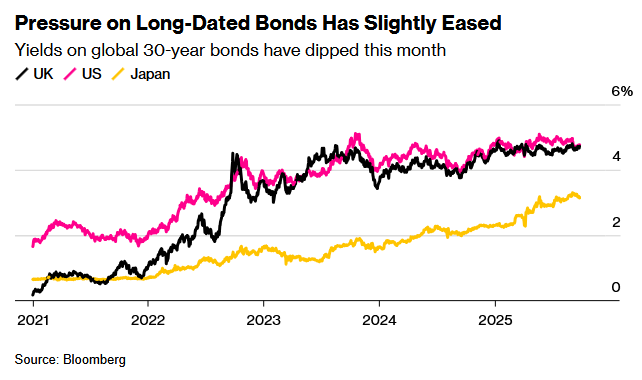
Group 1 - The global long-term bond market is experiencing a rebound as investors seek buying opportunities after a sell-off, with U.S. and Japanese 30-year bond yields dropping approximately 20 basis points since early September, and UK yields falling over 10 basis points [1] - The recent decline in long-term bond yields is partly driven by reduced supply, as some countries shift their issuance focus to cheaper short-term bonds, with Japan proposing to cut long-term bond issuance and the UK central bank reducing long-term bond sales in its quantitative tightening plan [1][2] - There is a growing optimism in the long-term bond market, highlighting the significant role of supply concerns in recent sell-offs, despite ongoing worries about rising fiscal deficits [2] Group 2 - Strong economic growth globally is alleviating concerns about fiscal deficits and prompting investors to reconsider long-term interest rate trends, with recommendations for Australian investors to adopt positions that benefit from a flattening yield curve [3] - The Bloomberg Global Aggregate Index indicates that bets on long-term bonds are starting to pay off, with 10-year and longer bonds returning 0.7% this month, outperforming shorter-term bonds [6] - Recent auctions show strong demand for long-term bonds, with Japan's 40-year bonds seeing enthusiastic buying and the strongest demand for 20-year bonds since 2020 [6]

澳大利亚3年期国债收益率延续涨势,涨10个基点至3.55%
Mei Ri Jing Ji Xin Wen· 2025-09-03 05:16
Group 1 - The 3-year Australian government bond yield continues to rise, increasing by 10 basis points to 3.55% [1]
澳大利亚3年期国债收益率继续下跌6个基点,因就业数据疲软。
news flash· 2025-07-17 01:39
Core Viewpoint - Australia's 3-year government bond yields have continued to decline by 6 basis points due to weak employment data [1] Group 1 - The decline in bond yields indicates a response to economic indicators, particularly employment figures [1] - Weak employment data suggests potential economic slowdown, influencing investor sentiment towards government bonds [1]