红利资产

Search documents
公募基金四季度投资策略来了!布局科技成长与资源周期双主线
Zhong Guo Ji Jin Bao· 2025-10-17 08:49
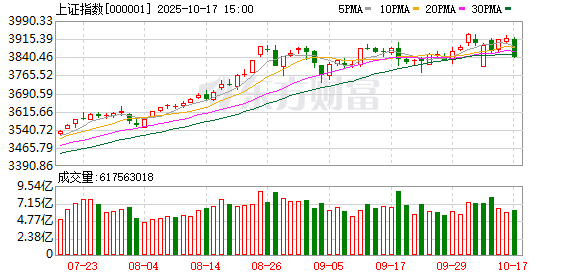
Core Viewpoint - The A-share market has started strongly in the fourth quarter, with the Shanghai Composite Index surpassing 3900 points, leading to a focus on market trends and investment strategies. Multiple fund companies believe there are opportunities for bullish positions, particularly in technology growth sectors and high-dividend blue-chip stocks [2]. Group 1: Market Sentiment and Outlook - The public fund industry generally sees a significant increase in the attractiveness of stock assets, but a slow bull market requires fundamental support [3]. - Overall, there is a cautious outlook from some funds regarding the market's current valuation attractiveness, suggesting that further increases will need more policy or economic support [3]. - Historical experiences indicate that early bull markets often rely on liquidity improvements for valuation recovery, while sustained increases require tangible improvements in fundamentals [3]. Group 2: Investment Opportunities - Despite the need for fundamental support, there is a consensus among public funds that the market still offers opportunities for bullish positions [4]. - Structural market opportunities are expected to remain, with ample liquidity and a favorable environment for equity assets [4]. - The current economic environment in China is seen as providing valuable certainty, which may attract more long-term global capital into A-shares and Hong Kong stocks [5]. Group 3: Sector-Specific Strategies - Investment strategies should focus on technology growth sectors and high-dividend blue-chip stocks, which are expected to provide stable returns [6]. - High-dividend blue-chip stocks, particularly in banking, public utilities, and transportation, are highlighted for their stability and attractive yields compared to bond returns [6]. - The pharmaceutical sector is viewed positively, with expectations for innovation-driven growth and recovery in medical device industries [7]. Group 4: Market Dynamics and Risks - Key upcoming events, such as the Fourth Plenary Session and the US-China summit, are expected to influence market sentiment and create investment opportunities [8]. - The potential for increased volatility due to US-China trade tensions is acknowledged, with expectations for the market to stabilize and rise amidst fluctuations [8].

公募基金,四季度投资策略来了
Zhong Guo Ji Jin Bao· 2025-10-17 08:37
Group 1 - The core viewpoint is that the A-share market has started strong in Q4, with the Shanghai Composite Index surpassing 3900 points, indicating potential opportunities for investment, particularly in technology growth sectors and high-dividend blue-chip stocks [1] Group 2 - The public fund industry believes that the attractiveness of stock assets has significantly increased, but a sustainable "slow bull" market requires fundamental support [2] - There is a consensus among public funds that despite the need for fundamental backing, there are still opportunities to go long in the market [3] Group 3 - The current environment shows that the A-share and Hong Kong stock markets are becoming increasingly valuable in global asset allocation, likely attracting more long-term capital [4] Group 4 - Investment strategies for Q4 should focus on technology growth and high-dividend blue-chip stocks, with an emphasis on sectors like banking, public utilities, and transportation, which offer stable earnings and low valuations [5][6] - The pharmaceutical sector is expected to see structural investment opportunities due to liquidity release from the Federal Reserve's rate cuts, benefiting innovative drugs and their supply chains [6] Group 5 - The gold and precious metals sector is viewed positively, with macroeconomic factors providing solid support for gold prices, driven by global fiscal expansion and central banks diversifying their reserve assets [7]
公募基金,四季度投资策略来了
中国基金报· 2025-10-17 08:30
Core Viewpoint - The article discusses the investment strategies for the fourth quarter, highlighting the strong start of the A-share market and the focus on sectors with sustained industry prosperity, particularly in technology growth and high-dividend blue-chip stocks [2]. Group 1: Market Outlook - The current environment has significantly increased the attractiveness of equity assets, but a slow bull market requires fundamental support [4]. - There is a consensus among public funds that despite the need for fundamental backing, there are still opportunities to go long in the market [5]. - The supply and demand dynamics indicate that the "allocation attractiveness" of the stock market will further highlight in the fourth quarter, driven by the migration of long-term funds from bank wealth management and insurance [7]. Group 2: Investment Strategies - The recommended investment strategy includes a balanced approach focusing on sectors with verified industry prosperity, particularly in technology growth [10]. - High-dividend blue-chip stocks are highlighted for their stable performance and attractive yields compared to bond returns, while high-growth stocks in sectors like renewable energy and AI are also recommended [10]. - The pharmaceutical sector is viewed positively due to the potential for innovation and recovery in the medical device industry, alongside stable cash flow from traditional Chinese medicine companies [11]. Group 3: Economic and Policy Considerations - The market's ideal path is for the fundamentals to catch up, leading to a sustainable "slow bull" market, as historical trends suggest that early bull markets rely on liquidity improvements, while sustained growth requires real fundamental improvements [4]. - The upcoming political events, such as the Fourth Plenary Session and the US-China summit, are expected to influence market sentiment and create various thematic investment opportunities [12].

收评:沪指跌近2%,券商、酿酒等板块走低,免税概念逆市活跃
Zheng Quan Shi Bao Wang· 2025-10-17 07:32
Core Viewpoint - The major stock indices in China experienced a significant decline, with the Shanghai Composite Index dropping nearly 2%, reflecting a decrease in market risk appetite and a mixed performance across various sectors [1]. Market Performance - The Shanghai Composite Index closed down 1.95% at 3839.76 points, the Shenzhen Component fell 3.04% to 12688.94 points, and the ChiNext Index decreased by 3.36% to 2935.37 points [1]. - The total trading volume in the Shanghai and Shenzhen markets reached 19.547 trillion yuan [1]. Sector Analysis - Sectors such as semiconductors, automobiles, non-ferrous metals, brokerage firms, and liquor companies saw declines, while gas, oil, coal, and banking sectors performed positively [1]. - The duty-free concept stocks were notably active despite the overall market downturn [1]. Market Sentiment - The recent trading volume has significantly shrunk, reaching a new low, indicating a decrease in overall market risk appetite and a prevalent wait-and-see attitude among investors [1]. - The market's focus is expected to shift towards corporate earnings and fundamentals as the third-quarter earnings reporting period approaches [1]. Monetary Policy Context - Data from the central bank indicates that new social financing and credit data for September maintained a high growth rate, reflecting a moderately loose monetary policy stance and continued financial support for the real economy [1].
红利ETF易方达(515180) 规模破百亿,联接基金迎年内首次分红
Mei Ri Jing Ji Xin Wen· 2025-10-17 07:21
Core Insights - The recent performance of dividend assets has been strong, with the CSI Dividend Index showing a cumulative increase of over 3% this month [1] - The E Fund Dividend ETF (515180) has seen net inflows for four consecutive trading days, with its latest scale surpassing 10 billion yuan [1] - The ETF's linked funds will distribute dividends for the first time this year, with investors receiving 0.52 yuan for every 10 fund shares held [1] Group 1: ETF Performance - The E Fund Dividend ETF has experienced significant net inflows, indicating strong investor interest [1] - The current dividend yield of the CSI Dividend Index is 4.4%, reflecting the overall performance of high-dividend A-share listed companies [1] Group 2: Fund Management and Fees - E Fund is the only company offering a low fee structure for all its dividend ETFs, with a management fee rate of 0.15% per year for its products [1] - The index tracked by the E Fund Dividend ETF consists of 100 stocks with high cash dividend yields and stable dividends, primarily from the banking, coal, and transportation sectors, which together account for over 50% of the index [1]
底仓价值凸显,红利低波策略再受追捧
Mei Ri Jing Ji Xin Wen· 2025-10-17 06:45
Core Insights - The demand for defensive asset allocation has significantly increased, leading to renewed interest in dividend assets [1] - The Hong Kong stock market's dividend assets have also gained attention due to their strong resilience [1][2] Group 1: Dividend ETF Performance - The Dividend Low Volatility ETF (512890) has seen a net inflow of 2.072 billion yuan over four trading days, raising its total assets to 23.271 billion yuan, a record high [1] - The average daily trading volume for the ETF reached 1.169 billion yuan, a substantial increase from the 434 million yuan average since 2025 [1] - The ETF has consistently delivered positive returns annually from 2019 to 2024, making it a preferred option for long-term value-seeking investors [1] Group 2: Hong Kong Stock Market Insights - The Hong Kong Stock Connect Dividend Low Volatility ETF (520890) has attracted over 22 million yuan in net inflows since September 22, 2025, with a nearly 30% increase in size [1] - The ETF tracks an index with a dividend yield exceeding 6%, offering a notable advantage over some mainstream dividend indices in both A-shares and Hong Kong stocks [1] - The Hong Kong Stock Connect allows for investment in Hong Kong dividend assets without QDII quota restrictions and supports T+0 trading [2] Group 3: Market Outlook and Tax Benefits - The AH premium is expected to recover from low levels, potentially driving A-share dividend assets upward, especially compared to Hong Kong dividend assets [2] - The current policy allows for tax exemptions on capital gains from investments made through the Hong Kong Stock Connect until the end of 2027, reducing tax burdens by 20% compared to other channels [2] - Huatai-PineBridge Fund, a pioneer in ETF management, has over 18 years of experience in dividend-themed investments, managing a total of 45.818 billion yuan in dividend-themed ETFs as of October 16, 2025 [2]
大盘震荡,配点红利,红利国企ETF(510720)涨超0.5%,关注上市以来连续分红18个月,可月月评估分红的红利国企ETF
Sou Hu Cai Jing· 2025-10-17 04:13
Core Viewpoint - The Red Dividend State-Owned Enterprise ETF (510720) has shown a rise of over 0.5%, highlighting its consistent monthly dividend distribution for 18 consecutive months since its listing, making it a unique investment option in the market [1]. Group 1: Dividend Characteristics - Dividend assets are characterized by stable cash flow returns, lower volatility, and long-term compounding effects, which are encouraged by policy measures such as the new "National Nine Articles" aimed at enhancing dividend yields [1]. - The Red Dividend State-Owned Enterprise ETF (510720) tracks the State-Owned Dividend Index (000151), which selects stocks with high dividend characteristics, stable dividend performance, and good liquidity, primarily covering traditional sectors like finance, energy, and industry [1]. Group 2: Investment Strategy - The ETF embodies a value investment strategy that focuses on stable returns and long-term dividends, making it suitable for investors looking for a solid asset allocation base [1]. - The consistent monthly dividend distribution since its inception positions the ETF as an attractive option for investors interested in dividend income, especially during market fluctuations [1].
就市论市丨农业银行再创历史新高 红利资产会阶段性成为市场主线吗?
Di Yi Cai Jing· 2025-10-17 03:58
Core Insights - The market has seen a significant rally in large-cap stocks, particularly in the banking and coal sectors, indicating a shift in market style [1] - The focus remains on defensive strategies as the third-quarter earnings reports are set to be released, prompting investors to pay attention to the alignment of valuations and performance [1] Group 1 - Large-cap stocks have been performing well, with notable increases in the banking and coal industries [1] - The market style is changing, suggesting a potential shift in investment strategies [1] - The upcoming third-quarter earnings reports will be crucial for assessing investment opportunities [1]

股市面面观 |双创回调红利大涨,A股风格生变?
Zhong Guo Jin Rong Xin Xi Wang· 2025-10-17 03:13
Group 1 - The A-share market is experiencing a shift in style post the Mid-Autumn and National Day holidays, with a notable decline in technology stocks and a significant rebound in dividend assets [1] - The ChiNext 50 Index and the Sci-Tech 50 Index have decreased by 6.86% and 5.26% respectively in October, while the Shanghai 50 Index has increased by 1.01% and the Shanghai Dividend Index has risen by 5.17%, marking its best monthly performance of the year [1] - In Q3, the ChiNext 50 Index surged by 59.45% and the Sci-Tech 50 Index rose by 49.02%, contrasting with the Shanghai 50 Index's 10.21% increase and the Shanghai Dividend Index's 3.44% decline [1] Group 2 - The Xinhua Zhongxin Dividend Value Index recorded a 2.67% increase this month, narrowing its year-to-date decline to 1.58%, outperforming the Shanghai Dividend Index for the year [1] - CITIC Securities suggests that Q4 2025 may be a critical time for bottom-fishing in dividend stocks, as current pessimistic expectations may have been fully reflected in the market [1] - The report highlights that leading companies in the highway sector have returned to a dividend yield of around 5%, indicating potential opportunities for investment as valuation bottoms and incremental capital stabilizes [1] Group 3 - In October, the coal sector leads the monthly gainers with a 9.53% increase, while the banking and public utilities sectors also show strong performance [2] - Conversely, sectors such as media, electronics, communication, and computing have experienced significant declines, with the media sector down by 7.46% [3] - Institutions recommend a balanced allocation between new technology and cyclical stocks, with a focus on sectors like electric new energy, electronics, and non-ferrous metals [4] Group 4 - Most institutions maintain a long-term positive outlook on high-growth sectors, anticipating new highs after the current phase of index fluctuations and sector confusion [5] - The cyclical sectors may require additional policy support to continue outperforming in the market [5]

大盘震荡,红利登场,关注煤炭ETF(515220)
Mei Ri Jing Ji Xin Wen· 2025-10-17 03:06
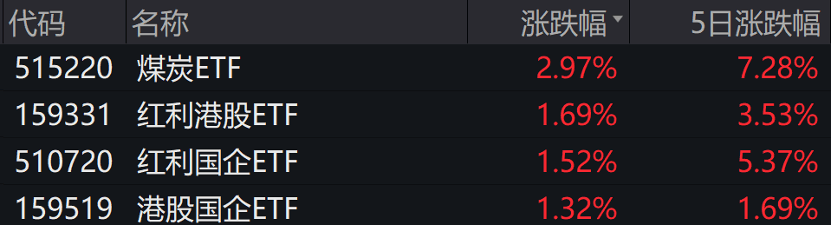
Core Viewpoint - The coal sector is gaining attention due to rising prices and increased demand expectations driven by a cold winter forecast, with specific ETFs showing significant gains [1][3][4]. Market Performance - The coal ETF (515220) rose by 2.97% on October 16, with a five-day change of 7.28% [1][2]. - Other ETFs, including the Dividend Hong Kong ETF (159331), Dividend State-Owned Enterprise ETF (510720), and Hong Kong State-Owned Enterprise ETF (159519), also reported gains [1][2]. Weather Impact - A strong cold front has swept across northern China, causing temperature drops exceeding 10°C, leading to heating supply activation and increased coal demand [2][3]. - Major cities are expected to experience their lowest temperatures of the year during the period from October 15 to 19 [2]. Demand and Supply Dynamics - The China Electricity Council anticipates that electricity consumption growth in the second half of the year will exceed that of the first half, with a projected 5%-6% year-on-year increase in national electricity consumption for 2025 [3]. - The coal market is expected to see a rebound in prices due to reduced supply and increased winter demand, with coal production expected to slightly decline and imports projected to decrease by about 16% [3]. Policy and Market Sentiment - The National Development and Reform Commission has announced measures to regulate price competition, which may stabilize market prices and reduce internal competition [3]. - The coal sector is viewed as having both cyclical and dividend attributes, with current low holdings indicating a potential investment opportunity as fundamentals improve [4].