
乡村全面振兴

Search documents
学习贯彻党的二十届四中全会精神丨面向基层宣讲 推动全会精神走深走实
Yang Guang Wang· 2026-01-05 08:18
Group 1 - The core message emphasizes the implementation of the spirit of the 20th Central Committee's Fourth Plenary Session across various provinces, focusing on grassroots engagement and diverse forms of promotion [1][2][3] - Jilin Province has formed a multi-faceted team of party members and experts to conduct targeted and audience-specific presentations, ensuring the spirit of the plenary session is effectively communicated [1] - In Jiangxi, a five-level team of presenters is organized to promote themes such as rural revitalization and building a beautiful China, utilizing community centers and educational bases for outreach [1][2] Group 2 - In Yunnan, local departments have established teams to focus on green energy, highland特色 agriculture, and cultural tourism, aiming to deeply embed the plenary session's spirit within the community [2] - The deputy director of the cultural tourism bureau in Kunming emphasizes the integration of the plenary session's spirit with Xi Jinping's important speeches, aiming to enhance cultural confidence and meet the growing cultural needs of the populace [2] - In the Xinjiang Production and Construction Corps, presenters from various sectors use relatable language and data to engage the community, addressing public concerns and ensuring a comprehensive understanding of the plenary session's spirit [2][3]
沉下心来抓落实、办实事——各地区各部门推动经济社会发展开年见闻
Ren Min Ri Bao· 2026-01-04 02:14
Group 1 - The year 2026 marks the beginning of the "15th Five-Year Plan," emphasizing the importance of execution and a broad perspective in economic work [1][2] - Regions are encouraged to align their actions with national strategies and market demands, exploring new models for high-quality development [2][3] - Hainan Free Trade Port is actively engaging with international high-standard economic and trade rules, leveraging policy advantages for development [3] Group 2 - The Yangtze River Delta is enhancing its supply chain for robotics, showcasing regional collaboration in technology innovation [4] - Various regions are focusing on transforming local resources into clean energy and improving ecological safety, contributing to national goals [5] - Beijing is implementing reforms to enhance urban governance through citizen feedback, aiming for rapid response to public needs [6][7] Group 3 - The importance of addressing problems in development is highlighted, with a focus on immediate and long-term solutions [6][10] - Collaborative efforts across provinces are being emphasized, particularly in ecological protection and resource management along the Yangtze River [11] - Inter-departmental cooperation is crucial for overcoming challenges in the modular construction industry, facilitating market access in Hong Kong and Macau [12]
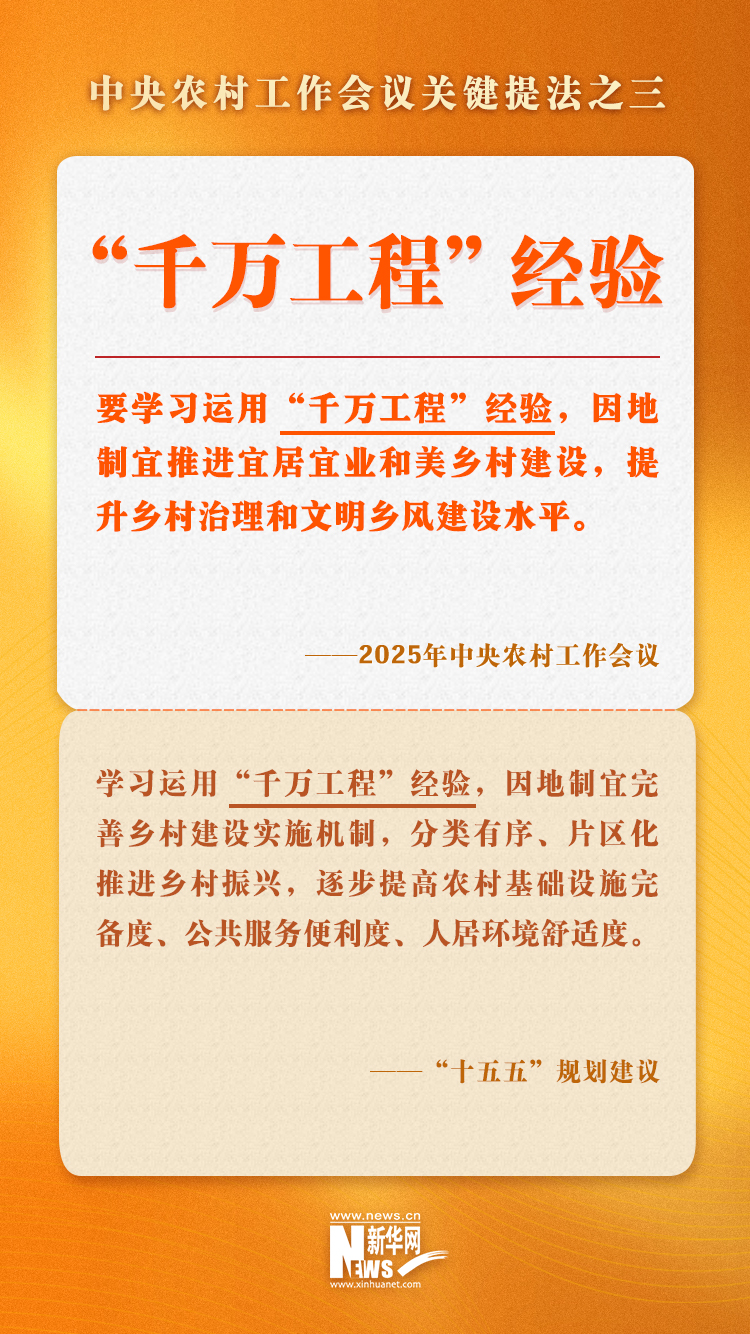
中央农村工作会议关键提法之三:“千万工程”经验
Xin Hua Wang· 2026-01-04 02:11
Group 1 - The recent Central Rural Work Conference analyzed the current situation and challenges facing the "three rural issues" and outlined the work for 2026 [1] - The conference emphasized the importance of learning and applying the "Thousand Villages Project" experience to promote comprehensive rural revitalization [6] - The "Thousand Villages Project," initiated in 2003, aimed to select around 10,000 administrative villages for comprehensive improvement, with a focus on creating demonstration villages for a well-off society [5] Group 2 - The "Thousand Villages Project" has evolved over 20 years, expanding its scope and enriching its content, transitioning from "demonstration and improvement" to "beautification and common prosperity" [5] - The next steps involve deeper implementation of the "Thousand Villages Project" experience, focusing on practical measures that meet the needs of farmers and exploring new paths for rural revitalization [6] - During the 14th Five-Year Plan period, regions are encouraged to learn from each other and implement the "Thousand Villages Project" experience in a phased and systematic manner [6]

省政协党组扩大会议暨党组理论学习中心组学习会召开
Xin Lang Cai Jing· 2026-01-04 00:24
羊城晚报讯 日前,省政协党组召开扩大会议暨理论学习中心组学习会,认真传达学习贯彻习近平总书 记近期重要讲话和重要指示精神,专题传达学习贯彻省委十三届八次全会暨省委经济工作会议精神,研 究贯彻落实意见。省政协党组书记、主席林克庆主持并讲话。 省政协领导许瑞生、袁宝成、王学成、黄武、张嘉极、郑轲、陈文明作交流发言。 (薛江华 杨晓伟 周贤伦) 会议指出,习近平总书记在中央政治局民主生活会、中央政治局会议上发表的重要讲话,对做好"三 农"工作作出的重要指示,高屋建瓴、内涵丰富,具有很强的政治性、思想性、指导性,为我们深化作 风建设、纵深推进全面从严治党、服务乡村全面振兴指明了前进方向、提供了根本遵循。要深入学习领 会总书记重要讲话重要指示精神,带头在笃信务实担当自律上作示范,坚定拥护"两个确立"、坚决做 到"两个维护"。要扛牢管党治党政治责任,进一步严明政治纪律和政治规矩,驰而不息正风肃纪反腐, 营造良好政治生态,以高质量党建引领政协事业高质量发展。要准确把握当前"三农"工作的中心任务和 重点工作要求,紧扣助力"百县千镇万村高质量发展工程"、提升乡村建设水平等重大课题,深入乡村一 线和界别群众调查研究,务实建言献策 ...
沉下心来抓落实、办实事——各地区各部门推动经济社会发展开年见闻(“十五五”开好局起好步)
Ren Min Ri Bao· 2026-01-03 22:17
Core Viewpoint - The "15th Five-Year Plan" marks a crucial period for achieving socialist modernization, emphasizing the importance of starting strong and maintaining momentum in development efforts [1][2]. Group 1: National Strategy and Regional Development - The central government emphasizes the need for all regions and departments to act within the national framework, ensuring coordinated efforts across the country [3][4]. - Regions are encouraged to explore new models of high-quality development that align with national strategies, market demands, and local advantages [4]. Group 2: Economic and Technological Innovation - Hainan Free Trade Port is leveraging policy advantages to enhance its development, aiming to align with international high-standard economic and trade rules [5]. - The Yangtze River Delta is developing a robust supply chain for robotics, showcasing regional collaboration in technological innovation [6]. Group 3: Problem-Solving and Public Services - The government is adopting a problem-oriented approach to address development challenges, emphasizing quick responses to public service issues [9][10]. - Beijing is enhancing its citizen service hotline to improve urban governance and address community needs effectively [10][11]. Group 4: Collaborative Efforts and Integration - Regions are encouraged to work together to achieve coordinated development, with examples of cross-regional environmental protection initiatives [15]. - Departments are collaborating to streamline processes and standards, facilitating the integration of modular construction products into the Hong Kong and Macau markets [16].
2025年农业农村发展稳中有进
Xin Lang Cai Jing· 2026-01-03 19:18
本报北京1月3日电(记者陈晨)全国农业农村厅局长会议日前在北京召开。会议指出,2025年,各级农 业农村部门扎实有力推进乡村全面振兴和农业强国建设重点工作,保持了农业农村稳中有进、稳中向好 的势头,为应对风险挑战、推动经济社会高质量发展提供了基础支撑。 2025年,我国农业综合生产能力进一步提升,粮食产量再创历史新高,连续两年稳定在1.4万亿斤 以上,"菜篮子"产品供给充足、种类多样,粮食安全根基进一步夯实,中国人的饭碗端得更牢。脱贫攻 坚成果持续巩固拓展,圆满完成过渡期各项目标任务,牢牢守住了不发生规模性返贫致贫底线。农业科 技装备支撑不断强化,宜居宜业和美乡村建设扎实推进,农村改革持续深化,农业农村发展活力不断增 强。 (来源:光明日报) 加快建设农业强国、推进乡村全面振兴的任务仍然艰巨繁重。会议强调,各级农业农村部门要迎难 而上,埋头苦干,稳住农业基本盘,守好"三农"压舱石。要聚焦粮食和重要农产品稳产保供,着力提升 农业综合生产能力和质量效益,统筹发展科技农业、绿色农业、质量农业、品牌农业,毫不放松抓好粮 食生产,稳定粮食播种面积,更大力度推进粮油作物大面积单产提升,多油并举提高大豆油料产能和自 给率, ...
一周“纪”事丨书写无愧于人民的时代答卷
Zhong Yang Ji Wei Guo Jia Jian Wei Wang Zhan· 2026-01-03 01:37
中央纪委国家监委网站 张磊 2025年12月31日,习近平总书记发表2026年新年贺词,深情回望极不寻常的"十四五"历程和很不平凡的 2025年,致敬"每一位辛勤付出的奋斗者",鞭策全党"砥砺初心使命,持之以恒、久久为功,继续回答 好延安'窑洞之问',书写无愧于人民的时代答卷",号召全党全国人民"一起为梦想奋斗、为幸福打拼, 把宏伟愿景变成美好现实",激荡起团结奋进的磅礴力量。 奋斗没有终点、永无止境。2026年是"十五五"开局之年,是承前启后、乘势而上推进中国式现代化新的 历史起点。惟有接续奋斗,才能续写中国奇迹新篇章,开创中国式现代化建设新局面。在奋斗中书写时 代答卷,离不开自我革命这个跳出治乱兴衰历史周期率的第二个答案。坚决把党的自我革命要求落实到 位,通过彻底的自我革命,弘扬新风正气、纠治顽瘴痼疾,营造良好政治生态,激励干部担当作为,凝 聚民心民力,就能为伟大社会革命提供坚强保障。 做好2026年"三农"工作,对实现"十五五"良好开局至关重要。纪检监察机关肩负监督保障乡村全面振兴 的重大责任,必须深入学悟习近平总书记重要指示精神,认真学习中央农村工作会议精神,聚焦加强党 对"三农"工作的全面领导这一根 ...
推动农业农村现代化再上新台阶
Ren Min Ri Bao· 2026-01-02 00:18
推动农业农村现代化再上新台阶 ——习近平总书记对做好"三农"工作的重要指示激励广大干部群众扎实推进乡村全面振兴 "锚定农业农村现代化,扎实推进乡村全面振兴,推动城乡融合发展。""各级党委和政府要坚持把解决 好'三农'问题作为重中之重,坚持五级书记抓乡村振兴,奋发进取、真抓实干,努力把农业建成现代化 大产业、使农村基本具备现代生活条件、让农民生活更加富裕美好。" 中央农村工作会议2025年12月29日至12月30日在北京召开,习近平总书记对做好"三农"工作的重要指 示,在广大干部群众中引发热烈反响。大家表示,要铆足干劲、真抓实干,深入贯彻落实习近平总书记 的重要指示精神,落实好中央农村工作会议部署,提升农业综合生产能力和质量效益,促进农民稳定增 收,守牢不发生规模性返贫致贫底线,推动乡村全面振兴取得新进展、农业农村现代化再上新台阶。 把农业建成现代化大产业 "要毫不放松抓好粮食生产,促进良田良种良机良法集成增效,提升农业综合生产能力和质量效益。"习 近平总书记的重要指示为现代农业发展指明了方向。 2025年,全国粮食产量达到14297.5亿斤,实现高位增产。"菜篮子"产品供应足、种类多,城乡居民愈 加丰富的餐桌 ...
省委常委会召开会议学习习近平总书记重要讲话重要指示精神部署进一步加强作风建设和“三农”等工作
Shan Xi Ri Bao· 2026-01-01 00:13
Core Viewpoint - The meeting emphasizes the importance of modernizing agriculture and rural areas, promoting comprehensive rural revitalization, and advancing urban-rural integration [2] Group 1: Political Guidance and Leadership - The meeting highlights the need to strengthen the Party's innovative theoretical armament and deepen the understanding of the decisive significance of the "two establishments" [1] - It calls for the promotion of a correct view of achievements among Party members and cadres, focusing on the fundamental interests of the people [1] - The meeting stresses the importance of adhering to the spirit of the Central Eight Regulations and promoting a clean political environment [1] Group 2: Agricultural and Rural Development - The meeting sets a clear goal for agricultural modernization and emphasizes the need to ensure food production and high-quality construction of high-standard farmland [2] - It aims to consolidate and expand the achievements of poverty alleviation, integrating regular assistance into the rural revitalization strategy [2] - The meeting encourages the development of county economies and the strengthening of characteristic economies, collective economies, and channels for farmers to participate in industrial development [2] - It promotes the "Thousand Villages Demonstration, Ten Thousand Villages Improvement" project to enhance rural industries, construction, and governance [2] - The meeting underscores the need for comprehensive Party leadership in "three rural" work and the implementation of rural revitalization responsibilities [2]
方圆之间 蔚为大观(文化中国行·华夏博物之旅·传统建筑)
Ren Min Ri Bao· 2025-12-31 23:51
Core Viewpoint - The Fujian Tulou showcases the wisdom of harmonious coexistence between humans and nature through its unique architectural design and construction traditions, reflecting the profound cultural heritage of Chinese civilization [1]. Group 1: Architectural Features - Fujian Tulou is primarily constructed using local materials, featuring rammed earth walls and wooden frameworks, designed in square and circular shapes, with living spaces arranged around a central courtyard [1]. - The oldest recorded Tulou, the Yide Lou, dates back to the Ming Dynasty, emphasizing the traditional communal living and defensive functions of these structures [2]. - Coastal Tulou are built with granite stone bases to enhance weather resistance, while mountainous Tulou utilize river stones for their foundations, adapting to local environmental conditions [3][4]. Group 2: Types of Tulou - Tulou can be categorized into Minnan Tulou and Hakka Tulou based on user demographics and spatial types, with Minnan Tulou featuring independent entrances and courtyards, while Hakka Tulou typically have interconnected layouts [5]. - The shapes of Tulou include square, circular, and special forms, with square Tulou often having multiple stories and circular Tulou ranging from 30 to 95 meters in diameter [6][7]. Group 3: Construction Techniques - The construction process of Tulou involves meticulous steps such as site selection, foundation building, and layering of rammed earth walls, incorporating bamboo or wood for stability [10]. - Innovative design elements, such as the "soft" structural features of wooden frameworks, allow Tulou to withstand seismic activity, demonstrating a blend of traditional craftsmanship and modern engineering principles [10]. Group 4: Cultural Significance - Tulou is celebrated not only for its unique appearance but also for its rich cultural connotations, with decorative arts like gray sculpture, stonework, and wood carving reflecting the aspirations of the inhabitants [11]. - Recent revitalization efforts, supported by local governments and designers, have enhanced the living conditions within Tulou while preserving their historical aesthetics, leading to recognition in various design awards [11]. Group 5: Technological Integration - Advances in technology, such as 3D scanning and digital twin techniques, are being utilized to analyze and preserve the traditional construction methods of Tulou, facilitating the global dissemination of Tulou architectural culture [11]. Group 6: Overall Impact - The Fujian Tulou represents a unique architectural narrative rooted in the land and life, continuously inspiring and resonating with people [12].