AI芯片

Search documents
百度官宣:昆仑芯已赴港IPO
财联社· 2026-01-02 05:43
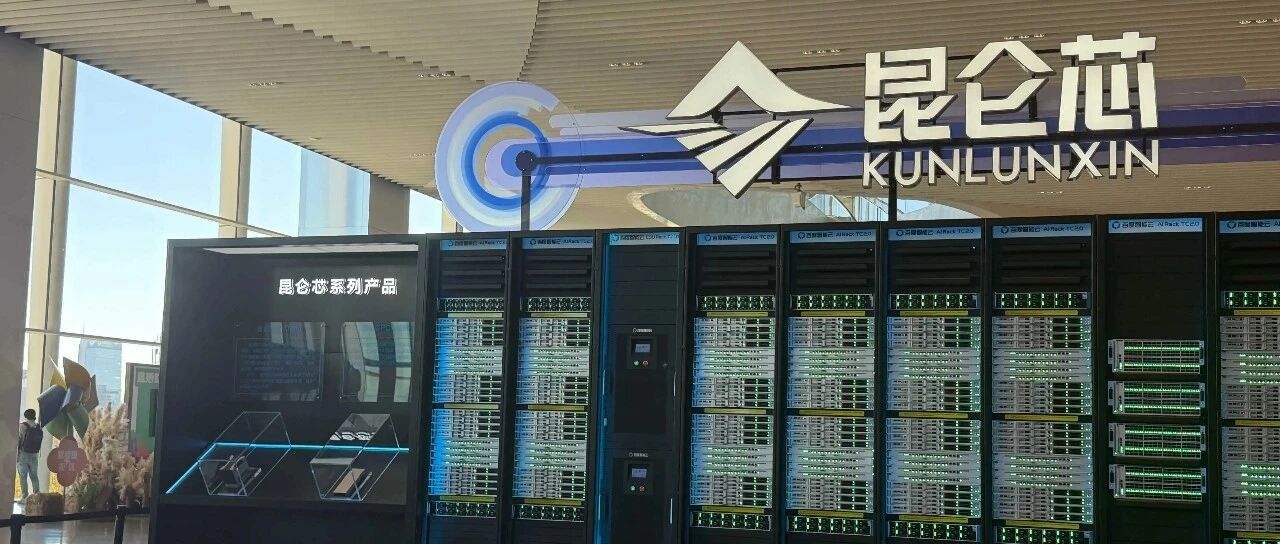
Core Viewpoint - Baidu's Kunlun Chip has submitted a listing application to the Hong Kong Stock Exchange, aiming for a public offering while remaining a subsidiary of Baidu after the spin-off [4]. Group 1: Company Developments - Kunlun Chip, previously part of Baidu's intelligent chip and architecture department, completed independent financing in April 2021 with an initial valuation of approximately 13 billion RMB [4]. - As of December 16, 2025, Kunlun Chip transformed into a joint-stock company, increasing its registered capital from about 2.128 million RMB to 400 million RMB, a growth of approximately 1780% [5]. - The new generation of Kunlun Chips, M100 and M300, is set to be launched in 2026 and 2027, respectively, targeting large-scale inference and multimodal model training tasks [5]. Group 2: Market Position and Valuation - Goldman Sachs estimates the value of Baidu's 59% stake in Kunlun Chip to be between 3 billion to 11 billion USD, while Macquarie Securities values it at approximately 16.5 billion USD, accounting for 30% of Baidu's target valuation [6]. - Morgan Stanley predicts that revenue from Baidu's self-developed AI chips will surge from 1.3 billion RMB in 2025 to 8.3 billion RMB in 2026, a sixfold increase, which will also double Baidu's GPU computing revenue in 2026 [6]. Group 3: Industry Trends - There is a wave of IPOs in the AI chip sector, with domestic GPU companies like Muxi and Moole Technology recently listing on the STAR Market, experiencing significant stock price increases on their debut [7]. - Wall Street analysts suggest that the current period is an optimal time for AI narratives, positioning Kunlun Chip favorably to capitalize on market trends and shed the perception of being solely for internal use by large companies [9]. - According to IDC's 2024 report, Nvidia holds a 70% market share in accelerated computing chip shipments, with Kunlun Chip ranking among the top domestic AI chip manufacturers, having shipped 69,000 units [10].



沸腾了!暴涨560点,全线飙升!这板块又火了
中国基金报· 2026-01-02 04:49
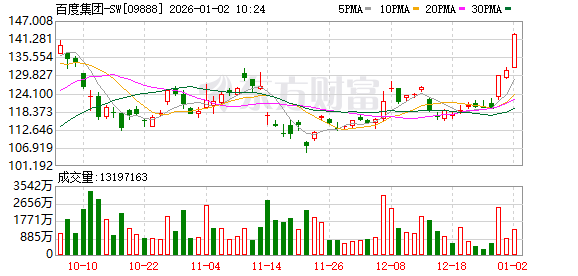
【 导读 】 港股迎来"开门红", 恒生指数大涨近560点, 恒生科技涨超3%;半导体板块飙涨,百度集团创近期新高 盘面上,上午港股半导体、国防军工、软件服务、大消费等板块集体走高,卫星导航、电力设备、集成电路、芯片等概念股走强。 | | | Wind香港二级行业指数 | | | --- | --- | --- | --- | | 半导体 7.60% | 国防军工 6.20% | 软件服务 3.26% | 耐用消费品 3.13% | | 钢铁Ⅲ 2.91% | 可选消费零售 2.70% | 电气设备 2.25% | 有色金属 2.23% | | 硬件设备 | 家电工 | 医疗设备与服务 | 房地产投资信托 | | 2.15% | 2.07% | 0.49% | 0.49% | | 交通运输 0.46% | 机械 0.42% | 纺织服装Ⅱ 0.33% | 环保工 0.29% | | 企业服务 | 公用事业工 | 化工 | 家庭用品 | | 0.12% | 0.00% | -0.10% | -0.64% | 中国基金报记者 晨曦 大家好!来一起关注港股上午的行情和最新资讯~ 1月2日,港股早间小幅高开,上午持续 ...

港股“国产GPU第一股”壁仞科技上市大涨,创始人身家百亿
Sou Hu Cai Jing· 2026-01-02 04:28
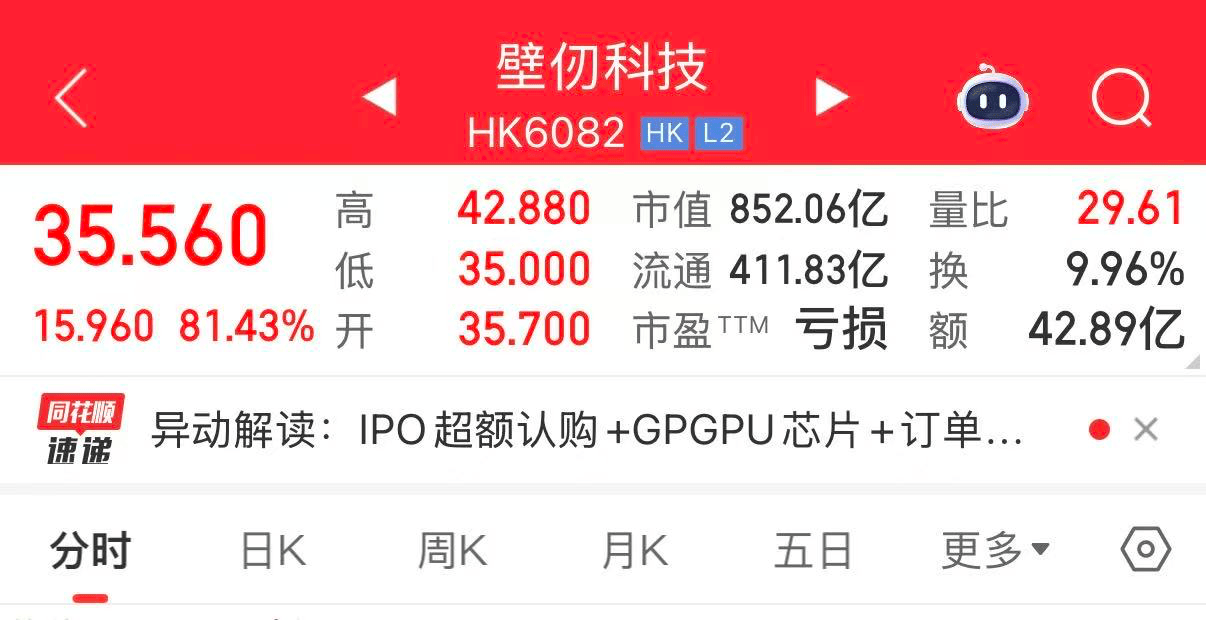
Core Viewpoint - Wallan Technology, a domestic GPU manufacturer, officially listed on the Hong Kong Stock Exchange, becoming the first domestic GPU stock and the first company to go public in 2026, with a significant opening price increase of 82% from its initial offering price [1][3]. Group 1: Listing Details - Wallan Technology's global offering consisted of approximately 285 million H-shares, with 17.39% allocated for public offering and 82.61% for international offering, achieving a record oversubscription of 2346.53 times for the public offering [3]. - The company raised a total of HKD 5.583 billion, marking the largest fundraising project since the implementation of Chapter 18C of the Hong Kong Stock Exchange listing rules [4]. Group 2: Financial Performance - Wallan Technology reported revenues of RMB 0.499 million, RMB 62.03 million, and RMB 337 million for the years 2022, 2023, and 2024, respectively, with a compound annual growth rate of 2500% [6]. - The company has not yet achieved profitability, with net losses of RMB 1.474 billion, RMB 1.744 billion, RMB 1.538 billion, and RMB 1.601 billion for the years 2022, 2023, 2024, and the first half of 2025, totaling over RMB 6.3 billion in cumulative losses [6]. Group 3: Future Prospects - Wallan Technology plans to utilize the funds raised for the development of intelligent computing solutions, including hardware and software upgrades, and the commercialization of these solutions [4]. - The AI chip sector is experiencing a hot market, with Wallan Technology's successful listing potentially influencing the trajectory of other domestic AI chip manufacturers in 2026 [7].
壁仞登陆港股,暴涨!昆仑芯也冲刺IPO
半导体行业观察· 2026-01-02 03:33
Core Viewpoint - Wallen Technology successfully listed on the Hong Kong Stock Exchange, becoming the first new stock to list in 2026, with an initial price surge of 118.78% and a market capitalization exceeding HKD 100 billion [1] Group 1: Wallen Technology IPO - Wallen Technology's IPO was priced at HKD 19.60 per share, with a staggering subscription rate of 2347.53 times for the public offering [1] - The IPO attracted 471,000 individual investors, marking the highest number of retail subscriptions for a new stock in the past year in the Hong Kong market [1] - This IPO is the largest fundraising project since the implementation of Chapter 18C of the Hong Kong listing rules [1] Group 2: Business Focus and Future Plans - Founded in 2019, Wallen Technology specializes in developing GPGPU chips and intelligent computing solutions for AI, integrating proprietary hardware and software platforms [1] - As of December 15, 2025, Wallen Technology holds orders valued at approximately CNY 1.241 billion, including five framework sales agreements and 24 sales contracts [1] - The company plans to allocate about 85% of the IPO proceeds to R&D, focusing on next-generation product iterations and technological innovation [2] Group 3: Next-Generation Products - The next flagship chip, BR20X, is scheduled for commercialization in 2026, featuring significant upgrades in computing power, memory capacity, and interconnect bandwidth [2] - The BR30X for cloud training and BR31X for edge inference are in preliminary development, with an expected launch in 2028, indicating a continuous product pipeline for growth [2] Group 4: Baidu's Spin-off Plans - Baidu announced plans to spin off Kunlunxin Technology Co., Ltd. for independent listing on the Hong Kong Stock Exchange, aiming to showcase its value and attract AI chip-focused investors [3][4] - The spin-off is intended to enhance Kunlunxin's market image and negotiation position with clients and suppliers, while optimizing Baidu's financial resource allocation [4][5] - The proposal aims to improve operational and financial transparency for Kunlunxin, allowing investors to independently assess its performance and potential [4]

百度1月2日公告:昆仑芯提交香港上市申请,分拆上市计划进入新阶段
Sou Hu Cai Jing· 2026-01-02 03:13
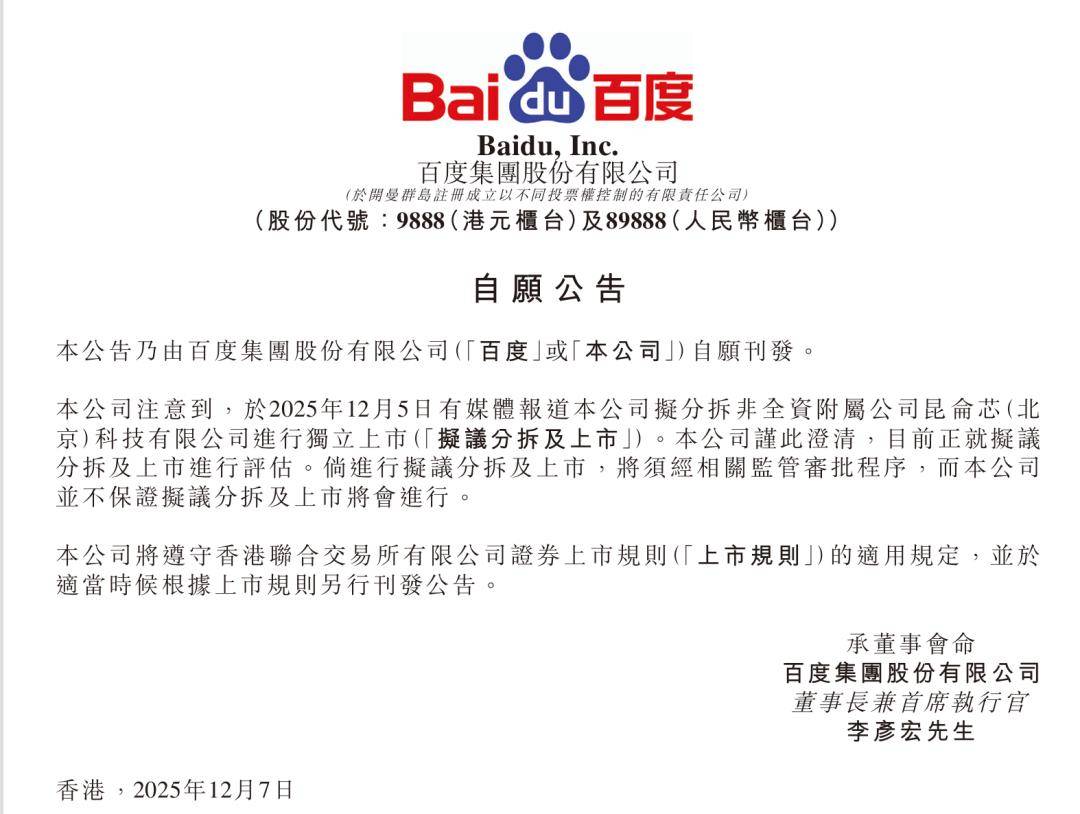
Group 1 - Kunlun Chip, a semiconductor subsidiary of Baidu focused on AI chip development, is advancing its plan for a Hong Kong IPO by submitting the A1 form to the Hong Kong Stock Exchange [1] - The IPO plan aims to achieve global offerings, including a public offering to the Hong Kong public and allocations to institutional and professional investors [1] - The latest financing round for Kunlun Chip has reached an estimated valuation of approximately 21 billion RMB (about 2.97 billion USD) [3] Group 2 - Baidu confirmed on December 7 that it is evaluating the spin-off and listing plan for Kunlun Chip, noting that the process requires regulatory approval and does not guarantee implementation [3] - Following the news of the IPO plans, Baidu's stock price increased by 5% on the same day [3] - Kunlun Chip is positioned as an important player in Baidu's AI chip strategy, with products primarily used in data centers, cloud computing, and autonomous driving [3]
百度昆仑芯保密提交赴港上市申请
第一财经· 2026-01-02 03:10
Core Viewpoint - Baidu has announced the plan to spin off its AI chip subsidiary Kunlun Chip for independent listing on the Hong Kong Stock Exchange, marking a significant step following its evaluation of the split in late 2025 [3]. Group 1: Spin-off Details - The spin-off will involve a global offering of Kunlun Chip, including a public offering in Hong Kong and allocations for institutional and professional investors [3]. - Post-spin-off, Kunlun Chip is expected to remain a non-wholly-owned subsidiary of Baidu [3]. - The reasons for the spin-off include the potential to better reflect Kunlun Chip's value, attract specialized investors, and provide an independent financing platform [3]. Group 2: Regulatory Aspects - Baidu has received a waiver from the Hong Kong Stock Exchange regarding specific listing rules, which typically protect existing shareholders during a spin-off [4]. - The waiver was granted due to the high costs and extensive work involved in complying with these rules, which were deemed disproportionate to the benefits for shareholders [4]. Group 3: Business Context - Kunlun Chip is a key part of Baidu's AI infrastructure strategy and has been independently financed since 2021, catering to both internal and external AI chip demands [4]. - The main product of Kunlun Chip is the P800, with a diverse client base including major companies like China Merchants Bank and Geely [4]. - The competitive landscape for Kunlun Chip is intense, with major players like Nvidia and AMD globally, and local competitors such as Huawei and Cambricon in China [5]. Group 4: Future Considerations - The successful completion of the spin-off depends on several conditions, including approval from the Hong Kong Stock Exchange and the China Securities Regulatory Commission [5]. - Baidu has not yet finalized details regarding the scale and structure of the global offering or the dilution of its ownership stake in Kunlun Chip [5].
刚刚,壁仞科技敲钟上市!GPU在手订单超12亿,拿下多个国产第一
Sou Hu Cai Jing· 2026-01-02 02:55
Core Viewpoint - Wallen Technology, a leading GPU company in Shanghai, has successfully listed on the Hong Kong Stock Exchange, becoming the first domestic GPU stock and the first new stock listed in the Hong Kong market in 2026 [2] Group 1: Company Overview - Wallen Technology's IPO price was HKD 19.60 (approximately RMB 17.60), with an opening price surge of 82.14% to HKD 35.70 (approximately RMB 32.05), resulting in a market capitalization of HKD 855.42 billion (approximately RMB 768 billion) [2] - As of 9:35 AM, the stock price reached HKD 41.80 (approximately RMB 37.52), with a latest market capitalization of HKD 1002 billion (approximately RMB 899 billion) [2] - Founded in 2019, Wallen Technology reported revenue of RMB 49.9 million in 2022, projected to grow to RMB 337 million in 2024, reflecting a compound annual growth rate (CAGR) of 2500% [3][5] Group 2: Technological Achievements - Wallen Technology is the first Chinese company to adopt 2.5D chiplet technology for dual AI computing bare chips and has achieved significant technical milestones in the domestic AI chip sector [5] - The company has a high R&D ratio, with 83% of its workforce in R&D and over 70% of its expenses allocated to R&D, ranking first in China for the number of invention patent applications in the GPGPU sector [8][9] - Wallen Technology has applied for over 1500 patents globally, with a 100% authorization rate for invention patents, establishing a strong patent wall for long-term development [9] Group 3: Product Development and Innovation - The company has developed a self-researched GPGPU architecture that integrates innovations to enhance performance and efficiency, with plans for next-generation chips supporting FP8 and FP4 precision [15][16] - Wallen Technology's GPGPU architecture features advanced designs such as dual chiplets, tensor core architecture, and near-memory computing, significantly improving AI computation efficiency and energy consumption [18][19] - The company has successfully commercialized high-performance OAM and general-purpose boards, being one of the first in China to do so [22] Group 4: Market Position and Strategy - Wallen Technology aims to provide comprehensive solutions for large-scale intelligent computing clusters, integrating its hardware and software with third-party infrastructure [27] - The company has established partnerships with major telecom operators and has served nine Fortune China 500 companies, including five from the Fortune Global 500 [32] - Wallen Technology's software platform, BIRENSUPA, is designed to lower migration costs and enhance ecosystem development, supporting various AI models and facilitating collaboration with top universities [31]

刚刚,暴涨超118%!
Zhong Guo Ji Jin Bao· 2026-01-02 02:38
Core Viewpoint - Wall Street's first stock of the new year, Birran Technology, saw a significant increase of over 118% on its debut in the Hong Kong Stock Exchange, indicating strong market interest and investor confidence in the company [2][4]. Group 1: Company Overview - Birran Technology, established in 2019, is a Chinese high-performance general-purpose computing chip company headquartered in Shanghai, focusing on the development of general-purpose GPUs and AI acceleration chips [4]. - The company aims to provide computing power solutions for AI training, inference, and high-performance computing [4]. Group 2: IPO Details - Birran Technology's shares were priced at HKD 19.60, raising approximately HKD 55.83 billion, making it the largest fundraising project since the implementation of Chapter 18C of Hong Kong's listing rules [4]. - The IPO attracted 471,000 retail investors, marking it as the most sought-after new stock in the Hong Kong market over the past year [4]. Group 3: Market Position and Projections - As of 2024, Birran Technology holds a market share of 0.16% in China's intelligent computing chip market and 0.20% in the GPGPU market, with expectations to capture about 0.2% of the projected USD 50.4 billion market by 2025 [4]. - The company has secured sales agreements valued at approximately RMB 1.241 billion as of December 15, 2025 [4]. Group 4: Financial Performance - Revenue projections for Birran Technology from 2022 to 2024 are as follows: RMB 0.5 million, RMB 62.03 million, and RMB 337 million, with adjusted net losses of RMB 1.038 billion, RMB 1.051 billion, and RMB 767 million respectively [7]. - For the first half of 2025, the company reported revenue of RMB 58.9 million and an adjusted net loss of RMB 552 million [7]. Group 5: Innovation and Intellectual Property - As of June 30, 2025, Birran Technology has submitted 1,158 self-developed invention patent applications, ranking first among Chinese GPGPU companies, and has received 388 invention patents with a 100% authorization rate [8].

刚刚,暴涨超118%!
中国基金报· 2026-01-02 02:32
Core Viewpoint - Wallen Technology, a Chinese high-performance general-purpose computing chip company, made its debut on the Hong Kong Stock Exchange on January 2, 2024, with a significant price increase of over 118% from its opening price [2][5][8]. Group 1: Company Overview - Wallen Technology, established in 2019 and headquartered in Shanghai, focuses on the research and development of general-purpose GPUs and AI acceleration chips, aiming to provide computing power solutions for AI training, inference, and high-performance computing [5][6]. - The company is recognized as one of the "Four Little Dragons" of domestic GPUs in China [4][8]. Group 2: IPO Details - The IPO was priced at HKD 19.60 per share, raising approximately HKD 5.583 billion, and attracted 471,000 retail investors, marking it as the most subscribed new stock in the Hong Kong market over the past year [5][12]. - This IPO is the largest fundraising project since the implementation of Chapter 18C of Hong Kong's listing rules [5]. Group 3: Market Position and Projections - As of 2024, Wallen Technology holds a market share of 0.16% in China's intelligent computing chip market and 0.20% in the GPGPU market, with expectations to capture approximately 0.2% of the market by 2025, which is projected to reach USD 50.4 billion [6][12]. - The company has secured sales agreements valued at approximately RMB 1.241 billion and plans to launch its next-generation flagship data center chip, the Wallen™ 20X series, by 2026 [7]. Group 4: Financial Performance - Wallen Technology's revenue from 2022 to 2024 is projected to be RMB 0.5 million, RMB 62.03 million, and RMB 337 million, with adjusted net losses of RMB 1.038 billion, RMB 1.051 billion, and RMB 767 million respectively [12]. - As of the first half of 2025, the company reported revenue of RMB 58.9 million and an adjusted net loss of RMB 552 million [12]. Group 5: Investment and Support - The IPO attracted 23 cornerstone investors, including prominent firms such as Qiming Venture Partners and Ping An Life Insurance, providing strong backing for the company [10][11].

百度股价暴涨!公司官宣:分拆芯片业务 独立IPO!机构预测:昆仑芯今年收入将大增6倍
Mei Ri Jing Ji Xin Wen· 2026-01-02 02:23
Core Viewpoint - Baidu's subsidiary Kunlun Chip has submitted a listing application to the Hong Kong Stock Exchange, aiming for a public offering to enhance its operational transparency and attract specialized investors in AI computing chips [2][4]. Group 1: Listing and Financial Aspects - The proposed spin-off will involve a global offering of Kunlun Chip shares, including a public offering in Hong Kong and allocations to institutional investors [1]. - Kunlun Chip's latest financing round in July 2023 valued the company at approximately 21 billion RMB (about 2.97 billion USD), with Baidu holding a 59.45% stake [5]. - Following positive news, Baidu's stock surged by 6.92% on January 2, 2024, bringing its total market capitalization to 386.7 billion HKD [4]. Group 2: Strategic Rationale for Spin-off - The spin-off is expected to better reflect Kunlun Chip's value based on its strengths, enhancing operational and financial transparency for investors [4]. - Kunlun Chip's business model is anticipated to attract investors focused on AI computing chips, differentiating it from Baidu's more diversified business [4]. - The separation will improve Kunlun Chip's image among clients, suppliers, and potential strategic partners, allowing for more effective negotiations and access to capital markets [4]. Group 3: Market Position and Product Development - Kunlun Chip is positioned in the top tier of the domestic AI chip market, with its P800 series chips recognized for their performance and energy efficiency [8]. - The P800 chip supports configurations of 8 and 16 cards, achieving a maximum throughput of 482 times per second, and is the first domestic chip to support full deployment of large models [8]. - IDC forecasts that Kunlun Chip's shipment volume will reach 69,000 units in 2024, significantly surpassing competitors like Cambricon [10]. Group 4: Future Growth Potential - Morgan Stanley predicts Kunlun Chip's revenue will increase from approximately 1.3 billion RMB in 2025 to 8.3 billion RMB in 2026, a sixfold increase [7]. - The company has secured a significant order worth 1 billion RMB from China Mobile, which will enhance its position as a neutral supplier and attract more external clients post-IPO [7].