
氢能产业

Search documents
庆铃云创启新程 哈密制造耀边疆 博世庆铃携手共绘新疆发展华章
Zhong Guo Qi Che Bao Wang· 2025-07-31 14:05
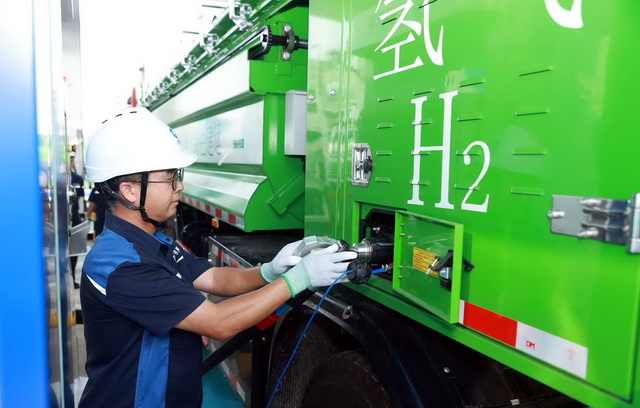
Core Viewpoint - The launch of the first batch of 49-ton hydrogen fuel cell tractors by Qingling Motors marks a significant step towards green transformation in coal transportation in Xinjiang, leveraging government policies and technological advancements in hydrogen energy [1][5][7]. Industry Developments - Xinjiang, rich in coal resources, is promoting the green transformation of coal transportation through the large-scale application of new energy heavy trucks, as outlined in the "Three-Year Action Plan for Hydrogen Energy Industry Development (2023-2025)" [3]. - Hami City has been selected as one of the second batch of demonstration application cities for fuel cell vehicles, accelerating the implementation of hydrogen energy [3]. Company Initiatives - Qingling Motors has signed a contract for the first batch of 52 customized 49-ton hydrogen fuel cell tractors, aimed at addressing pollution issues in traditional resource transportation [5][10]. - The company has established a dedicated R&D and production team to customize vehicles for Hami's extreme climate conditions, ensuring operational stability in temperatures ranging from -30°C to 70°C [8][10]. Technological Advancements - The tractors feature a 6×4 drive system and are equipped with a 190KW Bosch fuel cell system, enabling strong power output even under full load [11]. - The vehicles have a large 2200L hydrogen storage tank, achieving a range of over 600 kilometers and allowing for quick refueling in just 10 minutes [13]. Economic Benefits - The hydrogen fuel cost is estimated to be 30%-35% lower than traditional diesel, with maintenance costs reduced to about 30% of those for fuel vehicles, significantly lowering overall operational costs [15]. - The fuel cell's lifespan exceeds 10 years, reducing the frequency of replacements and maintenance time [15]. Future Outlook - Qingling Motors aims to accelerate hydrogen technology research and product innovation, contributing to the construction of a green transportation system in China and promoting the large-scale application of hydrogen-powered commercial vehicles [17].


铂钯行业研究系列报告:“铂”取大势,“钯”握微末(九):前路漫漫,铂钯氢能需求仍有瓶颈
Guo Tai Jun An Qi Huo· 2025-07-31 13:54
Report Industry Investment Rating No relevant content provided. Core Views of the Report - The hydrogen energy sector is a key focus in the platinum market. Platinum is a crucial catalyst in proton exchange membrane technology, while palladium is used in hydrogen purification but has low technology penetration due to high costs [1][2][63]. - The hydrogen energy industry is currently in a bottleneck period, facing challenges in technology, cost, safety, and infrastructure. These factors limit the growth of downstream hydrogen demand [2][26]. - By 2030, platinum demand in the hydrogen energy sector is expected to reach around 5.53 tons. In the next 5 years, this demand will remain small and unlikely to impact the overall platinum supply - demand balance. The growth of platinum demand is slower than expected due to the decline in fuel - cell vehicle sales, and proton exchange membrane electrolyzers may surpass fuel - cell vehicles as the main application scenario for platinum demand in the hydrogen energy sector [2][59][60]. Summary by Directory 1. Tracing the Origins: Physical and Chemical Properties of Platinum and Palladium and Their Applications in the Hydrogen Energy Industry - In 2024, global platinum demand in hydrogen - related fields was only about 44 thousand ounces, accounting for 0.53% of the total demand. There is no separate statistical data for palladium in the hydrogen - related field [6]. - Platinum is mainly used in hydrogen production and utilization, while palladium is mainly used in the purification stage of hydrogen production [10]. - Platinum is a catalyst material for proton exchange membranes. Proton exchange membranes are widely used in hydrogen production and utilization. Platinum has high catalytic activity and acid - resistance stability, making it suitable for this role [12][18][19]. - Palladium can selectively permeate hydrogen and is used in hydrogen purification. However, due to high costs, the palladium membrane method has low penetration compared to the PSA method [20][21][25]. 2. A Long Road Ahead: Analysis of the Hydrogen Energy Industry Development - **Current situation**: Electrolytic water hydrogen production is growing rapidly, but fuel - cell vehicles, the main application of hydrogen fuel cells, are facing difficulties in promotion, with a decline in new promotion numbers [2][27]. - **Advantages**: Hydrogen energy has excellent coupling with renewable energy, which can solve the mismatch between renewable energy power generation and power consumption [29][30]. - **Policy differences**: China views the hydrogen energy industry as an important means to achieve the dual - carbon goal. Japan and South Korea focus on fuel - cell vehicles, while EU countries represented by Germany emphasize environmental protection and energy supply [2][34][36]. - **Bottlenecks**: The hydrogen energy industry is restricted by technology, cost, safety, and infrastructure, which limit the growth of downstream hydrogen demand [2][26][38]. 3. Long - Term Strategy: Estimation of Platinum and Palladium Demand in the Hydrogen Energy Industry - **Single consumption of core applications**: In fuel - cell vehicles, the estimated platinum consumption per passenger car is about 25 grams, and per commercial vehicle is about 65 grams. For proton exchange membrane electrolyzers, the estimated platinum consumption per megawatt is about 700 grams. Reducing platinum loading is a major research direction in the proton exchange membrane industry [42][43][44]. - **Development prediction of related fields**: For proton exchange membrane electrolyzers, the maximum installed capacity of announced projects is about 520GW, but after excluding early - stage projects, the maximum installed capacity from 2025 - 2030 is 225GW. It is predicted that by 2030, the new installed capacity of proton exchange membrane electrolyzers will have a compound annual growth rate of 44% - 56%. For proton exchange membrane fuel cells, considering infrastructure challenges, it is predicted that by 2030, fuel - cell commercial vehicle sales will have a small compound annual decline of 1% - 5%, and passenger vehicle sales will have a larger decline of 23% - 27% [48][50][54]. - **Prediction results**: By 2030, platinum demand in the hydrogen energy sector is expected to reach around 5.53 tons. In the next 5 years, this demand will be small, the growth rate is slower than expected, and proton exchange membrane electrolyzers may become the main application scenario for platinum demand [59][60][61].
立足市场前端 杭氧股份拟新设合资公司进一步孵化氢能产业链
Quan Jing Wang· 2025-07-31 06:59
Core Viewpoint - The establishment of a joint venture, Luoyang Hangyang Longze Hydrogen Energy Co., Ltd., aims to build a complete hydrogen energy industry chain, enhancing the company's capabilities in the hydrogen sector and contributing to the national "dual carbon" strategy [1][2]. Group 1: Joint Venture and Investment - Hangyang Co., Ltd. plans to invest in a joint venture with Longze Energy and Shanghai Qinfeng, with a registered capital of 15 million yuan, where Hangyang will contribute 7.65 million yuan, holding a 51% stake [1]. - The joint venture will invest in a hydrogen production and filling facility with a capacity of 2825 Nm3/h, with a total project investment of approximately 45.5 million yuan [1]. Group 2: Industry Context and Strategic Importance - The hydrogen energy sector is becoming a crucial part of global energy transition, supporting deep decarbonization in industries and aligning with China's energy production and consumption revolution [2]. - The National Energy Administration's report indicates that China's hydrogen production and consumption scale will exceed 36.5 million tons by 2024, positioning the country as a leader in renewable energy hydrogen production [2]. Group 3: Technological Advancements and Achievements - Hangyang Co., Ltd. has a strong foundation in technology innovation and R&D in the hydrogen sector, with successful product certifications and the establishment of a hydrogen refueling station [3]. - The company has achieved significant milestones, including the largest daily hydrogen refueling capacity in the country at 9000 kg/day, showcasing its leadership in the hydrogen industry [3]. Group 4: Long-term Goals and Market Position - The establishment of the joint venture is a strategic move to deepen the company's presence in the hydrogen energy market and enhance its competitive advantage [5]. - Hangyang Co., Ltd. aims to become a world-class enterprise in the gas industry, leveraging its strong position in air separation equipment and a diversified gas product matrix to drive innovation and contribute to the green upgrade of the global gas industry [5].

建设加氢站、推广氢能车,多地加快推动氢能产业发展
Di Yi Cai Jing· 2025-07-31 00:57
Core Viewpoint - The hydrogen energy industry is experiencing rapid development with the expansion of application scenarios, leading to increased construction of hydrogen refueling stations and promotion of hydrogen fuel cell vehicles in various regions [1][5]. Group 1: Hydrogen Infrastructure Development - The first large-capacity hydrogen refueling station in South China, "Liangtian Hydrogen Station," has been put into operation in Guangzhou, with a maximum daily refueling capacity of 4,000 kg, supporting over 200 hydrogen vehicles [1][4]. - Guangzhou has implemented measures to support the construction of hydrogen refueling stations, providing subsidies for stations with a daily refueling capacity of 500 kg or more [1][6]. - As of now, Guangzhou has promoted over 1,000 hydrogen fuel cell vehicles and established approximately 200,000 square meters of hydrogen energy industrial parks [2]. Group 2: Technological Advancements - The "Liangtian Hydrogen Station" features a unique "4 stations and 8 nozzles" architecture, achieving a refueling speed of 3.6 kg/min, which is a 33.3% efficiency improvement compared to similar stations [2]. - The hydrogen supply chain in Guangdong has been enhanced through the establishment of multiple hydrogen supply channels, ensuring stable and economical hydrogen supply [2]. Group 3: National and Regional Initiatives - China Petrochemical's hydrogen fuel cell supply center in Guangzhou has been expanded, with an annual production capacity of 5,100 tons, contributing to the establishment of 142 hydrogen refueling stations nationwide [3]. - Jiangsu Province aims to achieve a hydrogen industry scale exceeding 100 billion yuan by 2027, with plans to build over 100 hydrogen refueling stations and promote more than 10,000 fuel cell vehicles [5][6]. - The National Energy Administration's report anticipates that by the end of 2024, over 540 hydrogen refueling stations will be built, and approximately 24,000 fuel cell vehicles will be promoted across various sectors [6].
杭氧股份拟投资设立氢能合资公司
Zhi Tong Cai Jing· 2025-07-30 13:23
Core Viewpoint - The company plans to establish a joint venture named Luoyang Hangyang Longze Hydrogen Energy Co., Ltd. with Longze Energy and Shanghai Hydrogen Maple, aiming to enhance its capabilities in the hydrogen energy sector [1] Group 1: Joint Venture Details - The registered capital of the joint venture is set at 15 million yuan, with the company contributing 7.65 million yuan for a 51% stake [1] - Longze Energy will invest 5.85 million yuan for a 39% stake, while Shanghai Hydrogen Maple will contribute 1.5 million yuan for a 10% stake [1] Group 2: Strategic Objectives - The investment leverages the growth opportunities in the domestic hydrogen energy industry [1] - The collaboration aims to utilize the high-quality resources of Longze Energy and Shanghai Hydrogen Maple to further develop the company's hydrogen energy supply chain [1] - The initiative is expected to diversify the company's gas product offerings, adjust the product structure, and enhance its overall strength in the hydrogen energy sector [1]
杭氧股份:拟设立氢能合资公司 生产销售高纯氢及燃料电池汽车用氢产品
Zheng Quan Shi Bao Wang· 2025-07-30 13:00
Core Viewpoint - The company plans to establish a joint venture with two other companies to invest in hydrogen production and sales, focusing on high-purity hydrogen and hydrogen products for fuel cell vehicles [1] Group 1: Joint Venture Details - The company will collaborate with Luoyang Longze Energy Co., Ltd. and Shanghai Hydrogen Maple Energy Technology Co., Ltd. to form a joint venture named Luoyang Hangyang Longze Hydrogen Energy Co., Ltd. [1] - The registered capital of the joint venture will be 15 million yuan, with the company contributing 7.65 million yuan, accounting for 51% of the total [1] Group 2: Project Investment and Capacity - The joint venture aims to invest in and construct a hydrogen production and filling facility with a capacity of 2825 Nm3/h using coke oven gas [1] - The total investment for the project is approximately 45.5 million yuan, with the company, Longze Energy, and Shanghai Hydrogen Maple contributing 15 million yuan collectively, while the remaining funds will be sourced through external financing [1]
西安,氢力全开!
Xi An Ri Bao· 2025-07-30 09:08
Group 1 - Xi'an's hydrogen energy industry is rapidly developing, showcasing vitality through technological breakthroughs and scene expansion, creating a complete industrial ecosystem covering upstream, midstream, and downstream [1][2] - The hydrogen energy industry has become a new hallmark of Xi'an's future industrial development, with an estimated output value of nearly 3 billion yuan in 2024 and over 120 hydrogen energy enterprises established in the city [2][3] - Local universities are making significant advancements in hydrogen production technologies, including photocatalytic hydrogen production and water electrolysis [2][3] Group 2 - Xi'an has made breakthroughs in large-scale fuel cell development, with a production line capable of producing 3,000 fuel cell stacks annually and the establishment of various hydrogen production and testing facilities [3][4] - The city is witnessing the integration of hydrogen energy into daily life through applications such as hydrogen-powered assistive vehicles and drones, enhancing user experience and operational efficiency [4][5] - The development of innovative products, such as hydrogen leak detection tape, has filled domestic gaps and reduced costs significantly compared to imported alternatives [6] Group 3 - Companies like Xuhydrogen Times are collaborating with academic institutions to enhance hydrogen fuel cell stack production, achieving significant efficiency improvements and establishing a fully automated production line [7][8] - The integration of advanced materials, such as titanium, is crucial for reducing costs and extending the lifespan of hydrogen fuel cells, with local companies leading the way in this innovation [10][11] - The establishment of a comprehensive supply chain from titanium processing to hydrogen fuel cell production is enabling cost control and enhancing the competitiveness of Xi'an's hydrogen energy sector [13][14] Group 4 - The local hydrogen energy industry is supported by favorable policies, talent availability, and financial backing, fostering an environment conducive to innovation and growth [9][15] - Xi'an's hydrogen energy sector is positioned as a key player in the national landscape, with ongoing projects and collaborations aimed at advancing technology and expanding market reach [9][16]
加氢站关停潮下,氢燃料电池车难行
Zhong Guo Qi Che Bao Wang· 2025-07-28 09:26
Group 1: Industry Overview - The global automotive industry is experiencing a shift towards electrification, with hydrogen fuel cell vehicles (FCVs) gaining attention due to their zero emissions and long driving range [2] - Major automakers like Toyota, Hyundai, and Honda have invested heavily in hydrogen FCVs, launching models such as Toyota Mirai, Honda Clarity, and Hyundai Nexo [2] - Despite the investments, the hydrogen industry faces challenges, including high purchase prices and operational costs of FCVs, leading to low consumer demand and insufficient hydrogen station utilization [2][3] Group 2: Market Challenges in the U.S. - In California, a lawsuit has been filed against Toyota by hundreds of Mirai owners, claiming the company misled consumers about the convenience of hydrogen refueling [3] - The number of operational hydrogen stations in the U.S. is declining, with only 51 public and 21 private stations reported as of July 2025, significantly below the required infrastructure for widespread FCV adoption [4] - The rising cost of hydrogen, from $13 per kilogram in 2022 to $36 per kilogram in 2024, exacerbates the challenges faced by FCV owners [4] Group 3: European Market Developments - Stellantis has halted its hydrogen fuel cell technology development due to limited refueling infrastructure and high funding requirements, indicating a lack of commercial viability for hydrogen FCVs in the near term [8][9] - The European hydrogen station network is underdeveloped, with only about 250 stations across the EU as of 2024, far below initial targets [11] - Several hydrogen stations in Europe have closed due to profitability issues, highlighting the slow commercialization of hydrogen FCVs [10] Group 4: Japan's Hydrogen Strategy - Japan has been proactive in developing a hydrogen society, with significant government investment in hydrogen infrastructure and FCVs [12] - However, the number of operational hydrogen stations in Japan has decreased from 161 in April 2024 to 151 by July 2025, reflecting operational difficulties [13] - The high cost of hydrogen FCVs, such as the Toyota Mirai priced at approximately ¥7.414 million to ¥8.6108 million, remains a barrier to consumer adoption [13] Group 5: South Korea's Hydrogen Initiatives - South Korea has launched the new generation of Hyundai Nexo, with a price range of 7.644 million to 8.345 million KRW, but faces challenges in infrastructure and safety incidents [17][19] - The number of hydrogen stations in South Korea is 218, but safety concerns and supply chain issues have hindered growth [18] - The South Korean government plans to provide subsidies for 11,000 hydrogen FCVs and 2,000 hydrogen buses by 2025, aiming to enhance infrastructure and reduce costs for users [20]


陕西氢能全产业链加速崛起
Ke Ji Ri Bao· 2025-07-28 08:01
Core Insights - The hydrogen energy industry in Shaanxi is rapidly developing, with over 100 hydrogen enterprises established, and the total industry output value expected to exceed 4 billion yuan this year [1] - The first fully automated hydrogen fuel cell stack production line in Northwest China has been launched, enabling domestic production of hydrogen fuel cell stacks that were previously monopolized by foreign companies [2] - Significant cost reductions in hydrogen storage and transportation have been achieved, with new technology lowering the cost from 23.3 yuan per kilogram to below 11 yuan [3] Industry Development - The "14th Five-Year Plan" for hydrogen energy industry development in Shaanxi is being implemented, promoting large-scale demonstration applications of hydrogen energy in various sectors such as public transport and logistics [4] - The first hydrogen energy bus line in Shaanxi has been launched, showcasing the practical application of hydrogen energy in public transportation [5] - Hydrogen-powered assistive bikes are being used in tourist areas, demonstrating the versatility of hydrogen energy applications [6] Ecosystem Construction - A complete hydrogen energy industry chain is being established in the Yulin High-tech Zone, integrating hydrogen production, storage, refueling, and application [7] - The first international joint laboratory for hydrogen energy in Shaanxi has been established, focusing on new hydrogen storage materials and AI-assisted design [7] - The strategic layout of "one core leading, two axes connecting, and three centers supporting" is being implemented to strengthen the hydrogen energy industry in Shaanxi [8][9] Future Projections - By 2025, Shaanxi aims to achieve an annual high-purity hydrogen production capacity of 50,000 tons, with over 200 hydrogen enterprises and a core component output value of around 1 billion yuan [11] - By 2030, a comprehensive hydrogen energy technology innovation system and green hydrogen preparation and supply system are expected to be established, supporting carbon peak goals [11]
“大规模盐穴储氢”主体工程开建
Ke Ji Ri Bao· 2025-07-27 23:21
Core Insights - The "Large-Scale Salt Cavern Hydrogen Storage" project marks a significant step in China's hydrogen energy industry, addressing the need for large-scale hydrogen storage solutions [1][2] - The project aims to fill the gap in China's large-scale salt cavern hydrogen storage sector and provide practical examples to overcome technical challenges in gaseous hydrogen storage [1] - The initiative is a collaboration between China Salt Group, Tsinghua University, and several other institutions, focusing on developing a complete technology system with independent intellectual property rights for salt cavern hydrogen storage [1] Group 1 - The project officially commenced on July 25, 2023, in Changzhou, Jiangsu, and is part of a national key research and development plan [1] - The project will establish two new salt caverns, including two hydrogen injection and extraction wells and two brine injection and discharge wells, serving as a testbed for hydrogen storage performance [2] - The project is set to tackle core issues related to safety, efficiency, and cost in large-scale hydrogen storage, including geological space optimization and new material development [1][2] Group 2 - The project is expected to enhance China's strategic hydrogen storage capacity and provide essential infrastructure for the future large-scale application of hydrogen energy [2] - The project will also create a geological large-scale hydrogen storage verification platform for experimental research [1]