信托业转型

Search documents
资产管理信托将迎新规 倒逼提升主动管理能力
Shang Hai Zheng Quan Bao· 2025-11-03 18:16
Core Viewpoint - The release of the "Asset Management Trust Management Measures (Draft for Comments)" marks a significant step in the transformation of the trust industry, emphasizing the need for improved active management capabilities and compliance in asset management trusts [1][6]. Group 1: Regulatory Changes - The new measures introduce specific requirements for asset management trusts, including limits on investment amounts from individual and institutional investors, which aim to end the single financing model for non-standard trusts [2][3]. - The measures require trust companies to enhance their active management capabilities and focus on developing and managing equity-related products while adhering to compliance [1][6]. Group 2: Sales and Compliance - The measures will eliminate the single performance assessment model for sales personnel, mandating the establishment of qualification assessments, ongoing training, and tracking evaluations [4][6]. - Trust companies are now required to define their sales channels clearly, allowing for direct sales or sales through licensed institutions, which aims to reduce risks associated with third-party sales channels [4][5]. Group 3: Industry Trends - Many trust companies are prioritizing wealth management by recruiting talent to strengthen their wealth management teams, indicating a shift towards a more client-oriented approach [5]. - The industry is facing challenges such as increased revenue without corresponding profit growth, prompting a need for trust companies to reduce channel business and enhance active management capabilities [3][6].
32.43万亿元,再创新高!
Shang Hai Zheng Quan Bao· 2025-10-22 11:16
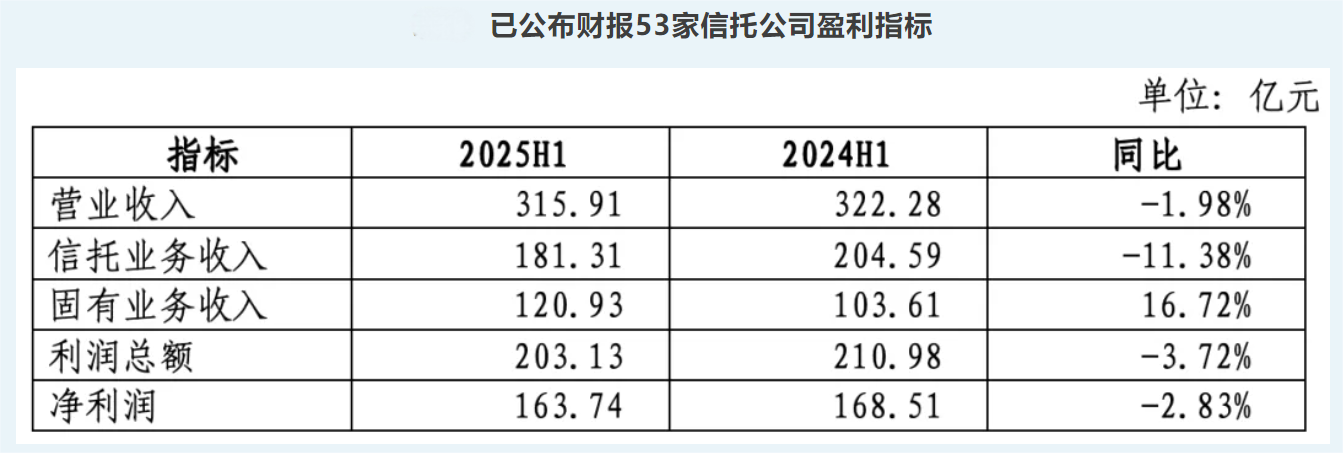
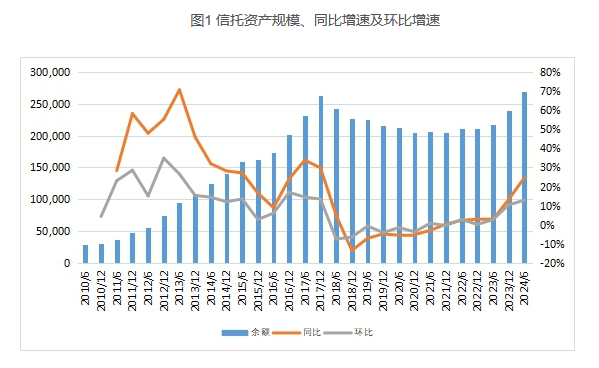
Core Insights - The trust industry in China is experiencing rapid expansion, with the total asset management scale reaching a historical high of 32.43 trillion yuan as of June 2023, marking a year-on-year growth of over 20% [1][2] Industry Growth - The trust industry's asset management scale increased by 2.87 trillion yuan from the end of last year, representing a growth rate of 9.7% [2] - The scale of trust assets has shown accelerated growth over the past two years, with significant increases noted in 2022 and 2023 [2] - The trust asset scale was only 3.04 trillion yuan in 2010, but surged to 26.25 trillion yuan by 2017, driven by the booming real estate sector [2] - Following regulatory changes, the industry faced a contraction from 2018 to 2020, dropping to 20.49 trillion yuan, but has since rebounded [2] Institutional Expansion - The number of trillion-yuan trust institutions has increased, with seven institutions now managing over 1 trillion yuan in assets [5] - China Ping An Trust reported a management scale of 1,052.416 billion yuan as of June 2025 [5] Market Trends - By the end of 2024, the scale of funds directed towards the securities market reached 10.27 trillion yuan, a significant increase of 55.61% from the previous year [7] - Trust companies are shifting their focus from traditional non-standard financing to more diversified and professional asset services, indicating a positive trend in scale recovery and structural optimization [7] Profitability Challenges - Despite the rapid growth in scale, the profitability of the trust industry remains under pressure, with a reported decline in revenue and net profit for many companies [9] - The total operating income for 53 reporting trust companies was 31.591 billion yuan in the first half of the year, down 1.98% year-on-year, while net profit fell by 2.83% [9] - The industry faces challenges due to late transformation for some companies, leading to a decline in traditional business income and difficulties in generating profits from innovative business models [9][10]

信托业规模突破30万亿元大关
Shang Hai Zheng Quan Bao· 2025-10-21 13:50
Core Insights - The trust industry in China has seen significant growth, with total assets under management reaching 32.43 trillion yuan by mid-2023, marking an increase of 2.87 trillion yuan (9.7%) from the end of the previous year and a year-on-year increase of 5.43 trillion yuan (20.11%) [1][2] Group 1 - The trust industry's asset management scale has rapidly increased from 3.04 trillion yuan in 2010 to 26.25 trillion yuan in 2017, driven by the booming real estate sector [1] - Following a period of contraction from 2018 to 2020, where the scale fell to 20.49 trillion yuan, the industry has shown signs of recovery, with asset sizes projected to reach 29.56 trillion yuan by the end of 2024, an increase of 5.64 trillion yuan (23.58%) from 2023 [1] - The trust industry is transitioning from traditional non-standard financing to more diversified and specialized services, including asset service trusts, asset management trusts, and charitable trusts [2] Group 2 - The transformation of trust companies has been positively influenced by regulatory guidance, leading to a recovery in scale and optimization of structure [2] - The future focus for the trust industry includes enhancing the independent property and asset isolation functions, while adhering to the "three classifications" of business [2] - Aiming for high-quality development, the industry seeks to establish a framework characterized by clear positioning, improved governance, stable operations, professional services, and effective regulation [2]
信托业10月招聘战打响,“专业+复合”成香饽饽
Xin Lang Cai Jing· 2025-10-17 15:15
Core Viewpoint - The trust industry is experiencing a targeted recruitment trend in response to regulatory changes and the need for transformation, emphasizing the strategic value of talent as a core driver for this transition [2][5]. Group 1: Recruitment Trends - Multiple trust companies, including Zhongguo Trust, Xiamen International Trust, and CITIC Trust, have launched recruitment plans focusing on wealth management, asset management, and risk compliance, covering various job levels from department heads to technical positions [2][3]. - The recruitment strategies are tailored to align with each company's transformation direction, showcasing a clear focus on specialized talent needs rather than broad hiring [3][4]. - Zhongguo Trust is leveraging its state-owned enterprise background to recruit both experienced and young talents in key cities, focusing on wealth management and digital operations [3][4]. Group 2: Industry Transformation - The recruitment drive is primarily driven by the need to adapt to new regulatory frameworks and business models, moving from reliance on non-standard products to core businesses like asset securitization and family trusts [5][6]. - The trust industry is witnessing a rebound in employee numbers, with a reported increase to 17,884 employees by the end of 2024, reflecting a strategic shift rather than mere personnel adjustments [6][8]. - The emphasis on hiring is not just about filling vacancies but is seen as a foundational investment for future transformation [6][7]. Group 3: Skills and Competencies - Trust companies are prioritizing not only professional skills but also soft skills such as communication, customer service, and teamwork in their recruitment strategies [5][6]. - The need for a structured training system is highlighted to ensure new hires can quickly adapt to business needs and regulatory requirements [7][8]. - The regulatory body is also enhancing training programs to align with the evolving legal and compliance landscape, introducing new subjects like Trust Law to better equip industry professionals [8].

探索对企业闲置不动产进行“激活”
Jin Rong Shi Bao· 2025-09-30 02:51
Core Viewpoint - The recent launch of the real estate trust property registration pilot in Tianjin marks the fifth city in China to implement such a program, aimed at revitalizing idle real estate assets and improving the efficiency of state-owned asset management [1][2]. Group 1: Significance of Real Estate Trust Registration - The pilot program aims to clarify the legal status of trust properties, thereby effectively revitalizing a large volume of idle assets [2]. - The "Tianjin Real Estate No. 1" project involves a state-owned enterprise entrusting its commercial real estate valued at 3 million yuan to a trust company, showcasing the potential for asset isolation and revitalization [2]. - The initiative is expected to enhance liquidity and value of previously idle assets, transforming them into tradable financial assets [2][3]. Group 2: Trust Industry Transformation - The pilot program aligns with national policies aimed at promoting high-quality development in the trust industry, encouraging innovation and a return to core business functions [3]. - The recent trials in various cities signal a strong push towards building the infrastructure of the trust system, allowing companies to move away from traditional financing dependencies [3][6]. - Trust companies are encouraged to develop differentiated competitive advantages by focusing on specialized products and services tailored to local economic needs [6]. Group 3: Market Opportunities and Challenges - The ongoing trials are expected to expand to more regions, presenting opportunities for trust companies to capitalize on favorable policies while managing risks [6]. - Trust companies should cultivate a skilled workforce proficient in real estate investment and management to meet the complexities of real estate trust operations [6]. - The focus on niche markets, such as industrial logistics and elder care real estate trusts, is recommended for trust companies to enhance their market positioning [6].
天津试点不动产信托登记 探索对企业闲置不动产进行“激活”
Jin Rong Shi Bao· 2025-09-30 01:13
Core Insights - The recent announcement of the pilot program for real estate trust property registration in Tianjin marks the fifth city in China to implement such a program, following Beijing, Shanghai, Guangzhou, and Xiamen [1] - The "Tianjin Real Estate No. 1" trust project involves a company registering its commercial real estate for operation by a trust company, differing from previous practices that focused on individual property ownership [1][2] - This initiative aims to activate idle real estate assets, enhance the efficiency of state-owned asset management, and represents a significant breakthrough in asset management [1][2] Summary by Sections Pilot Program Significance - The pilot program for real estate trust registration clarifies the legal status of trust property, facilitating the activation of substantial idle assets [2] - Experts believe that the trust registration will enable professional operation, centralized planning, risk isolation, and dedicated revenue management for real estate assets [2] Case Study: "Tianjin Real Estate No. 1" - The project involves a state-owned enterprise entrusting a two-story commercial property valued at 3 million yuan to a trust company, demonstrating the potential for asset activation [2] - The activation of this 3 million yuan asset is seen as significant for state-owned asset management, transforming previously idle properties into liquid and valuable assets [2][3] Trust Industry Transformation - The recent pilot programs signal a shift in the trust industry towards high-quality development and a return to core business functions [3] - Trust companies are encouraged to innovate and transition towards asset isolation, wealth planning, and management services [3][6] Diverse Applications of Real Estate Trusts - Recent real estate trust cases show that they can meet various demographic needs, including retirement security and intergenerational wealth transfer [4][5] - The integration of trust systems with retirement needs provides new solutions for elder financial security [5] Competitive Landscape for Trust Companies - With five cities now piloting real estate trust registration, more regions are expected to follow suit, presenting opportunities for trust companies [6] - Trust companies should focus on developing specialized teams with expertise in real estate investment and management to enhance their competitive edge [6] - Companies are advised to explore niche markets and tailor products to local economic characteristics, such as logistics and real estate related to free trade zones [6]
万亿信托换帅
Jing Ji Guan Cha Wang· 2025-09-17 12:04
Core Viewpoint - Ping An Trust has appointed Wang Xin as the new chairman, succeeding Fang Weihua, who has been reassigned to Ping An Bank as vice president. Wang Xin's extensive experience in banking and asset management is expected to drive the company's strategic transformation and enhance its business operations [1][2]. Group 1: Leadership Changes - Wang Xin has officially taken over as chairman of Ping An Trust as of September 16, 2025, following approval from the Shenzhen Regulatory Bureau of the National Financial Supervisory Administration [1]. - Fang Weihua, the former chairman, has transitioned to a role as vice president at Ping An Bank after serving as chairman since January 2024 [1]. - Wang Xin joined Ping An Trust in May 2025, bringing 29 years of experience in the banking and insurance asset management sectors [1]. Group 2: Business Transformation - The current focus for Ping An Trust is on transforming its business model, particularly by reducing financing-type trust businesses and emphasizing standard investment and service-type trust businesses [3]. - By the end of 2024, Ping An Trust's asset management scale reached 993 billion yuan, reflecting a year-on-year growth of 49.88% [3]. - Following the "Three Classification New Regulations," Ping An Trust has actively adjusted its business strategies to align with regulatory requirements, particularly in wealth management and asset service trusts [3]. Group 3: Financial Performance - In 2024, Ping An Trust reported operating revenue of 14.148 billion yuan, with net profit at 3.421 billion yuan, indicating a decline in both metrics compared to the previous year [3]. - The wealth management service trust business experienced over 30% growth in 2024, with the latest data in April 2025 showing the overall scale of this business surpassing 220 billion yuan, accounting for 20% of the industry [3].
拐点隐现 信托业转型效果渐显
Xin Hua Wang· 2025-08-12 06:29
Core Insights - The trust industry in China is showing signs of stabilization and recovery, with key indicators such as asset scale and total profit experiencing growth, indicating a potential turning point in 2021 for the industry [1][2][6] Asset Scale Recovery - The total trust asset scale reached 20.55 trillion yuan by the end of 2021, marking a year-on-year increase of 0.29%, the first growth since the industry entered a downturn in 2018 [2] - The asset scale had previously declined from a peak of 26.25 trillion yuan in 2017 to 20.49 trillion yuan in 2020, with annual declines of 13.50%, 4.83%, and 5.17% respectively [2] Profit Growth - The total profit for the trust industry was 601.67 billion yuan in 2021, reflecting a year-on-year growth of 3.17%, also the first positive growth since 2018 [2] Revenue from Trust Business - Trust business revenue reached 868.74 billion yuan in 2021, with a year-on-year increase of 0.49%, indicating a stable rise in its contribution to overall operating income [2] Capital Strength Enhancement - By the end of 2021, the industry's proprietary assets amounted to 875.30 billion yuan, up 6.12% year-on-year, while total equity reached 703.32 billion yuan, increasing by 4.80% [3] Structural Changes in Trust Sources - The trust property sources have undergone significant changes, with a notable decline in single fund trusts, which decreased by 28% to 4.42 trillion yuan, now accounting for 21.49% of the total [4] - Collective fund trusts grew to 10.59 trillion yuan, up 4.10%, and management property trusts surged by 32.53% to 5.54 trillion yuan, now representing a 6.56 percentage point increase [4] Shift Towards Active Management - Active management trusts (financing + investment) increased to 12.08 trillion yuan, a growth of 6.91%, now making up 58.80% of the total, with a significant shift from financing trusts to investment trusts [4] New Development Phase - The introduction of new regulations and policies has led to profound changes in the functions and structure of trust businesses, suggesting that the industry may have reached a critical point of transition [6] - The future focus will be on reducing channel trust business and promoting non-channel trust business, particularly in the realm of investment trusts [6] Future Opportunities - The trust industry is expected to explore areas such as green trusts, pension trusts, and charitable trusts, particularly in response to aging demographics and wealth management needs [7]
上半年业绩稳中承压 信托业加快布局转型创新
Xin Hua Wang· 2025-08-12 06:19
Core Viewpoint - The trust industry is experiencing a slowdown in growth for the first half of 2022, with some companies showing strong performance in their trust business. The focus for the second half remains on transformation and innovation to achieve high-quality development [1][2]. Group 1: Performance Overview - As of now, most trust companies have disclosed their unaudited financial reports for the first half of 2022, showing overall performance under pressure. The total operating income for 56 trust companies reached 57.544 billion yuan, with trust business income at 37.358 billion yuan, a year-on-year decrease of 13.86%. Proprietary business income was 20.187 billion yuan, down 15.21% year-on-year [2][3]. - Notably, Ping An Trust achieved operating income of 11.679 billion yuan, surpassing the 10 billion yuan mark, while Jianxin Trust saw a steady increase with revenue of 6.288 billion yuan, up 16% year-on-year. Other companies like CITIC Trust, Chongqing Trust, Wukuang Trust, Everbright Trust, and Zhongrong Trust also reported revenues exceeding 2 billion yuan [2][3]. - Many trust companies experienced a slowdown in net profit growth, with some reporting negative growth. Jiangsu International Trust was one of the few to achieve net growth in both operating income and net profit, with figures of 1.124 billion yuan and 1.328 billion yuan, respectively, marking increases of 134 million yuan and 128 million yuan year-on-year [2][3]. Group 2: Business Income Analysis - In terms of trust business income, CITIC Trust, Everbright Trust, and Wukuang Trust each reported over 2 billion yuan, but still saw declines compared to the previous year. Jianxin Trust, Yingda Trust, Foreign Trade Trust, and Guotou Taikang Trust achieved positive year-on-year growth, with Jianxin Trust's income at 1.429 billion yuan, up 10.38% year-on-year, and Guotou Taikang Trust showing a remarkable growth of 52.89% [3][4]. - Analysts attribute the narrowing of trust business income to regulatory pressures and a reduction in financing and management trust business scales. Additionally, fluctuations in the capital market have led to impairments in fair value changes, resulting in lackluster performance in proprietary business income [3][4]. Group 3: Strategic Focus on Transformation - Many trust companies are emphasizing "innovation and transformation" in their mid-year meetings, with a focus on standard product trusts and family trusts as key strategic areas for development. Shanghai Trust highlighted the need to align with asset management and wealth management directions [4][5]. - The issuance of standard product trust products saw a significant increase, with 1,031 products issued in July, up 13.07% month-on-month, and a total issuance scale of 73.653 billion yuan, reflecting a 23.39% month-on-month growth. This segment is becoming a major support for the trust market's growth [4][5]. - Family trust business is also gaining traction, with a reported existing scale of approximately 349.481 billion yuan by the end of 2021, and over 10 billion yuan added in June alone, marking a month-on-month growth of over 60% [5][6]. Group 4: Future Outlook - The trust industry is expected to see performance improvements as various "stabilizing growth" policies are implemented and the economy recovers. Trust companies are encouraged to leverage their resource advantages and explore business transformations in line with the latest regulatory classifications [6][7]. - The asset management and wealth management sectors are anticipated to become focal points for future development, although the industry currently lacks a differentiated competitive landscape, necessitating improvements in technology, research capabilities, and talent quality [7][8].
上半年信托收入与净利双降:信托业仍未走出转型阵痛 盈利模式重构成当务之急
Zhong Guo Jing Ying Bao· 2025-08-10 03:55
Core Viewpoint - The trust industry is undergoing a transformation and is currently facing profitability challenges, with a significant decline in trust business income and net profit in the first half of 2025 compared to the same period in 2024 [1][10][11]. Financial Performance - As of the first half of 2025, 53 trust companies reported a total trust business income of 181.31 billion yuan, a year-on-year decrease of 11.38% from 204.59 billion yuan in the same period of 2024 [7][4]. - The net profit for these companies was 163.74 billion yuan, down 2.83% from 168.51 billion yuan in the previous year [7][4]. - Overall, the operating income for the industry decreased by 1.98%, and total profit fell by 3.72% year-on-year [2]. Business Structure Changes - The trust business is under pressure, with traditional high-yield trust business continuing to shrink, while proprietary business income has shown strong growth, increasing by 16.72% year-on-year [4][11]. - The decline in profit metrics is less severe than the drop in trust business income, indicating that trust companies are actively working on cost reduction and efficiency improvements [4]. Industry Challenges - The trust industry is transitioning from a traditional "interest margin-driven" profit model to a new model based on "management fees + performance sharing," which has led to a significant drop in trust business income [11][18]. - Increased compliance and operational costs due to stricter regulatory requirements are also impacting profitability [11]. - The industry is still dealing with legacy risk projects, which continue to erode profits [11]. Future Outlook - Experts believe that the trust industry, with its dual advantages in asset management and wealth management, has the potential for sustainable profitability and high-quality development as new business models are gradually adopted [1][17]. - The restructuring of profit models is seen as a critical necessity, with a focus on new business areas and enhancing active management capabilities [15][18]. - The industry is expected to stabilize and potentially recover as the proportion of new business increases and risk management continues [18].