劳动者权益保护

Search documents
何为不合理工作量,法律自有公正裁决
Nan Fang Du Shi Bao· 2025-07-10 15:05
Core Viewpoint - The court ruled that the employer unlawfully terminated the labor relationship with the employee, requiring compensation of 120,000 yuan due to unreasonable work demands placed on the employee [1][3]. Group 1: Employee Rights and Employer Responsibilities - Employers must consider the reasonable workload and capabilities of employees when assigning tasks, avoiding excessive demands that infringe on workers' rights [1][2]. - The law stipulates that termination is only justified in cases of serious violations of labor discipline or significant losses caused by the employee, not for minor infractions [2][3]. - Employees have the right to refuse unreasonable work assignments, and such refusals should not be grounds for termination [3]. Group 2: Legal Implications and Labor Relations - The case highlights the importance of maintaining a balanced and respectful labor relationship, where employers cannot exploit employees by imposing unmanageable workloads [3]. - Judicial decisions serve to reinforce the rights of employees against unreasonable demands, promoting a fairer labor environment [3].
商务部:本次复制推广的试点举措中 还包括知识产权保护及国有企业改革等措施
news flash· 2025-07-04 07:31
Group 1 - The core viewpoint of the article emphasizes the introduction of pilot measures aimed at promoting reforms in various sectors, including trade, investment, intellectual property protection, government procurement reform, labor rights protection, state-owned enterprise reform, and environmental protection [1] - Nearly half of the total pilot measures being promoted are focused on areas such as intellectual property protection and labor rights, indicating a significant commitment to enhancing these sectors [1] - The measures are expected to create a transparent, stable, and predictable institutional environment, which is crucial for fostering economic growth and attracting investment [1]
发烧请假反被羞辱,可不是简单的个人纠纷
Nan Fang Du Shi Bao· 2025-06-08 07:35
Core Viewpoint - The incident highlights a significant issue regarding employee rights and workplace culture, particularly in how HR handled a sick employee's request for leave, reflecting a lack of empathy and respect for labor rights [2][3][4]. Group 1: Employee Rights and Labor Laws - Labor laws in China clearly stipulate the rights of employees to take sick leave for treatment and rest, emphasizing the need for companies to protect and respect these rights [3]. - The company's attempt to downplay the incident as a personal dispute fails to recognize the psychological impact of HR's derogatory remarks on the employee, indicating a violation of personal rights and labor rights [3][4]. Group 2: Workplace Culture and Management - The incident reveals a broader issue of workplace culture, where employees may feel pressured not to take sick leave due to fear of ridicule or negative consequences, suggesting a lack of proper institutional support [4][5]. - The HR's actions, including deleting the employee's work account and zeroing out performance pay, demonstrate a lack of transparent processes and respect for employee rights, indicating potential deficiencies in management culture [4][5]. Group 3: Company Response and Future Considerations - The involved company has announced the termination of the HR's contract and has made arrangements for the affected employee, indicating a recognition of the need for corrective action [4]. - There is a call for the company to reflect on the difficult circumstances employees face when requesting leave, and to address underlying cultural issues to foster a more supportive work environment [5].


超全面的企业人力资源管理体系搭建!从招聘、用工到离职
梧桐树下V· 2025-06-06 04:00
Core Viewpoint - The article emphasizes the increasing importance of labor rights protection in China, highlighting recent adjustments in labor laws and regulations since 2025, which necessitate higher compliance standards in human resource management for companies [1]. Recruitment and Onboarding Stage - Recruitment advertisements must avoid discriminatory language related to gender or marital status [1]. - Background checks require employee consent and should focus solely on job-related information; failure to verify if a candidate has resolved their previous employment can lead to joint liability [1][2]. - Issuing written offers without proper consideration may result in "contractual negligence" claims [2]. In-Job Management Stage - The maximum probation period is six months, with probationary wages not less than 80% of the regular salary and local minimum wage [2]. - Leave policies must be clearly defined, and annual leave cannot be forcibly forfeited [2]. - Salary calculations for overtime must adhere to specific rules: double pay for weekend work and triple pay for public holidays; performance metrics should be quantifiable, and employees must sign off on assessment results [2]. - Special provisions exist for female employees during pregnancy, maternity, and breastfeeding periods regarding disciplinary actions [2]. Termination and Transition Stage - During termination negotiations, both parties should agree on compensation; evidence must be retained for dismissals due to misconduct, while non-misconduct terminations require prior notice and compensation [2]. - Exit documents must clearly state contract duration, and employee files and social security must be transferred within 15 days [2]. - For employees under non-compete agreements, companies must provide monthly compensation, and penalties for breach must be reasonable [2]. Additional Insights - The article suggests that the discussed points are just the tip of the iceberg regarding human resource compliance, with more detailed insights available in a course that covers compliance from recruitment to termination [3]. - The course includes five sessions totaling 1 hour and 56 minutes, covering legal compliance, recruitment channels, candidate selection, contract signing, and management of probation periods [4][5].
奔跑的身影应有保障托举
Jing Ji Ri Bao· 2025-05-10 22:16
Group 1 - The platform economy has created numerous job opportunities and new employment forms, with 84 million workers currently engaged in new employment forms in China [1] - New employment forms offer flexible working hours and locations, but also present challenges in labor rights protection due to complex employment relationships [1] - Government departments and platforms have made efforts to protect the rights of new employment form workers, including issuing guidelines on rest rights and labor remuneration [1] Group 2 - The "five insurances and one fund" are basic rights for workers, and there is a need to optimize social insurance procedures and expand coverage for new employment form workers [2] - Labor disputes in new employment forms pose new challenges for legal frameworks, necessitating the establishment of clear labor relationships and innovative dispute resolution methods [2] - Ensuring the rights of new employment form workers requires institutional innovation and corporate social responsibility to enhance their work motivation and contribute to high-quality economic development [2]
苏州劳动争议“十大案例”发布
Su Zhou Ri Bao· 2025-05-01 00:36
Core Viewpoint - The Suzhou Intermediate Court and Suzhou Human Resources and Social Security Bureau released the top ten typical labor dispute cases for 2024, aiming to promote a harmonious labor relationship between employers and employees, reflecting common issues in current labor relations [1] Group 1: Wage and Employment Rights - In the "Wages Paid in Coupons" case, the court ruled that employers must pay wages in monetary form, rejecting a supply chain company's practice of using vouchers instead of cash for labor compensation, thus protecting workers' rights to receive wages [2] - In the "Delayed Wage Payment" case, an individual was held criminally liable for malicious wage arrears, demonstrating the legal system's strict stance against such behavior to safeguard workers' property rights [2] - The court did not support a new materials company's attempt to offset annual leave with team-building activities, emphasizing the need for employers to respect employees' autonomy regarding their vacation time and methods [2] Group 2: Employment Discrimination and Rights Protection - In the case of employment discrimination, a physically disabled worker's right to equal employment was upheld, with the court ruling that a manufacturing company's termination of the labor contract was unlawful [3] - The court recognized the rights of a hearing-impaired delivery worker regarding occupational injury and provided him with options for relief, reflecting the protection of rights for workers in new employment forms [2] - An elderly worker received support for compensation discrepancies due to the employer's failure to timely report an occupational injury, clarifying that elderly workers should enjoy equal occupational injury insurance benefits during their coverage period [2] Group 3: Confidentiality and Non-Compete Agreements - In the area of commercial secret protection, an individual was deemed to have committed a serious violation by photographing and storing company secrets, leading to the lawful termination of their labor contract [3] - In a dispute involving non-compete obligations, the court legally defined the scope of non-compete duties and competitive relationships, ensuring the orderly flow of high-tech talent [3] - An individual faced fines for refusing to comply with a court's preservation order, highlighting the legal protection of high-tech companies' legitimate rights [3]
职业病防范要与时俱进
Zheng Quan Shi Bao· 2025-04-29 01:43
Core Viewpoint - The recent adjustments to the "Occupational Disease Classification and Directory" in China aim to address new challenges in occupational health, particularly by including musculoskeletal disorders and mental health issues as recognized occupational diseases [1][2][3] Group 1: New Occupational Disease Categories - The updated directory now includes two new categories: occupational musculoskeletal diseases and occupational mental and behavioral disorders, aligning with international standards [1][2] - The total number of legally recognized occupational diseases in China will increase to 12 categories and 135 types starting August 1 of this year [1] Group 2: Impact on Workers - Many modern workers, such as office staff, teachers, and emergency responders, are at risk for musculoskeletal injuries due to prolonged sitting or specific postures, making the inclusion of these disorders in the occupational disease category reasonable [2] - The addition of mental health disorders, including post-traumatic stress disorder for emergency responders, highlights the need for better psychological health protections for all workers [2] Group 3: Responsibilities of Employers - Employers will face increased responsibilities with the addition of new disease categories, necessitating improvements in work environments and the dissemination of disease prevention knowledge [3] - There is a need for effective measures to ensure that the recognition of new diseases does not lead to unfair burdens on employers, while also ensuring that workers' rights are adequately protected [3]
坐牢式上班”:小鹿妈妈何以变成“狼性妈妈
Xin Jing Bao· 2025-03-27 11:11
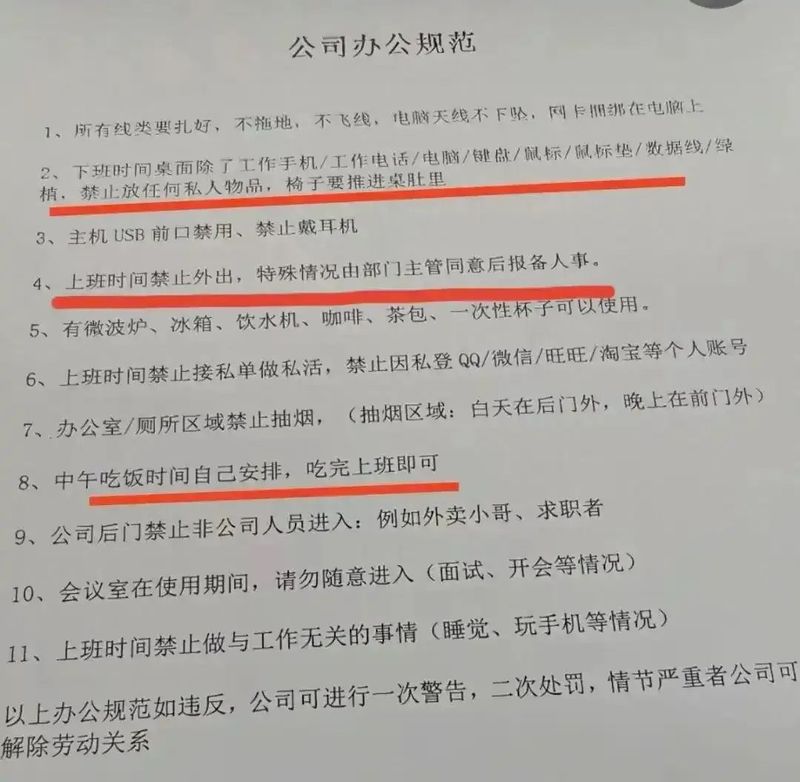
近日,小鹿妈妈公司被多名员工反映存在"强制员工工位就餐"等严苛规定,引发热议。据正在新闻等媒体报道,3 月26日,合肥市庐阳区劳动保障监察大队表示,已去过小鹿妈妈公司调查,并已经立案。 小鹿妈妈被员工形容为上班时间就像"坐牢"。其实,"坐牢式上班"做法如果属实,则不只是缺乏人性化,或者简 单的管理严苛问题,而且是涉嫌侵犯员工的多项权益,有系统性违法嫌疑。如此,"坐牢式上班"则成为"职场翻 车"公司的又一典型样本,也反映出劳动者权益保护和健康职场管理文化构建仍然在路上。 人有生存生活的基本需求。员工应享有休息和自主安排的权利,而"午休时无法出门就餐",外卖也必须在工位 吃,禁止员工出公司,这样的做法如属实,则侵犯了员工的休息权和人身自由,涉嫌违法。如此将员工"禁锢"在 工作场所,也已超出合理管理边界,实质上构成了对人身自由权的非法限制。这不是所谓"严格管理"就能说得过 去的。小鹿妈妈变成了"狼性妈妈"。 小鹿妈妈公司不是一家籍籍无名的小公司。公开信息显示,安徽鹿妈妈生物科技有限公司("小鹿妈妈"母公司全 称)主要产品为"牙线",常在电梯里能够看到它的"魔性广告"。而据极目新闻报道,2024年6月"小鹿妈妈牙线" ...