
原子级制造

Search documents
吉林“十五五”规划建议:抢占人工智能、氢能与新型储能、空天信息、生物制造、原子级制造等未来产业发展新赛道
Zheng Quan Shi Bao Wang· 2025-12-11 02:19
Core Viewpoint - The Jilin Provincial Committee of the Communist Party of China has released recommendations for the 15th Five-Year Plan, emphasizing the strategic development of future industries such as artificial intelligence, hydrogen energy, and biomanufacturing [1] Group 1: Future Industry Development - The plan aims to seize opportunities in future industries, including artificial intelligence, hydrogen energy, new energy storage, aerospace information, biomanufacturing, and atomic-level manufacturing [1] - A focus on building high-performance computing clusters and promoting the "AI+" initiative to develop a comprehensive intelligent and humanoid robotics industry [1] - Accelerating the layout of the hydrogen energy industry and constructing a "hydrogen energy+" industrial ecosystem, including the promotion of hydrogen-powered intercity trains [1] Group 2: Technological Advancements - The plan emphasizes the development of high-efficiency, low-cost new battery products and the research of next-generation satellite products [1] - It aims to create an integrated information infrastructure and service system that combines space, ground, and remote sensing technologies [1] - There is a strong focus on advancing bioproducts and developing new biological health products, alongside tackling key technologies in high-precision equipment, advanced materials, and micro-nano manufacturing processes [1]
吉林“十五五”规划建议:打造全链条具身智能与人形机器人产业
Di Yi Cai Jing· 2025-12-11 02:12
Core Viewpoint - The Jilin Provincial Committee of the Communist Party of China has released recommendations for the 15th Five-Year Plan for the province's economic and social development, focusing on future industries and strategic positioning in emerging sectors [1] Group 1: Future Industry Development - The plan emphasizes the importance of seizing opportunities in future industries such as artificial intelligence, hydrogen energy, new energy storage, aerospace information, biomanufacturing, and atomic-level manufacturing [1] - A high-performance computing cluster will be established to promote the "Artificial Intelligence +" initiative, aiming to develop a comprehensive intelligent and humanoid robotics industry [1] - The hydrogen energy industry will be accelerated, with a focus on creating a "Hydrogen +" industrial ecosystem and promoting applications like hydrogen-powered intercity trains to establish hydrogen transportation corridors [1] Group 2: Technological Advancements - The plan advocates for the development of high-efficiency, low-cost new battery products and the research of next-generation satellite products [1] - It aims to build an integrated information infrastructure and service system that combines space, ground, and remote sensing technologies [1] - There is a strong emphasis on advancing bioproducts and developing new biological health products, alongside tackling key technologies in high-precision equipment, advanced materials, and micro-nano manufacturing processes to accelerate industrialization [1]

2025原子级制造产业发展论坛即将在上海举办
Xin Hua Cai Jing· 2025-12-03 05:47
Core Points - The 2025 Atomic-Level Manufacturing Industry Development Forum will be held on December 19-20, 2025, in Shanghai, focusing on the theme "Synergistic Development of Science and Industry" [1] - The forum is organized by the Shanghai Industrial Technology Innovation Promotion Association and the Atomic-Level Manufacturing Innovation Development Alliance, with the Mechanical Industry Instrumentation Comprehensive Technology Economic Research Institute as the host [1] - The event will gather experts, scholars, and industry representatives from various sectors, including universities, research institutions, state-owned enterprises, innovative technology companies, financial investment institutions, and government [1] - The forum aims to present national strategies and regional development dynamics, share innovative development concepts from academicians and experts, and discuss future paths for synchronized development of science and industry [1] - It will showcase the technological foresight, industrial innovation, international strategy, and economic driving force of atomic-level manufacturing, while also promoting collaboration among government, industry, academia, research, and finance [1]
《三体》中的“水滴”来了?全球原子科学家齐聚南京定义下一代制造革命
Yang Zi Wan Bao Wang· 2025-11-14 14:09
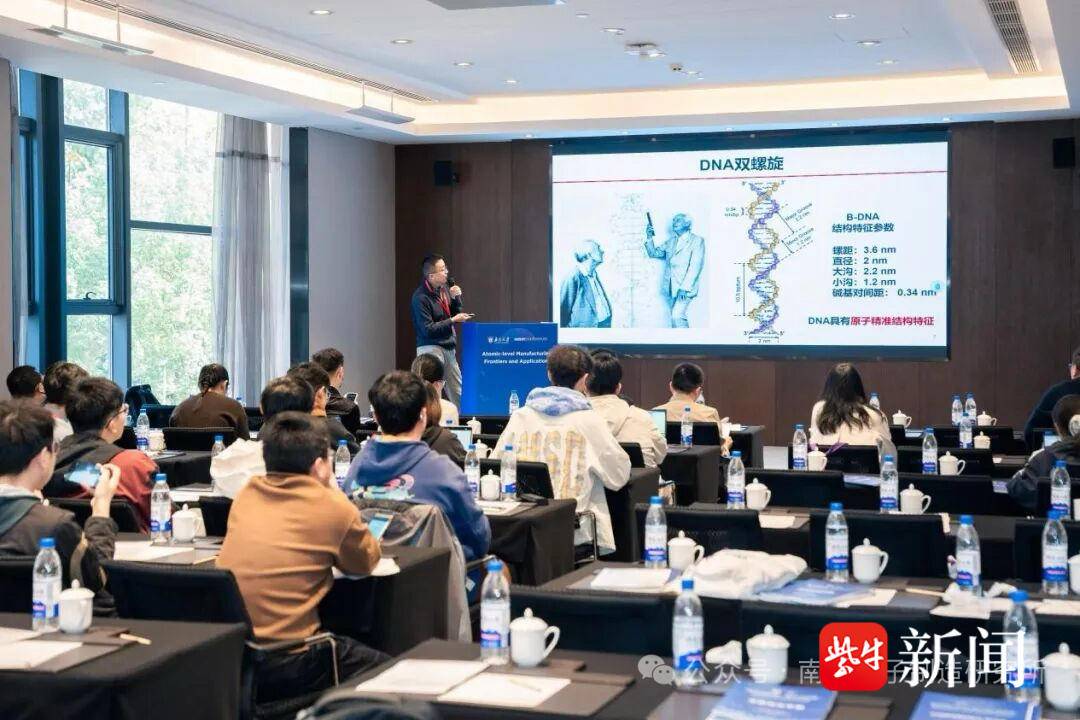
Group 1: Core Concept of Atomic-Level Manufacturing - Atomic-level manufacturing is described as the ultimate form of material manipulation, akin to "extreme Lego" or "atomic embroidery," allowing precise control over individual atoms to create new materials and devices [2][3] - The technology has evolved from merely observing atoms to manipulating them, with significant advancements in techniques that allow for the determination of atomic coordinates [3][4] Group 2: Industry Applications and Implications - In the integrated circuit industry, achieving single-atom features in chips could reduce size and power consumption to less than one-thousandth of current levels while increasing computational power by over a thousand times [3] - The development of atomic-level manufacturing is seen as a strategic priority for major countries, with initiatives like the National Natural Science Foundation of China launching special projects by 2025 [3][4] Group 3: Research and Technological Innovations - Researchers are exploring innovative methods, such as using DNA as a programming language to guide the precise construction of atomic-level structures [3][4] - The Nanjing Atomic Manufacturing Research Institute has established a 30-meter-long experimental facility capable of manipulating atomic clusters at unprecedented speeds, achieving over a trillion operations per second [4][5] Group 4: Future Prospects and Global Collaboration - The potential of atomic-level manufacturing is vast, with applications ranging from energy solutions, such as artificial leaves for clean energy production, to breakthroughs in quantum computing and medical technologies [13][14][15] - The realization of atomic-level manufacturing will require interdisciplinary collaboration and the development of a skilled workforce across various scientific fields [15]



从原子“出发”制造万物还有多远?——国内外学者畅议原子级制造未来
Ke Ji Ri Bao· 2025-11-14 06:35
将重塑材料、器件与信息体系的根基 原子级制造,就是以原子为原料,制造所需的材料和器件产品。"原子级制造是通过对原子的规模化精 准操控,实现原子尺度结构或原子精度加工。它的独特价值在于,'原子'成为可编程的制造单元。"会 议召集人之一、华南师范大学教授赵纪军表示,原子级制造是先进制造技术向极微观深入发展的必然趋 势,也是我国构筑未来产业竞争优势的重要战略选择。 也许有一天,人类可以精确地操控原子,让物质和材料合成摆脱对体系和配方的依赖,从而按照需求自 由定制。这项听上去有些科幻的技术,正一步步向现实迈进。 "原子级制造不仅是材料科学与制造工程的交汇点,更是人类认识和重构物质的全新方式。"11月11日至 14日,南京大学与施普林格·自然出版集团联合主办的"原子级制造:前沿与应用"国际会议在南京大学 举行。会议发起人之一、南京大学原子制造研究院院长宋凤麒教授介绍,如何将原子垒砌成"人工分 子",继而制造出新材料、新结构、新产品,正在成为全球科学家改造物质世界的热门探索。 此次会议吸引了来自全球的500余位学者、专家及产业代表参加。多位与会学者表示,原子级制造作为 面向未来的重要战略技术,正在重塑材料科学、器件物理与 ...
打造大科学装置要注重“沿途下蛋”
Ke Ji Ri Bao· 2025-11-12 23:59
Core Viewpoint - The article emphasizes the importance of integrating scientific exploration with industrial contributions in the development of atomic-level manufacturing technologies, as highlighted by the recent Xiangshan Science Conference [1]. Group 1: Technological Development - The NANO-X facility, developed by the Suzhou Institute of Nano-Tech and Nano-Bionics, serves as a model for "laying eggs along the way," focusing on both scientific research and industrial application [1]. - NANO-X has established five major platform modules for research and development of nanomaterials and devices in a vacuum environment, achieving efficient and stable operation [1]. Group 2: Research and Collaboration - The facility has conducted 780 collaborative projects and served over 280 users, accumulating more than 140,000 service hours, resulting in 381 published academic papers [2]. - A significant portion of the service users are enterprises, particularly startups, which utilize the platform to explore processes and verify material properties, thereby reducing R&D costs [2].
操控原子 “按需造物”的时代来了?
Ke Ji Ri Bao· 2025-11-12 23:54
Core Viewpoint - The article discusses the significance of atomic-level manufacturing in advancing technology and enhancing national competitiveness, highlighting the establishment of the NANO-X facility as a pivotal step in this field [2][4]. Group 1: Overview of NANO-X - NANO-X is described as the world's largest, most efficient, and highly shared vacuum interconnection experimental facility, integrating over 50 large scientific research devices [1]. - The facility aims to explore cutting-edge technology in atomic-level manufacturing, which involves precise manipulation of atoms to create materials and devices with specific functions [3]. Group 2: Importance of Atomic-Level Manufacturing - Atomic-level manufacturing is seen as a transformative technology that can create unprecedented new states of matter, materials, and devices, applicable in critical fields such as integrated circuits, quantum computing, and artificial intelligence [4]. - The current research in this area has progressed from single-atom manipulation to the manipulation of hundreds of thousands of atoms, indicating significant advancements in the field [4]. Group 3: Challenges and Requirements - There are substantial gaps between scientific research in atomic manipulation and the manufacturing of atomic-level devices, necessitating comprehensive scientific infrastructure to address common scientific issues [5]. - The need for ultra-high vacuum environments is emphasized to eliminate external contamination that could adversely affect the performance of atomic-level materials and devices [5][6]. Group 4: Research Focus Areas - The NANO-X facility focuses on three key scientific issues: the creation of atomic-level materials, precise processing of atomic-level devices, and high-resolution dynamic characterization of manufacturing processes [6]. - The goal is to achieve accurate manufacturing, precision processing, and clear observation of atomic-level production [6]. Group 5: Role of Artificial Intelligence - AI is positioned as a crucial enabler in the creation of new materials and device simulations, with plans to establish a comprehensive open-source database for single-atom catalysts and intelligent models [7]. - The integration of AI with high-throughput computing and experimental results is expected to address core questions in new material creation, enhancing the efficiency and effectiveness of the research [7].
“原子级制造:前沿与应用”卫星会议在宁举办
Yang Zi Wan Bao Wang· 2025-11-12 07:29
Core Insights - The "Atomic-Level Manufacturing: Frontiers and Applications" satellite conference, hosted by Nanjing University, commenced a four-day series of Nature Conferences focused on atomic-level manufacturing, featuring cutting-edge research from experts in the field [1] Group 1: Conference Themes - The conference included three parallel thematic sessions: atomic-level construction mechanisms and theoretical foundations, interdisciplinary empowerment and functional system design, and detection metrology and process standardization [3] - In the session on atomic-level construction mechanisms, notable presentations included a keynote by Professor Zhao Jijun from South China Normal University on "Atomic Element Calculation Design for Atomic-Level Manufacturing," and advancements in quantum device preparation by researchers from Shenzhen International Quantum Research Institute [3][5] - The interdisciplinary empowerment session highlighted new strategies in nanoscale manufacturing and atomic-level detection techniques, with contributions from professors at Harbin Institute of Technology and Nanjing University [5][6] Group 2: Roundtable Discussions - Three roundtable forums were held, focusing on atomic-level construction mechanisms, intelligent empowerment, and detection systems, with discussions led by various professors emphasizing the need for multi-field coupling and AI integration in atomic manufacturing [7][8] - The forums addressed challenges in scaling scanning probe technology and the importance of establishing cross-institutional data-sharing platforms to enhance research efficiency [7][8] - Experts agreed on the significance of the concept of "atomic-level manufacturing," which embodies both precision control from atoms to devices and a fundamental restructuring of performance and structural hierarchies [8]
纳米技术赋能产业创新,洞见未来制造新图景
Zhong Guo Jin Rong Xin Xi Wang· 2025-10-24 06:52
Core Insights - The 15th China International Nanotechnology Industry Expo (Nanotech Expo) opened in Suzhou, showcasing the integration of nanotechnology and industry with a focus on advanced manufacturing and innovative applications [1][3] Group 1: Advanced Manufacturing - Atomic-level manufacturing is highlighted as the "ultimate form" of manufacturing technology, with discussions centered around its transition from laboratory to industrial application [3] - The Suzhou Institute of Nano-Tech and Nano-Bionics showcased its nano vacuum interconnection experimental station, which provides an ultra-clean environment essential for atomic-level manufacturing [3] - The facility has attracted nearly 300 users, serving as a crucial bridge between fundamental research and industrial application [3] Group 2: MEMS Manufacturing - The MEMS manufacturing section features products that are integral to smart devices, including gene sequencing chips and AR eye-tracking modules [5] - Companies like Suzhou New Dimension and Crystal Electronics demonstrated their leading capabilities in nano-manufacturing technologies [5] - The products showcased have wide applications in biomedicine, micro-nano optics, and flexible electronics [5] Group 3: Robotics and Perception - Nanotechnology is positioned as a key enabling technology for enhancing the performance of embodied robots, with applications in micro-sensors and precision control [7] - The Galaxy series NSPIC intelligent operating system supports deep learning and computer vision, catering to humanoid robots' real-time perception and decision-making needs [7] - Future applications of humanoid robots are expected in various sectors, including cultural tourism and industrial sorting [7] Group 4: Consumer Innovation - The application of nanotechnology in consumer products is exemplified by Su Dawei Ge's photo-curing technology, which creates a three-dimensional visual effect on cards and collectibles [9] - This technology combines lithography and nano-imprinting processes to achieve strong visual effects while maintaining a smooth surface [9] Group 5: Industry Ecosystem - The Nanotech Expo operates on a model that integrates exhibition, competition, awards, and releases, fostering a cross-industry ecosystem [11] - The event aims to accelerate the transition of nanotechnology from research to production and everyday life, promoting collaboration and technology transfer [11]

苏州纳博会上看“原子级制造”“机器人进化”……一把“纳米钥匙”开启产业未来
Xin Hua Ri Bao· 2025-10-22 23:05
Core Insights - The 15th China International Nanotechnology Industry Expo showcased innovations in micro-nano manufacturing, third-generation semiconductors, and nano health, featuring over 450 exhibitors and 605 cutting-edge reports [1][2] Group 1: Event Overview - The expo covered a total exhibition area of 25,000 square meters, emphasizing precision matching, deep integration, and future leadership in technology [1] - The event has attracted over 7,900 companies and more than 150,000 attendees since its inception in 2010, establishing itself as a significant international platform for the nanotechnology industry [5] Group 2: Key Technologies and Trends - Atomic-level manufacturing is highlighted as the "ultimate form" of manufacturing technology, enabling the creation of new materials and systems through energy application at the atomic level [2] - The Suzhou Institute of Nano-Tech and Nano-Bionics presented its Nano Vacuum Interconnect Experimental Station, the world's first large scientific device integrating material growth, device processing, and testing analysis [2] Group 3: Industry Impact - Nanotechnology is seen as a critical enabling technology for future industries, particularly in enhancing the performance of embodied robots through nano materials and micro-sensors [4] - Suzhou has become a leading region for the nanotechnology industry, with over 1,500 related enterprises and an industrial output value of 197.51 billion yuan last year [7]