存储芯片周期

Search documents
存储芯片进入新一轮周期,国产AI芯片大时代已经开启 | 投研报告
Zhong Guo Neng Yuan Wang· 2025-09-30 01:29
Group 1 - The electronic industry experienced a 3.51% increase from September 22 to September 26, ranking third among major sectors [2][3] - The electronic industry's price-to-earnings ratio stands at 72.55, with the highest valuations in the computer, defense, and electronic sectors [2][3] - Within the electronic sector, semiconductor equipment saw the largest increase of 15.56% during the same period [2][3] Group 2 - The storage chip market is entering a new price increase cycle, with major manufacturers like Samsung and SK Hynix reducing DDR4 production to focus on higher-margin products [3][4] - Flash memory prices have risen significantly, with NAND Flash wafer prices increasing by nearly 10% in September, and DRAM prices rising approximately 72% over the past six months [3][4] - Companies such as Micron and SanDisk have announced price hikes of 20%-30% and over 10%, respectively, indicating strong demand in the enterprise market [3][4] Group 3 - Alibaba announced significant upgrades to its AI infrastructure at the Cloud Summit, including the launch of the Qwen3-Max model with over a trillion parameters [6] - The new AI server, Panjiu 128, supports 128 AI computing chips and offers substantial improvements in performance and efficiency [6] - The successful IPO of Moore Threads marks a significant milestone in the domestic AI chip industry, with the company achieving technological breakthroughs in GPU architecture [7][8]

芯片狂潮向存储蔓延,大摩:NAND好于DRAM,存在显著上涨潜力
Hua Er Jie Jian Wen· 2025-09-24 07:26
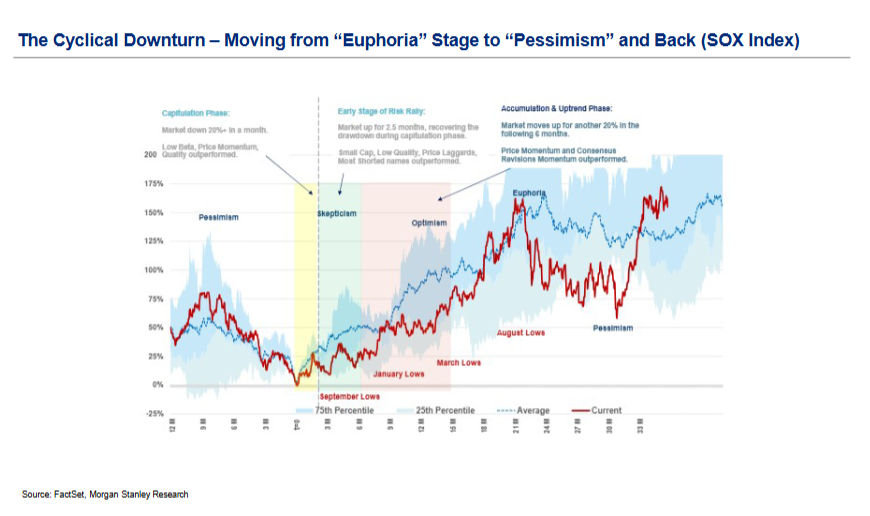
Core Viewpoint - The chip frenzy driven by AI is rapidly spreading from GPUs to storage chips, particularly NAND flash, which is in the early stages of a sustained upward cycle according to Morgan Stanley [1][2] Group 1: Market Dynamics - The storage market, especially NAND flash, is experiencing strong demand driven by AI data centers, leading to significant price increases, with DRAM prices rising by up to 30% [1] - Morgan Stanley's report indicates that the current market is at a critical turning point, with expectations of a recovery cycle for storage prices by 2026 after a double bottom [1][12] - The supply-demand dynamics for flash memory are showing a more pronounced upward potential compared to DRAM and mechanical hard drives due to a sharp shift in supply-demand balance [1][12] Group 2: Price Trends - The report predicts that storage chip pricing may face a "double bottom" scenario, with a rebound followed by a potential decline before entering a sustained upward trend [14] - Contract prices for DRAM and flash memory are expected to rise by 3-8% in Q2 2025, although some categories may see flat or slight declines in Q4 2025 before stronger increases in 2026 [15][18] - Flash memory prices are projected to increase by 15-20% in the first half of 2026 following a near double-digit increase in Q4 2025 [22] Group 3: Demand Drivers - Cloud service providers (CSPs) are placing unprecedented orders for enterprise solid-state drives (eSSD) due to AI inference business and limited mechanical hard drive supply, creating a significant supply gap [18] - Major clients have already placed orders for approximately 200 exabytes (EB) of NL eSSD, with an additional 150 EB related to AI demand, indicating a strong market outlook [19][22] Group 4: Investment Opportunities - Investors are advised to focus on pure flash manufacturers like KIOXIA and SanDisk, as well as major players like Samsung and SK Hynix, which are expected to benefit from the overall strengthening of the storage commodity cycle [1][27][29] - KIOXIA is positioned well in the eSSD market due to its advanced BiCS-8 technology, while SanDisk is expected to benefit significantly from the overall price increases in flash memory [27][28] - Module manufacturers such as Longsys and Phison are also likely to gain from rising flash commodity prices [30]