
房地产开发投资

Search documents
国家统计局:1—11月全国房地产开发投资同比下降15.9%
Guo Jia Tong Ji Ju· 2025-12-15 02:09
Core Viewpoint - The real estate development investment in China for the first eleven months of the year reached 78,591 billion yuan, representing a year-on-year decline of 15.9% [1]. Investment and Construction - Real estate development investment totaled 78,591 billion yuan, with residential investment at 60,432 billion yuan, both showing declines of 15.9% and 15.0% respectively [1][15]. - The total construction area for real estate development was 656,066 million square meters, down 9.6% year-on-year, with residential construction area decreasing by 10.0% to 457,551 million square meters [3][15]. - New construction area was 53,457 million square meters, a decline of 20.5%, with residential new construction area at 39,189 million square meters, down 19.9% [3][15]. - The completed construction area was 39,454 million square meters, down 18.0%, with residential completed area at 28,105 million square meters, a decrease of 20.1% [3][15]. Sales Performance - The sales area of new commercial housing was 78,702 million square meters, down 7.8% year-on-year, with residential sales area decreasing by 8.1% [4][17]. - The sales revenue from new commercial housing reached 75,130 billion yuan, reflecting an 11.1% decline, with residential sales revenue down 11.2% to 66,008 billion yuan [4][17]. Inventory and Funding - As of the end of November, the unsold commercial housing area was 75,306 million square meters, a decrease of 301 million square meters from October, with residential unsold area down by 284 million square meters [8]. - The total funds available for real estate development enterprises amounted to 85,145 billion yuan, a decline of 11.9% year-on-year, with domestic loans at 13,149 billion yuan, down 2.5% [8][15]. Market Sentiment - The real estate development prosperity index (National Housing Prosperity Index) stood at 91.90 in November, indicating a lower level of market sentiment [11][22].

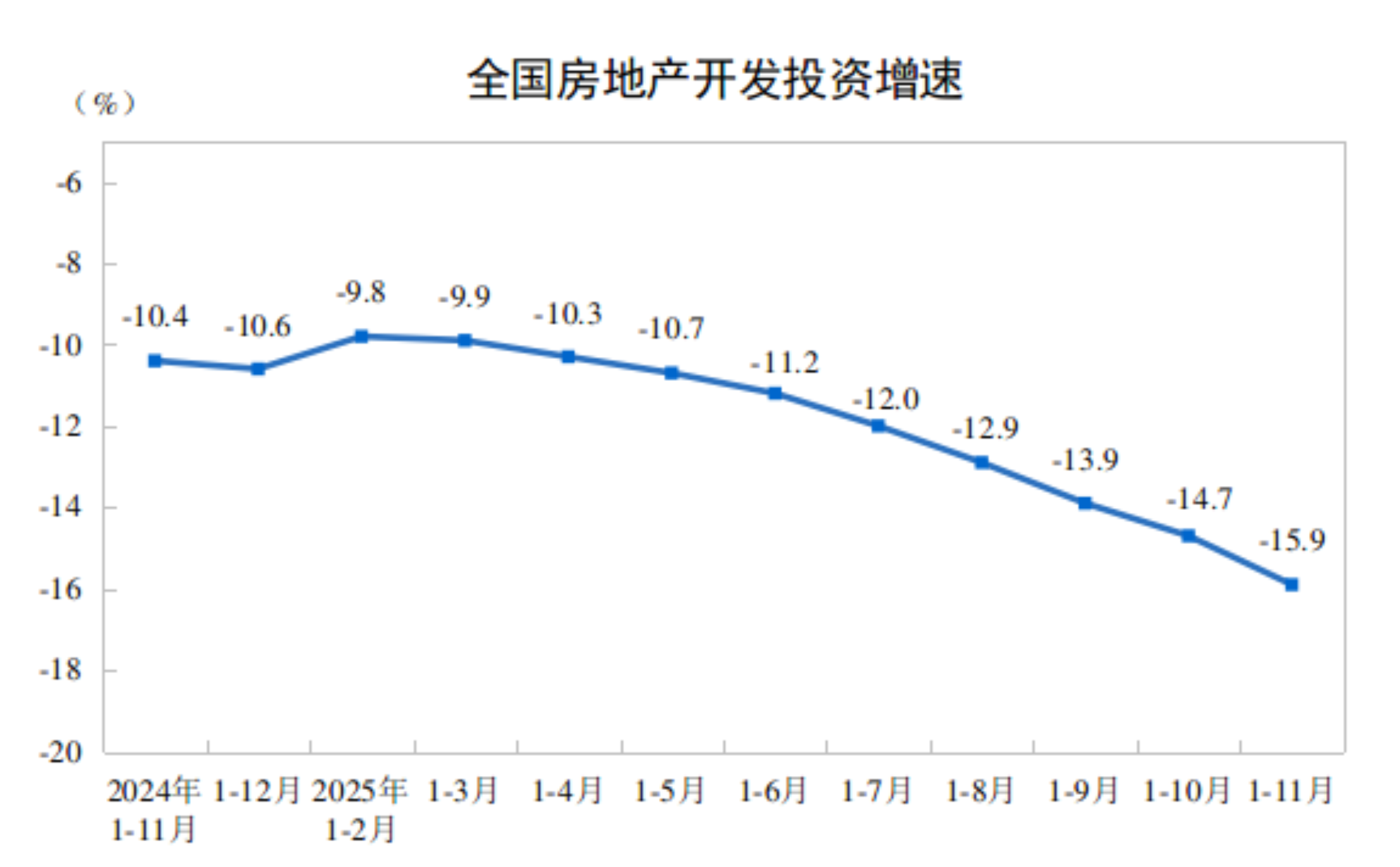
国家统计局:1—11月份全国房地产开发投资78591亿元 同比下降15.9%
Guo Jia Tong Ji Ju· 2025-12-15 02:02
国家统计局:1—11月份,全国房地产开发投资78591亿元,同比下降15.9%,其中,住宅投资60432亿 元,下降15.0%。 (文章来源:国家统计局) ...
2026年经济政策有望维持宽松基调,更加强调质效并重丨第一财经首席经济学家调研
Di Yi Cai Jing· 2025-12-08 09:08
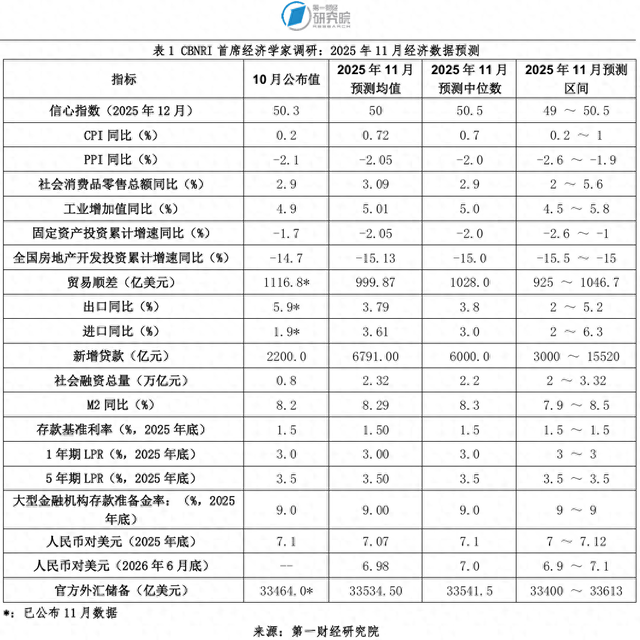
Economic Confidence Index - The "Economic Confidence Index" for December 2025 is reported at 50, slightly lower than the previous month, indicating a weak recovery in the economy [6][8]. Inflation Predictions - Economists predict the Consumer Price Index (CPI) for November 2025 to be 0.72%, up from 0.2% in the previous month, while the Producer Price Index (PPI) is expected to be -2.05% [9][10]. Retail Sales Growth - The forecast for the year-on-year growth of social retail sales in November is 3.09%, slightly higher than the previous month's 2.9%, driven by the "Double 11" shopping festival and a recovery in the dining sector [10][11]. Industrial Value Added - The predicted year-on-year growth rate for industrial value added in November is 5.0%, an increase from the previous month's 4.9% [11]. Fixed Asset Investment - The forecast for the year-on-year growth rate of fixed asset investment in November is -2.1%, lower than the previous month's -1.7%, indicating continued pressure from the real estate market [12][14]. Real Estate Investment - The predicted year-on-year growth rate for real estate development investment in November is -15.1%, reflecting ongoing challenges in the sector [14]. Trade Surplus - China's trade surplus for November is reported at $111.68 billion, with exports growing by 5.9% and imports by 1.9%, aligning with economists' expectations [15]. New Loans - Economists forecast new loans for November to rebound to 679.1 billion yuan, significantly higher than the previous month's 220 billion yuan [16]. Total Social Financing - The predicted total social financing for November is 2.32 trillion yuan, an increase from the previous month's 0.81 trillion yuan [17]. M2 Growth Rate - The forecast for the year-on-year growth rate of M2 in November is 8.29%, slightly above the previous month's 8.2% [18]. Monetary Policy Outlook - Economists expect the possibility of adjustments to the Loan Prime Rate (LPR) and reserve requirement ratios to be low in the near term, with a continued focus on maintaining liquidity in the market [20]. Exchange Rate Predictions - The predicted exchange rate for the Chinese yuan against the US dollar at the end of 2025 is 7.07, with expectations of a potential adjustment to 6.98 by mid-2026 [21]. Foreign Exchange Reserves - As of the end of November, China's foreign exchange reserves are reported at $33,464 billion, reflecting a slight increase from the previous month [22][23].
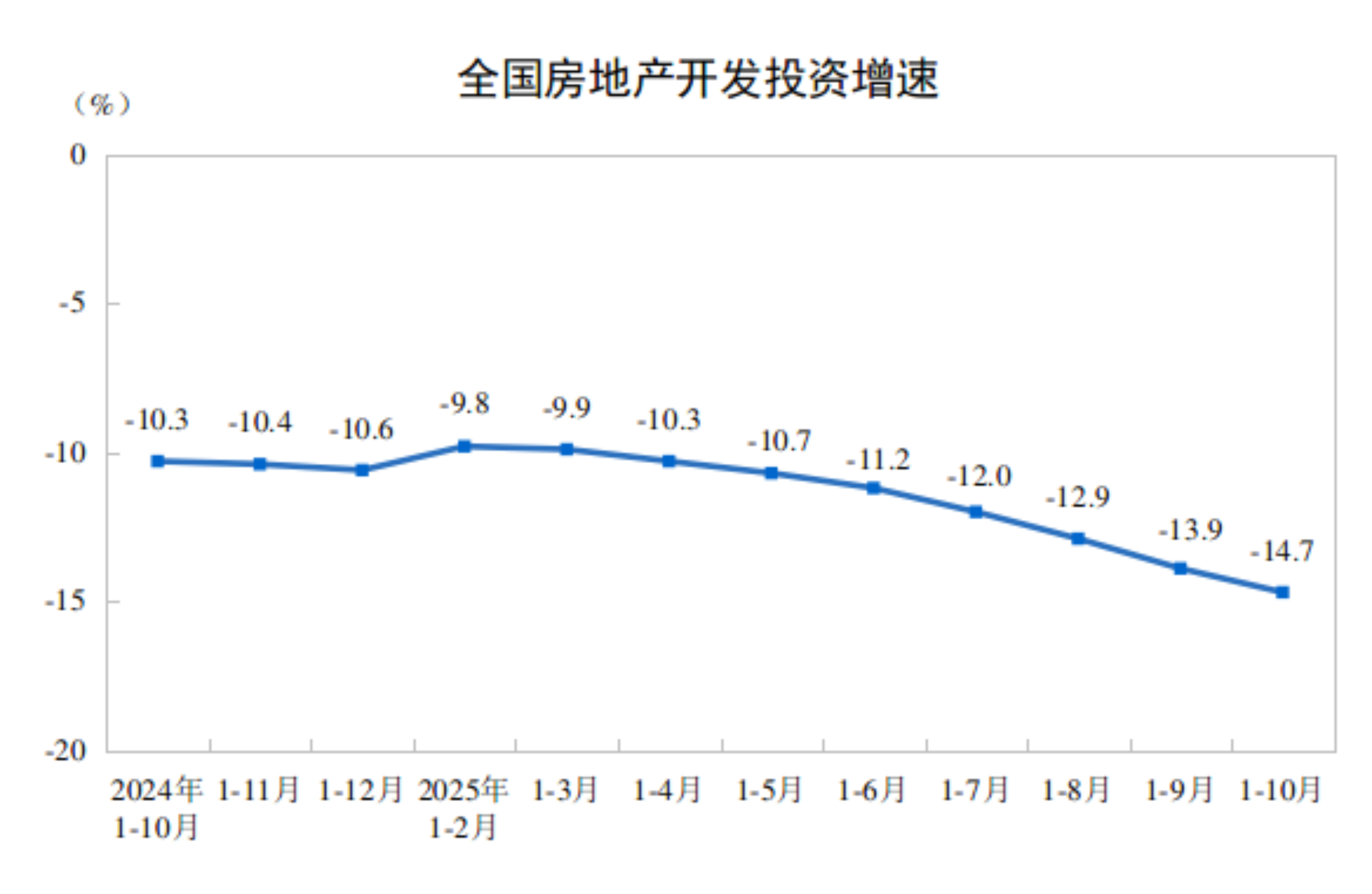
国家统计局:1—10月全国房地产开发投资73563亿元 同比下降14.7%
Guo Jia Tong Ji Ju· 2025-11-14 02:44
Core Insights - The real estate development investment in China from January to October reached 73,563 billion yuan, a year-on-year decrease of 14.7% [2][11] - Residential investment accounted for 56,595 billion yuan, down 13.8% compared to the previous year [2][11] - The sales area of newly built commercial housing was 71,982 million square meters, reflecting a decline of 6.8% year-on-year [5][13] Real Estate Development Investment - Total real estate development investment was 73,563 billion yuan, with a year-on-year decline of 14.7% [2][11] - Residential investment was 56,595 billion yuan, down 13.8% [2][11] - Investment in office buildings decreased by 20.2% to 2,775 billion yuan [11] Construction Activity - The total construction area for real estate development was 652,939 million square meters, a decrease of 9.4% year-on-year [4][11] - New construction area was 49,061 million square meters, down 19.8% [4][11] - The completion area was 34,861 million square meters, reflecting a decline of 16.9% [4][11] Sales Performance - Newly built commercial housing sales amounted to 69,017 billion yuan, a decrease of 9.6% year-on-year [5][11] - The sales area for residential properties was 60,272 million square meters, down 7.0% [5][11] - The sales area for office buildings decreased by 7.2% to 1,744 million square meters [11] Inventory Situation - The inventory of commercial housing at the end of October was 75,606 million square meters, a reduction of 322 million square meters from September [5][11] - The inventory of residential properties decreased by 292 million square meters [5][11] Funding Situation - The total funds available for real estate development enterprises was 78,853 billion yuan, down 9.7% year-on-year [7][11] - Domestic loans amounted to 12,160 billion yuan, a decrease of 1.8% [7][11] - Personal mortgage loans fell by 12.8% to 10,834 billion yuan [7][11] Regional Performance - Eastern region investment was 43,030 billion yuan, down 16.8% year-on-year [12] - Central region investment decreased by 12.9% to 14,638 billion yuan [12] - Western region investment saw a decline of 8.2% to 14,300 billion yuan [12]
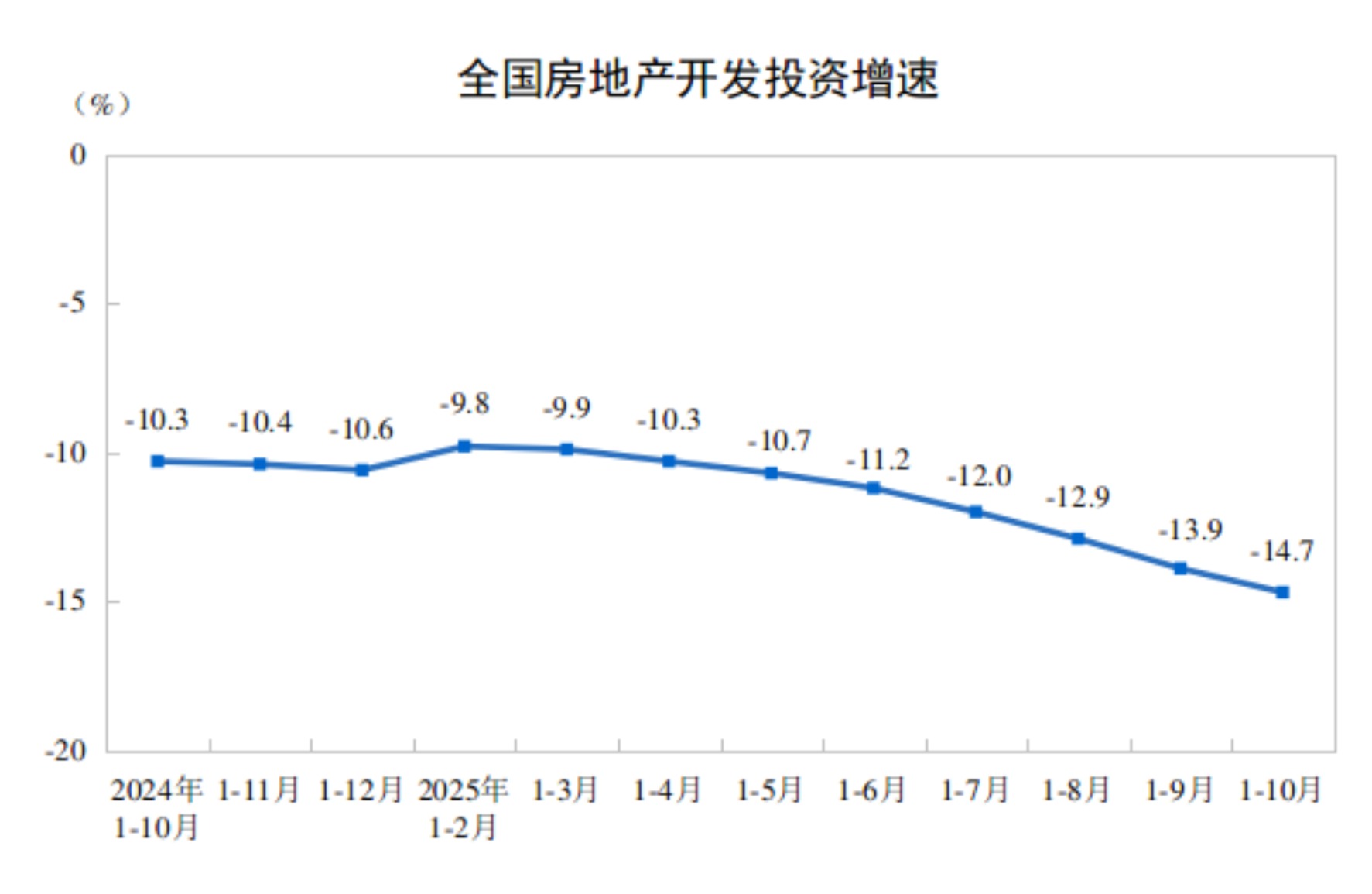
国家统计局:1—10月份全国房地产开发投资同比下降14.7%
Xin Hua Cai Jing· 2025-11-14 02:25
Group 1 - From January to October, the total construction area of real estate development enterprises reached 652.939 million square meters, a year-on-year decrease of 9.4%. The residential construction area was 455.253 million square meters, down 9.7% [2] - The new construction area for buildings was 49.061 million square meters, a decline of 19.8%, with residential new construction area at 35.952 million square meters, down 19.3% [2] - The completion area for buildings was 34.861 million square meters, a decrease of 16.9%, while the residential completion area was 24.866 million square meters, down 18.9% [2] Group 2 - In the same period, the sales area of newly built commercial housing was 71.982 million square meters, a year-on-year decrease of 6.8%, with residential sales area down 7.0% [2] - The sales revenue of newly built commercial housing reached 690.17 billion yuan, a decline of 9.6%, with residential sales revenue decreasing by 9.4% [2] Group 3 - By the end of October, the unsold area of commercial housing was 75.606 million square meters, a reduction of 3.22 million square meters compared to the end of September, with residential unsold area decreasing by 2.92 million square meters [5] - From January to October, the total funds available for real estate development enterprises amounted to 788.53 billion yuan, a year-on-year decrease of 9.7% [5] - Domestic loans accounted for 121.6 billion yuan, down 1.8%, while foreign investment utilization was 1.9 billion yuan, down 37.5% [5] Group 4 - The real estate development prosperity index, known as the "National Housing Prosperity Index," stood at 92.43 in October [6]
国家统计局:1—10月份全国房地产开发投资73563亿元 同比下降14.7%
Guo Jia Tong Ji Ju· 2025-11-14 02:03
Core Insights - The National Bureau of Statistics reported that from January to October, national real estate development investment reached 73,563 billion yuan, representing a year-on-year decline of 14.7% [1] - Residential investment amounted to 56,595 billion yuan, showing a decrease of 13.8% [1] Group 1 - National real estate development investment for the first ten months of the year is 73,563 billion yuan [1] - Year-on-year decline in real estate investment is 14.7% [1] - Residential investment totals 56,595 billion yuan [1] Group 2 - The decline in residential investment is 13.8% year-on-year [1]
中信建投证券首席经济学家黄文涛:预计2026年出口增速有望继续超预期
Sou Hu Cai Jing· 2025-11-13 05:42
Core Viewpoint - The 2026 GDP growth target for China is set at around 5%, which is deemed necessary and feasible to stabilize investor confidence in Chinese assets and capital markets [1][3]. Group 1: Economic Growth Projections - The chief economist of CITIC Securities, Huang Wentao, indicated that China's GDP growth is expected to reach around 5% next year due to policy support [1]. - The average GDP growth rate required from 2020 to 2035 to achieve the goal of reaching the per capita GDP of a moderately developed country by 2035 is approximately 4.73% [1]. - The average GDP growth rate during the 14th Five-Year Plan period is above 5%, meeting the stage requirements [1]. Group 2: Export and External Demand - Huang noted that external demand remains resilient, with China's export performance in 2025 exceeding expectations, contributing over 30% to GDP growth in the first half of the year [2]. - If the trade agreements are effectively executed and non-U.S. economies continue to expand, the export growth rate in 2026 is expected to exceed expectations [3]. Group 3: Real Estate Market Outlook - The negative impact of the real estate sector on the economy is expected to diminish, with a projected slight narrowing of the decline in real estate development investment and new housing sales in 2026 [3]. - The decline in new housing sales is anticipated to be within 5%, reducing the negative drag on the economy [3]. Group 4: Policy Support and Consumer Recovery - There is ample room for policy support, with fiscal, monetary, and industrial policies expected to work in tandem in 2026 [3]. - The implementation of "two重" and "two新" policies is expected to continue, with an increase in support for service consumption and the expansion of trade-in policies for consumer goods [3]. - If fiscal policies align with consumer recovery efforts, consumption is projected to improve from its current low state [3].

一财首席经济学家调研:信心指数持平50.3,全年5%增速有望实现
Di Yi Cai Jing· 2025-11-05 12:56
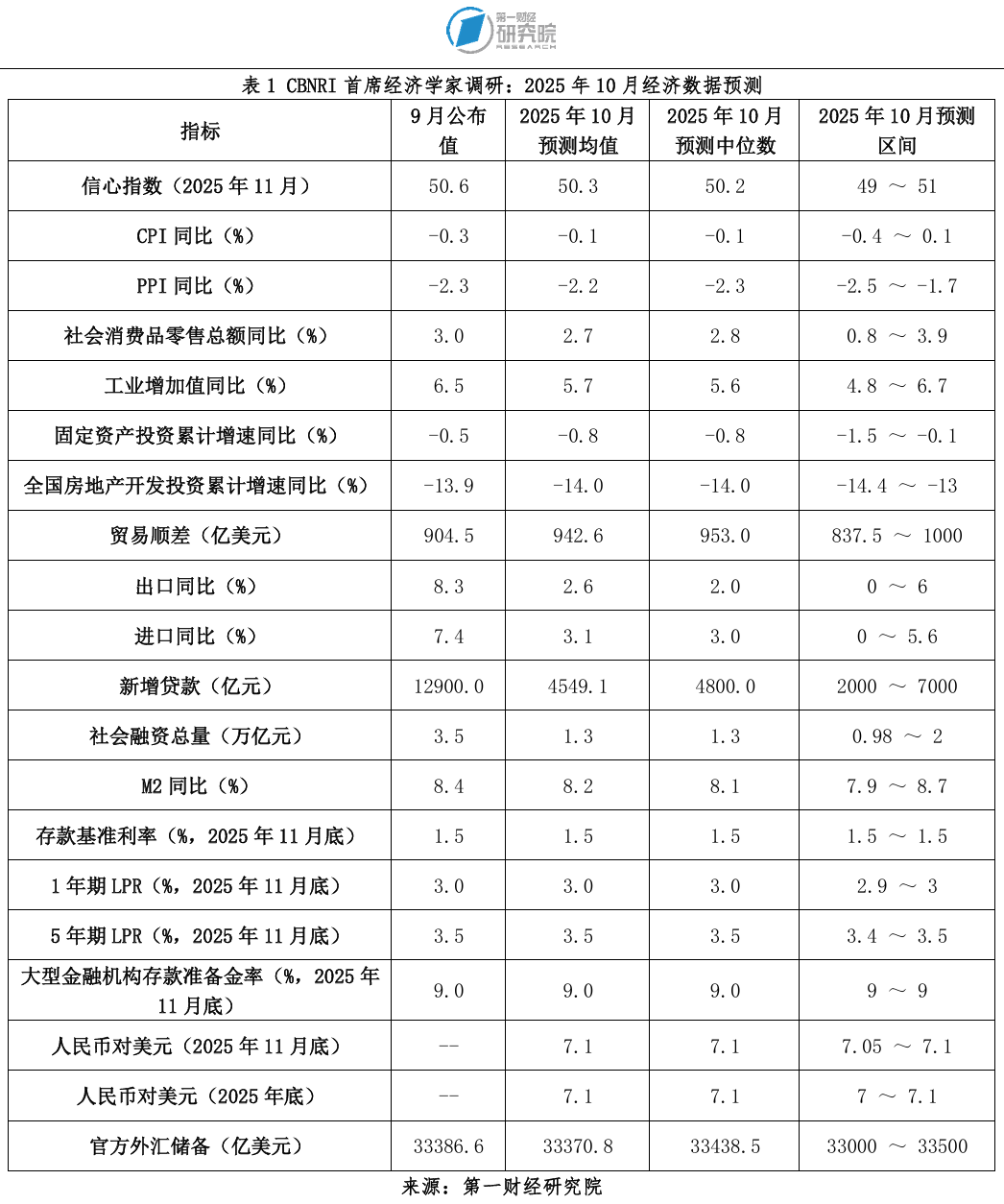
Economic Outlook - The economic confidence index for November 2025 is reported at 50.3, remaining stable compared to the previous month, indicating a steady economic outlook with a target growth rate of 5% for the year [1][4][8] - Economists predict that the external environment will remain complex and variable, emphasizing the need for domestic economic focus on restoring internal demand [1][7] Price Trends - The Consumer Price Index (CPI) for October is forecasted to be -0.1%, showing a slight recovery from the previous month's -0.3% [2][9] - The Producer Price Index (PPI) is expected to be -2.2%, slightly better than the previous month's -2.3% [2][9] Retail and Consumption - The year-on-year growth rate for social retail sales in October is predicted to be 2.7%, down from 3% in the previous month [2][10] - Factors affecting retail growth include a decline in automotive sales and a slowdown in the real estate market, despite positive trends in tourism and online consumption [11][10] Industrial Production - The industrial added value for October is expected to grow by 5.7%, a decrease from the previous month's 6.5% [2][12] - High-frequency data indicates strong production activity, particularly in steel and chemical sectors, suggesting continued robust industrial performance [12] Investment Trends - Fixed asset investment growth is projected to be -0.8%, slightly lower than the previous month's -0.5% [2][13] - Infrastructure investment is anticipated to receive a boost from new fiscal policies, while real estate investment continues to face challenges [14][15] Trade Balance - The trade surplus for October is forecasted to be $94.26 billion, an increase from the previous month's $90.45 billion [2][16][18] - Export growth is expected to be 2.6%, while import growth is projected at 3.1%, both lower than previous figures [18] Financial Indicators - New loans for October are expected to drop to 454.91 billion yuan from 1.29 trillion yuan in September [2][19] - The total social financing amount is predicted to be 1.3 trillion yuan, down from 3.53 trillion yuan in September [20] Monetary Policy - The M2 money supply growth rate is forecasted to be 8.2%, slightly lower than the previous month's 8.4% [21] - Economists expect little change in the LPR and reserve requirement ratios in the near term, with potential for slight adjustments to stimulate domestic demand [22] Currency and Foreign Reserves - The RMB to USD exchange rate is expected to stabilize at 7.1 by the end of November [3][23] - Foreign exchange reserves are projected to remain steady at approximately $333.71 billion [24] Policy Directions - Macroeconomic policies are expected to focus on enhancing infrastructure and social welfare, with an emphasis on "investment in people" to drive sustainable economic growth [26][27][29] - The government aims to improve residents' income and consumption capacity, which is crucial for stimulating domestic demand [31][32]
西南区域三季报公布,川渝领跑
Di Yi Cai Jing· 2025-10-29 12:52
Core Insights - The economic growth of the four southwestern provinces (Yunnan, Guizhou, Sichuan, and Chongqing) has significantly declined in recent years, with their GDP growth rates falling below the national average [1][2][3][4] Economic Performance - In the first three quarters of this year, the GDP figures for the four provinces were as follows: Yunnan at 23,518.47 billion, Guizhou at 17,352.04 billion, Sichuan at 49,322.2 billion, and Chongqing at 24,449.36 billion, with respective year-on-year growth rates of 4.3%, 4.9%, 5.5%, and 5.3% [1][2] - Guizhou's GDP growth has dropped below the national average, with a forecasted growth of 5.3% for 2024, which is only 0.3 percentage points higher than the national average [2][4] - Yunnan's growth has also declined, with a forecast of only 3.3% for 2024, placing it at the bottom of the national growth rankings [2][3] Investment Trends - Investment growth has been a significant factor in the economic slowdown of the southwestern provinces, with a notable decline in fixed asset investment [4][5] - Historical data shows that Guizhou's fixed asset investment growth has decreased from 28.0% in 2013 to negative growth in recent years, indicating a shift from being a leader to one of the provinces with negative growth [4] - Yunnan's fixed asset investment has also suffered, with declines of 10.6% and 7.7% in 2022 and 2023, respectively, largely due to a downturn in real estate development investment [4][5] Sector Performance - The traditional pillar industries in the region, such as alcohol, coal, electricity, and tobacco, are facing challenges, particularly in Guizhou, where the liquor industry is undergoing significant adjustments [5] - In the first three quarters, Guizhou's coal mining and washing industry grew by 8.0%, while the electricity and heat production sector grew by 4.1% [5] - Yunnan's traditional industries are also experiencing low growth rates, with the tobacco industry increasing by only 1.0% and the electricity sector by 1.8%, although the non-ferrous metals industry saw a significant increase of 14.6% [5]