期现联动

Search documents
利好来了!上海最新发布
Zhong Guo Ji Jin Bao· 2026-01-20 13:26
二是提升有色金属大宗商品期现货市场国际化水平,增强"上海价格"影响力。扩大上海有色金属期货市场高水平制度开放,逐步将符合条件的有色金属商 品期货期权品种纳入对外开放品种范围,并同步完善与对外开放品种相适配的业务细则。积极探索跨境交割机制创新,深化交割服务"走出去",在风险可 控的前提下,落地境外设库、跨境交割业务模式。《行动方案》依托在沪金融基础设施,加强有色金属大宗商品国际影响力,提升"上海价格"影响力。 三是集聚市场主体,培育良好有色金属市场生态圈。培育具有综合竞争力的贸易主体,推动大宗商品企业与产业链上下游企业合作。扩展区块链在有色金 属领域应用,推动更多跨平台、跨机构、跨地域的数据共享。探索通过仓单立法实现全仓登仓单登记的有效性和权威性。《行动方案》推动各市场主体形 成合力,助力提升上海有色金属行业影响力。 【导读】上海发布18项措施,提升有色金属大宗商品能级和全球定价影响力 1月20日,中共上海市委金融委员会办公室、中国人民银行上海总部、国家金融监督管理总局上海监管局、中国证券监督管理委员会上海监管局、上海市 商务委员会联合发布《加强期现联动提升有色金属大宗商品能级行动方案》(以下简称《行动方案》) ...

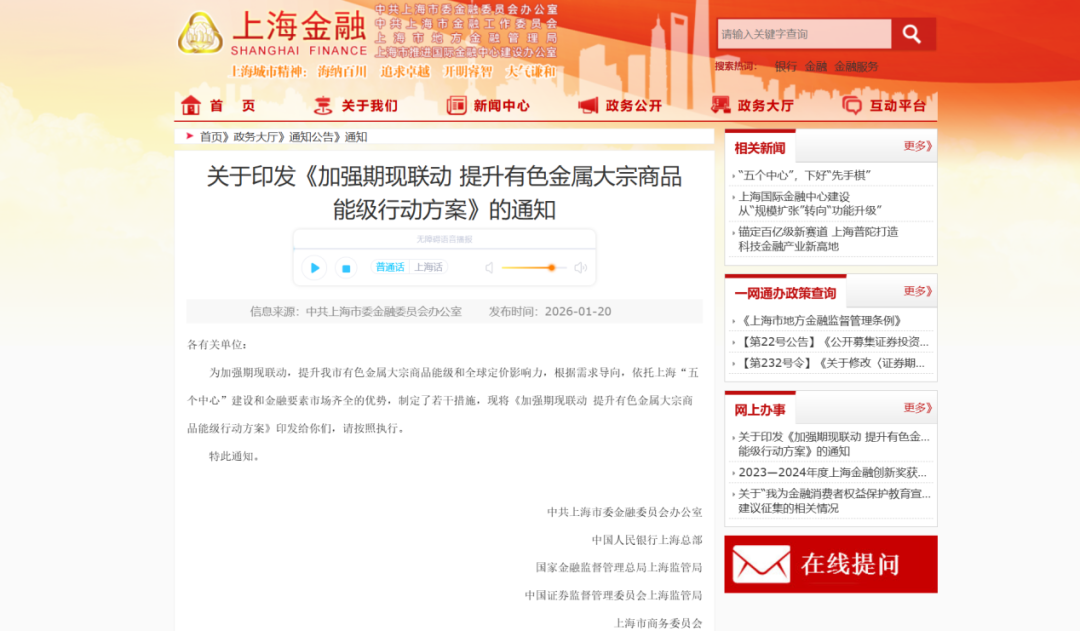
扩大高水平制度开放!有色金属大宗商品能级提升行动方案出台
Zhong Guo Jing Ying Bao· 2026-01-20 13:01
中经记者 郝亚娟 夏欣 上海 北京报道 2026年1月20日,上海市委金融办联合上海期货交易所、上海清算所、上海市商务委共同召开新闻发布 会,介绍《加强期现联动 提升有色金属大宗商品能级行动方案》(以下简称《行动方案》)相关情 况。 《行动方案》主要包括三部分18项具体措施。 一是推进有色金属市场互通,促进"期—现—衍"联动发展。支持上海清算所、上海期货交易所探索在清 算、风险管理方面开展沟通交流。支持本市有色金属现货交易场所通过大宗商品清算通开展资金清结 算,提高现货市场结算效率和安全性。推动汽车生产、建筑、家电制造等各类型有色金属应用类企业参 与期货和场外衍生品市场,更好管理价格风险。 《行动方案》聚焦市场参与主体,从基础设施到实体企业,加强"期—现—衍"联动,提升有色金属大宗 商品服务实体经济能级。 三是集聚市场主体,培育良好有色金属市场生态圈。培育具有综合竞争力的贸易主体,推动大宗商品企 业与产业链上下游企业合作。扩展区块链在有色金属领域应用,推动更多跨平台、跨机构、跨地域的数 据共享。探索通过仓单立法实现全仓登仓单登记的有效性和权威性。 《行动方案》推动各市场主体形成合力,助力提升上海有色金属行业影 ...
《加强期现联动 提升有色金属大宗商品能级行动方案》发布
Zheng Quan Ri Bao Wang· 2026-01-20 12:46
Core Viewpoint - The "Action Plan" aims to enhance the linkage between futures and spot markets in the non-ferrous metals sector, leveraging Shanghai's financial infrastructure and manufacturing base to improve service capabilities for the real economy [1][2][3] Group 1: Market Development - The plan promotes the interconnection of the non-ferrous metals market, supporting communication between Shanghai Clearing House and Shanghai Futures Exchange for risk management and settlement efficiency [2] - It encourages participation from various sectors such as automotive, construction, and home appliances in futures and OTC markets to better manage price risks [2] Group 2: Internationalization - The initiative seeks to elevate the internationalization of the non-ferrous metals market, enhancing the influence of "Shanghai prices" through high-level institutional openness [2] - It includes plans to gradually incorporate eligible non-ferrous metal futures options into the list of open products and to explore innovative cross-border delivery mechanisms [2] Group 3: Market Ecosystem - The plan focuses on cultivating a competitive trading ecosystem by fostering collaboration between commodity companies and upstream/downstream enterprises [3] - It promotes the application of blockchain technology in the non-ferrous metals sector to enhance data sharing across platforms and regions [3] - Support for warehouse receipt legislation is included to ensure the effectiveness and authority of warehouse receipt registration [3]
期现联动做强“上海价格”,有色金属大宗商品能级再提升
Di Yi Cai Jing· 2026-01-20 12:27
Core Viewpoint - Shanghai is enhancing its international influence in the non-ferrous metal futures market through a comprehensive action plan aimed at increasing the number of open products and improving the pricing power of "Shanghai prices" globally [1][4]. Group 1: Market Development - The number of open products has increased to 32, accounting for over 70% of the listed products [1][3]. - Shanghai Futures Exchange has listed 25 futures and 18 options, covering all major non-ferrous metal varieties, including copper, aluminum, zinc, and lead [2][3]. - The non-ferrous metal futures sector, represented by Shanghai copper, has become one of the most mature and widely participated commodity futures sequences in China, ranking among the global pricing centers for non-ferrous metals [2][3]. Group 2: Action Plan Measures - The action plan includes 18 specific measures to enhance the global pricing capability of non-ferrous metal commodities [4][5]. - It aims to strengthen the interconnection between futures, spot, and derivatives markets, enhancing operational efficiency and safety in the spot market [5]. - The plan seeks to elevate the internationalization of the futures market and expand the influence of "Shanghai prices" through high-level institutional opening and innovative cross-border delivery mechanisms [5]. Group 3: Future Implementation - The Shanghai Municipal Financial Office will collaborate with relevant units to accelerate the implementation of the action plan, focusing on market interlinkage and supporting the real economy in the non-ferrous metal sector [6].
提升有色金属大宗商品能级和全球定价影响力,上海发布18项措施
Sou Hu Cai Jing· 2026-01-20 11:50
Group 1 - The core viewpoint of the news is the introduction of the "Action Plan" aimed at enhancing the linkage between futures and spot markets for non-ferrous metals, thereby improving the overall capability of the non-ferrous metal commodity sector in Shanghai [1][2] - The "Action Plan" includes three main parts with 18 measures, focusing on promoting market interconnectivity and supporting enterprises in managing price risks through participation in futures and OTC derivatives markets [1][2] - The Shanghai Futures Exchange has listed 11 non-ferrous metal futures and 10 options, with some products gaining pricing power globally, establishing Shanghai as one of the three major pricing centers for non-ferrous metals [3] Group 2 - The plan aims to enhance the internationalization of the non-ferrous metal commodity market and increase the influence of "Shanghai prices" by expanding the range of open futures and options and exploring cross-border delivery mechanisms [2] - The initiative seeks to cultivate a robust ecosystem for the non-ferrous metal market by fostering competitive trading entities and promoting data sharing across platforms and regions [2] - Challenges remain in the non-ferrous metal commodity trade, including the need for stronger linkage between futures and spot markets, insufficient international pricing power, and a lack of leading global commodity traders [4]
加强期现联动 上海发布提升有色金属大宗商品能级行动方案
Guo Ji Jin Rong Bao· 2026-01-20 11:03
Core Viewpoint - The Shanghai Municipal Financial Office, in collaboration with various financial institutions, introduced the "Action Plan to Strengthen the Linkage between Futures and Spot Markets and Enhance the Competitiveness of Non-ferrous Metal Commodities" to address the growing importance of non-ferrous metals in the economy and to improve market dynamics [1][3]. Group 1: Economic Context - China's economy is undergoing a transformation amidst complex international trade dynamics, with non-ferrous metals playing a crucial role in emerging industries such as new energy vehicles, aerospace, and semiconductors [3]. - Shanghai, as a leading city in reform and opening-up, leverages its manufacturing base and financial markets to enhance the development of the non-ferrous metal sector [4]. Group 2: Market Structure - The Shanghai Futures Exchange has listed 11 non-ferrous metal futures and 10 options, establishing itself as one of the top three pricing centers globally for non-ferrous metals [4]. - The Shanghai Clearing House has been providing central counterparty clearing services for various non-ferrous metal derivatives since 2013, supporting risk management for entities in the sector [5]. Group 3: Action Plan Measures - The Action Plan includes 18 measures aimed at promoting the interconnectivity of the non-ferrous metal market, enhancing the linkage between futures, spot, and derivatives markets [6]. - It emphasizes improving the internationalization of the non-ferrous metal market and increasing the influence of "Shanghai prices" through expanded market access and innovative cross-border delivery mechanisms [6][7]. - The plan also focuses on cultivating a competitive ecosystem for non-ferrous metals by fostering collaboration among trade entities and enhancing data sharing through blockchain technology [7].
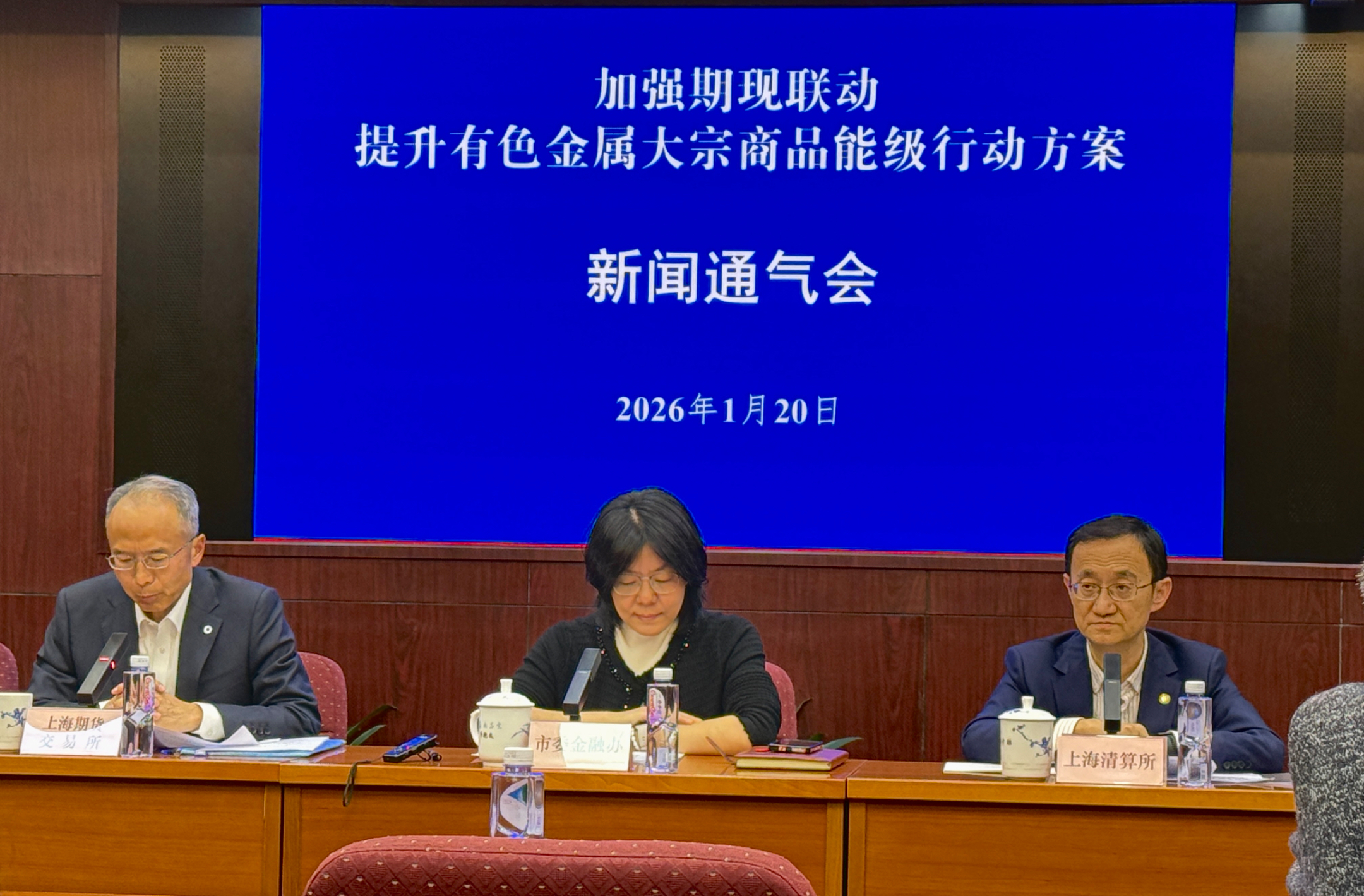
上海发布18项措施:提升有色金属大宗商品能级和全球定价影响力
Sou Hu Cai Jing· 2026-01-20 10:23
Core Viewpoint - The "Action Plan" aims to strengthen the linkage between futures and spot markets, enhancing the capability of non-ferrous metal commodities in Shanghai, amidst the backdrop of economic transformation and complex international trade dynamics [4][6]. Group 1: Background of the Document - The document highlights the increasing importance of bulk commodities in China's economy, particularly with the growth of strategic emerging industries such as new energy vehicles and aerospace [4]. - Shanghai has established itself as a key player in the non-ferrous metal sector, with a well-developed futures, spot, and OTC derivatives market [4]. - The Shanghai Futures Exchange has listed 11 non-ferrous metal futures and 10 options, with "Shanghai Copper" recognized as one of the three major pricing centers globally [4]. Group 2: Main Content of the Action Plan - The "Action Plan" consists of three main parts with 18 specific measures aimed at promoting the development of the non-ferrous metal market [7]. - It emphasizes the need for better integration of futures, spot, and derivatives markets, encouraging participation from various industries such as automotive and construction to manage price risks effectively [7][10]. - The plan seeks to enhance the internationalization of the non-ferrous metal market, increasing the influence of "Shanghai prices" through expanded market access and cross-border delivery mechanisms [7][11]. - It aims to cultivate a robust market ecosystem by fostering competitive trading entities and promoting collaboration across the supply chain, including the application of blockchain technology for data sharing [8][12]. Group 3: Specific Measures - Support for local non-ferrous metal trading venues to improve settlement efficiency and safety through the use of a centralized clearing system [10]. - Encouragement for enterprises to utilize futures and OTC derivatives for hedging against price fluctuations, thereby stabilizing operations [11]. - Initiatives to attract foreign trading firms and enhance cross-border business operations, including the introduction of foreign entities into bonded warehouse transactions [11][12]. - Development of a comprehensive credit archive for commodity trading enterprises, leveraging big data to enhance market transparency and trust [12][13].
上海发布18项措施,提升有色金属大宗商品能级和全球定价影响力
Sou Hu Cai Jing· 2026-01-20 09:55
Group 1 - The core viewpoint of the news is the release of the "Action Plan to Strengthen the Linkage between Futures and Spot Markets and Enhance the Competitiveness of Nonferrous Metal Commodities" by Shanghai, aimed at improving resource allocation and global pricing influence in the nonferrous metal sector to support the construction of Shanghai as a financial hub [1] Group 2 - The plan includes 18 measures focusing on enhancing market interconnectivity and promoting the development of futures, spot, and derivatives markets in the nonferrous metal sector [2] - It supports the Shanghai Clearing House and Shanghai Futures Exchange in communication regarding clearing and risk management, and encourages local enterprises in sectors like automotive, construction, and home appliances to participate in futures and OTC derivatives markets for better price risk management [2] Group 3 - The plan aims to enhance the internationalization of the nonferrous metal futures market and increase the influence of "Shanghai prices" by gradually opening up high-level systems and including eligible nonferrous metal futures options in the scope of foreign access [3] - It also explores innovative cross-border delivery mechanisms and aims to implement overseas warehousing and cross-border delivery business models under controlled risks [3] Group 4 - The initiative focuses on cultivating a competitive trading ecosystem by promoting collaboration between commodity enterprises and upstream and downstream industries [4] - It encourages the application of blockchain technology in the nonferrous metal sector to facilitate data sharing across platforms, institutions, and regions, and supports legislation on warehouse receipts to enhance their validity and authority [4]
聚焦“期现联动”,上海提升有色金属大宗商品能级和国际化水平
Xin Hua Cai Jing· 2026-01-20 09:43
Core Viewpoint - Shanghai aims to enhance the internationalization and resource allocation capabilities of the non-ferrous metal commodity market through the "Action Plan" which focuses on strengthening the linkage between futures and spot markets [1][4]. Group 1: Strategic Importance of Non-Ferrous Metals - Non-ferrous metals play an increasingly vital role in the national economy, especially with the growth of strategic emerging industries such as new energy vehicles, aerospace, and semiconductors [2]. - Shanghai has developed a linked market structure for non-ferrous metals, integrating futures, spot, and over-the-counter derivatives markets [2][3]. - The Shanghai Futures Exchange has listed 11 non-ferrous metal futures and 10 options, with some products gaining global pricing capabilities, positioning Shanghai among the top three global pricing centers for non-ferrous metals [2]. Group 2: Market Infrastructure and Services - The Shanghai Clearing House has established a framework for over-the-counter commodity derivatives trading and provides central counterparty clearing services for various products, enhancing risk management for non-ferrous metals [3]. - Local trading platforms like the Shanghai Nonferrous Metals Trading Center are pivotal in supporting the development of the non-ferrous metal spot market [3]. Group 3: Action Plan Measures - The "Action Plan" includes 18 measures aimed at promoting the interconnectivity of the non-ferrous metal market, enhancing the efficiency and safety of settlement processes, and encouraging participation from various industries [4][5]. - It emphasizes the need to improve the internationalization of the non-ferrous metal market and enhance the influence of "Shanghai prices" through high-level institutional openness and cross-border delivery mechanisms [4]. - The plan also focuses on cultivating a competitive ecosystem for non-ferrous metal trading, promoting collaboration across the supply chain, and leveraging blockchain technology for data sharing [5].
突破14万元大关!碳酸锂价格6天上涨19%,现货与期货定价趋同
Sou Hu Cai Jing· 2026-01-10 10:37
Group 1 - The price of lithium carbonate has surged to over 140,000 yuan per ton, marking a 19% increase from the end of 2025, driven by supply disruptions and explosive downstream demand [2][5] - The current market dynamics show a close correlation between spot and futures prices, with spot prices now largely referencing futures pricing, contributing to rapid price increases [2][6][7] - The recent price increase is attributed to supply disturbances, particularly from the Jiangxiawo mining area, and a significant rise in demand from both the power and energy storage sectors [5][6] Group 2 - The futures market reflects strong short-term trends, with the main contract for lithium carbonate reaching 143,400 yuan per ton, indicating robust market expectations [3][8] - The pricing strategy for lithium carbonate is evolving, with suppliers now offering options that tie pricing to futures rather than traditional methods, enhancing price transmission efficiency [7][8] - There is a notable increase in the production of lithium carbonate, with weekly inventory rising to 110,000 tons, indicating a shift from a depletion to an accumulation phase [6]