
大宗商品清算通

Search documents
上海出台18项措施强化期现联动,提升有色金属大宗商品能级
2 1 Shi Ji Jing Ji Bao Dao· 2026-01-21 08:33
Core Viewpoint - China's economy is undergoing transformation, and the role of bulk commodities, particularly non-ferrous metals, is becoming increasingly significant due to the growth of strategic emerging industries such as new energy vehicles, aerospace, and semiconductors [1] Group 1: Action Plan Overview - The "Action Plan" was jointly released by multiple financial and regulatory bodies in Shanghai to enhance the trading capabilities of non-ferrous metal bulk commodities [2] - The plan identifies challenges such as the need for improved interaction between futures, spot, and derivatives markets, insufficient international pricing power, and a lack of leading international commodity traders [2] Group 2: Specific Measures - The Action Plan includes 18 specific measures aimed at promoting market connectivity and enhancing the development of futures, spot, and derivatives markets [2] - It supports the Shanghai Clearing House and Shanghai Futures Exchange in improving communication on clearing and risk management [2] - The plan encourages local enterprises in sectors like automotive, construction, and home appliances to engage in futures and derivatives markets for better price risk management [2] Group 3: Internationalization and Ecosystem Development - The Action Plan aims to enhance the internationalization of the non-ferrous metal market and increase the influence of "Shanghai prices" through high-level institutional openness [3] - It promotes the exploration of cross-border delivery mechanisms and the establishment of overseas warehouses to enhance international service capabilities [3] - The plan focuses on cultivating a competitive trading ecosystem by fostering collaboration between commodity companies and upstream/downstream enterprises [3] Group 4: Current Market Landscape - Shanghai has established a linked development pattern for futures, spot, and over-the-counter derivative markets in the non-ferrous metal sector, with 11 futures and 10 options products listed [5] - Some futures products have gained pricing capabilities on a global or regional scale, with "Shanghai copper" being a notable example [5] - The Shanghai Clearing House has been providing central counterparty clearing services for various non-ferrous metal products since 2013, enhancing risk management and supporting the development of the spot trading platform [5] Group 5: Future Developments - The Shanghai government has initiated a three-year action plan (2025-2027) to accelerate the transformation of bulk commodity trading [6] - The establishment of Guomao Holdings, a state-owned enterprise, aims to integrate port resources and enhance the logistics industry, focusing on international commodity trade and investment [6] - Guomao Holdings has a registered capital of 13 billion RMB and is positioned as a key player in Shanghai's international shipping center development [6]
上海发布18项措施!提升有色金属大宗商品能级
Zhong Guo Zheng Quan Bao· 2026-01-20 14:58
Core Viewpoint - The Shanghai Municipal Financial Office, in collaboration with various financial institutions, has introduced an action plan aimed at enhancing the linkage between the futures and spot markets for non-ferrous metals, thereby improving the international competitiveness and pricing influence of Shanghai's non-ferrous metal commodities [1][2]. Group 1: Action Plan Overview - The action plan includes 18 specific measures divided into three main parts, focusing on market interconnectivity, internationalization, and ecosystem development for non-ferrous metals [2]. - It aims to promote the use of futures prices in trade settlements and encourages financial institutions to utilize hedging tools to mitigate price volatility risks [2][3]. Group 2: Market Interconnectivity - The plan supports the establishment of efficient and secure settlement systems for non-ferrous metal spot markets through commodity clearing channels [2]. - It encourages the development of price indices by trading venues and index service providers, facilitating trade settlements based on these indices [2]. Group 3: Internationalization of the Market - The action plan emphasizes international cooperation, aiming to explore cross-border business and product innovations with foreign regulatory bodies and exchanges [2]. - It proposes expanding the openness of Shanghai's non-ferrous metal futures market and exploring cross-border delivery models [2]. Group 4: Ecosystem Development - The plan advocates for the application of blockchain technology in the non-ferrous metal sector to enhance data sharing across platforms and institutions [3]. - It aims to strengthen the functionality of national commodity warehouse registration centers and expand the coverage of warehouse receipt registration for key non-ferrous metal products [3]. Group 5: Importance of Non-Ferrous Metals - Non-ferrous metals are increasingly vital to the national economy, especially with the growth of strategic emerging industries such as new energy vehicles and aerospace [4]. - Shanghai has developed a comprehensive market structure for non-ferrous metals, integrating futures, spot, and over-the-counter derivatives markets [4]. Group 6: Futures and Derivatives Market - The Shanghai Futures Exchange has listed 11 non-ferrous metal futures and 10 options, with some products gaining global pricing capabilities, positioning Shanghai among the top three global pricing centers for non-ferrous metals [4]. - The Shanghai Clearing House has established a framework for over-the-counter commodity derivatives, providing central counterparty clearing services for various products [5][6].
利好来了!上海最新发布
Zhong Guo Ji Jin Bao· 2026-01-20 13:26
Core Viewpoint - Shanghai has released an action plan consisting of 18 measures aimed at enhancing the competitiveness and global pricing influence of non-ferrous metal commodities [1] Group 1: Promoting Market Connectivity - The plan supports the establishment of communication between Shanghai Clearing House and Shanghai Futures Exchange for risk management and clearing [2][5] - It encourages local non-ferrous metal trading venues to utilize commodity clearing channels for efficient fund settlement [2][5] - The initiative aims to involve various industries, such as automotive and construction, in futures and derivatives markets to better manage price risks [2][5][6] Group 2: Enhancing Internationalization - The action plan seeks to expand the international openness of Shanghai's non-ferrous metal futures market, gradually including eligible products in the list of open varieties [2][6] - It promotes cross-border delivery mechanisms and aims to establish overseas warehouses and cross-border delivery business models [2][6][7] - The plan emphasizes cooperation with foreign regulatory bodies and exchanges to explore cross-border business and product innovations [6][7] Group 3: Cultivating a Robust Market Ecosystem - The initiative focuses on nurturing competitive trading entities and fostering collaboration between commodity enterprises and their supply chain partners [3][7] - It explores the establishment of a market-making system for non-ferrous metal OTC derivatives [3][7] - The plan encourages the application of blockchain technology in the non-ferrous metal sector to enhance data sharing across platforms and institutions [3][7]

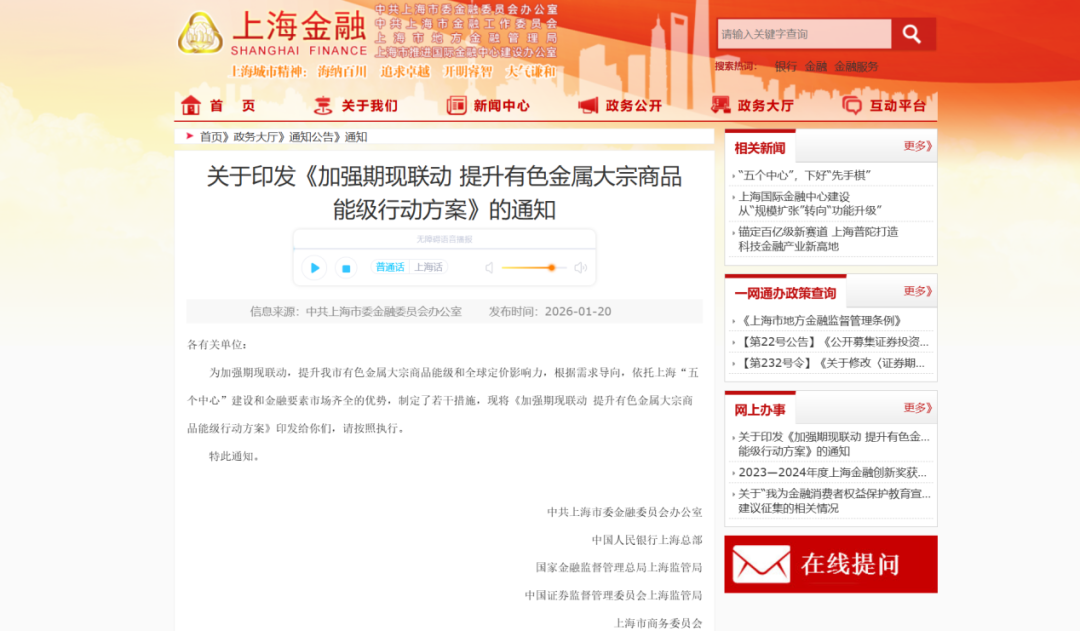
期现联动做强“上海价格”,有色金属大宗商品能级再提升
Di Yi Cai Jing· 2026-01-20 12:27
Core Viewpoint - Shanghai is enhancing its international influence in the non-ferrous metal futures market through a comprehensive action plan aimed at increasing the number of open products and improving the pricing power of "Shanghai prices" globally [1][4]. Group 1: Market Development - The number of open products has increased to 32, accounting for over 70% of the listed products [1][3]. - Shanghai Futures Exchange has listed 25 futures and 18 options, covering all major non-ferrous metal varieties, including copper, aluminum, zinc, and lead [2][3]. - The non-ferrous metal futures sector, represented by Shanghai copper, has become one of the most mature and widely participated commodity futures sequences in China, ranking among the global pricing centers for non-ferrous metals [2][3]. Group 2: Action Plan Measures - The action plan includes 18 specific measures to enhance the global pricing capability of non-ferrous metal commodities [4][5]. - It aims to strengthen the interconnection between futures, spot, and derivatives markets, enhancing operational efficiency and safety in the spot market [5]. - The plan seeks to elevate the internationalization of the futures market and expand the influence of "Shanghai prices" through high-level institutional opening and innovative cross-border delivery mechanisms [5]. Group 3: Future Implementation - The Shanghai Municipal Financial Office will collaborate with relevant units to accelerate the implementation of the action plan, focusing on market interlinkage and supporting the real economy in the non-ferrous metal sector [6].
提升有色金属大宗商品能级和全球定价影响力,上海发布18项措施
Sou Hu Cai Jing· 2026-01-20 11:50
Group 1 - The core viewpoint of the news is the introduction of the "Action Plan" aimed at enhancing the linkage between futures and spot markets for non-ferrous metals, thereby improving the overall capability of the non-ferrous metal commodity sector in Shanghai [1][2] - The "Action Plan" includes three main parts with 18 measures, focusing on promoting market interconnectivity and supporting enterprises in managing price risks through participation in futures and OTC derivatives markets [1][2] - The Shanghai Futures Exchange has listed 11 non-ferrous metal futures and 10 options, with some products gaining pricing power globally, establishing Shanghai as one of the three major pricing centers for non-ferrous metals [3] Group 2 - The plan aims to enhance the internationalization of the non-ferrous metal commodity market and increase the influence of "Shanghai prices" by expanding the range of open futures and options and exploring cross-border delivery mechanisms [2] - The initiative seeks to cultivate a robust ecosystem for the non-ferrous metal market by fostering competitive trading entities and promoting data sharing across platforms and regions [2] - Challenges remain in the non-ferrous metal commodity trade, including the need for stronger linkage between futures and spot markets, insufficient international pricing power, and a lack of leading global commodity traders [4]
上海发布18项措施:提升有色金属大宗商品能级和全球定价影响力
Sou Hu Cai Jing· 2026-01-20 10:23
Core Viewpoint - The "Action Plan" aims to strengthen the linkage between futures and spot markets, enhancing the capability of non-ferrous metal commodities in Shanghai, amidst the backdrop of economic transformation and complex international trade dynamics [4][6]. Group 1: Background of the Document - The document highlights the increasing importance of bulk commodities in China's economy, particularly with the growth of strategic emerging industries such as new energy vehicles and aerospace [4]. - Shanghai has established itself as a key player in the non-ferrous metal sector, with a well-developed futures, spot, and OTC derivatives market [4]. - The Shanghai Futures Exchange has listed 11 non-ferrous metal futures and 10 options, with "Shanghai Copper" recognized as one of the three major pricing centers globally [4]. Group 2: Main Content of the Action Plan - The "Action Plan" consists of three main parts with 18 specific measures aimed at promoting the development of the non-ferrous metal market [7]. - It emphasizes the need for better integration of futures, spot, and derivatives markets, encouraging participation from various industries such as automotive and construction to manage price risks effectively [7][10]. - The plan seeks to enhance the internationalization of the non-ferrous metal market, increasing the influence of "Shanghai prices" through expanded market access and cross-border delivery mechanisms [7][11]. - It aims to cultivate a robust market ecosystem by fostering competitive trading entities and promoting collaboration across the supply chain, including the application of blockchain technology for data sharing [8][12]. Group 3: Specific Measures - Support for local non-ferrous metal trading venues to improve settlement efficiency and safety through the use of a centralized clearing system [10]. - Encouragement for enterprises to utilize futures and OTC derivatives for hedging against price fluctuations, thereby stabilizing operations [11]. - Initiatives to attract foreign trading firms and enhance cross-border business operations, including the introduction of foreign entities into bonded warehouse transactions [11][12]. - Development of a comprehensive credit archive for commodity trading enterprises, leveraging big data to enhance market transparency and trust [12][13].
建设安全高效的中央对手清算机构 全力服务金融市场稳健运行和高质量发展
Jin Rong Shi Bao· 2026-01-09 02:07
Core Viewpoint - The 20th Central Committee's Fourth Plenary Session emphasizes the strategic deployment for accelerating the construction of a financial power during the "14th Five-Year Plan" period, focusing on building safe and efficient financial infrastructure, with the Shanghai Clearing House playing a crucial role in this initiative [1]. Group 1: Importance of Central Counterparty Clearing - The establishment of a safe and efficient central counterparty clearing institution is vital for ensuring the stable operation and high-quality development of the financial market, serving as a historical mission to support the construction of a financial power [1]. - Central counterparties are essential for the modern financial system in China, acting as a key platform for financial policy transmission, resource allocation, and risk management [2]. - They play a critical role in macro-prudential management, helping to prevent and mitigate financial risks through effective risk management mechanisms [2]. Group 2: Achievements During the 14th Five-Year Plan - The Shanghai Clearing House has developed six major platforms, including the largest OTC foreign exchange clearing platform globally and a leading RMB asset allocation platform, significantly contributing to the high-quality development of the financial market [4]. - The scale of centralized clearing business increased from 417 trillion yuan in 2020 to 819 trillion yuan by 2025, with an average annual growth rate of approximately 14.4% [4]. - The bond custody increased from 24.5 trillion yuan to 49.9 trillion yuan, with an average annual growth rate of about 15.3% [4]. Group 3: Product Innovation and Risk Management - The Shanghai Clearing House has established a comprehensive central counterparty clearing service system covering five major categories, becoming a significant provider of financial products and services [5]. - It has developed innovative products in various fields, including foreign exchange, interest rates, and credit derivatives, enhancing market competitiveness [6]. - The risk management system has been recognized both domestically and internationally, successfully meeting the highest international standards and receiving cross-border regulatory certifications [6]. Group 4: Internationalization and Open Financial Market - The Shanghai Clearing House aims to create a "one-point access" hub for domestic and international financial markets, enhancing cross-border service chains through innovative products [7]. - It has established itself as a key player in international financial governance, with its standards being adopted by over 99% of mainstream peers globally [7]. - The focus on international cooperation and the Belt and Road Initiative aims to expand the depth and breadth of cross-border connectivity [8]. Group 5: Future Goals for the 15th Five-Year Plan - The Shanghai Clearing House plans to establish itself as the main registration and custody institution for overseas RMB bond assets, promoting the "Yulan Bond" model and expanding its international network [10]. - It aims to become a central counterparty for overseas RMB financial products, enhancing the supply of RMB clearing products and providing risk hedging tools for foreign investors [10]. - The goal is to become the primary centralized clearing institution for OTC bulk commodity trading, integrating various financial services to support the healthy development of the real economy [11].
上海市委常委、常务副市长吴伟:金融发展正从规模扩张向质量提升转型升级
Zhong Guo Jin Rong Xin Xi Wang· 2025-12-27 07:04
Core Viewpoint - Shanghai is committed to enhancing its international financial center status through a series of financial reforms and innovations, aiming for synchronized growth in both the scale and quality of its financial services [1][2]. Group 1: Financial Development Metrics - By the third quarter of 2025, the value added by Shanghai's financial sector is expected to grow by 9.8% year-on-year, serving as a stabilizing force for the economy [1]. - The total transaction volume in Shanghai's financial market has increased by over 10% year-on-year, indicating a diversification of financial products and services [1]. - The loan balance of Shanghai's "Five Major Financial Articles" has grown by 13.9%, with financial institutions launching various products to support technological innovation, green development, and improvements in people's livelihoods [1]. Group 2: Cross-Border Financial Services - Shanghai has implemented a plan to enhance the convenience of cross-border financial services, with over 90% of the 70 specific tasks already in effect, leading to an expansion in cross-border investment and financing [1]. Group 3: Financial Innovation Recognition - The event recognized several financial innovations in Shanghai, awarding the "Shanghai Financial Innovation Achievement Award" to projects such as the launch of shipping index futures and 30-year treasury futures, among others [2].
上海清算所大宗商品清算通落地首单玉米交收业务
Jin Rong Shi Bao· 2025-08-08 08:00
Core Viewpoint - The successful completion of the first corn delivery transaction through the Shanghai Clearing House's commodity clearing service marks a significant advancement in financial infrastructure supporting agriculture and rural development [1] Group 1: Financial Infrastructure Development - The Shanghai Clearing House has integrated corn, soybean meal, and rapeseed meal into its commodity clearing system to enhance financial services for agriculture and the real economy [1] - The establishment of a secure, standardized, and efficient online clearing and settlement service system has effectively reduced circulation costs for agricultural products and increased market vitality [1] Group 2: Support for Agriculture and Rural Development - The initiative aims to promote the modernization of agriculture, which is essential for achieving high-quality development and establishing a strong agricultural nation [1] - The Shanghai Clearing House plans to continue supporting key areas such as agriculture and small and medium-sized enterprises, while accelerating the construction of a multi-tiered commodity clearing system [1] Group 3: Market Impact - The new clearing service significantly enhances market transparency and stability, contributing to the standardized development of agricultural markets [1] - The Shanghai Clearing House is committed to safeguarding the high-quality and stable development of the real economy through its services [1]
首单落地!上海清算所大宗商品清算通构建服务“三农”新通道
Xin Hua Cai Jing· 2025-06-25 05:22
Group 1 - The core viewpoint of the news is that the successful launch of the first corn delivery business under the Commodity Clearing Link marks a significant breakthrough in providing financial services to the agricultural sector, enhancing the stability of grain and feed supply [1] - The Commodity Clearing Link has integrated key agricultural products such as corn, soybean meal, and rapeseed meal into its system, addressing issues of high costs, low efficiency, and the need for improved standardization in agricultural product circulation [1][2] - The Commodity Clearing Link has processed over 650,000 spot transactions, with a cumulative clearing amount of 2.9 trillion yuan and a delivery volume exceeding 430 million tons, demonstrating its effectiveness in serving the real economy [2] Group 2 - The core model of the Commodity Clearing Link involves connecting government-supported compliant commodity spot platforms and their partner storage enterprises, providing real-time, cross-bank, and efficient financial settlement services for commodity transactions [3] - The Commodity Clearing Link has been included in several important policy documents aimed at enhancing cross-border financial service facilitation and promoting integrated development in the Yangtze River Delta region, indicating its strategic importance [3] - The Shanghai Clearing House aims to deepen financial support for key areas such as agriculture and small and medium-sized enterprises, enhancing the clearing system to better serve the national unified market and support high-quality economic development [3]