
构建人类命运共同体

Search documents
年终特稿丨2025,以中国方案作答“世界之问”
Xin Hua Wang· 2025-12-30 04:30
面对变乱交织的世界,中国坚定站在历史正确的一边、人类文明进步的一边,以深厚的战略定力和 负责任的大国担当为世界筑牢稳定之锚。 今年9月,习近平主席郑重提出全球治理倡议,凝聚起要团结不要分裂、要合作不要对抗的共识和 力量。该倡议与先前提出的全球发展倡议、全球安全倡议、全球文明倡议相辅相成,共同构成构建人类 命运共同体的战略引领。英国国际关系专家基思·贝内特指出,全球治理倡议推动全球治理体系向着更 加包容、公正的方向发展,"这正是当下全球治理改革的要义所在"。 10月,国际调解院在中国香港开业运营,作为全球首个专门通过调解解决国际争端的政府间法律组 织,其理念与全球治理倡议高度契合。俄罗斯科学院专家叶卡捷琳娜·扎克利亚济明斯卡娅认为,在越 来越多国家希望践行真正多边主义的今天,国际调解院的成立恰逢其时,这种机制创新彰显了中国推动 构建更加公正合理国际秩序的实干担当。 新华社北京12月30日电 题:2025,以中国方案作答"世界之问" 新华社记者叶书宏 谢彬彬 朱婉君 2025年即将翻过最后一页,这是百年变局加速演进的一年,是旧秩序与新力量深度博弈的一年,也 是人类社会在迷雾中艰难探索、砥砺前行的一年。 日升月落间 ...
习近平新时代中国特色社会主义思想获国际社会高度认同
Ren Min Ri Bao· 2025-12-30 02:16
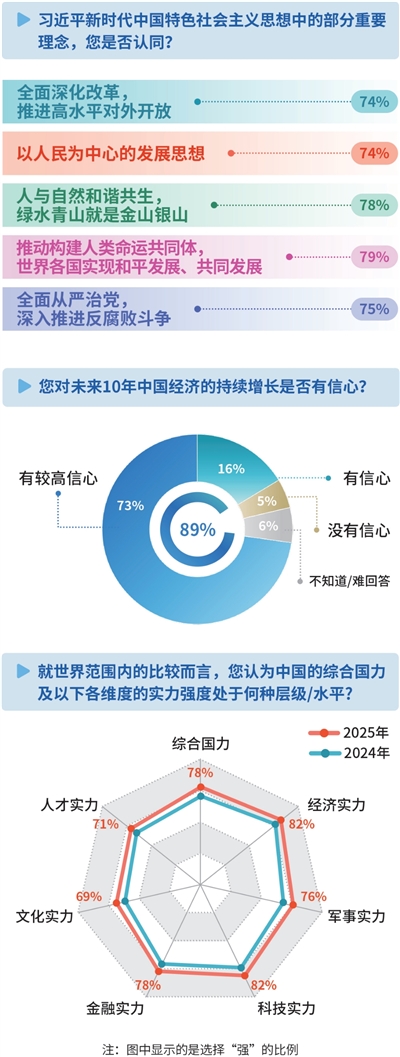
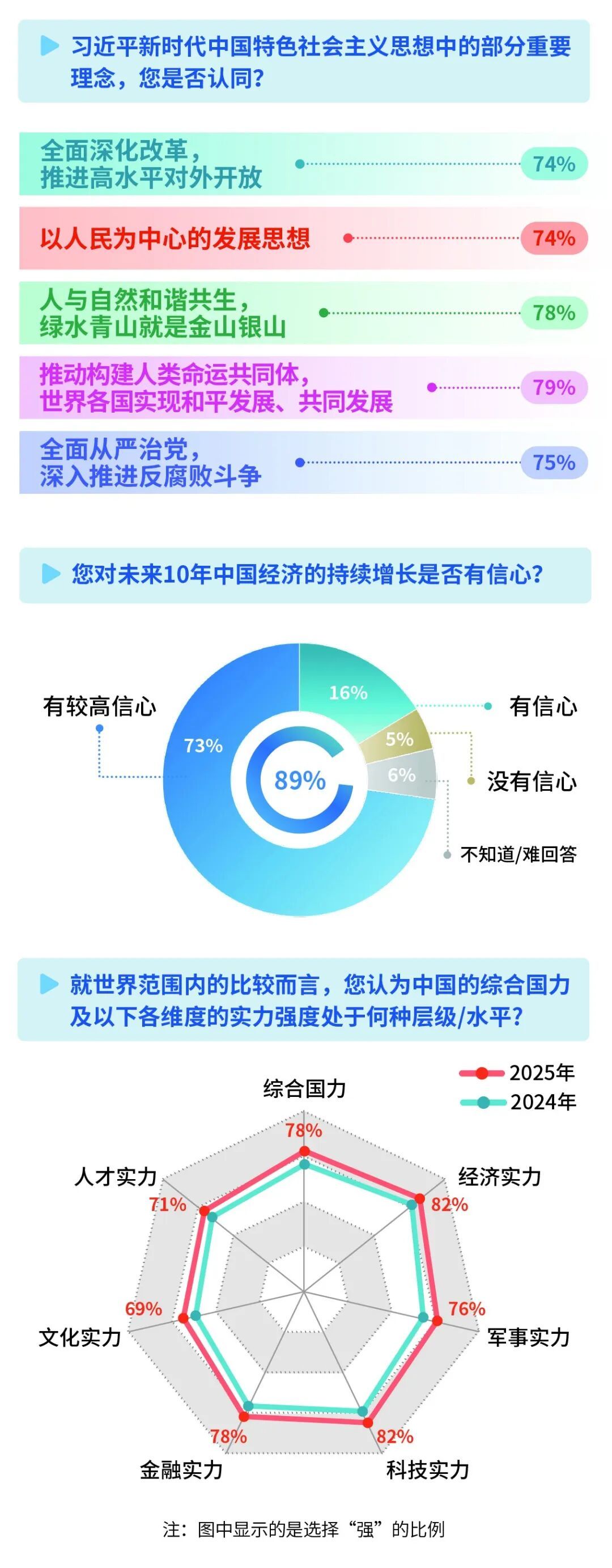
Core Insights - The global survey indicates a high level of international recognition for Xi Jinping's Thought on Socialism with Chinese Characteristics for a New Era, with significant approval for various governance principles and initiatives [6][7]. Group 1: International Perception of China's Strengths - 78% of international respondents recognize the enhancement of China's comprehensive national strength, an increase of 8 percentage points from 2024 [9]. - 82% of respondents view China's economic and technological strength as "strong," with both metrics showing growth compared to the previous year [9]. - 69% of international respondents have a favorable impression of China, reflecting a 6 percentage point increase from 2024 [10]. Group 2: Confidence in China's Economic Growth - Over 80% of international respondents express positive views on China's economic growth by 2025, with 86% from developing countries and 75% from developed countries [9]. - Nearly 90% of respondents are confident in China's sustained economic growth over the next decade, with developing countries showing a higher confidence level by nearly 20 percentage points compared to developed countries [9]. Group 3: Support for Governance and Policy Initiatives - Approximately 70% of international respondents support the implementation of strict governance measures by the Chinese Communist Party, with higher approval in BRICS and ASEAN countries [8]. - More than 75% of respondents recognize the importance of China's five-year planning as a significant experience for economic and social development, with over 80% approval in BRICS, Middle Eastern, ASEAN, and African countries [8]. Group 4: Interest in China's Role in Global Affairs - Over 70% of international respondents expect China to play a larger role in international affairs, with a significant increase in this expectation compared to previous years [12]. - More than 60% of respondents anticipate China's involvement in resolving international conflicts, such as the Ukraine crisis and the Israel-Palestine conflict [12]. Group 5: Future Relations with China - Over 75% of international respondents view their countries' relations with China as normal, friendly, or strategic, with a notable increase from 2024 [15]. - More than two-thirds of respondents hope for improved relations with China in the future, with this sentiment particularly strong in developing countries and among younger demographics [16].

“给阿拉伯国家发展带来更多启迪”
Ren Min Ri Bao· 2025-12-30 00:11
Core Viewpoint - The insights and governance strategies of China are valuable for Arab countries, particularly in terms of long-term planning and high-quality development [1][2] Group 1: Governance and Development Strategies - The Chinese Communist Party's strategic planning has transformed China from a poor agricultural nation into the world's leading manufacturing power and the second-largest economy [1] - The emphasis on medium to long-term planning has effectively mobilized resources and guided socio-economic development [1] - The concept of "Chinese-style modernization" is seen as a model for Arab nations to set more ambitious and reasonable development goals [1] Group 2: Economic and Technological Cooperation - Arab countries are facing significant economic transformation challenges, and China's experience in promoting high-quality development is particularly relevant [1] - China’s focus on new productive forces, green development, and technological innovation serves as an important reference for Arab nations [1] Group 3: Bilateral Relations and Cultural Exchange - Strengthening dialogue and cooperation between the peoples of China and Arab countries is crucial for mutual development and global peace [1][2] - The "Lebanon-China Dialogue Road" Association aims to enhance exchanges between media and academic institutions in both regions, fostering better mutual understanding [2] - Joint research projects focusing on Chinese governance philosophies are encouraged to inspire development in Arab countries [2]
社评:一份民调,测出了当代中国的感召力
Xin Lang Cai Jing· 2025-12-29 16:09
Group 1 - The core viewpoint of the report is that Xi Jinping's Thought on Socialism with Chinese Characteristics for a New Era has gained high recognition from the international community, with nearly 80% of respondents supporting concepts like "building a community with a shared future for mankind" and "green mountains and clear waters are as valuable as mountains of gold and silver" [1] - The report indicates that over 70% of respondents recognize the principles of "comprehensively governing the Party with strictness," "comprehensively deepening reforms," and "putting people at the center" [1] - The survey reflects a growing international consensus on China's development achievements and the desire to understand China's proposed ideas and initiatives, especially in the context of rising protectionism and widening development gaps [1][2] Group 2 - The international recognition of Chinese ideas and solutions is attributed to the institutional realization of long-term goals by the Communist Party of China and its self-restraint in power [2] - The positive evaluation of China's five-year plans signifies global acknowledgment of "long-termism" and the effective transformation of institutional advantages into governance efficiency and public welfare [2] - Keywords that resonate most with foreign respondents regarding China include economy, technology, culture, and innovation, highlighting the tangible aspects of China's development [2] Group 3 - There is a strong international expectation for China's experience in genuine multilateralism and a fair international order, with over half of foreign respondents expressing hope for China's involvement in resolving international conflicts [3] - The rising discontent with unilateralism and the weaponization of rules indicates a global demand for cooperation and mutual benefit rather than a zero-sum approach [3] - The survey captures the growing global appeal of contemporary China, emphasizing the need for continued openness and sustainable cooperation, particularly among youth [3]
2025年中国国际形象全球调查报告发布
Huan Qiu Shi Bao· 2025-12-29 07:28
调查简介:本次全球调查由环球时报研究院具体执行。调查国家样本中包括15个发达国家和31个发展中 国家,涵盖各大洲代表性国家及G20国家、9个金砖国家、10个东盟国家。不含中国。调查对象样本选 取及问卷投放、数据回收等工作依行业规范开展。调查方式根据不同国家的实际情况采用适宜方式,包 括面对面访问(CAPI/PAPI)、计算机辅助电话调查(CATI)、大规模会员样本库在线调查(Online) 三种。调查对象为18岁-70岁的普通民众。数据回收过程中,根据各国人口特征对样本组构成进行了一 定程度的配额限定。调查时间为2025年8月至10月。共获得有效样本数据51689份。 2025年,世界在变乱交织中加速演进。中国发展与世界格局的联动性不断增强,中国对全球增长、科技 变革和全球治理的影响更加深远而积极。为持续观察世界如何看待中国,环球时报社再度面向46个国 家、约5.17万民众开展"中国国际形象全球调查",客观、全面、准确地了解国外民众对中国的印象、认 知与评价。 习近平新时代中国特色社会主义思想获国际社会高度认同 本次调查选取了习近平新时代中国特色社会主义思想中的部分重要理念,询问国外受访民众的意 见。"构建人 ...
2025年中国国际形象全球调查报告:习近平新时代中国特色社会主义思想获国际社会高度认同 国际社会对华好感度持续提升
Xin Hua She· 2025-12-29 03:23
2025年中国国际形象全球调查报告:习近平新时代中国特色社会主义思想获国际社会高度认同 国 际社会对华好感度持续提升 调查显示,超过八成国外受访民众对2025年中国经济增长给予积极评价,近九成受访者表示对未 来10年中国经济增长有信心。近八成国外受访民众认可中国综合国力在增强,近七成国外受访民 众对中国抱有好感,对中国人的奋斗精神、创新精神的认同比例超过四分之三。九成多国外受访 民众对中国感兴趣,其中四成多兴趣程度很高。 在推动国际秩序朝着公正合理方向发展、改革完善全球治理、开展国际和地区热点问题斡旋与协 调,以及经贸合作、教科文合作等方面,八成左右国外受访民众期待中国未来开展更多行动或发 挥更大作用。 总体国际民意中,超过七成国外受访民众希望未来中美关系"趋向缓和"或"保持现状"。在"对中美 两国哪一个好感度更高"的比较中,国外受访民众选择中国的比例为39%,选择美国的比例为 26%,对华好感度超过对美好感度。美国政府对全球加征高额关税招致广泛担忧与批评,超过六 成国外受访民众持批评反对意见。中国政府采取了坚决反对和有力反制措施,超过七成国外受访 民众对此表示认同。 超过八成国外受访民众认为本国与中国是正常 ...
习近平新时代中国特色社会主义思想获国际社会高度认同 2025年中国国际形象全球调查报告发布
Huan Qiu Shi Bao· 2025-12-29 01:29
Group 1 - The survey conducted by Global Times Research Institute involved 15 developed countries and 31 developing countries, with a total of 51,689 valid samples collected from August to October 2025 [1] - The survey aimed to objectively understand foreign public perceptions of China, focusing on its international image and influence on global growth, technological change, and governance [1] Group 2 - Key concepts from Xi Jinping's Thought on Socialism with Chinese Characteristics for a New Era received high recognition internationally, with nearly 80% support for "building a community with a shared future for mankind" and "green mountains and clear waters are as valuable as mountains of gold and silver" [2] - Over 70% of respondents recognized initiatives such as the "Global Development Initiative" and "Global Security Initiative," indicating an increase in awareness compared to 2024 [2] Group 3 - Approximately 89% of respondents expressed confidence in China's comprehensive national strength, with 82% supporting its economic and technological capabilities [4][6] - The survey indicated that 78% of foreign respondents acknowledged the enhancement of China's comprehensive national strength, an increase of 8 percentage points from 2024 [9] Group 4 - Nearly 70% of foreign respondents held a favorable view of China, with the highest approval rates in Middle Eastern and ASEAN countries [10] - Interest in China was notably high, with over 90% of respondents expressing interest, particularly in cultural and technological aspects [13] Group 5 - More than 60% of respondents anticipated China's increased participation in international affairs, with a strong desire for China to contribute to resolving global issues [14] - The survey revealed that over 70% of respondents supported the idea of a fair and orderly multipolar world, with significant backing from developing countries [14] Group 6 - Over 75% of respondents viewed China's foreign policy positively, recognizing its role in promoting regional stability and development [20] - The desire for improved bilateral relations with China was expressed by over two-thirds of foreign respondents, reflecting a growing trend compared to 2024 [21]
学习规划建议每日问答 | 为什么要推动进出口平衡发展
Xin Hua She· 2025-12-24 04:26
Core Viewpoint - The article emphasizes the importance of promoting balanced development of imports and exports in China, highlighting the achievements and challenges faced in foreign trade during the 14th Five-Year Plan period, and outlines strategies for future growth and cooperation in international trade [1][2][3][4][5]. Group 1: Trade Performance and Goals - China's foreign trade has shown resilience, with merchandise trade surpassing $6 trillion in 2024, marking a 32.4% increase from 2020, maintaining its position as the world's largest trader for eight consecutive years [1]. - The trade surplus is projected to reach $992.2 billion in 2024, increasing pressure for China to expand high-level openness and achieve balanced trade [2]. - The service trade is expected to exceed $1 trillion for the first time in 2024, indicating a strong position in global service trade [1]. Group 2: Economic Contribution - Net exports of goods and services are expected to contribute 1.5 percentage points to economic growth in 2024, accounting for 30.3% of the overall growth [3]. - High-tech product exports have reached 18.2% of total exports, reflecting a shift towards higher quality and innovative products in foreign trade [3]. Group 3: Employment and Consumer Impact - Foreign trade has directly and indirectly supported 190 million jobs, representing 25% of total employment in China, with nearly 700,000 foreign trade entities involved [4]. - The import of quality products and services is set to enhance consumer choice, with over $250 billion in consumer goods expected to be imported in 2024 [4]. Group 4: Global Trade Relations - China has become a major trading partner for over 150 countries and regions, contributing to global supply chain stability and resilience [5]. - The China International Import Expo has facilitated over $500 billion in intended transactions, promoting global trade cooperation [5].
学习规划建议每日问答丨为什么要推动进出口平衡发展
Xin Hua She· 2025-12-24 03:32
Core Viewpoint - The article emphasizes the importance of promoting balanced development of imports and exports in China, highlighting the resilience of foreign trade during the "14th Five-Year Plan" period and the significant achievements in trade growth and international market share [1][2][3][4][5] Group 1: Trade Performance and Projections - China's foreign trade has shown resilience, with merchandise trade surpassing $6 trillion in 2024, marking a 32.4% increase from 2020, and maintaining its position as the world's largest trader for eight consecutive years [1] - The trade surplus is projected to reach $992.2 billion in 2024, increasing pressure for China to expand high-level openness and achieve a balance in trade [2] - The net export of goods and services is expected to contribute 1.5 percentage points to economic growth in 2024, accounting for 30.3% of the overall growth [3] Group 2: Quality and Structure of Trade - The quality of exports is improving, with high-tech products making up 18.2% of total exports, driven by digital and green transformations [3] - Policies have been implemented to enhance import potential, including reducing the overall tariff level to 7.3% and expanding zero-tariff treatment for products from least developed countries [2] - The establishment of 43 national import trade innovation demonstration zones has facilitated deeper integration of import trade with industrial upgrades [3] Group 3: Societal Impact of Trade - Foreign trade has significantly contributed to employment, directly and indirectly supporting 190 million jobs, which is about 25% of total employment in China [4] - The expansion of quality product imports and cross-border e-commerce has enriched consumer choices, with imports of consumer goods expected to exceed $250 billion in 2024 [4] - Promoting balanced trade development is seen as a way to enhance the well-being of the population and meet diverse consumer needs [4] Group 4: Global Trade Relations - China has become a major trading partner for over 150 countries and regions, contributing to global supply chain stability [5] - The country is a primary export destination for nearly 80 economies, with imports accounting for 10.5% of global total imports in 2024 [5] - The China International Import Expo has become a significant platform for global trade, with cumulative intended transaction amounts exceeding $500 billion [5]
学习规划建议每日问答|为什么要推动进出口平衡发展
Sou Hu Cai Jing· 2025-12-24 03:27
Core Viewpoint - The article emphasizes the importance of promoting balanced development of imports and exports in China, highlighting the achievements and challenges faced in foreign trade during the 14th Five-Year Plan period, and outlines strategies for future growth and cooperation in international trade [1][2][3][4][5]. Group 1: Trade Achievements - China's foreign trade has shown resilience, with merchandise trade surpassing $6 trillion in 2024, marking a 32.4% increase from 2020, maintaining its position as the world's largest trader for eight consecutive years [1]. - The export market share has stabilized at over 14%, while imports remain above 10% [1]. - Service trade is projected to exceed $1 trillion for the first time in 2024, placing China among the top in the world [1]. Group 2: High-Level Opening - The trade surplus is expected to reach $99.22 billion in 2024, increasing pressure for China to expand high-level openness and cooperation [2]. - Policies have been implemented to stabilize foreign trade and optimize its structure, including reducing the overall tariff level to 7.3% and enhancing import facilitation [2]. - China is actively expanding imports and has granted zero-tariff treatment on 100% of product categories to least developed countries with which it has diplomatic relations [2]. Group 3: High-Quality Development - In 2024, net exports of goods and services are projected to contribute 1.5 percentage points to economic growth, accounting for 30.3% of the total growth [3]. - The export of high-tech products has reached 18.2%, reflecting a shift towards digital and green transformation in trade [3]. - The import of advanced technologies and key components supports industrial upgrading and enhances the stability and competitiveness of China's supply chain [3]. Group 4: Meeting People's Needs - Foreign trade has significantly contributed to economic stability, employment, and improved living standards, directly and indirectly supporting 190 million jobs, which is about 25% of total employment in China [4]. - The import of quality products and services is being expanded, with over $250 billion in consumer goods expected to be imported in 2024, enhancing consumer choice [4]. - Promoting balanced trade development is seen as beneficial for improving the well-being of the population and meeting diverse consumer needs [4]. Group 5: Global Cooperation - China has become a major trading partner for over 150 countries and regions, contributing to global supply chain stability [5]. - In 2024, China is expected to account for 10.5% of global imports, reinforcing its role as a significant player in the global market [5]. - The China International Import Expo has facilitated over $500 billion in intended transactions, promoting global economic cooperation and shared opportunities [5].