
扩大高水平开放

Search documents
【招银研究|政策】区域联动,协调发展——“十五五”规划纲要学习体会之区域篇
招商银行研究· 2026-03-24 09:17
Core Viewpoint - The article discusses the approval of the 15th Five-Year Plan for national economic and social development, emphasizing the need for high-quality regional economic development and coordination among different regions in China [1][2]. Overall Strategy: Serving the Whole, Systematic Interaction - The 15th Five-Year Plan highlights the upgraded development goals aimed at serving the national unified market and promoting domestic and international dual circulation [2]. - It emphasizes the need for a systematic reshaping of regional economic development, moving from single-point breakthroughs to "advantage complementarity" and "coordinated development" [2][3]. Key Tasks: Coordinated Development, Regional Interaction, New Urbanization Coordinated Development: Restructuring the System - The plan elevates the importance of enhancing regional development coordination and integrates previous strategies into a cohesive framework [5]. - It aims to create a new development pattern characterized by "advantage complementarity" and "functional synergy" among the four major regions [6]. Regional Interaction: Improving Layout, Strengthening Mechanisms - The plan introduces a dedicated chapter on promoting regional interaction, focusing on both "hard connectivity" through infrastructure and "soft connectivity" through cooperative mechanisms [12]. - It emphasizes the need for cross-regional infrastructure development and the establishment of effective cooperation mechanisms to facilitate resource flow [13][16]. New Urbanization: People-Centric, Quality Development - The new urbanization strategy shifts focus from mere population migration to optimizing the quality of urbanization, emphasizing human-centered development [17]. - It includes specific measures for the urbanization of agricultural transfer populations and the modernization of urban areas [18][20]. External Opening: Optimizing Layout, Strengthening Support - The plan prioritizes expanding high-level opening-up, shifting from a focus on scale to a more systematic approach to institutional opening [23]. - It outlines significant changes in regional opening-up strategies, including the upgrade of Hainan Free Trade Port and the enhancement of free trade zones [24][25]. Conclusion - The 15th Five-Year Plan represents a comprehensive approach to regional economic development, emphasizing coordination, interaction, and quality urbanization, while also addressing the need for a robust external opening strategy to adapt to complex global environments [1][2][23].

商务部:中英共同签署了四项经贸成果文件
Nan Fang Du Shi Bao· 2026-01-30 10:57
Core Viewpoint - The recent signing of multiple economic and trade cooperation documents between China and the UK during Prime Minister Starmer's visit aims to deepen bilateral trade relations across goods, services, and economic mechanisms. Group 1: Export Cooperation - The signing of the memorandum on "Exporting to China" marks the UK as the first country to join this initiative, showcasing China's commitment to expanding high-level openness and sharing market opportunities [2] - The cooperation mechanism will focus on identifying quality UK goods and services for export to China, enhancing information exchange, and promoting trade facilitation [2] Group 2: Service Trade Cooperation - The UK, being the second-largest service exporter globally, will engage in a feasibility study for a service trade agreement and establish a bilateral service partnership [3] - The collaboration will leverage the complementary strengths of both nations in sectors such as creative industries, professional services, financial services, and healthcare [3] Group 3: Strengthening Economic and Trade Commission - The memorandum aims to reinforce the role of the China-UK Economic and Trade Commission as a platform for policy dialogue and trade investment promotion [4] - It will enhance interaction between the commission and the China-UK Entrepreneurs Committee, facilitating dialogue between governments and businesses to address mutual concerns [4]

学习规划建议每日问答 | 为什么要推动进出口平衡发展
Xin Hua She· 2025-12-24 04:26
Core Viewpoint - The article emphasizes the importance of promoting balanced development of imports and exports in China, highlighting the achievements and challenges faced in foreign trade during the 14th Five-Year Plan period, and outlines strategies for future growth and cooperation in international trade [1][2][3][4][5]. Group 1: Trade Performance and Goals - China's foreign trade has shown resilience, with merchandise trade surpassing $6 trillion in 2024, marking a 32.4% increase from 2020, maintaining its position as the world's largest trader for eight consecutive years [1]. - The trade surplus is projected to reach $992.2 billion in 2024, increasing pressure for China to expand high-level openness and achieve balanced trade [2]. - The service trade is expected to exceed $1 trillion for the first time in 2024, indicating a strong position in global service trade [1]. Group 2: Economic Contribution - Net exports of goods and services are expected to contribute 1.5 percentage points to economic growth in 2024, accounting for 30.3% of the overall growth [3]. - High-tech product exports have reached 18.2% of total exports, reflecting a shift towards higher quality and innovative products in foreign trade [3]. Group 3: Employment and Consumer Impact - Foreign trade has directly and indirectly supported 190 million jobs, representing 25% of total employment in China, with nearly 700,000 foreign trade entities involved [4]. - The import of quality products and services is set to enhance consumer choice, with over $250 billion in consumer goods expected to be imported in 2024 [4]. Group 4: Global Trade Relations - China has become a major trading partner for over 150 countries and regions, contributing to global supply chain stability and resilience [5]. - The China International Import Expo has facilitated over $500 billion in intended transactions, promoting global trade cooperation [5].
学习规划建议每日问答|为什么要推动进出口平衡发展
Sou Hu Cai Jing· 2025-12-24 03:27
Core Viewpoint - The article emphasizes the importance of promoting balanced development of imports and exports in China, highlighting the achievements and challenges faced in foreign trade during the 14th Five-Year Plan period, and outlines strategies for future growth and cooperation in international trade [1][2][3][4][5]. Group 1: Trade Achievements - China's foreign trade has shown resilience, with merchandise trade surpassing $6 trillion in 2024, marking a 32.4% increase from 2020, maintaining its position as the world's largest trader for eight consecutive years [1]. - The export market share has stabilized at over 14%, while imports remain above 10% [1]. - Service trade is projected to exceed $1 trillion for the first time in 2024, placing China among the top in the world [1]. Group 2: High-Level Opening - The trade surplus is expected to reach $99.22 billion in 2024, increasing pressure for China to expand high-level openness and cooperation [2]. - Policies have been implemented to stabilize foreign trade and optimize its structure, including reducing the overall tariff level to 7.3% and enhancing import facilitation [2]. - China is actively expanding imports and has granted zero-tariff treatment on 100% of product categories to least developed countries with which it has diplomatic relations [2]. Group 3: High-Quality Development - In 2024, net exports of goods and services are projected to contribute 1.5 percentage points to economic growth, accounting for 30.3% of the total growth [3]. - The export of high-tech products has reached 18.2%, reflecting a shift towards digital and green transformation in trade [3]. - The import of advanced technologies and key components supports industrial upgrading and enhances the stability and competitiveness of China's supply chain [3]. Group 4: Meeting People's Needs - Foreign trade has significantly contributed to economic stability, employment, and improved living standards, directly and indirectly supporting 190 million jobs, which is about 25% of total employment in China [4]. - The import of quality products and services is being expanded, with over $250 billion in consumer goods expected to be imported in 2024, enhancing consumer choice [4]. - Promoting balanced trade development is seen as beneficial for improving the well-being of the population and meeting diverse consumer needs [4]. Group 5: Global Cooperation - China has become a major trading partner for over 150 countries and regions, contributing to global supply chain stability [5]. - In 2024, China is expected to account for 10.5% of global imports, reinforcing its role as a significant player in the global market [5]. - The China International Import Expo has facilitated over $500 billion in intended transactions, promoting global economic cooperation and shared opportunities [5].
海南封关:为什么是扩大高水平开放的标志性举措?
Yang Shi Wang· 2025-12-20 18:22
Core Viewpoint - The official launch of the Hainan Free Trade Port on December 18 marks a significant step in China's commitment to high-level opening up and the construction of an open world economy [1] Group 1 - The Hainan Free Trade Port's closure operation is seen as a landmark initiative for expanding high-level openness [1] - Experts and media have been actively commenting on the implications of Hainan's closure, indicating its high-profile significance [1] - The government describes this move as a demonstration of China's unwavering commitment to promoting an open global economy [1]
新华社权威速览|中央财办十问十答,一起来学习!
Xin Hua She· 2025-12-17 14:48
Group 1 - The central economic work conference indicates that 2025 will be a significant year for China's economy, which is expected to grow by around 5%, maintaining its position among the world's major economies, with a total economic output projected to reach approximately 140 trillion yuan [4][5] - Active flows of factors and innovation are expected to inject new momentum into development, with a rapid growth trend in the movement of people, goods, information, and capital, leading to a recovery in investment and consumption growth next year [7] - The conference emphasizes the implementation of a more proactive fiscal policy next year, maintaining necessary fiscal deficits and total debt levels while ensuring fiscal sustainability [9] Group 2 - Expanding domestic demand is prioritized as a key task for next year, focusing on structural changes in consumption and boosting investment to stabilize growth [12][13] - The expansion of international science and technology innovation centers is a major deployment aimed at enhancing global competitiveness and influence, with significant achievements in regions like Beijing and Shanghai [16][17] - The government will take targeted measures to enhance the effectiveness of the unified national market, including improving market operation rules and establishing a foundational institutional framework [20][22] Group 3 - The strategy for regional coordinated development will be implemented, promoting urban-rural integration and regional linkage while avoiding "policy lowlands" [28] - The focus will be on promoting high-quality employment, with policies aimed at stabilizing jobs and supporting key groups such as college graduates and migrant workers [35] - The real estate sector is expected to see significant development potential, with a shift towards a new model that emphasizes high-quality development and the transformation of real estate companies [39][41]

“愿与中国市场共同发展”(锐财经)
Ren Min Ri Bao Hai Wai Ban· 2025-12-01 22:11
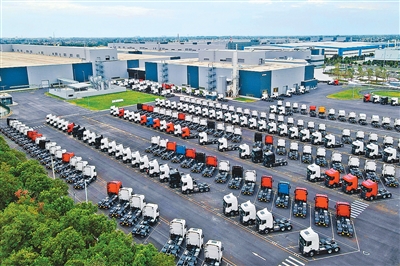
Group 1 - Scania has established its third global production base in Jiangsu, China, with an annual production capacity of 50,000 heavy trucks [2] - Foreign companies are increasingly investing in China, with a 14.7% year-on-year increase in newly established foreign-invested enterprises, totaling 53,782 from January to October this year [2][3] - The actual use of foreign capital in China reached 621.93 billion yuan, with significant investments in high-tech industries, including a 173.1% increase in e-commerce services [3] Group 2 - Guangdong province saw a 32.2% increase in newly established foreign investment projects, totaling 27,000, with actual foreign capital utilization of 84.62 billion yuan, a 7.5% increase [4] - Many foreign enterprises are reinvesting profits earned in China, indicating a strong confidence in the Chinese market [4] - The Chinese government is implementing policies to attract foreign investment, including financial support for foreign R&D centers and initiatives to address foreign enterprises' concerns [7][8] Group 3 - The Ministry of Commerce is focusing on expanding market access for foreign investment, particularly in the service sector, and enhancing the investment environment [8] - A series of investment promotion activities are being held domestically and internationally to showcase investment opportunities in China [8] - The government aims to create a market-oriented, law-based, and international business environment for foreign investors [8]
习近平主席接连两场会见,传递哪些重要信息?
Yang Shi Xin Wen Ke Hu Duan· 2025-11-15 07:03
Core Points - The meetings between President Xi Jinping and the Kings of Thailand and Spain emphasize the themes of friendship and cooperation [1][2] - This year marks the 50th anniversary of diplomatic relations between China and Thailand, with the Thai King being the first to visit China, highlighting the importance of the relationship [1] - The year also marks the 20th anniversary of the comprehensive strategic partnership between China and Spain, showcasing a model of friendly coexistence and mutual development [1] Summary by Categories China-Thailand Relations - China is willing to steadily advance major project cooperation, such as the China-Thailand railway, and expand imports of high-quality Thai agricultural products [1] - There is an intention to explore cooperation in emerging fields like artificial intelligence [1] China-Spain Relations - China expresses willingness to import more high-quality products from Spain and to explore potential cooperation in emerging sectors [1] - The focus is on expanding mutual investment and creating more landmark projects [1] Global Context - The current global environment is characterized by instability and weak economic recovery, making friendly cooperation increasingly valuable [2] - More countries are engaging in mutual cooperation with China, aiming for a win-win future [2]
商务部部长王文涛:缩减外资准入负面清单
Jin Rong Shi Bao· 2025-11-07 10:33
Core Viewpoint - The article emphasizes the importance of expanding high-level openness in China's economy, advocating for a comprehensive leadership role in open policies, and promoting international cooperation for shared development opportunities [1] Group 1: Expanding Self-Initiated Openness - The focus is on aligning with international high-standard economic and trade rules while expanding market access, particularly in the service sector [2] - Plans include expanding pilot programs in telecommunications, biotechnology, and foreign-invested hospitals, as well as enhancing educational and cultural openness [2] - The strategy involves accelerating regional and bilateral trade agreements, promoting high-standard free trade zones, and advancing the internationalization of the Renminbi [2] Group 2: Promoting Trade Innovation - The goal is to enhance the quality and efficiency of foreign trade, with an emphasis on optimizing goods trade and expanding green and digital trade [3] - There is a push for increased imports and the establishment of national import trade innovation demonstration zones [3] - The development of service trade is prioritized, encouraging exports of knowledge-intensive services and improving cross-border service trade management [3] Group 3: Expanding Investment Cooperation - The initiative aims to create a strong "Invest in China" brand and enhance international cooperation in supply chains [4] - Efforts include reducing the negative list for foreign investment and improving the service guarantee system for foreign enterprises [4] - The focus is on fostering a transparent and stable institutional environment for foreign investments [4] Group 4: High-Quality Belt and Road Initiative - The strategy seeks to strengthen mutual trust and benefit with partner countries, expanding win-win development opportunities [5] - Emphasis is placed on aligning strategies with partner countries and enhancing connectivity through major projects [5] - The initiative aims to diversify investment and financing systems while protecting overseas interests and providing legal support for enterprises [5]
扎实有力推进经济社会发展 市政府召开四季度工作会议
Jie Fang Ri Bao· 2025-10-14 01:36
Core Points - The Shanghai municipal government emphasizes the importance of achieving economic and social development goals for the year and the "14th Five-Year Plan" during the fourth quarter [1][2] - The government aims to enhance urban governance modernization and improve public services while ensuring safety and environmental protection [2] Economic Development - The overall economic and social development in Shanghai has been stable and progressing this year, with a focus on completing annual and "14th Five-Year Plan" targets [1] - Key initiatives include promoting growth in key industries, advancing major project construction, and enhancing the impact of significant events [1] Urban Governance - The government plans to implement urban renewal actions, accelerate the transformation of old neighborhoods, and improve outdated industrial areas [2] - There is a strong emphasis on ecological protection, environmental governance, and enhancing public services to improve citizens' welfare [2] Safety and Planning - Ensuring the safety of urban operations is a priority, with measures for risk prevention and safety management being reinforced [2] - The government is focused on high-quality planning for the "15th Five-Year Plan" and preparing for the upcoming year's work [2] Government Efficiency - The government system is encouraged to boost morale and improve work efficiency to ensure effective implementation of various tasks [2] - A collaborative approach is emphasized, with a focus on accountability and discipline in executing government initiatives [2]