汽车以旧换新补贴政策

Search documents
乘用车近期终端需求跟踪及展望
2025-12-29 15:51
Summary of Conference Call Records Industry Overview - The records focus on the automotive industry, specifically the passenger vehicle market in China, with an emphasis on new energy vehicles (NEVs) and the impact of government subsidy policies on consumer behavior and market dynamics [1][2][11]. Key Points and Arguments Government Subsidy Policies - The total subsidy amount for 2026 is expected to remain at 300 billion, with approximately 100 billion allocated for automotive subsidies [1][2]. - The "trade-in" policy for old vehicles may require that the old car be held for over a year to prevent subsidy fraud [2][4]. - Expected subsidies for 2025 include 8% for NEVs and 6% for fuel vehicles, with scrapping subsidies of 12% for NEVs and 10% for fuel vehicles [1][2][11]. - The average subsidy per vehicle in 2025 is projected to be around 11,500 yuan, with a similar expectation for 2026 [1][3]. Consumer Behavior and Market Demand - Consumer expectations for the trade-in policy are high, with subsidies accounting for about 7% of the average transaction price of 100,000 yuan for passenger vehicles [1][4]. - Approximately two-thirds of potential customers are waiting for the 2026 subsidy updates, particularly for trade-in subsidies [1][5]. - The demand for NEVs is expected to see significant growth in Q1 2026, driven by new subsidy policies and promotional activities from manufacturers to clear inventory [6][11]. Inventory and Sales Dynamics - Major manufacturers like BYD are facing high inventory levels, with an inventory coefficient exceeding 2, while brands like Geely and Leap Motor have lower coefficients of 1.1-1.5 [7][8]. - Leap Motor has maintained strong sales due to its focus on electric vehicles priced between 120,000 and 150,000 yuan, achieving a market share that has doubled [9]. - BYD is expected to leverage its strong inventory and product updates to improve sales efficiency and reduce inventory pressure in the coming months [10]. Price Control and Market Strategy - The government plans to implement strict price control measures to prevent significant price reductions, which could lead to legal risks for brands [12]. - Dealers are expected to benefit from this environment, potentially achieving profitability per vehicle sold [12]. - Manufacturers will likely respond by enhancing product quality and value, with expectations of a price increase of over 3,000 yuan in the overall sedan market [12]. Future Vehicle Plans - Geely plans to launch new models under the Galaxy series, including several new SUVs and sedans, with a total of about 10 new models expected [17]. - Other brands like Lynk & Co and Zeekr are also planning to introduce new models to invigorate the market [18]. Additional Important Insights - The anticipated decline in the market for electric vehicles priced below 100,000 yuan could significantly impact state-owned enterprises and brands focused on low-end electric vehicles [11]. - The overall market dynamics indicate a shift towards larger vehicles with increased battery capacity, while maintaining price competitiveness within the specified subsidy ranges [11].
2026年“国补”推进!十余个城市开始行动!专家:补贴力度较今年或有所减弱
Mei Ri Jing Ji Xin Wen· 2025-12-25 14:16
据新华社报道,12月10日至11日举行的中央经济工作会议,将"坚持内需主导,建设强大国内市场"列为2026年经济工作重点任务之首,并明确提出优化"两 新"(大规模设备更新、消费品以旧换新)政策实施,不过会议并未透露政策的具体实施细则和时间。 商务部数据显示,今年前11个月,消费品以旧换新带动相关商品销售额超2.5万亿元,其中汽车"以旧换新"成交量超1120万辆。 "在强劲的'以旧换新'补贴政策支持下,2025年我国汽车'以旧换新'市场规模预计突破1800亿元。"乘联分会秘书长崔东树向记者透露。 12月25日,《每日经济新闻》记者查询广州市商务局官方网站获悉,广州市已对2026年汽车"置换更新"补贴平台服务企业展开遴选工作。 根据《广州市商务局关于公开遴选2026年汽车"置换更新"补贴平台服务企业的通知》,广州市汽车"以旧换新"补贴项目包括汽车"置换更新"和"报废更新", 入选服务企业的工作任务包括系统开发、资格核验、资金控制、风险管理等。 值得一提的是,为了保障以旧换新市场有序运行,各地遴选工作列出了多项任务要求。如,入选企业需要加强风险监测及管控,还应接受政府部门监督管 理,如实提供系统申报数据,为每名申请 ...

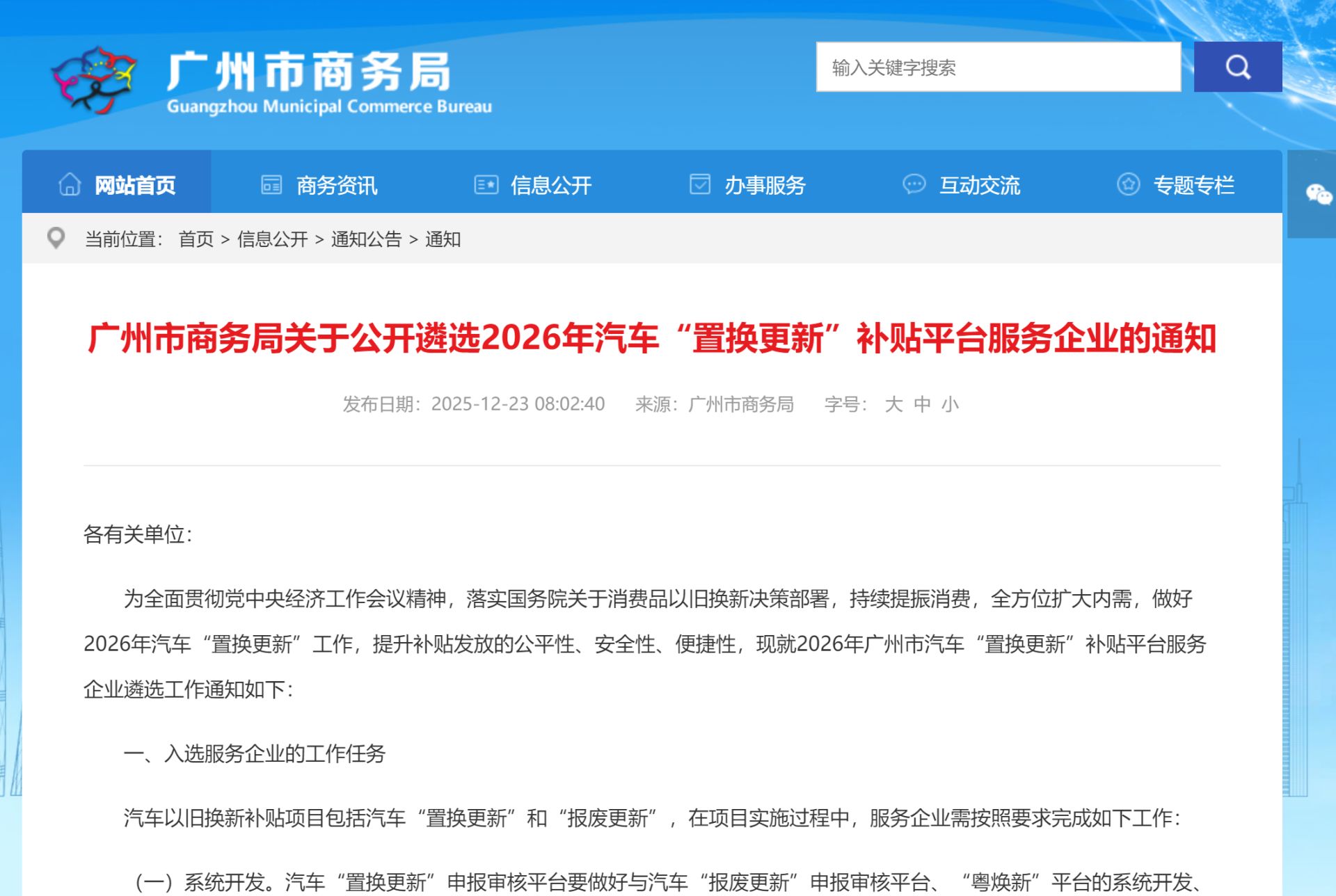
湖北调整2025年汽车以旧换新补贴政策
Zheng Quan Shi Bao Wang· 2025-11-11 04:33
Core Viewpoint - Hubei Province's Commerce Department announced adjustments to the 2025 automobile trade-in subsidy policy, including the suspension of the vehicle scrapping and updating subsidy policy starting November 13, 2025 [1][2]. Group 1: Suspension of Subsidy Policy - The automobile scrapping and updating subsidy policy will be suspended from November 13, 2025 [2][3]. - Consumers who obtain a new vehicle sales invoice by November 12, 2025, and meet the subsidy conditions must submit their application by November 15, 2025, at 24:00 [3]. - Applications submitted after the deadline will not be accepted, and those that do not meet the requirements will be returned [3]. Group 2: Adjustments to Subsidy Qualification Voucher Issuance - The method of issuing qualification vouchers will be adjusted to four concentrated batches starting November 15, 2025, with specific issuance times [4]. - The deadline for submitting subsidy applications is extended to December 31, 2025, at 24:00, while the deadline for submitting supplementary application materials is January 20, 2026, at 24:00 [4]. - Failure to submit applications or supplementary materials by the deadlines will result in automatic forfeiture of the application [4].
乘联分会:预计10月狭义乘用车零售220万辆 新能源渗透率有望升至60%
智通财经网· 2025-10-26 11:25
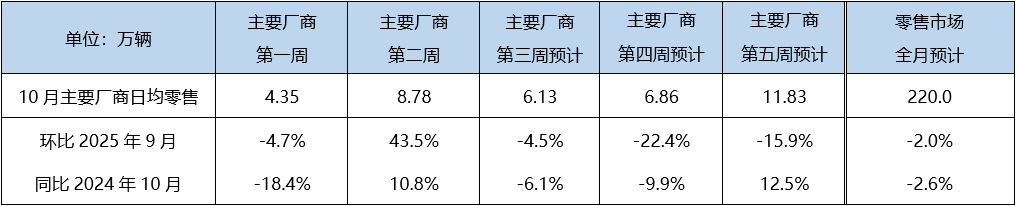
Core Insights - The narrow passenger car retail market in October is expected to reach approximately 2.2 million units, reflecting a month-on-month decrease of 2.0% and a year-on-year decrease of 2.6% [1][3] - New energy vehicle (NEV) retail is projected to be around 1.32 million units, with a penetration rate anticipated to rise to about 60% [1][3] - The market is entering the traditional "Silver October" sales peak, driven by the National Day holiday's customer attraction effect and year-end policy adjustments [1] Market Performance - In September, the narrow passenger car retail market achieved 2.244 million units, showing a year-on-year growth of 6.4% and a month-on-month growth of 11.2% [2] - NEV retail in September reached 1.299 million units, with a year-on-year increase of 15.7% and a month-on-month increase of 16.5%, resulting in a penetration rate of 57.8% [2] Manufacturer Sales Outlook - Most manufacturers maintain an optimistic sales outlook for October, with major manufacturers setting retail targets that are largely stable month-on-month [3] - The anticipated retail market size for narrow passenger cars in October is around 2.2 million units, with NEV retail expected to reach 1.32 million units [3] Weekly Sales Trends - The first week of October saw daily retail of 43,500 units, a year-on-year decrease of 18.4% and a month-on-month decrease of 4.7% due to the holiday effect [4] - The second week experienced a surge in daily retail to 87,800 units, reflecting a year-on-year increase of 10.8% and a month-on-month increase of 43.5% [4] - The overall monthly retail forecast remains at 2.2 million units, with varying weekly performances influenced by holiday dynamics and policy adjustments [4] Market Structure and Consumer Behavior - Post-holiday, there has been a slight seasonal recovery in terminal discounts, indicating a stable overall market operation [5] - As of October 22, 2025, over 10 million applications for the vehicle replacement subsidy have been submitted, significantly impacting the market in the first three quarters [5] - The market is expected to be supported by continued vehicle scrappage and the upcoming decline in NEV purchase tax subsidies, which may drive early purchasing behavior [5]
江苏、宁波等多地暂停汽车以旧换新补贴
Sou Hu Cai Jing· 2025-09-30 01:41
Core Viewpoint - The recent adjustments in the "old-for-new" automobile subsidy policies across various regions in China indicate a strategic pause to manage funding effectively and ensure the sustainability of the program until the end of the year [1][2][3]. Group 1: Policy Adjustments - Jiangsu Province announced the suspension of its automobile replacement subsidy policy effective from September 28, 2025 [1]. - Ningbo City followed suit, stating that its automobile replacement subsidy policy would be suspended starting October 11, 2025 [1]. - Multiple regions, including Guangxi and Rizhao, have also announced similar suspensions in September, reflecting a trend of local governments pausing subsidy programs [1]. Group 2: Funding and Implementation - The Chinese government has allocated a total of 300 billion yuan in national debt funds to support the "old-for-new" consumption policy throughout the year [2]. - As of October, the government plans to distribute the fourth batch of 69 billion yuan, completing the annual target of 300 billion yuan [2]. - Local governments have previously faced challenges in disbursing subsidies due to funding issues, but these have been resolved with the recent allocations [2]. Group 3: Market Impact - The implementation of the "old-for-new" policy has led to a significant increase in automobile consumption, with 8.3 million applications submitted by September 10 this year [4]. - Data indicates that over half of the consumers have benefited from the subsidies, with cumulative passenger car sales reaching 14.765 million units from January to August [4].
限额管理、资格调控,江苏省2025年汽车以旧换新政策暂停
Yang Zi Wan Bao Wang· 2025-09-28 13:22
Core Points - Jiangsu Province's automobile replacement subsidy policy will be suspended on September 28, 2025, at 24:00 [1] - Consumers who obtained a new vehicle sales invoice between January 1, 2025, and September 28, 2025, and meet the subsidy application criteria will not be affected by the policy change [1] - Applications must be submitted by October 20, 2025, and any modifications to submitted applications must be completed by October 31, 2025, or they will be considered abandoned [1] Subsidy Application Impact - Consumers with new vehicle sales invoices issued before September 28, 2025, will not be affected by the policy change regarding scrapping and updating subsidies [2] - Consumers with invoices issued after September 28, 2025, must follow a "qualify first, then apply for subsidies" approach, with further details to be announced [2] Application Review and Payment - The Jiangsu Province has increased the number of reviewers to expedite the processing of subsidy applications due to a high volume of submissions [2] - All subsidy payments for applications approved by August 3, 2025, have been disbursed, and consumers should verify their bank account details in the application system [2] - For applications approved after August 4, 2025, consumers are advised to wait for funds to be available before payments are issued [2] Consumer Support - Consumers can call a unified customer service hotline for inquiries regarding the automobile replacement policy, application progress, and subsidy disbursement [3] - Local business departments' hotline numbers can also be accessed through the "Su Xin Consumption Jiangsu Consumer Goods Replacement Platform" WeChat mini-program or the Jiangsu Province automobile replacement subsidy application platform [3]
多地汽车国补暂停又重启,精细化调控上场
Zhong Guo Qi Che Bao Wang· 2025-08-20 06:26
Core Viewpoint - The recent suspension and subsequent resumption of the vehicle trade-in policy in Wuhan highlights a broader trend of temporary halts in vehicle replacement subsidies across multiple regions in China, indicating a shift towards more precise policy adjustments in automotive consumption support [2][3][4]. Summary by Sections Policy Adjustments - Wuhan's vehicle trade-in policy was initially suspended on August 19, 2025, but was quickly reinstated, maintaining the previous subsidy framework [2]. - Various cities, including Hefei, Changsha, and others, have paused their vehicle replacement subsidy programs since July, with some even halting scrappage policies [3]. - The suspension of subsidies is attributed to an unexpectedly high consumption surge, leading to rapid depletion of allocated funds [3]. Financial Implications - The Ministry of Finance allocated 300 billion yuan for long-term special bonds to support consumption, with 412 million applications for vehicle trade-in subsidies by May 31 [3]. - The rapid consumption of funds has prompted regulatory scrutiny, with some regions initiating audits to address market irregularities [3]. Future Policy Directions - The suspension of subsidies is not a termination but a temporary adjustment, with plans for future funding allocations still in place [4]. - The National Development and Reform Commission and the Ministry of Finance confirmed that the national subsidy policy will remain in effect until December 31, 2025 [4]. Market Dynamics - The China Automotive Industry Association reported that over 15 million vehicles were produced and sold in the first half of the year, with the trade-in policy significantly boosting domestic demand [6]. - The proportion of consumers trading in old vehicles for new energy vehicles is expected to exceed 60% in 2024, indicating a shift towards greener automotive options [6][7]. Regional Policy Innovations - Regions like Gansu and Chongqing have restarted their vehicle replacement subsidies with new mechanisms, such as monthly funding allocations and limited "coupon" models to control expenditure [7]. - New supportive measures, including interest subsidies for consumer loans in the automotive sector, have been introduced to stimulate demand [8]. Additional Support Measures - Hubei province has launched a 100 million yuan retail consumption voucher program, which includes automotive after-market services [8]. - New policies are being implemented to ensure that the automotive consumption support continues effectively, indicating a strategic pivot rather than a complete withdrawal of support [8].

多地暂停汽车“国补”,怎么回事?
第一财经· 2025-08-18 09:55
Core Viewpoint - Recent adjustments to the automobile trade-in policies across various regions in China indicate a shift in government support for the automotive industry, with some areas pausing or modifying their subsidy programs while others are reintroducing them to stimulate consumption [3][5][6]. Group 1: Policy Adjustments - Multiple regions, including Wuhan and Xiangyang, have announced the suspension of automobile trade-in policies effective from August 19, 2025, while the vehicle scrapping and updating policies will continue [3]. - Several provinces, such as Qinghai, Guizhou, and Inner Mongolia, have also paused their trade-in subsidies, with some areas halting scrapping policies as well [3]. - The suspension of trade-in policies is not permanent; for instance, Guizhou cited a technical upgrade as the reason for the pause, indicating a future resumption [3]. Group 2: Financial Support and Subsidy Distribution - The Ministry of Finance has allocated 300 billion yuan in special long-term bonds to support the trade-in program, with 162 billion yuan already disbursed in two batches earlier this year [4][5]. - A third batch of 69 billion yuan has been distributed to various regions, with remaining funds expected to be allocated in October [5]. - Some regions, like Chongqing, have reintroduced trade-in subsidies with a budget of 300 million yuan for the third quarter, implementing a "first come, first served" approach [5]. Group 3: Market Impact and Consumer Behavior - The China Passenger Car Association reported that from January to July, retail sales of passenger cars reached 12.728 million units, a year-on-year increase of 10.1%, with July sales at 1.826 million units, up 6.3% [6]. - The introduction and adjustment of trade-in and scrapping subsidies have significantly influenced market dynamics, creating a "policy red envelope effect" in the first half of the year [6]. - However, the recent pause in subsidies and the tightening of high-interest loan policies have led to increased consumer costs, resulting in a new wave of market hesitation [6].
多地汽车“国补”暂停,都是价格战惹的祸?
经济观察报· 2025-06-22 02:41
Core Viewpoint - The suspension of the "old-for-new" subsidy for cars in various regions is primarily due to a mismatch between the demand for subsidies and the phased funding mechanism, despite strong demand for vehicle replacements. The marginal effectiveness of the policy is diminishing due to factors such as price wars in the automotive market [1][3][4]. Summary by Sections Suspension of Subsidies - From mid-May to June 15, multiple regions across the country announced the suspension of applications for the "old-for-new" subsidy due to exhausted funds [2]. - Regions such as Zhengzhou, Luoyang, and others have reported that the suspension is due to the "subsidy funds being used up" [2][8]. Market Reaction - The suspension of the "old-for-new" subsidy has caused unrest in the automotive market, with dealers using the news to encourage consumers to make purchases quickly [3]. - The actual impact of the subsidy policy is more favorable for low-end models, as consumer purchasing power declines and price wars intensify, leading to a decrease in the policy's stimulating effect [4]. Sales Data and Trends - From January to May, automotive sales increased by 3.5 percentage points year-on-year, significantly aided by the "old-for-new" policy. However, the suspension of subsidies and ongoing price wars have led to increased consumer hesitation [5][17]. - The overall retail sales of automobiles remained stagnant, with a total automotive consumption value of 1,884.7 billion yuan, showing zero growth year-on-year [17]. Funding Mechanism - The "old-for-new" subsidy is part of a larger funding pool of 3 trillion yuan for various consumer goods, with the distribution of funds being a challenge due to the mismatch between local demand and the phased release of funds [11][12]. - As of June 18, the central government has allocated 1,620 billion yuan of the planned 3 trillion yuan, with the remaining funds to be distributed in the latter half of the year [6][11]. Future Implications - The marginal effectiveness of the "old-for-new" policy is expected to continue diminishing, with consumers adopting a wait-and-see attitude due to aggressive price cuts in the market [16]. - The automotive market is facing pressure for growth, with expectations for more robust policies to stimulate demand, such as tax reductions and incentives for purchasing vehicles [16][18].
以旧换新补贴暂停背后:3000亿资金难解汽车增量不增收困局
Jing Ji Guan Cha Wang· 2025-06-21 02:25
Group 1 - The core viewpoint of the articles highlights the suspension of the "old-for-new" subsidy program across various regions in China due to the exhaustion of subsidy funds, leading to increased consumer uncertainty in the automotive market [2][3][4] - The "old-for-new" subsidy program has been effective in boosting automotive sales, with a reported 3.5 percentage point increase in year-on-year sales growth from January to May 2023, but a 1.9% decline in retail sales in May due to the suspension of subsidies and ongoing price wars [3][8] - The central government has allocated 300 billion yuan in special bonds to support the "old-for-new" program, with 162 billion yuan already distributed to local governments, indicating a structured approach to funding [5][6] Group 2 - The suspension of subsidies is attributed to a mismatch between the distribution of funds and local demand, with regions experiencing high demand for subsidies facing insufficient allocations [5][6] - The "old-for-new" subsidy policy is set to continue until December 31, 2025, with specific subsidy amounts for different vehicle categories, including 20,000 yuan for scrapping new energy vehicles [4][6] - The automotive market is experiencing a shift towards lower-end models, with significant sales increases in A00 and A0 class vehicles, while higher-end vehicle sales are declining, reflecting a change in consumer purchasing behavior [9][10] Group 3 - The overall impact of the "old-for-new" policy on high-end vehicle sales has been limited, with average vehicle prices decreasing by 7,000 yuan compared to 2024, indicating a trend towards more affordable models [10] - Industry experts express concerns that the focus on low-end vehicles due to subsidy policies may disrupt market dynamics and hinder innovation in higher-end products [10][11] - The automotive industry is facing challenges with stagnant revenue despite increased sales volumes, as the shift towards lower-priced vehicles has resulted in zero growth in automotive consumption value [9][10]