消费贷款贴息

Search documents
消费贷贴息“国补”出炉,沪指两次突破3700点丨一周热点回顾
Di Yi Cai Jing· 2025-08-16 02:48
Group 1: Consumer Loan Subsidy Policy - The central government has introduced a subsidy policy for personal consumer loans and service industry loans, referred to as "national subsidy" in the consumer loan sector [2][3] - The subsidy rate is set at 1 percentage point for both personal consumer loans and service industry loans, aimed at reducing credit costs for residents and businesses [2][3] - The policy targets consumption in key areas such as home appliances, automobiles, education, and healthcare, with specific conditions for loans to service industry entities [2][3] Group 2: Economic Indicators - In July, the industrial added value increased by 5.7% year-on-year, while retail sales of consumer goods grew by 3.7%, both showing a decline compared to June [4] - Fixed asset investment from January to July rose by 1.6%, indicating a slowdown in growth compared to the first half of the year [4] - The National Bureau of Statistics highlighted external challenges such as trade protectionism and extreme weather affecting economic performance [4] Group 3: Social Financing and Monetary Supply - As of the end of July, the total social financing scale reached 431.26 trillion yuan, with a year-on-year growth of 9% [5] - The increase in bond financing has significantly contributed to the growth of social financing, with government bond net financing up by 4.88 trillion yuan year-on-year [5] - The M2 money supply grew by 8.8% year-on-year, while M1 increased by 5.6%, indicating improved liquidity and efficiency in the financial system [5][6] Group 4: Stock Market Performance - The Shanghai Composite Index broke through the 3700-point mark, reaching a high of 3704.77 points, marking a significant recovery in the A-share market [7] - The number of new stock accounts opened in July surged by 71% year-on-year, reflecting increased investor enthusiasm [7] - Analysts suggest that the upward momentum in the stock market is supported by clear policy backing and the influx of new capital [7] Group 5: Trade Relations - The U.S. and China have agreed to suspend the implementation of 24% tariffs for 90 days, while retaining 10% tariffs on certain goods [8] - This agreement follows a series of trade talks aimed at reducing tensions and enhancing cooperation between the two nations [8] - The ongoing discussions indicate a willingness to engage in dialogue to resolve trade issues, although challenges remain [8] Group 6: Healthcare Policy - The National Healthcare Security Administration has published a list of drugs that passed the preliminary review for inclusion in the national medical insurance and commercial insurance innovation drug directories [9] - A total of 534 drugs were approved for the basic medical insurance directory, while 121 drugs were approved for the commercial insurance innovation directory [9][10] - The introduction of the commercial insurance innovation drug directory aims to support high-value innovative drugs and facilitate their market entry [10] Group 7: Taxation Policy - The Ministry of Finance and the State Taxation Administration have released a draft for public consultation regarding the implementation of the Value-Added Tax Law, set to take effect on January 1, 2026 [11][12] - The draft aims to clarify regulations and enhance the operability of the tax system, although expectations for loan interest to be tax-deductible were not met [11][12] - The implementation of the VAT law is seen as a crucial step in establishing a comprehensive legal framework for taxation in China [12]
保民生、促消费,财政政策持续加码
第一财经· 2025-08-15 10:02
Core Viewpoint - A series of fiscal policies have been introduced to invest more financial resources in people's livelihoods, promote consumption, and stabilize the economy [3][4]. Group 1: Childcare Subsidies - Starting from January 1, 2025, a monthly childcare subsidy of 300 yuan will be provided for infants under three years old, benefiting over 28 million children, with a total potential subsidy of up to 10,800 yuan per newborn over three years [3][4]. - The Ministry of Finance estimates that the childcare subsidy policy will increase fiscal spending by approximately 100 billion yuan annually, with the central government covering about 90% of the costs [3][4]. Group 2: Free Preschool Education - From the autumn semester of 2025, the fees for kindergarten classes will be waived, directly benefiting around 12 million children, with an estimated fiscal expenditure of about 200 billion yuan for one semester [3][4]. Group 3: Pension Increases and Consumption Support - A 2% increase in basic pensions has been implemented, benefiting approximately 150 million retirees [5]. - A total of 300 billion yuan in special long-term bonds will be allocated in four batches to support consumption through trade-in programs [5]. Group 4: Loan Subsidy Policies - The implementation of personal consumption loan and service industry loan interest subsidies at 1% per year, with maximum subsidies of 3,000 yuan and 10,000 yuan respectively, aims to reduce credit costs for residents and businesses [7][8]. - As of July 16, 2025, approximately 280 million people have applied for the consumption subsidy, leading to sales exceeding 1.6 trillion yuan [7][8]. Group 5: Economic Impact and Expert Insights - Experts believe that the interest subsidy policies will leverage fiscal funds to enhance consumption, particularly in the service sector, by addressing both demand and supply sides [8][9]. - The initial implementation of consumption loan subsidies in Sichuan province showed an increase in loan growth from 7.2% to 8.1% in the first month [9].


多机构表态推进,4S店、手机店着手调整策略,消费贴息落地准备紧锣密鼓
Hua Xia Shi Bao· 2025-08-15 07:40
本报(chinatimes.net.cn)记者付乐 北京摄影报道 8月12日,《个人消费贷款财政贴息政策实施方案》和《服务业经营主体贷款贴息政策实施方案》发 布,两项贴息政策均明确了支持范围、贴息标准、贷款经办机构等细节。 多家金融机构对《华夏时报》记者表示,将按市场化、法治化原则落实贴息,一些银行已明确,将于 2025年9月1日起正式执行。 8月14日,记者以消费者身份走访了北京多家汽车4S店、手机店发现,面对市场变化,已有门店着手调 整经营思路与策略。其中,部分4S店准备推出低门槛首付,并借助政策利好吸引潜在客户。某手机品 牌门店工作人员则表示,目前优惠只有品牌自身补贴,若贴息政策施行,总部应会结合新政进一步调整 优惠力度。 中国邮政储蓄银行研究员娄飞鹏对本报记者表示,贷款贴息政策能够充分发挥财政和金融政策的协同优 势,有助于降低居民消费成本和提高居民消费意愿,对服务业经营主体贷款贴息则有助于更好地推进其 投资经营和提升服务质量。 紧锣密鼓提前布局 8月14日,记者以消费者身份走访了北京多家汽车4S店、手机店。面对市场变化,有4S店已迅速行动起 来,着手调整销售策略。有销售人员称,他们准备推出低门槛首付, ...

三部门印发消费贷款贴息新政 家居家装等领域迎来政策利好
Bei Jing Shang Bao· 2025-08-15 04:59
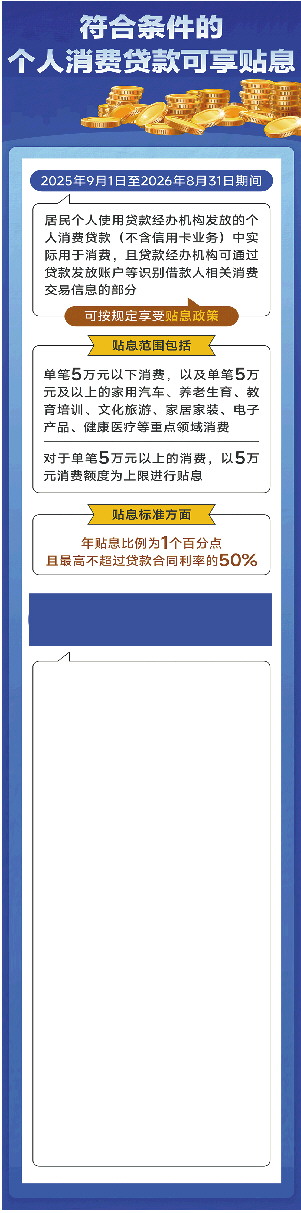
Group 1 - The implementation plan for personal consumption loan interest subsidies aims to stimulate consumer spending and expand domestic demand from September 1, 2025, to August 31, 2026 [1] - The subsidy covers consumption loans under 50,000 yuan and loans for home decoration, household appliances, automobiles, and healthcare for amounts above 50,000 yuan, with a cap at 50,000 yuan for subsidies [1] - The plan is expected to lower credit costs for residents and significantly boost demand in the home decoration and other essential consumption sectors, providing strong recovery momentum for the current consumer market [2] Group 2 - The short-term effect of the implementation plan is anticipated to effectively stimulate consumption and increase order volumes in the home decoration industry [2] - Long-term impacts will depend on various factors, including income and consumption structure, indicating a need for further analysis and adaptation by companies [2] - The introduction of the plan is viewed as a crucial measure for boosting consumption and promoting economic development [2]
【新华解读】两项贴息政策力促居民消费潜力释放 财政金融联动支持促消费、扩内需
Xin Hua Cai Jing· 2025-08-14 13:55
新华财经北京8月14日电(记者董道勇)近日,《个人消费贷款财政贴息政策实施方案》和《服务业经 营主体贷款贴息政策实施方案》两项政策正式发布,备受市场关注。 多位业内人士表示,提振消费是扩大内需的重要发力点,是当前和未来宏观政策的重中之重。两项贷款 贴息政策通过财政和金融的联动,支持促消费、扩内需,释放居民消费潜力,有助于进一步稳定和提升 居民消费弹性。 两项贷款贴息政策释放居民消费潜力 消费是经济增长的重要引擎,是畅通国内大循环的关键环节。今年政府工作报告将"大力提振消费、提 高投资效益,全方位扩大国内需求"列为十项重点任务之首。2025年3月,中共中央办公厅、国务院办公 厅印发《提振消费专项行动方案》,正式实施"提振消费专项行动",并明确"对符合条件的个人消费贷 款和消费领域的服务业经营主体贷款给予财政贴息"。 根据本次实施的《个人消费贷款财政贴息政策实施方案》,2025年9月1日至2026年8月31日期间,居民 个人使用贷款经办机构发放的个人消费贷款(不含信用卡业务)中实际用于消费的,且贷款经办机构可 通过贷款发放账户等识别借款人相关消费交易信息的部分,可按规定享受贴息政策,年贴息比例为1个 百分点,且最 ...
消费贷款五万可贴息五百 多家银行咨询量大增 某网点:有客户提前申请额度
Di Yi Cai Jing· 2025-08-14 11:04
Core Viewpoint - The implementation of a 1% annual interest subsidy for personal consumption loans starting from September 1 is expected to significantly boost consumer spending by several hundred billion yuan [1]. Group 1 - The policy was jointly issued by three departments, indicating a coordinated effort to stimulate consumer lending [1]. - Following the announcement, there has been a notable increase in inquiries at bank branches in Shenzhen, with many customers preemptively applying for loan limits in anticipation of the policy's official rollout [1]. - Experts estimate that this initiative could lead to a substantial increase in consumption, potentially amounting to several hundred billion yuan [1].
交通银行股价报7.60元 六大行集体落实消费贷款贴息政策
Sou Hu Cai Jing· 2025-08-14 10:06
根据最新消息,财政部、中国人民银行、金融监管总局联合发布《个人消费贷款财政贴息政策实施方 案》,对符合条件的个人消费贷款给予财政贴息。交通银行与其他五大国有银行已明确表态,将按市场 化、法治化原则落实该项贴息政策。 截至2025年8月14日15时,交通银行最新股价为7.60元,较前一交易日收盘价上涨0.02元。当日成交量为 129.8万手,成交金额达9.89亿元。 数据显示,交通银行当日主力资金净流入2035.43万元。近五日主力资金净流出2.75亿元。 交通银行是我国历史最悠久的商业银行之一,总部设在上海。作为国有大型商业银行,其主要经营领域 涵盖公司金融业务、个人金融业务、资金业务等。该行在全球范围内设有分支机构,为客户提供全面的 金融服务。 风险提示:投资有风险,入市需谨慎。 来源:金融界 ...

六大行,集体官宣
天天基金网· 2025-08-14 05:09
Core Viewpoint - The article discusses the implementation of a fiscal subsidy policy for personal consumption loans, initiated by the Ministry of Finance, the People's Bank of China, and the Financial Regulatory Bureau, aimed at boosting consumer confidence and stimulating domestic demand [1][24]. Group 1: Implementation of the Policy - The Agricultural Bank of China announced that it will implement the subsidy for eligible personal consumption loans starting from September 1, 2025, following market-oriented and legal principles [2]. - Postal Savings Bank is actively organizing the implementation of the fiscal subsidy policy for personal consumption loans and service industry loans, ensuring that the benefits reach consumers efficiently [4]. - The Bank of Communications stated it will comply with the policy and streamline the loan application process for eligible personal consumption loans [6]. Group 2: Other Banks' Responses - The Industrial and Commercial Bank of China is progressing with the fiscal subsidy work in an orderly manner, ensuring no service fees are charged for the loan subsidy process [8]. - The Bank of China will begin the fiscal subsidy for eligible personal consumption loans on September 1, 2025, aiming to stimulate consumer potential [11]. - China Construction Bank is also set to implement the subsidy for qualifying customers starting September 1, 2025 [14]. Group 3: Broader Participation - Several other banks, including Shanghai Pudong Development Bank, China Merchants Bank, and Guangfa Bank, have announced their commitment to implementing the personal consumption loan subsidy policy [16][18][21]. - A total of 23 financial institutions have been selected as loan processing agencies, including six major state-owned banks and twelve national joint-stock commercial banks [24].



四部门详解两项贴息政策
Xin Hua She· 2025-08-14 03:38
Core Points - The Ministry of Finance and other departments have released two subsidy policies for personal consumption loans and service industry loans, aimed at boosting consumer spending and supporting service sector businesses [1][2] Group 1: Personal Consumption Loan Subsidy Policy - The personal consumption loan subsidy policy is described as a "national subsidy" for consumer loans, directly benefiting the public [2] - The subsidy applies to personal consumption loans used for daily expenses under 50,000 yuan and key consumption areas above 50,000 yuan, with a subsidy rate of 1% [2] - The policy is designed to be inclusive, covering diverse consumer needs and simplifying the application process to ensure accessibility [2][3] Group 2: Service Industry Loan Subsidy Policy - The service industry loan subsidy focuses on eight key sectors, including dining, health, and tourism, with a maximum loan amount of 1 million yuan per entity and a subsidy cap of 10,000 yuan [2][3] - The policy aims to enhance financing support for service providers, reflecting a coordinated effort between fiscal and financial policies [3] Group 3: Financial Coordination and Impact - The People's Bank of China has initiated measures to support consumption, including a 500 billion yuan re-loan for service consumption and elderly care [3] - The subsidy policies are expected to leverage public funds to stimulate additional lending, potentially generating 100 yuan in loans for every 1 yuan in subsidies [3] - The effectiveness of these policies will be evaluated post-implementation, with considerations for extending or expanding support [3][4] Group 4: Implementation and Oversight - Successful implementation of the policies relies on collaboration among various stakeholders, including financial institutions and regulatory bodies [4][5] - The Ministry of Commerce will oversee the management of sectors included in the subsidy, ensuring proper policy execution and monitoring [5] - The financial regulatory authority will guide lending institutions in setting appropriate loan terms and ensuring compliance with fund usage [5]
“双贴息”政策落地,消费“热起来”有底气
Qi Lu Wan Bao· 2025-08-13 22:50
Core Points - The newly introduced personal consumption loan interest subsidy policy aims to stimulate consumer spending and support various sectors of the economy [3][4][9] Group 1: Personal Consumption Loan Subsidy - The subsidy applies to personal consumption loans issued by financial institutions, specifically for actual consumption expenditures, including daily expenses under 50,000 yuan and significant purchases in key areas [4][5] - The subsidy rate is set at 1 percentage point, which is approximately one-third of the current commercial bank personal consumption loan interest rates, and the policy will be in effect for one year [4][5] - Individuals can receive a maximum subsidy of 500 yuan per single transaction, with the potential to accumulate up to 1,000 yuan for multiple transactions at the same institution [5][8] Group 2: Service Industry Loan Subsidy - The service industry loan subsidy targets eight key sectors, including dining, health, elderly care, childcare, home services, cultural entertainment, tourism, and sports, with a similar subsidy rate of 1 percentage point [4][6] - Each service entity can receive a maximum loan subsidy of 10,000 yuan, with a total loan amount capped at 1 million yuan [4][6] Group 3: Application Process and Implementation - The application process for both subsidies is simplified, requiring no additional actions from borrowers, as the financial institutions will handle the subsidy calculations and disbursements [7][13] - Borrowers must grant permission to the lending institution to access transaction information to facilitate the subsidy process [8][13] Group 4: Policy Evaluation and Future Considerations - The effectiveness of the subsidy policies will be evaluated after their expiration, with potential considerations for extending the policy duration or expanding its scope [9][10] - The policies are designed to prevent misuse of funds, ensuring that subsidies are only granted for legitimate consumption activities [10][11][12][15]