白酒高端化

Search documents
白酒价格彻底崩塌,经销商哭诉:卖一箱亏200,挺不住了
商业洞察· 2025-07-01 10:30
Core Viewpoint - The Chinese liquor industry, particularly the high-end segment, is experiencing significant challenges, with prices declining and consumer preferences shifting towards more affordable options [3][5][6]. Group 1: Price Trends and Market Dynamics - During the 2023 618 shopping festival, the prices of high-end liquors like Moutai and Wuliangye fell sharply due to aggressive discounts, with Moutai's price dropping to as low as 1840 yuan per bottle, a significant decrease compared to the previous year [3][9]. - The overall market for high-end liquor is under pressure, with many brands experiencing price declines and some products seeing price drops of over 1000 yuan within a year [10][11]. - The pricing structure of the liquor industry is changing, moving from a focus on market comparison and cost advantages to aggressive price competition, similar to trends seen in the electric vehicle sector [12]. Group 2: Industry Challenges - The liquor industry is facing a significant inventory crisis, with total inventory across 20 listed companies reaching 153.6 billion yuan, a 12.41% increase year-on-year, and many companies experiencing rising stock levels [18][19]. - The industry is grappling with overcapacity and stagnant consumption, with production capacity among the top six liquor companies increasing by 37% since 2020, while consumer demand has not kept pace [22]. - The shift in consumer demographics is notable, with younger generations consuming significantly less liquor than their predecessors, leading to a structural decline in demand [22][23]. Group 3: Future Outlook - The liquor industry is expected to continue its adjustment phase, with price declines likely to persist, necessitating changes from both companies and the industry as a whole to foster a healthier market environment [33]. - The focus is shifting back to the true value of liquor as a consumer product, moving away from the excessive added values previously associated with it, such as status symbols and investment properties [30][32]. - Companies that can effectively engage younger consumers and adapt their product offerings will be better positioned for long-term success in the evolving market landscape [30][31].




白酒格局巨变,山西汾酒能站稳行业第三吗?
Sou Hu Cai Jing· 2025-06-03 01:59
Core Viewpoint - The Chinese liquor industry, particularly the baijiu sector, is facing significant challenges due to weak consumer demand and increased competition, with Shanxi Fenjiu emerging as the third-largest player in 2024, but struggling to maintain its position against stronger competitors like Kweichow Moutai and Wuliangye [2][3][5]. Group 1: Industry Overview - The baijiu industry is experiencing a downturn, with a notable decline in production and a competitive landscape that poses risks even for leading companies [2][5]. - In 2024, the total revenue of the baijiu industry reached 796.38 billion yuan, with a year-on-year growth of 5.3%, while production fell to 4.145 million kiloliters, down 1.8% from the previous year [5][6]. Group 2: Shanxi Fenjiu's Performance - Shanxi Fenjiu reported a revenue of 36.011 billion yuan in 2024, marking a 12.79% increase year-on-year, and a net profit of 12.243 billion yuan, up 17.29% [3][4]. - In Q1 2025, Shanxi Fenjiu continued its growth trajectory with a revenue of 16.522 billion yuan, a 7.72% increase, and a net profit of 6.648 billion yuan, up 6.15% [4]. Group 3: Competitive Positioning - Despite its revenue growth, Shanxi Fenjiu's profitability is under pressure, as it lags behind competitors like Luzhou Laojiao in net profit, with Shanxi Fenjiu's profit at 12.243 billion yuan compared to Luzhou Laojiao's 13.473 billion yuan [6][8]. - Shanxi Fenjiu's strategy appears to focus on volume over price, leading to lower average selling prices compared to competitors, which may hinder its ability to compete in the high-end market [8][9]. Group 4: Management and Governance Issues - Shanxi Fenjiu currently lacks a complete executive team, with the position of General Manager remaining vacant since June 2023, raising concerns about governance stability [10][12][15]. - The absence of a General Manager and recent high-level management changes may impact the company's strategic direction and operational effectiveness [15][16]. Group 5: Market Challenges - The company faces challenges from counterfeit products and market saturation, which could undermine its brand and consumer trust [18][19]. - Shanxi Fenjiu's market position is threatened by increasing competition from both established players and emerging brands, making it difficult to maintain its third-place ranking in the industry [2][19].


摸着“洋河” ,今世缘要过“全国化”这条河
3 6 Ke· 2025-05-26 12:49
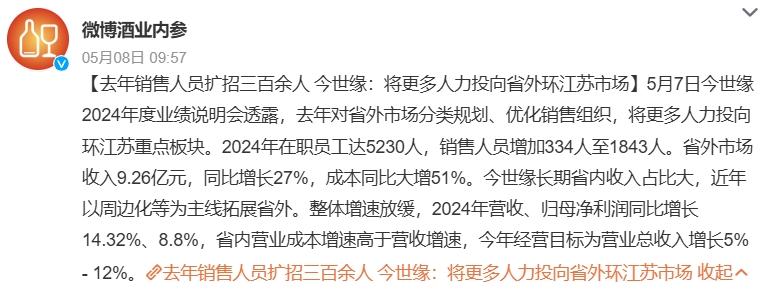
Core Viewpoint - Jinshiyuan is accelerating its national expansion strategy while facing challenges in achieving its revenue targets and competing in a saturated market [1][2][5]. Group 1: Company Strategy and Performance - Jinshiyuan is focusing on increasing its manpower investment in markets outside Jiangsu and optimizing its sales organization to enhance its presence in surrounding provinces [1][16]. - The company aims to achieve a revenue target of approximately 150 billion yuan by 2025, with a goal of having 20% of its revenue come from outside Jiangsu [2][5]. - In 2024, Jinshiyuan reported a revenue of 11.544 billion yuan, a year-on-year increase of 14.32%, and a net profit of 3.412 billion yuan, up 8.8% from the previous year [3][4]. Group 2: Market Challenges - Despite achieving over 100 billion yuan in revenue, Jinshiyuan's growth has slowed, with its stock price declining by over 10% in the second quarter of 2024 [5][7]. - The company’s revenue from outside Jiangsu was only 9.3 billion yuan in 2024, accounting for just 8.02% of total revenue, indicating slow progress in national expansion [12][14]. - Jinshiyuan's strategy of following the market leader, Yanghe, has not translated effectively to markets outside Jiangsu, leading to difficulties in establishing brand recognition [11][12]. Group 3: Competitive Positioning - Jinshiyuan has positioned its products competitively against Yanghe by offering similar products at lower price points across various price segments [7][11]. - The company has adopted a differentiated marketing strategy to enhance channel profitability and incentivize distributors, which has led to a rapid market rollout [10][11]. - However, the high-end product pricing strategy has faced challenges, with significant price discrepancies leading to consumer skepticism about value [21][22]. Group 4: Financial Health and Inventory Management - Jinshiyuan's contract liabilities have decreased significantly, indicating a shift in its sales strategy to reduce prepayment requirements from distributors [24]. - The company's inventory levels have increased, with a notable rise in inventory turnover days, reflecting potential overstock issues [26]. - As of the end of 2024, Jinshiyuan's total assets reached approximately 24.22 billion yuan, with a net asset value of about 15.45 billion yuan, showing a healthy balance sheet despite operational challenges [4][24].

白酒巨头们,要过一段苦日子了
投中网· 2025-05-23 02:29
Core Viewpoint - The high-end liquor market in China, particularly the segment above 1000 yuan, is experiencing significant price declines, with major brands like Wuliangye, Guojiao 1573, and Moutai 1935 losing their price stability and market value [4][10][20]. Group 1: Price Trends and Market Dynamics - The retail prices of high-end liquors have dropped significantly, with Wuliangye and Guojiao 1573 now selling for around 930 to 980 yuan, while Moutai 1935 has fallen to as low as 700 yuan [6][10][21]. - The official guidance prices for these products remain high, with Wuliangye at 1499 yuan, Guojiao 1573 at 1399 yuan, and Moutai 1935 at 1188 yuan, but actual market prices are consistently below these levels [6][14][15]. - The decline in prices is attributed to poor market conditions and oversupply, leading to a situation where many retailers are selling below their cost price [17][20]. Group 2: Brand Strategies and Market Positioning - Wuliangye and Guojiao 1573 have historically increased their prices in response to market trends, while Moutai has attempted to fill the gap in the high-end market with Moutai 1935, which has not sustained its initial pricing power [13][16]. - Moutai 1935, launched in 2022, initially saw high demand but has since struggled with excess inventory and declining sales, leading to significant price drops [18][21]. - The competitive landscape is shifting, with brands like Wuliangye and Guojiao 1573 managing to maintain some price stability, while Moutai 1935 is increasingly seen as unable to uphold its market position [23][24]. Group 3: Future Outlook and Industry Challenges - The overall high-end liquor market is facing challenges as consumer demand wanes and price competition intensifies, making it difficult for brands to maintain their pricing strategies [20][24]. - Moutai plans to expand its product offerings and stabilize prices, but the effectiveness of these strategies remains uncertain given the current market conditions [21][22]. - The industry is witnessing a return to more rational consumer behavior, leading to further price corrections and challenges for brands that have previously relied on high pricing strategies [24].

“河北王”老白干酒的未来:区域龙头如何破局全国市场?
Sou Hu Cai Jing· 2025-05-11 09:05
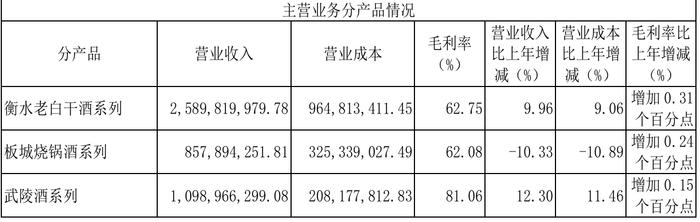
Core Viewpoint - The revenue growth of Laobai Gan liquor has significantly declined, with a 2024 revenue of 5.36 billion yuan, a mere 1.91% increase year-on-year, raising concerns about the sustainability of profit growth despite a net profit increase of 18.19% [2][4][5] Financial Performance - In 2024, Laobai Gan achieved a total revenue of 5.36 billion yuan, up 1.91% from 2023's 5.26 billion yuan, which had a 12.98% growth [3][4] - The net profit attributable to shareholders was 787 million yuan, reflecting an 18.19% increase compared to 666 million yuan in 2023 [3][4] - The net profit after deducting non-recurring gains and losses was 738 million yuan, a 20.12% increase from 614 million yuan in 2023 [3] Revenue Breakdown - The primary sales region for Laobai Gan remains Hebei, generating 3.12 billion yuan in revenue, a 2.61% increase [5] - Other notable revenue contributions include Hunan at 1.10 billion yuan (12.30% growth), Anhui at 550 million yuan (0.53% growth), and Shandong at 210 million yuan (31.39% growth) [5] Product Performance - The core product line, Laobai Gan series, generated 2.59 billion yuan, accounting for 48% of total revenue, with a growth of 9.96% [8] - The Wuling series saw a revenue of 1.10 billion yuan, up 13.30%, while the Kongfu family series grew by 28.12% to 230 million yuan [8] - High-end products priced above 100 yuan generated 2.70 billion yuan, a 5.29% increase, while products priced at or below 100 yuan generated 2.62 billion yuan, a 7.09% increase [8][9] Strategic Challenges - Laobai Gan's struggle to expand its market presence and high-end product sales is attributed to limited geographical reach and insufficient brand recognition [5][7] - The company faces intense competition not only from leading domestic brands but also from local competitors in Hebei [7] - The high pricing strategy for the 1915 series has not translated into significant market traction, highlighting the challenges of positioning as a premium brand [10] Future Outlook - The company's ability to penetrate the high-end market through targeted marketing and the success of its regional strategies will be critical for future growth [12] - Without achieving a revenue scale of 10 billion yuan within the next 3-5 years, Laobai Gan risks falling out of the second-tier market [12]


今世缘:2024、25Q1业绩点评业绩符合预期,目标务实积极-20250505
ZHESHANG SECURITIES· 2025-05-05 15:40
Investment Rating - The investment rating for the company is "Buy" (maintained) [6] Core Views - The company's performance in 2024 and Q1 2025 met expectations, with total revenue and net profit for 2024 reaching 115.46 billion and 34.12 billion respectively, reflecting year-on-year growth of 14.31% and 8.80% [10] - The company is currently in a phase of significant growth, with strong performance in both domestic and international markets, particularly in the high-end segment [10] - The company aims for a total revenue growth of 5%-12% and a net profit increase slightly lower than revenue growth for 2025, indicating confidence in sustained momentum [10] Revenue Growth - In 2024, the revenue growth rates for domestic and international markets were 13.32% and 27.37% respectively, with the proportion of international revenue increasing by 1.73 percentage points [2] - For Q1 2025, the revenue growth rates were 8.45% for domestic and 19.04% for international markets, with the international revenue share rising by 1.38 percentage points [2] Profitability and Cash Flow - The company's gross margin and net margin for 2024 were 74.74% and 29.55%, showing a slight decline of 3.60 and 1.50 percentage points year-on-year [3] - Operating cash flow increased by 2.37% in 2024 and by 42.5% in Q1 2025, indicating strong cash flow performance [3] Earnings Forecast and Valuation - Revenue growth forecasts for 2025-2027 are 9.1%, 9.6%, and 9.7% respectively, with net profit growth rates of 7.9%, 9.4%, and 9.5% [4] - The expected earnings per share (EPS) for 2025, 2026, and 2027 are 2.95, 3.23, and 3.54 yuan per share, with corresponding price-to-earnings (P/E) ratios of 16.05, 14.67, and 13.40 [4]
2024年营收突破360亿元,清香白酒龙头延续发展韧性
21世纪经济报道· 2025-04-30 07:53
白酒深度调整期,山西汾酒延续了"汾酒速度",交出了一份逆势上扬的成绩单。 4月3 0日,山西汾酒披露2 0 2 4年年度报告和2 0 2 5年一季度报。财报显示,2 0 2 4年全年汾酒实 现 营 业 收 入 3 6 0 . 11 亿 元 , 同 比 增 长 1 2 . 7 9% , 稳 居 行 业 前 三 ; 归 属 于 上 市 公 司 股 东 的 净 利 润 1 2 2 . 4 3亿元,同比增长1 7 . 2 9%。 2 0 2 5年一季度也表现不俗,营业收入1 6 5 . 2 2亿元,同比增长7 . 7 2%,净利润6 6 . 4 8亿元,同比 增长6 . 1 5%。 2 0 2 4年的白酒行业,饱受"产能过剩" "价格倒挂" "库存高压"的压力。当多数酒企承受阵痛之 时,山西汾酒营收与净利润双增长的成绩,颇为不易。 穿越周期的韧性背后,是汾酒通过产品结构、市场等维度的坚实筑基,实现高端化及全国化 布局的进一步突围。随着清香型白酒不断攀高,市场持续扩容,在汾酒的带领下,清香大时 代已全面开启。 高端产品成功卡位 玻汾稳固"霸主地位" 在市场持续消化能力不足,营销刺激效果减弱,渠道库存压力增大,产品动销频 ...
老白干酒身上压着“三座大山”
Xin Lang Cai Jing· 2025-04-28 10:25
Core Viewpoint - The financial report of Laobai Ganjiu for 2024 shows a revenue of 5.358 billion yuan, a year-on-year increase of 1.9%, and a net profit of 787 million yuan, a year-on-year increase of 18% [1] Revenue and Profit Analysis - The revenue growth in 2024 was primarily driven by an optimized product structure with increased sales of mid-to-high-end liquor and ongoing cost reduction initiatives [1] - The company set a revenue target of 5.78 billion yuan for 2024 but fell short, achieving only 5.358 billion yuan, which is a significant slowdown compared to previous years [1] - Historical revenue figures from 2021 to 2023 were 4.027 billion yuan, 4.653 billion yuan, and 5.257 billion yuan, with growth rates of 11.93%, 15.54%, and 12.98% respectively [1] Product Performance - The revenue from products priced above 100 yuan reached 2.7 billion yuan, a year-on-year increase of 5.29%, while products below 100 yuan generated 2.6 billion yuan, a year-on-year increase of 7.09% [2] - The main revenue contributor is the Hengshui Laobai Ganjiu series, which generated approximately 2.59 billion yuan in 2024, accounting for about 48% of total revenue [3] - The highest revenue growth was seen in the Kongfu Family Wine series, which achieved approximately 230 million yuan, a year-on-year increase of 28.12% [3] - The only product series with a revenue decline was the Bancheng Shaoguo series, which saw a revenue drop of 10.33% to approximately 858 million yuan [3] Market Performance - The primary sales region for Laobai Ganjiu in 2024 was Hebei, contributing 3.118 billion yuan, a year-on-year increase of 2.61%, accounting for nearly 60% of total revenue [3] - The second-largest market was Hunan, where revenue reached approximately 1.098 billion yuan, a year-on-year increase of 12.30%, with a high gross margin of 81.06% [3] Strategic Initiatives - The company is currently discussing plans for national expansion and product management, with no specific details disclosed yet [5] - Laobai Ganjiu has been focusing on mid-to-high-end transformation, particularly with the Wuling wine brand, which has shown good growth despite a challenging market environment [5] - The gross margin for Wuling wine reached 81.06%, significantly higher than the overall product gross margin of 66.15% [6] Cost Management - The company successfully implemented cost control measures, with total operating costs kept within 4.366 billion yuan, including operating costs of 1.824 billion yuan and expenses of 1.654 billion yuan [6] - For 2025, Laobai Ganjiu has set a more conservative revenue target of 5.47 billion yuan, with a projected growth rate of 2.1% [6] - In the first quarter of 2025, the company achieved revenue of 1.168 billion yuan, a year-on-year increase of 3.36%, and a net profit of 152 million yuan, a year-on-year increase of 11.91% [6]
年轻人上桌,白酒慌了?
3 6 Ke· 2025-04-26 09:45
Industry Overview - The Chinese liquor industry is experiencing a downturn in early 2024, with some second and third-tier companies facing significant challenges, including substantial profit declines and even losses, while top-tier companies maintain stability [2][4] - The overall growth of the industry is slowing, with the liquor sector's stock prices dropping over 12% since November of the previous year [2] Market Dynamics - The companies that previously saw rapid growth due to price increases and channel expansions are now under pressure from both performance and inventory challenges [4] - The financial attributes of liquor have impacted both investors and distributors, with first-tier liquor prices remaining stable, while lower-tier brands struggle to find a compelling narrative [5] Inventory and Pricing - By the first three quarters of 2024, the inventory levels of listed liquor companies approached the total for 2023, nearly doubling since 2019 [8] - Major brands like Moutai have had to lower their wholesale prices from around 2600 yuan to approximately 2200 yuan per bottle, while still maintaining profitability due to a lower factory price [8] Consumer Trends - The main consumer demographic for liquor is shifting, with younger generations (born between 1985-1994 and post-1995) becoming the new primary consumers, accounting for 34% and 18% respectively [10] - Despite a general decline in consumption across other sectors, the young liquor market has grown to 400 billion yuan, with a potential consumer base of 490 million [10] Changing Preferences - Young consumers are increasingly resistant to traditional liquor culture, associating it with negative connotations and preferring lower alcohol content beverages [14][20] - Many liquor companies are responding to these changing preferences by introducing lower-alcohol products, but these still may not appeal to younger consumers accustomed to sweeter drinks [14] Marketing Strategies - Liquor brands are attempting to modernize their image through cross-industry collaborations, such as partnerships with ice cream and coffee brands, to attract younger consumers [19] - However, these marketing efforts often fail to create lasting brand loyalty, as the core product remains unchanged [22] Future Outlook - The liquor industry is entering a new cycle characterized by market segmentation, consumption upgrades, and structural transformation [22] - The perception of liquor is being redefined, with younger consumers not abandoning it but rather seeking to understand and adapt it to their preferences [22]