
竞业限制

Search documents
“宁王”阻击“小宁德”,“泄密案”打破吴祖钰上市梦?
阿尔法工场研究院· 2025-08-08 00:07
Core Viewpoint - The article discusses the challenges faced by Haichen Energy Storage, particularly in light of legal issues and its upcoming IPO, which may impact its market position and financial stability [5][7][14]. Group 1: Legal Issues and IPO Impact - Haichen Energy Storage's president was detained for allegedly infringing on trade secrets, which has raised concerns about the company's IPO prospects [5][7]. - The company must demonstrate to regulators that ongoing litigation does not affect its operational capabilities, or it risks delays or termination of its IPO process [7][8]. - The legal troubles stem from competitive tensions with CATL, with Haichen asserting that the disputed technology is publicly known and not a trade secret [9][11]. Group 2: Company Background and Growth - Founded in 2019, Haichen Energy Storage has rapidly grown to become the third-largest energy storage battery manufacturer globally, focusing on lithium-ion storage solutions [16][14]. - The company has completed four rounds of financing, raising a total of 8 billion RMB, and has shown impressive revenue growth, with a compound annual growth rate of 89% from 2021 to 2024 [17][19]. - Despite its growth, the company faces financial risks, with accounts receivable surging from 22.3 million RMB in 2022 to 8.315 billion RMB in 2024, representing 69.5% of its revenue [19]. Group 3: International Expansion and Market Challenges - Haichen's international revenue share increased from 0% in 2022 to 28.6% in 2024, with significant contributions from the U.S. market [21][23]. - The company has faced challenges due to the recent bankruptcy of a major U.S. client, Powin, although it claims no direct financial impact from this event [23][24]. - The U.S. market's shrinking demand for energy storage solutions, exacerbated by recent legislative changes, poses a significant risk to Haichen's overseas operations and overall financial health [24][25].



创业之前,先擦干净竞业的屁股
Hu Xiu· 2025-08-05 07:18
Core Insights - The article discusses the competitive dynamics between companies and their employees during the resignation process, highlighting the tactics used by both parties to protect their interests [1][4][14] Group 1: Employee Tactics - Employees often engage in various strategies to safeguard their information and avoid detection when planning to leave a company, including encoding files and using QR codes to transfer data discreetly [3][12] - Some employees may take photos of important documents over time to ensure they have access to necessary information without leaving a trace [3][12] Group 2: Company Concerns - Companies are particularly troubled when key personnel leave and take other employees with them to form a competing business, which can significantly impact their operations [4][10] - The case of JD.com is highlighted, where the departure of core team members to establish a competing company, NineSight, raised concerns about premeditated actions and potential intellectual property theft [7][9] Group 3: Legal and Investigative Actions - JD.com has reported the situation to law enforcement, claiming to have gathered substantial evidence of infringement by NineSight, indicating a serious approach to protecting its interests [6][11] - The article suggests that companies often employ various methods to monitor former employees and prevent them from joining competitors, including surveillance and tracking their activities [12][13] Group 4: Ethical Considerations - The article raises questions about professional ethics in the workplace, noting that both companies and employees often struggle to adhere to legal and ethical standards during the resignation process [14][15] - It emphasizes the need for both parties to find a balance in their actions to avoid legal disputes and maintain professional relationships [15]


劳资双方不缴纳社保的约定,无效!
Ren Min Ri Bao· 2025-08-04 01:02
Group 1 - The core viewpoint of the article emphasizes the invalidity of agreements between employers and employees to not pay social insurance, reinforcing that employees can terminate contracts and seek compensation if social insurance is not paid [3][4] - The new interpretation, effective from September 1, 2025, clarifies the legal consequences of such agreements and supports employees' rights to compensation [2][4] - The article highlights a case where an employee successfully claimed compensation after the employer failed to pay social insurance, illustrating the enforcement of this legal principle [3][4] Group 2 - The article discusses a case where an employee's refusal to sign a written labor contract does not obligate the employer to pay double wages, as the employee acted intentionally [5][6] - It clarifies that the employer is not liable for double wages if the employee deliberately avoids signing a contract, emphasizing the mutual nature of contract agreements [6] - The interpretation also specifies conditions under which employers must offer indefinite contracts after two fixed-term contracts, preventing evasion of legal obligations [6][8] Group 3 - The article addresses the responsibility of contractors in construction projects regarding work-related injuries, stating that contractors must pay for work injury insurance even if there is no direct employment relationship [9][10] - It emphasizes that the contractor's liability for work injury insurance is crucial for protecting workers' rights and ensuring timely compensation in case of accidents [10] - The interpretation aims to regulate subcontracting practices and uphold labor rights in the construction industry [10]
福利待遇、竞业限制等劳动争议案件上升,最高法发布司法解释—— 劳资双方不缴纳社保的约定,无效!(法治聚焦)
Ren Min Ri Bao· 2025-08-03 21:52
Group 1 - The core viewpoint of the article emphasizes the invalidity of agreements between employers and employees to not pay social insurance fees, reinforcing that such agreements do not hold legal weight and employees can terminate contracts and seek compensation [3][4][6] - The Supreme People's Court's interpretation clarifies that any agreement or promise by an employer or employee to not pay social insurance fees is invalid, and courts will support employees in seeking economic compensation for non-payment [4][6][10] - The article highlights a trend of increasing labor disputes related to welfare benefits, non-compete clauses, and social insurance, indicating a growing need for legal clarity in these areas [1][4] Group 2 - The article discusses a case where an employee, who voluntarily chose not to sign a written labor contract, was denied the right to claim double wages, as the employer was not liable due to the employee's intentional non-compliance [5][6] - It is noted that the interpretation specifies that if an employee intentionally or negligently fails to sign a written labor contract, the employer is not obligated to pay double wages [6][8] - The article also addresses non-compete agreements, stating that such agreements must align with the employee's knowledge of the employer's trade secrets and intellectual property, and any excessive restrictions are deemed invalid [7][8] Group 3 - The article outlines that in cases of subcontracting in the construction industry, the primary contractor remains responsible for paying work-related injury insurance, even if there is no direct labor relationship with the injured worker [9][10] - It emphasizes that the responsibility for labor remuneration and work injury insurance lies with the contractor, regardless of whether the subcontractor has the legal qualifications to operate [10] - The interpretation aims to address common issues in subcontracting practices, ensuring that workers receive timely compensation and protecting their legal rights [10]
最高法发布司法解释 涉及社会保险、竞业限制、福利待遇等热点争议问题
Yang Shi Wang· 2025-08-01 08:22
Group 1 - The Supreme People's Court has issued judicial interpretations to address rising labor dispute cases, particularly focusing on social insurance, non-compete agreements, and labor contracts, effective September 1 [1][2] - The interpretations clarify that any agreement to not pay social insurance is invalid, reinforcing the obligation of employers and employees to participate in social insurance [1][2] - Employers are required to pay economic compensation to employees who terminate contracts due to non-payment of social insurance, calculated as one month's salary for each year of service [1][2] Group 2 - Non-compete agreements must be reasonable and cannot be applied indiscriminately; they are only valid for employees who have access to confidential information [3][4] - The interpretations specify that non-compete clauses are invalid if the employee has not been exposed to confidential information, promoting fair employment practices [4] - Employers must ensure that the scope, region, and duration of non-compete agreements are appropriate to the confidential information the employee has access to [4] Group 3 - The judicial interpretations clarify that employers are not liable to pay double wages if the employee intentionally fails to sign a labor contract [6][7] - Specific conditions under which double wage liability does not apply include situations caused by force majeure or employee negligence [6][7] - The calculation of double wages is defined as monthly, with provisions for partial months based on actual working days [7] Group 4 - The interpretations establish clear criteria for recognizing consecutive fixed-term labor contracts, ensuring employees' rights to request indefinite contracts after two consecutive terms [8] - Employers cannot deny the existence of two contracts to evade obligations, which protects employees' long-term job security [8] Group 5 - The interpretations address issues of subcontracting and mixed employment, holding contractors and associated parties responsible for labor rights violations [10] - In cases of mixed employment without written contracts, related companies are jointly liable for wage payments and other responsibilities [10] - Employees are advised to retain evidence of payment and work assignments to support their claims in case of rights violations [11]
关于竞业限制、社保等劳动争议,最高法明确→
Zhong Guo Xin Wen Wang· 2025-08-01 06:53
Group 1 - The Supreme People's Court has clarified the legal standards for labor disputes, including non-compete agreements and social insurance issues, effective from September 1 [1] - Non-compete clauses are invalid if the employee is unaware of the employer's trade secrets or related confidential matters, and the scope of such clauses must align with the employee's knowledge of these secrets [2] - Agreements between employers and employees to not pay social insurance are invalid, as social insurance is a fundamental right for employees and a legal obligation for employers [3] Group 2 - Employers are not liable to pay double wages if a written labor contract is not established due to force majeure or employee negligence, and specific conditions for continuous fixed-term contracts are clarified [5][6] - Contractors and subcontractors are responsible for labor remuneration and work-related injury insurance if they transfer their business to unqualified entities [7] - Courts will support employees in confirming labor relationships based on management behavior and other factors when no formal contract exists with the employing entity [8]
竞业限制、社保纠纷等案件呈上升趋势 最高法司法解释明确标准
2 1 Shi Ji Jing Ji Bao Dao· 2025-08-01 05:46
Core Viewpoint - The Supreme Court's new interpretation aims to regulate the abuse of non-compete agreements and ensure that employers fulfill their obligations regarding social insurance, addressing rising labor disputes and promoting harmonious labor relations [1][2][3]. Non-Compete Agreements - The new interpretation restricts the generalization and abuse of non-compete agreements, stating that such clauses are invalid if the employee is unaware of the employer's trade secrets or related confidentiality matters [2][3]. - Non-compete clauses must align with the employee's knowledge and exposure to the employer's confidential information, and any excessive restrictions are deemed invalid [2][3]. Social Insurance Obligations - Employers are mandated to pay social insurance, and any agreements to waive this obligation are considered invalid, even if the employee requests it [5][6]. - If an employee terminates their contract due to the employer's failure to pay social insurance, the employer is liable for economic compensation [5][6]. Labor Relations and Responsibilities - The interpretation clarifies that contractors and associated entities must bear responsibility for labor relations, ensuring that employees receive their wages and social insurance benefits [6][7]. - In cases of mixed employment, courts will support employees in confirming their labor relationships based on management practices and other relevant factors [7].
事关社保缴费、竞业限制等 最高法发布劳动争议案件司法解释
Xin Hua Wang· 2025-08-01 04:10
Core Points - The Supreme People's Court issued an interpretation to address legal issues in labor dispute cases, aiming to protect the legal rights of parties involved and maintain stable labor relations [1][2] - The interpretation emphasizes the combination of prioritizing stable employment and promoting high-quality economic development, guiding employers to fulfill their social responsibilities [1] Group 1 - The interpretation clarifies the criteria for determining "consecutive fixed-term labor contracts," preventing employers from evading the obligation to sign indefinite-term contracts [1] - It addresses common issues such as subcontracting, outsourcing, and non-payment of social insurance, establishing that contractors and those involved in mixed employment bear the responsibility for labor relations [1][2] - Agreements between employers and employees to not pay social insurance are deemed invalid, reinforcing the protection of workers' rights [1] Group 2 - To facilitate orderly talent mobility, the interpretation states that non-compete clauses are ineffective if the employee is unaware of the employer's trade secrets or related confidentiality matters [2] - Non-compete clauses must align with the trade secrets and intellectual property knowledge the employee has been exposed to; any excessive restrictions are invalid [2] - The interpretation allows courts to determine compensation responsibilities for employees who fail to fulfill agreed-upon labor terms after receiving special treatment from employers, based on actual losses and fault levels [2] Group 3 - The Supreme Court released six typical labor dispute cases to illustrate the rules established by the interpretation, aiding in better understanding and application [2] - The court plans to enhance judicial guidance by continuously publishing typical cases and improving the case database, providing robust judicial services to promote high-quality and full employment [2]
最高法:竞业限制不得滥用 非涉密人员签约不生效
Yang Shi Xin Wen· 2025-08-01 03:42
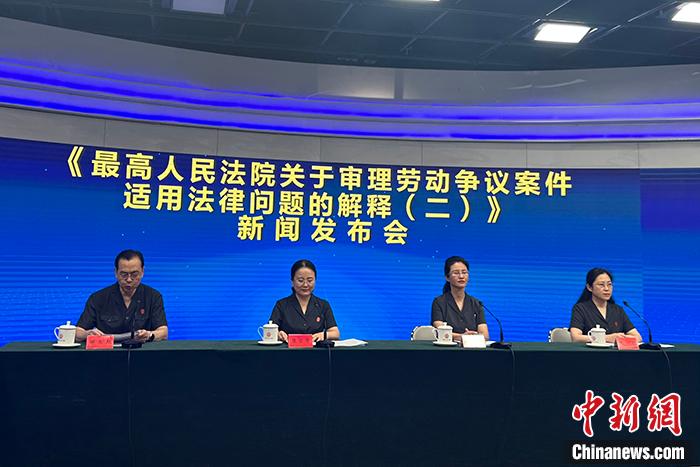
今天(8月1日),最高人民法院召开新闻发布会,发布《最高人民法院关于审理劳动争议案件适用法律 问题的解释(二)》,针对社会广泛关注的热点争议问题,统一法律适用标准,切实维护劳动者合法权 益。解释自9月1日起施行。 竞业限制协议是市场中常见的保护商业秘密等保密事项的合同。负有保密义务的劳动者在职期间及离职 后一定期限内,不得自营或者到与原单位有竞争关系的单位任职。但有些公司不管劳动者是否接触商业 秘密等保密事项,无差别地签订竞业限制协议,约定高额违约金,严重限制了劳动者的择业权。司法解 释针对这一问题作出明确规范,为竞业限制划出合法边界。 最高人民法院民一庭副庭长吴景丽介绍,竞业限制是指劳动者在单位工作期间,掌握了单位的商业秘 密,就不能在职期间或者离职之后从事与单位的商业秘密有关的具有竞争关系的这种活动;如果从事 了,那就应该承担相应的违约责任。竞业制度这样限制的目的主要就是为了防止恶性竞争,保护企业的 竞争优势。 为了防止商业秘密的泄露和不正当竞争,司法解释规定:用人单位依法与竞业限制人员约定的在职竞业 限制条款合法有效,劳动者违反竞业限制约定时,应依法承担违约责任。 最高人民法院民一庭副庭长 吴景丽:劳动 ...
最高法:竞业限制不得滥用,非涉密人员签约不生效
news flash· 2025-08-01 02:47
竞业限制协议是市场中常见的保护商业秘密等保密事项的合同。负有保密义务的劳动者在职期间及离职 后一定期限内,不得自营或者到与原单位有竞争关系的单位任职。但有些公司不管劳动者是否接触商业 秘密等保密事项,无差别地签订竞业限制协议,约定高额违约金,严重限制了劳动者的择业权。司法解 释针对这一问题作出明确规范,为竞业限制划出合法边界。 今天(8月1日),最高人民法院召开新闻发布会,发布《最高人民法院关于审理劳动争议案件适用法律 问题的解释(二)》,针对社会广泛关注的热点争议问题,统一法律适用标准,切实维护劳动者合法权 益。解释自9月1日起施行。 最高人民法院民一庭副庭长 吴景丽:劳动者是一个公司的销售经理,掌握着公司的客户资源。把客户 资源卖给了另外一个有竞争关系的供货商,导致供货商向公司客户出卖商品,这就相当于损害了本公司 的利益,也就违反了竞业限制,就应该承担相应的违约责任。 同时,为遏制竞业限制协议"滥用",保障人才有序流动,此次司法解释明确了竞业限制条款不生效或无 效的情形。司法解释规定:劳动者未知悉、接触保密事项,竞业限制条款不生效。这意味着,不属于竞 业限制范围的劳动者,即使订立竞业限制协议,此约定对劳动 ...