线下服务信用体系

Search documents
高德闪击美团,到店战火再升级
3 6 Ke· 2025-09-10 23:48
Core Insights - Alibaba's Gaode launched the "Street Ranking" to challenge Meituan's Dianping, aiming to establish a new offline service credit system [1][2] - The introduction of the Street Ranking signifies an escalation in the competition for Meituan's core profit area, transitioning from food delivery to instant retail and local services [3][8] - A "post-review era" is emerging, where real user behavior data will become the core metric for measuring commercial value, with credit replacing traffic as the most valuable asset for merchants [4][14] Gaode's Strategy - Gaode's Street Ranking integrates user behavior data with feedback, making it difficult to manipulate rankings, thus targeting Meituan's weaknesses [2][3] - The ranking system is based on a "behavior + credit" model, utilizing real user actions such as navigation to stores and repurchase rates to create a trustworthy scoring system [5][6] - By leveraging vast and authentic user data, Gaode aims to provide a more reliable evaluation system compared to traditional review platforms [10][11] Competitive Landscape - Gaode's entry into the local services market poses a significant threat to Meituan, which has relied heavily on its food delivery and local service business for profits [12][13] - Meituan's core local business, particularly in dining and travel, has a much higher profit margin compared to its food delivery segment, making it vulnerable to Gaode's new offerings [12][13] - The competition is intensifying, with both Gaode and Douyin (TikTok) targeting Meituan's market share, indicating a shift in the balance of power in the local services sector [13][14] Future Implications - The Street Ranking could transform how merchants operate, allowing them to focus on product and service quality rather than manipulating reviews for visibility [7][14] - For consumers, the new ranking system promises a more straightforward and trustworthy selection process, enhancing their overall experience [7][14] - Gaode's evolution from a navigation tool to a comprehensive service platform could redefine its role in the local economy, potentially becoming an essential "life service intelligence" provider [14]




对标美团,阿里砸10亿补贴推“高德扫街榜”
Xin Lang Cai Jing· 2025-09-10 15:17
Core Viewpoint - Alibaba's launch of the "Gaode Street Ranking" is seen as a direct competition to Meituan's review business, aiming to enhance local service consumption through user behavior-based rankings and significant subsidies [1][3]. Group 1: Gaode Street Ranking - The "Gaode Street Ranking" is the world's first ranking based on user behavior, designed to encourage offline consumption with over 1 billion yuan in subsidies, targeting an additional 10 million customers daily for the service industry [1]. - The ranking features various categories such as "Tire Wear Ranking" for long-distance visits and "Repeat Customer Ranking," with daily updates based on dynamic data [1][4]. - Gaode aims to establish a credit system for offline services, addressing the challenges faced by restaurants regarding low barriers for negative reviews and high costs for positive ones [3]. Group 2: Business Strategy and Financial Performance - Gaode's CEO emphasized that the ranking will never be commercialized, aiming to create a healthy ecosystem that prioritizes genuine user experiences over artificial metrics [3]. - Alibaba's recent financial report showed a revenue of 247.65 billion yuan for Q1 FY2026, a 2% year-on-year increase, with a 10% growth when excluding sold businesses [4]. - The company's instant retail business has shown significant growth, with a 25% year-on-year increase in monthly active consumers on the Taobao app, projecting a transaction increment of 1 trillion yuan over the next three years [4]. Group 3: Market Reaction - Following the announcement, Alibaba's stock opened nearly 2% higher, reaching a four-year high, while closing with a slight increase of 0.63% [5].
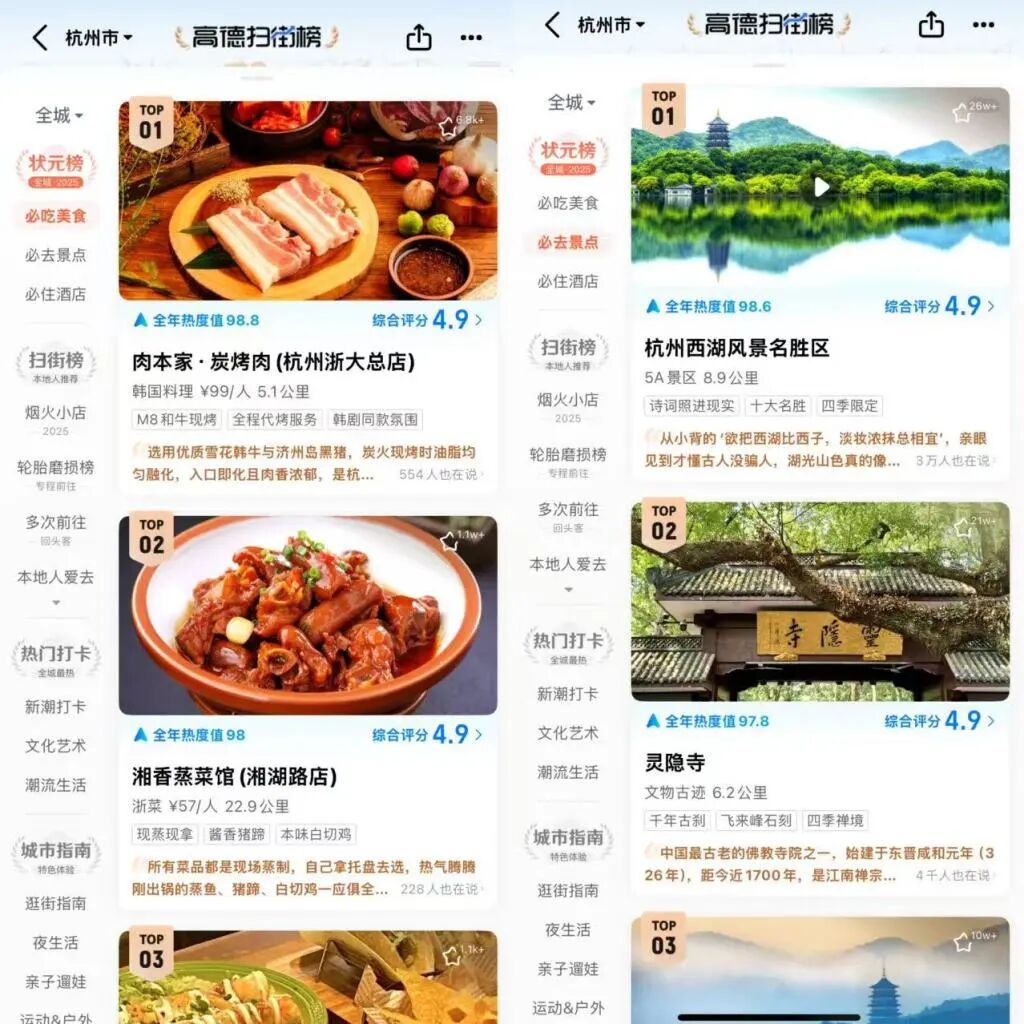
高德扫街榜亮相:AI驱动下如何重塑线下服务信用新生态?
Sou Hu Cai Jing· 2025-09-10 13:12
Core Insights - Alibaba's Gaode Map launched a new product called "Gaode Street Ranking" to establish a credit system for offline services, marking a significant innovation in the industry [1][2] - The ranking system utilizes AI technology to create a dual verification mechanism based on user behavior and credit, moving away from subjective evaluations [1][2] - The initiative addresses the trust crisis in the offline service industry, where traditional online review systems are often manipulated [2][3] Summary by Sections Product Launch - Gaode Street Ranking is positioned as a "super new entry" for Alibaba's life services, leveraging AI to redefine evaluation standards for service rankings [1] - The system analyzes user behavior data, such as navigation routes and visit frequency, combined with credit scoring to create an objective ranking mechanism [1][2] Industry Context - The launch coincides with a rapid growth phase in service consumption in China, with GDP per capita exceeding $13,000 and service retail expected to grow by 6.2% in 2024 [3] - A lack of a robust credit system has been identified as a barrier to unlocking the full potential of service consumption [3] Technical Feasibility - Gaode's comprehensive AI transformation allows for precise understanding of user intent and demand matching, enhancing the ranking's effectiveness [2][4] - The platform's daily AI search volume exceeds 120 million, supporting the authenticity of the rankings [2] Strategic Alignment - The launch aligns with Alibaba's strategic focus on technology and consumer platforms, as highlighted in their recent earnings call [4] - Gaode's initiative is part of a broader strategy to integrate online and offline services, enhancing the local life service ecosystem [4]
高德地图CEO郭宁:高德正在打造AI时代的全新线下服务信用体系
Zheng Quan Ri Bao Wang· 2025-09-10 10:29
Core Insights - Alibaba's Gaode Map launched a new AI-driven service ranking called "Street Ranking," aimed at enhancing consumer trust and boosting offline consumption by leveraging real travel and review data across over 300 cities in China [1][2] - The CEO of Gaode Map, Guo Ning, emphasized the importance of building a reliable offline service credit system through AI to foster consumer confidence and stimulate service consumption growth [2] Group 1: AI Integration and User Engagement - Gaode Map has transitioned to a fully AI-driven platform, evolving its navigation services into an intelligent travel assistant capable of deep temporal and spatial understanding [1] - The AI assistant "Xiao Gao Laoshi" achieved a daily usage of over 1.2 billion calls, with local lifestyle searches averaging 120 million per day and total navigation mileage reaching 1.5 billion kilometers [1] Group 2: Street Ranking Features - The "Street Ranking" is distinguished by its focus on "realness," utilizing a massive dataset of over 1 billion real behavior data points, including navigation and search activities [2] - The ranking system incorporates Sesame Credit scores and employs AI to filter out false information, ensuring the authenticity of user reviews [2] Group 3: Support for Local Businesses - Gaode Map introduced the "Firewood Good Store Support Plan," which includes a "Firewood Small Store" ranking to increase visibility and foot traffic for quality small businesses [3] - The initiative includes distributing 200 million yuan in ride-hailing vouchers and 950 million yuan in consumption vouchers to lower user costs and promote offline transactions [3] - The plan aims to provide over 50 million precise traffic exposures daily to small stores through AI recommendations and navigation voice broadcasts [3]
高德地图CEO郭宁:高德扫街榜是AI时代“用脚投票”的最真实榜单
Zheng Quan Shi Bao Wang· 2025-09-10 09:44
Core Viewpoint - Alibaba's Gaode Map launched a new AI-driven service ranking called "Street Ranking," aimed at enhancing consumer trust and boosting offline consumption by leveraging real travel and review data across over 300 cities in China [1][2]. Group 1: AI Integration and Consumer Behavior - Gaode Map has fully integrated AI into its services, evolving from a navigation tool to a comprehensive lifestyle service platform, with daily AI search volumes reaching 120 million and navigation distances totaling 1.5 billion kilometers [2]. - The service sector in China is projected to account for 56.7% of GDP in 2024, with per capita service consumption expenditure making up 46.1% of total consumption [2]. Group 2: Trust and Credibility in Consumption - The "Street Ranking" emphasizes "realness," utilizing a large volume of genuine behavioral data to ensure trustworthy evaluations, while also incorporating Sesame Credit scores to filter out false information [4][5]. - The initiative aims to create a more authentic and reliable consumption environment, addressing issues like distorted ratings that affect consumer choices [2][3]. Group 3: Support for Small Businesses - Gaode Map introduced the "Firewood Good Store Support Plan," which includes a budget of 2 billion yuan in ride-hailing vouchers and 9.5 billion yuan in consumption vouchers to drive foot traffic to small businesses [6]. - The plan aims to help 100,000 small stores gain visibility and customer flow, with an expected daily increase of 10 million consumers visiting offline stores due to the "Street Ranking" [5][6].
高德上线“高德扫街榜”,网友:太懂街溜子了
Qi Lu Wan Bao· 2025-09-10 08:34
Core Insights - Alibaba's Gaode Map has launched a new feature called "Gaode Street Ranking," aimed at establishing a new offline service credit system to support dining and service consumption [1][6]. Group 1: Product Overview - The Gaode Street Ranking is similar to Meituan's Dianping ranking, providing comprehensive scores and rankings for businesses across various sectors, including food, attractions, and hotels [6]. - The ranking is based on data from 51.32 million users, who made 1.3 billion navigations covering 22.8 billion kilometers over the past year, filtering through 1.18 million stores [6]. - The product manager emphasized that the ranking incorporates user action metrics, stating "actions are more credible," aiming to reflect genuine customer experiences and reduce the pressure on businesses to artificially inflate scores [6]. Group 2: Data and Coverage - The Gaode Street Ranking utilizes extensive real travel data, focusing on travel popularity and experience quality over the last 30 days, with daily updates based on user behavior such as searches, navigation, and transactions [7]. - The ranking currently covers over 300 cities in China, including 1.6 million offline service providers, with more than 870,000 restaurants, 230,000 hotels, and nearly 50,000 attractions included [7]. - User feedback indicates a positive reception, with comments highlighting the feature's understanding of local consumers [7].