
职业技能提升培训

Search documents
提供不断线、有温度的就业服务
Ren Min Ri Bao· 2025-07-22 21:51
Core Points - The article discusses the employment situation in China, highlighting that 6.95 million new urban jobs were created in the first half of the year, achieving 58% of the annual target [2] - The unemployment rate in June remained stable at 5.0%, the same as the previous year [2] - Various measures have been implemented to support employment, particularly for college graduates and young job seekers [3][4] Employment Policies and Measures - The Ministry of Human Resources and Social Security (HRSS) has introduced multiple channels to expand job opportunities and enhance financial support for enterprises, including a reduction in unemployment insurance fees that saved over 90 billion yuan for companies [3] - A series of recruitment events have been organized, providing over 4.58 million job postings through initiatives like the "Hundred Days of Recruitment" [4] - The "Three Supports and One Assistance" program aims to send college graduates to rural areas for education, agriculture, and medical support, with a recruitment target of 34,400 individuals [5] Financial Support for Entrepreneurship - The HRSS is promoting entrepreneurship among young people by offering government-subsidized loans up to 300,000 yuan for eligible college graduates and up to 4 million yuan for small enterprises [5] - First-time entrepreneurs can also apply for a one-time startup subsidy [5] Skills Training Initiatives - A large-scale vocational skills training initiative has been launched, focusing on sectors like advanced manufacturing and digital economy, with a goal to enhance the skills of the workforce [7] - The HRSS is working on a mechanism to coordinate training resources and implement specialized training plans across various industries [7] Digitalization of Social Insurance Services - The HRSS is advancing the digitalization of social insurance services, with over 1.07 billion people enrolled in basic pension insurance and 245 million in unemployment insurance as of June [10] - The integration of artificial intelligence in social insurance management aims to improve service efficiency and accuracy, including the use of intelligent customer service systems and automated processing of claims [10][11]

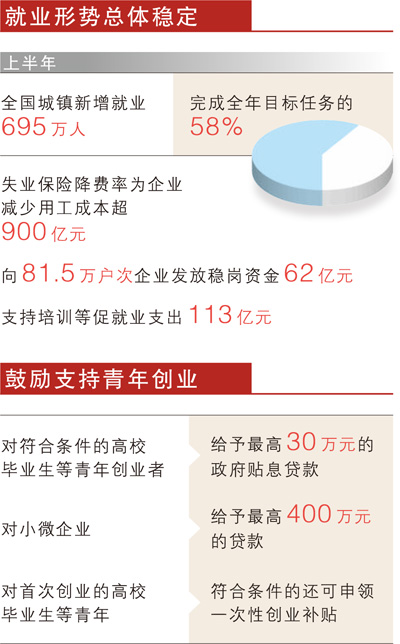
上半年我国就业形势总体平稳 三项社会保险基金累计结余9.83万亿元
Yang Shi Wang· 2025-07-22 09:42
Group 1 - The core viewpoint of the news is that the Chinese government is actively implementing policies to stabilize employment and support enterprises amid a complex external environment, achieving 6.95 million new urban jobs in the first half of the year, which is 58% of the annual target [1] - The urban surveyed unemployment rate in June remained stable at 5.0%, unchanged from the same period last year [1] - Various departments have intensified policy support to stabilize employment, enterprises, markets, and expectations [1] Group 2 - The government has introduced multiple channels to expand job opportunities, including increased financial support for enterprises, one-time job expansion subsidies, and continued implementation of policies to support state-owned enterprises [3] - In the first half of the year, the reduction in unemployment insurance fees saved enterprises over 90 billion yuan in labor costs, with 6.2 billion yuan in stability funds distributed to insured enterprises and 11.3 billion yuan allocated for training and employment promotion [3] Group 3 - A large-scale vocational skills enhancement training initiative has been launched, lasting three years, with a target of providing government-subsidized training for at least 10 million people annually [4] - The training will focus on increasing the supply of skilled talent in manufacturing and service sectors, targeting specific groups such as college graduates, enterprise employees, and migrant workers [4] Group 4 - As of the end of June, the number of participants in basic pension, unemployment, and work injury insurance reached 1.071 billion, 245 million, and 300 million respectively [6] - The total income of the three social insurance funds in the first half of the year was 4.53 trillion yuan, with total expenditures of 3.89 trillion yuan, resulting in a cumulative balance of 9.83 trillion yuan, indicating overall stability in fund operations [6]
我国部署2025至2027年广泛开展职业技能提升培训
Zhong Guo Fa Zhan Wang· 2025-07-21 06:53
Group 1 - The State Council's guidance aims to implement large-scale vocational skills training from 2025 to the end of 2027, targeting over 30 million training sessions focused on high-demand industries and key employment groups [1] - The training will emphasize sectors such as advanced manufacturing, digital economy, low-altitude economy, transportation, agriculture, and life services, enhancing the supply of skilled labor [1] - The guidance encourages localities to improve the quality and effectiveness of vocational training, engaging various training institutions and promoting a project-based training model that links job demand with skills training and employment services [1] Group 2 - Public training bases have played a significant role in enhancing labor skills and improving employment quality, with 414 bases established since 2016, supported by central budget investments [2] - In 2024, public training bases trained 1.63 million individuals, marking a 10% increase year-on-year, including 510,000 university graduates, 400,000 employees, 250,000 migrant workers, and 12,000 veterans [2] - These bases not only focus on skills training but also expand into skills evaluation, entrepreneurship training, employment recruitment, skills competitions, teacher training, and course development, fostering a skilled and innovative workforce [2]
筑牢现代化产业体系人才支撑 大规模职业技能提升培训行动启动
Zheng Quan Ri Bao Wang· 2025-07-16 10:28
Core Insights - The Chinese government has initiated a large-scale vocational skills enhancement training program aimed at increasing the supply of skilled talent in critical sectors from 2025 to 2027 [1][2] - The program focuses on high-precision industries and urgent sectors, targeting over 30 million training sessions to improve employment and income for workers [1][2] Group 1: Policy and Implementation - The "Guiding Opinions" issued by the State Council emphasize the importance of vocational skills training in advanced manufacturing, digital economy, low-altitude economy, transportation, agriculture, and service sectors [1][2] - Local governments, such as Beijing and Guangdong, are actively developing training programs tailored to emerging professions and industries, including digital technology engineers and new vocational standards [3] Group 2: Industry Needs and Talent Supply - High-precision industries require a skilled workforce with specialized knowledge and innovative capabilities, which are crucial for enhancing the competitiveness and resilience of the industrial system [1][2] - The shortage of composite talents in fields like low-altitude economy, particularly in drone development, poses a challenge to the large-scale application of these technologies [2] Group 3: Future Directions - The need for a dynamic training mechanism that adapts to rapid technological advancements in artificial intelligence and smart manufacturing is highlighted [3] - Recommendations include linking vocational skill assessments to technological developments and promoting a lifelong learning system to keep pace with industry changes [3]
聚焦六大领域 我国启动大规模职业技能提升培训行动
Yang Shi Wang· 2025-07-15 23:01
Core Viewpoint - The Chinese government is launching a large-scale vocational skills enhancement training initiative, aiming to provide over 30 million subsidized training sessions over the next three years, focusing on high-demand industries and key employment groups [1][3]. Group 1: Training Focus Areas - The training will target six key sectors: advanced manufacturing, digital economy, low-altitude economy, transportation, agriculture and rural areas, and life services, from 2025 to the end of 2027 [3]. - The initiative will prioritize three main groups: enterprise employees, college graduates, and migrant workers, ensuring continuous enhancement of vocational skills [3][4]. Group 2: Demand-Driven Approach - The training program is designed to meet the actual demand for skilled labor in various industries and the genuine employment needs of workers, tailoring training projects, formats, and content accordingly [4][6]. - Local governments will determine training projects based on economic development, industrial structure, and labor resources to enhance the effectiveness and relevance of the training [6]. Group 3: Collaborative Support - The initiative will leverage policy support and service guarantees, engaging enterprises, educational institutions, and training organizations to enhance the market's initiative, flexibility, and diversity [8]. - There will be a focus on coordinating efforts across departments to develop specialized training plans and strengthen the supply of urgently needed skilled labor [11]. Group 4: Employment Integration - The program emphasizes the importance of aligning training with employment opportunities, encouraging workers to participate in skill assessments and obtain certification to improve their job competitiveness [13]. - The goal is to ensure that training leads to employment, thereby increasing income for workers through effective job placement services integrated into the training evaluation process [13].
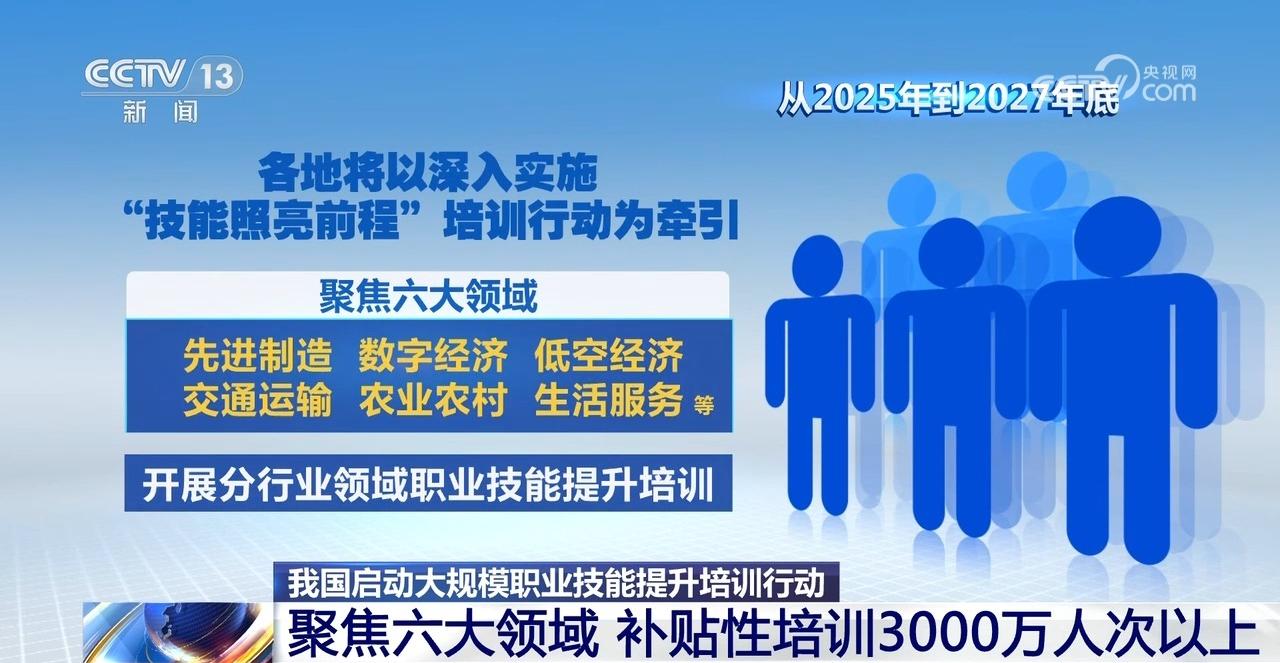
聚焦先进制造、数字经济等 大规模职业技能提升培训行动启动
news flash· 2025-07-15 07:26
Core Points - The government is launching a large-scale vocational skills enhancement training initiative from 2025 to the end of 2027, focusing on increasing the supply of skilled talent in the manufacturing and service sectors [1] - The initiative aims to provide subsidized training for over 30 million people, targeting high-tech industries, urgent sectors, and key employment groups to promote skill-based employment and income growth [1] - Various regions will focus on advanced manufacturing, digital economy, low-altitude economy, transportation, agriculture, and service industries to conduct vocational skills training [1] Training Implementation - The training will engage enterprises, vocational colleges, private training institutions, and public training bases, promoting a project-based training model that integrates job demand, skills training, skills evaluation, and employment services [1] - There will be a strong emphasis on the quality of vocational skills evaluation, enhancing the authority, circulation, and recognition of vocational skills certificates [1] - The initiative will promote a new "eight-level worker" vocational skills grading system and guide enterprises to link job compensation with job value and skill levels [1]
广东将围绕10个领域实施大规模职业技能提升培训
Zhong Guo Xin Wen Wang· 2025-07-02 17:57
Core Points - Guangdong Province has launched a large-scale vocational skills enhancement training action plan for 2025-2027, focusing on high-quality employment and modern industrial system needs [1] - The plan aims to provide subsidized vocational skills training for over 1.5 million participants and to add more than 1.5 million new vocational qualification or skill level certificates [1] - The training will target key groups such as college graduates, rural migrant workers, registered unemployed individuals, and those facing employment difficulties [1] Group 1 - The action plan emphasizes training in key sectors including health care, advanced manufacturing, modern services, and new occupations [1] - Guangdong will implement a project-based training model that integrates job demand, skills training, skills evaluation, and employment services [2] - The province has established 65 national high-skilled talent training bases and 65 national skill master studios, along with over 1,500 private vocational training schools to provide various vocational skills training services [2] Group 2 - The plan includes support measures for training entities such as enterprises, educational institutions, and social organizations, focusing on policy, funding, services, and resources [1] - The "New Eight-Level Worker" system will be fully implemented to encourage employee participation in training and skill enhancement [2] - The training will cover ten areas, including traditional industries, emerging industries, digital technology skills, modern services, and entrepreneurship training [1]
谌贻琴在浙江调研时强调 加快落实就业政策 全力做好稳就业工作
news flash· 2025-05-20 09:59
Core Viewpoint - The article emphasizes the importance of supporting industries and enterprises that have strong employment absorption capabilities, aiming to help businesses reduce burdens and stabilize jobs in response to external shocks [1] Employment and Skills Development - The focus is on enhancing employment for key groups, expanding quality job opportunities, and improving employment outcomes for college graduates and migrant workers, especially those from impoverished backgrounds [1] - The implementation of the "Skills Illuminate the Future" initiative is highlighted, which aims to conduct large-scale vocational skills enhancement training [1] - The role of enterprises and vocational colleges as training entities is underscored to assist in improving labor skills and increasing employment income, thereby cultivating high-quality skilled talent needed for development [1]