
新质生产力发展

Search documents
政府工作报告丨《纲要(草案)》提出6方面109项重大工程
证券时报· 2026-03-05 01:43
Core Viewpoint - The government work report presented at the 14th National People's Congress emphasizes the implementation of the "14th Five-Year Plan" with 109 major projects across six key areas to drive economic growth and development [1]. Group 1: Major Engineering Projects - 28 projects focus on enhancing industrial foundational capabilities, competitiveness, and fostering new industries and technological advancements [1]. - 23 projects aim to construct a modern infrastructure system, including a comprehensive transportation network and new energy systems [1]. - 9 projects are dedicated to promoting urban-rural integration through new urbanization and agricultural modernization [1]. Group 2: Social Development and Welfare - 25 projects are designed to improve and guarantee people's livelihoods, focusing on cultural prosperity, high-quality education, health initiatives, and social services for the elderly and children [1]. - 18 projects target green and low-carbon transformation, addressing carbon neutrality, environmental quality, and ecological protection [1]. - 6 projects are centered on ensuring security in key areas such as food and energy [1].

深耕科教沃土以真知灼见赋能
Xin Hua Ri Bao· 2026-02-27 20:02
Group 1 - The core focus is on the integration of technological innovation and industrial innovation, which is seen as a driving force for development [1][2] - The importance of deep integration between industry, academia, and research is emphasized, with a call for innovative mechanisms and win-win cooperation to overcome challenges [2] - A significant number of projects in synthetic biology and new energy have been successfully implemented, enhancing opportunities for quality education and university access [2] Group 2 - Research has revealed issues such as overcapacity in strategic emerging industries like new energy, leading to unhealthy competition [3] - There is a need for industry self-regulation and capacity control to foster healthy competition and promote technological innovation for industrial and consumer upgrades [3] - The future of technological innovation is anticipated to open new application scenarios, with a focus on areas like autonomous vehicles and embodied intelligence, leveraging unique advantages in talent, market scale, and industrial foundation [3]
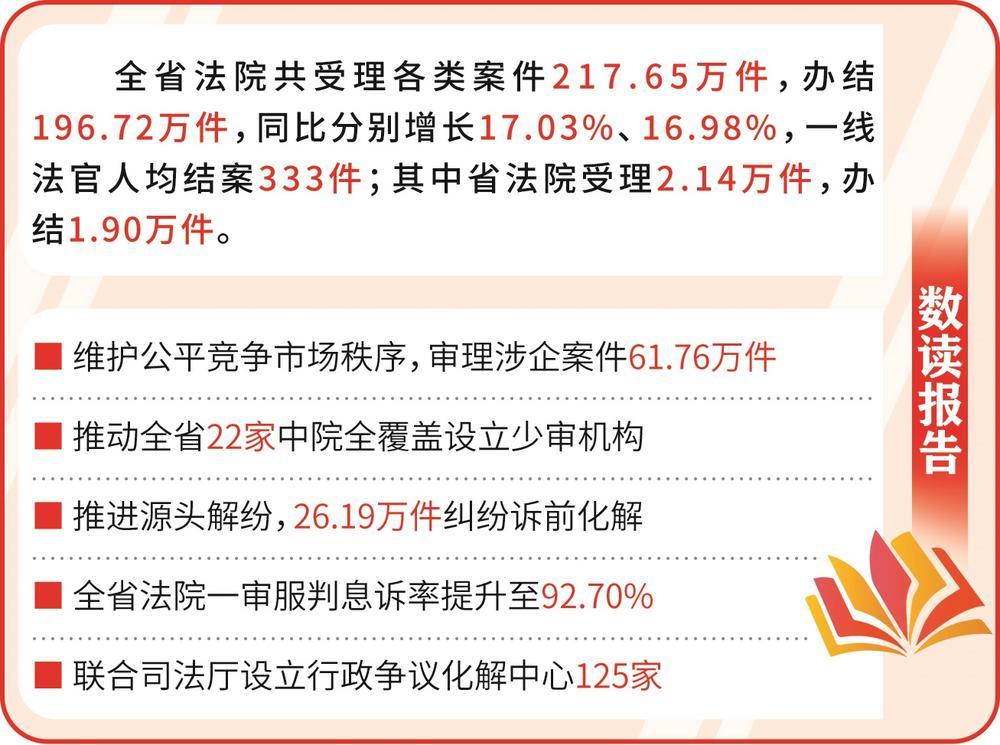
全省法院共受理各类案件217.65万件
Xin Lang Cai Jing· 2026-02-04 22:38
Core Viewpoint - The report from the Sichuan Provincial High People's Court highlights significant growth in case handling and emphasizes the court's commitment to improving the legal environment for businesses and protecting rights in various sectors, including innovation and tourism [1][2][3]. Group 1: Case Handling and Judicial Efficiency - In 2025, the provincial courts accepted 2.1765 million cases and concluded 1.9672 million cases, representing year-on-year growth of 17.03% and 16.98% respectively, with an average of 333 cases concluded per judge [1]. - The first-instance case resolution rate reached 92.70%, indicating a focus on not just closing cases but ensuring disputes are effectively resolved [3]. Group 2: Support for Business and Economic Development - The courts handled 617,600 enterprise-related cases, aiming to maintain fair competition and protect the legal rights of various business entities [1]. - Initiatives such as "face-to-face" meetings between courts and businesses were implemented to enhance judicial service efficiency and support private enterprises [1]. Group 3: Legal Protection and Innovation - The establishment of the Mianyang Intellectual Property Court aims to strengthen judicial protection of intellectual property, supporting the development of the digital economy and addressing cases related to artificial intelligence and virtual assets [1]. - The courts are also focused on fostering a high-quality development environment for tourism by resolving disputes efficiently through 27 specialized tourism environmental courts [2]. Group 4: Social Welfare and Community Engagement - The courts have set up 125 administrative dispute resolution centers to enhance government-court interaction and ensure comprehensive coverage at the municipal level [2]. - Efforts to protect vulnerable groups include establishing juvenile and elderly care institutions across 22 intermediate courts, ensuring support for the elderly and children [2]. Group 5: Future Work Plans - For 2026, the courts plan to enhance judicial services, particularly in commercial mediation and resolving enterprise-related disputes, while continuing to protect legal rights equally for all parties [5]. - There is a commitment to improve the quality and authority of judicial decisions, ensuring transparency and accountability in the judicial process [5].
“十五五”时期 经济社会发展重点任务
Xin Lang Cai Jing· 2026-01-31 23:41
Core Viewpoint - The "14th Five-Year Plan" period is crucial for China to achieve socialist modernization and for Heilongjiang to revitalize its economy, with a focus on implementing the "12 key tasks" to lay a solid foundation for building a modern strong province [1] Group 1: Industrial and Economic Development - The plan emphasizes the need to promote industrial revitalization, strengthen the foundation of the real economy, and build a more competitive modern industrial system [2] - It aims to enhance economic circulation efficiency and fully integrate into the national unified market to boost high-quality revitalization and development [10] - The plan includes reforms in the economic sector to maintain a socialist market economy and continuously stimulate high-quality revitalization and development [11] Group 2: Technological and Agricultural Advancement - There is a strong focus on promoting educational and technological revitalization, leading new productive forces through technological innovation to support national self-reliance in high-level technology [3] - Agricultural revitalization is also a priority, aiming to create livable and workable rural areas and accelerate agricultural modernization [4] Group 3: Regional and Ecological Coordination - The plan seeks to promote regional revitalization by optimizing economic spatial layout and resource allocation to facilitate coordinated regional development [5] - It emphasizes ecological revitalization to strengthen the ecological security barrier in northern China and promote a comprehensive green transformation of economic and social development [6] Group 4: Cultural and Social Improvement - Cultural revitalization is highlighted, with efforts to develop distinctive cultural tourism and prosper cultural industries [7] - The plan aims to enhance people's livelihoods by increasing efforts to guarantee and improve living standards, fulfilling the public's aspirations for a better life [8] Group 5: Talent and Security Enhancement - There is a focus on talent revitalization, aiming to cultivate a high-quality human resources team and promote high-quality population development [9] - The plan includes enhancing security capabilities to safeguard the northern border of the country, ensuring high-level security for high-quality revitalization and development [13] Group 6: Open Economy - The plan promotes high-level opening up to the outside world, aiming to establish a new high ground for China's northern openness and continuously expand the space for high-quality revitalization and development [12]
证监会:将深化创业板改革,持续推动科创板改革落实落地
Xin Hua Wang· 2026-01-30 13:29
Core Viewpoint - The Chairman of the China Securities Regulatory Commission (CSRC), Wu Qing, emphasized the importance of risk prevention, strong regulation, and promoting high-quality development in the capital market, aiming to consolidate the positive momentum of stability and growth [1][4]. Group 1: Capital Market Reforms - The CSRC plans to deepen comprehensive reforms in capital market investment and financing, enhance the adaptability and inclusiveness of the regulatory system, and expedite the reform of the ChiNext board [1][4]. - There will be a focus on improving the convenience, flexibility, and attractiveness of the refinancing system [1][4]. Group 2: Multi-layered Market Development - Wu Qing highlighted the need to promote the integrated high-quality development of the Beijing Stock Exchange and the New Third Board, enhancing the coverage and influence of multi-layered markets [4]. - The initiatives aim to effectively support the construction of a modern industrial system and the development of new productive forces, aligning with the goals of the 14th Five-Year Plan and the construction of a financial power [4]. Group 3: Strategic Alignment - The CSRC will thoroughly understand and implement the important directives from the 20th National Congress, focusing on significant issues related to the reform, development, and stability of the capital market during the 14th Five-Year Plan period [4]. - There is an emphasis on unifying strategic needs with practical possibilities, as well as aligning market demands with regulatory objectives to ensure high-quality implementation of the capital market's 14th Five-Year Plan [4].

吴清:抓紧推出深化创业板改革
Di Yi Cai Jing Zi Xun· 2026-01-30 12:57
Group 1 - The core viewpoint of the articles emphasizes the importance of planning for the "14th Five-Year" period in the development of the capital market, focusing on strategic goals, tasks, and key measures [1][2] - The China Securities Regulatory Commission (CSRC) is committed to enhancing the adaptability and inclusiveness of the regulatory framework to better support emerging industries and the transformation of traditional industries [1][2] - Suggestions from participants include optimizing the issuance and listing system, improving the efficiency of refinancing for listed companies, and fostering long-term capital to match the long-term needs of industrial development [1][2] Group 2 - CSRC Chairman Wu Qing highlighted the need for a comprehensive understanding of the Party's 20th Central Committee's important deployments, focusing on risk prevention, strong regulation, and promoting high-quality development [2] - The CSRC aims to deepen comprehensive reforms in capital market investment and financing, enhance the attractiveness and flexibility of refinancing systems, and support the integrated high-quality development of various market segments [2] - Listed companies are urged to focus on their core businesses, improve governance, and enhance their ability to return value to investors, thereby providing solid support for the high-quality development of the capital market [2]
等你来投!《清华金融评论》2026年3月刊“创新改革路径 推动资本市场高质量发展” 征稿启事
清华金融评论· 2026-01-30 09:54
Core Viewpoint - The article emphasizes the need for innovative reform paths to promote high-quality development in China's capital markets, focusing on multi-level market construction, improving the quality of listed companies, opening up to foreign investment, and protecting investors [3][4]. Group 1: Reform Directions - The core content revolves around four major reform directions: enhancing the inclusiveness of multi-level markets, solidifying the foundation for market stability, expanding high-level institutional openness, and strengthening investor protection [3][4]. Group 2: Establishment of the Capital Market Society - The China Capital Market Society was registered on June 16, 2025, under the Ministry of Civil Affairs, supervised by the China Securities Regulatory Commission, and aims to serve as a high-end think tank for theoretical research, academic exchange, and decision-making consultation in the capital market [3][4]. Group 3: Thematic Focus of Tsinghua Financial Review - The Tsinghua Financial Review plans to explore topics such as the support of capital markets for new productive forces, mechanisms for stabilizing the secondary market, capital market openness, and innovations in the bond market, seeking effective paths for reform and innovation [4][5]. Group 4: Call for Contributions - The article outlines 13 specific topics for discussion, including enhancing the inherent stability of capital markets, the role of long-term funds, effective foreign market opening, and innovations in the bond market, inviting experts and scholars to contribute original works [5].
最高法:探索深化综合整治“内卷式”竞争司法路径
Jing Ji Guan Cha Wang· 2026-01-29 06:22
Core Viewpoint - The Supreme People's Court Intellectual Property Court is exploring judicial paths to deepen the comprehensive governance of "involutionary" competition, focusing on regulating monopolistic and unfair competition behaviors to support the construction of a unified national market [1][2]. Summary by Relevant Sections Judicial Regulation of Competition - The Intellectual Property Court has identified "involutionary" competition as a significant issue in the construction of a unified national market, driven by factors such as monopolistic behaviors, insufficient innovation, and unfair competition [1][2]. - The court has recognized 66 cases as constituting monopolistic behavior since its establishment, with 15 cases identified in 2025 alone [2][3]. Strengthening Innovation Protection - The court is actively applying measures such as behavior preservation, evidence preservation, and punitive damages to combat patent infringement and promote a shift from low-quality competition to high-quality and innovative competition [2][3]. Addressing Malicious Competition - The court is focusing on regulating unfair competition practices, particularly those involving the theft of trade secrets and organized efforts to gain competitive advantages, aiming to break the cycle of "downward competition" [2][3]. Enhancing Judicial Efficiency - The court has handled 24,602 cases since its establishment, with 23,069 concluded, and has applied punitive damages in 58 cases, totaling 2.05 billion yuan [4][5]. - In 2025, the court received 4,679 cases and concluded 3,146, indicating a significant increase in case handling [4]. Supporting National Innovation Strategy - The court has strengthened judicial support for the national innovation-driven development strategy, with cases related to strategic emerging industries increasing from 17.6% in 2019 to 32.4% in 2025 [5]. - The court has also seen a rise in foreign-related cases, with 2,546 cases accepted, representing 10.3% of total cases, and an annual growth rate of 18.7% [5].
鲍威尔表态引爆商品市场,伦铜伦锡领涨!工业有色ETF万家(560860)大涨4%,突破160亿规模大关
Sou Hu Cai Jing· 2026-01-29 02:46
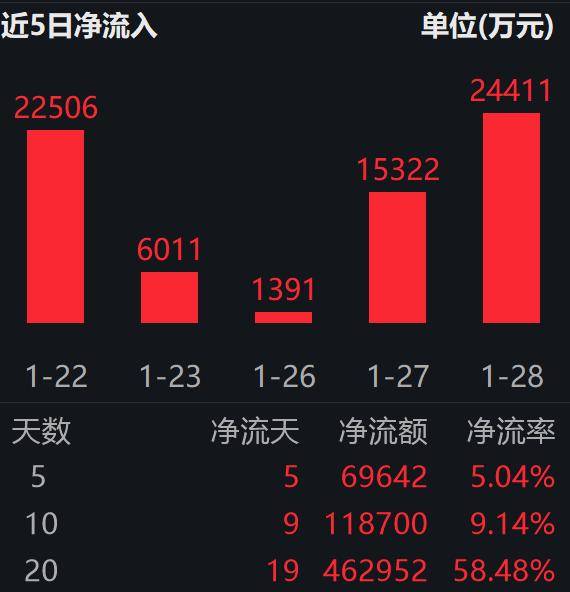
Group 1 - The domestic commodity futures market opened with most contracts rising, with notable increases in gold (over 7%), silver (over 4%), and fuel (nearly 3%) [1] - The industrial non-ferrous ETF WanJia (560860) saw a significant increase of 4.03%, reaching a historical high, with a trading volume of 290 million [1] - The ETF has attracted substantial capital inflows, with a total of over 6.9 billion yuan in net inflows over the past five days, and over 46 billion yuan in the last 20 days [1] Group 2 - Federal Reserve Chairman Jerome Powell indicated that inflation pressures are primarily due to tariffs rather than demand factors, leading to a significant rise in gold prices, which surpassed 5400 USD [3] - The London Metal Exchange (LME) saw most base metals rise, with tin increasing by 3.52% to 56,795 USD/ton, aluminum by 1.59% to 3,263.5 USD/ton, and copper by 0.74% to 13,120 USD/ton [3] - The metal industry is entering a weak supply cycle, with global mining supply expected to maintain strong rigidity until 2028, while demand is anticipated to increase due to green energy transitions and new production capabilities [3] Group 3 - The industrial non-ferrous ETF WanJia (560860) closely tracks the CSI Industrial Non-Ferrous Metals Theme Index, covering strategic resources such as copper, aluminum, and rare earths [4] - Investors can access this ETF through linked classes (A class: 018489; C class: 018490) to capitalize on cyclical and policy-driven opportunities [4]
有色60ETF(159881)收涨超7%,金属价格上行与供需格局变化利好
Mei Ri Jing Ji Xin Wen· 2026-01-28 13:34
Core Viewpoint - The non-ferrous metal industry is entering a weak supply cycle, with global mining supply expected to maintain strong rigidity until 2028, benefiting from rising metal prices and changes in supply-demand dynamics [1] Group 1: Supply and Demand Dynamics - The supply side of the metal industry is experiencing a slowdown in growth due to policy controls, while the demand side is driven by the growth of new energy vehicles and robotics, leading to a continuous increase in demand for rare earths [1] - The lithium industry's supply-demand relationship is expected to improve, with the oversupply situation anticipated to ease [1] - The antimony industry is entering a strong prosperity cycle due to supply-demand mismatch, with a growing global supply-demand gap [1] Group 2: Price and Profitability Outlook - The supply-demand balance for magnesium and molybdenum is also tight, which is likely to drive up price levels and facilitate industry profitability recovery [1] - The liquidity cycle shift is expected to enhance the elasticity of metal prices, with the global central bank's balance sheet expansion potentially providing liquidity premiums for small metal varieties that are already in a tight supply-demand state [1] Group 3: ETF and Index Information - The non-ferrous 60 ETF (159881) tracks the CSI Non-Ferrous Metals Index (930708), which selects listed companies involved in the mining, smelting, and processing of non-ferrous metals, covering sub-industries such as copper, gold, aluminum, rare earths, and lithium [1]