自贸协定

Search documents
全省外贸企业享惠超120亿元
Mei Ri Shang Bao· 2025-10-30 22:15
Core Insights - The signing of the upgraded China-ASEAN Free Trade Area 3.0 agreement in Malaysia is expected to inject new momentum into Zhejiang's foreign trade, with significant growth in trade volumes and benefits for enterprises [1] Group 1: Trade Performance - In the first three quarters, Hangzhou Customs issued 488,000 certificates of origin under the China-ASEAN Free Trade Agreement, with a total value of 142.92 billion yuan, representing year-on-year increases of 17.6% and 7.5% respectively, and is expected to benefit enterprises by approximately 12.8 billion yuan [1] - Zhejiang's exports of electromechanical products to ASEAN reached 188.52 billion yuan, a year-on-year increase of 21.7%, with "new three items" (new energy vehicles, lithium batteries, and photovoltaic products) exports amounting to 9.27 billion yuan, up 49.5% [2] - The export of automotive parts and ships from Zhejiang also saw significant growth, with values of 8.32 billion yuan and 4.34 billion yuan, reflecting year-on-year increases of 28.0% and 28.6% respectively [2] Group 2: Import Dynamics - ASEAN continues to enrich Zhejiang's consumer market with a variety of livelihood goods, including a notable increase in the import of aquatic products, which totaled 142 tons in the first three quarters, a 3.32-fold increase compared to the same period last year [2] - Key imports from ASEAN include agricultural products, basic organic chemicals, natural and synthetic rubber, and coal, which are crucial for stabilizing the local industrial supply chain [2] Group 3: Policy Support and Services - Hangzhou Customs has implemented a series of targeted service measures to ensure enterprises fully benefit from the free trade agreement, including the extension of "e-printing" for certificates of origin and the promotion of a one-stop consultation platform for preferential tax rates [3] - The customs authority is utilizing big data to identify enterprises that have not yet applied for benefits and is providing point-to-point guidance to facilitate policy implementation [3] - The most concentrated benefits from the agreement are observed in trade with Indonesia, Vietnam, and Thailand, with respective values of 44.19 billion yuan, 32.06 billion yuan, and 27.33 billion yuan in the first three quarters [3]
X @外汇交易员
外汇交易员· 2025-10-27 03:13
Trade Relations & Investment - China aims to upgrade the Free Trade Agreement with Australia [1] - China will continue to support Chinese companies to invest in Australia [1] - China hopes Australia will provide a fair and non-discriminatory environment for Chinese investments [1] - Restoring trade with China has significantly benefited Australian workers and businesses [1] Economic Significance - Australia-China relationship is crucial for economic security and stability [1] - China is Australia's largest trading partner [1]
迈赫尔通讯社编译版:伊朗与巴基斯坦自贸协定即将敲定
Shang Wu Bu Wang Zhan· 2025-09-19 06:45
Group 1 - The core focus of the article is the significant progress made in the Iran-Pakistan trade relations, particularly regarding the free trade agreement (FTA) [1] - The FTA was a major topic at the 22nd Iran-Pakistan Joint Economic Commission, with most of its content agreed upon during the meeting [1] - Both countries have committed to reviewing and finalizing the list of goods for tariff exemptions before the 23rd Joint Economic Commission [1]
日本推动与非洲国家签订自贸协定
Shang Wu Bu Wang Zhan· 2025-08-28 02:50
Core Points - The Japanese government is preparing to initiate free trade agreement (FTA) negotiations with African countries, starting with the East African Community (EAC) and major economies such as Nigeria and Ghana [1] Group 1 - The announcement regarding the FTA negotiations is expected to be made during the ninth Tokyo International Conference on African Development (TICAD), scheduled from August 20 to August 22 in Yokohama [1]
用好"金钥匙",自贸红利稳外贸
Zhong Guo Chan Ye Jing Ji Xin Xi Wang· 2025-08-18 22:36
Core Viewpoint - The article emphasizes the significance of certificates of origin as a "golden key" for companies like Xiaomi to expand into international markets, particularly highlighting the benefits of zero tariffs under free trade agreements [1][2]. Group 1: Impact of Certificates of Origin - Certificates of origin serve as essential documents for foreign trade enterprises to enjoy tariff reductions in importing countries, significantly enhancing international competitiveness [1]. - In the first half of the year, Beijing Customs issued 24,042 certificates of origin, with a total value of $1.752 billion, reflecting year-on-year growth of 15.26% and 15.03% respectively [2]. - The "China-Chile" free trade agreement has notably contributed to Xiaomi's success, allowing the company to reduce customs duties from 6% to zero, which is seen as a substantial financial benefit [1]. Group 2: Growth in Exports - Exports from Beijing to Latin American countries such as Nicaragua, Ecuador, and Chile have surged, with year-on-year growth rates of 780.12%, 297.35%, and 152.14% respectively [2]. - The total value of exports under the "China-Chile" free trade agreement reached $84.2629 million, marking the highest growth in value among various agreements [2]. Group 3: Regional Trade Agreements - The total value of preferential certificates of origin issued by the national trade promotion system reached $48.197 billion in the first half of the year, with a year-on-year increase of 39.45% [3]. - The Regional Comprehensive Economic Partnership (RCEP) has facilitated trade by integrating rules and opening markets, with the value of RCEP certificates amounting to $4.415 billion, also showing significant growth [3]. Group 4: Specific Industry Examples - In Kunming, Customs issued 52,600 certificates of origin for goods exported to RCEP member countries, with a total value of $9.191 billion, resulting in a tariff reduction of $230 million [4]. - The bicycle manufacturing industry in Tianjin has leveraged free trade agreements to expand overseas, with a 147% year-on-year increase in the issuance of certificates of origin for bicycle parts [6].
今年前7个月,天津海关为本市出口上合组织国家货物签发原产地证书5700份
Sou Hu Cai Jing· 2025-08-18 18:12
Group 1 - A cargo ship carrying 190 tons of sesame from Pakistan arrived at Tianjin Port, which will undergo processing to meet China's sesame oil consumption needs [1] - The sesame from Pakistan benefits from high yield and oil content due to its favorable geographical and climatic conditions, and the import tariff has been reduced from 10% to 0% under the China-Pakistan Free Trade Agreement, saving over 1.7 million yuan in tariff costs this year [1] - In the first seven months of this year, the value of imports from Shanghai Cooperation Organization (SCO) countries at Tianjin Port reached 1.36 billion yuan, resulting in a tariff reduction of 66 million yuan, with significant benefits for seafood, fruits, and grains [1] Group 2 - Besides the China-Pakistan Free Trade Agreement, China has signed and implemented other free trade agreements with SCO countries, enhancing the international competitiveness of exported products [3] - The rapid processing of origin certificates by customs has facilitated exports, with one company reporting a 20% year-on-year increase in exports to SCO countries, amounting to over 3 million yuan [3] - The issuance of origin certificates has allowed clients to save 150,000 yuan in tariffs, demonstrating the financial benefits of these agreements [3] Group 3 - In the first seven months of this year, Tianjin Customs issued 5,700 origin certificates for goods exported to SCO countries, with a total value of 3.43 billion yuan, reflecting year-on-year growth of 6.4% and 18.9% respectively [4]


2.4万把“金钥匙” 助力民企打开国际市场大门
Zhong Guo Jing Ji Wang· 2025-08-07 03:27
Group 1 - A batch of Xiaomi smartphones labeled "Made in China" has successfully entered the Chilean market with zero tariffs, thanks to the "China-Chile" Free Trade Agreement (FTA) origin certificate issued by Beijing Customs [1] - In the first half of 2025, Beijing Customs issued 24,042 origin certificates, with a total value of $1.752 billion, reflecting year-on-year growth of 15.26% and 15.03% respectively [1] - Xiaomi's global smartphone shipments are projected to reach 169 million units in 2024, representing a year-on-year increase of 15.7%, highlighting the company's strategic integration of FTA origin rules into its market expansion in Chile [1] Group 2 - The year 2025 marks the 20th anniversary of the first FTA signed between China and Latin American countries, with significant export growth from Beijing to several Latin American nations, particularly under the "China-Chile" FTA, which saw an increase of $84.2629 million in value [2] - Beijing Customs plans to enhance the implementation of the FTA by improving facilitation measures such as "intelligent review," "self-service printing," "appointment for certificate collection," and "mailing of certificates," aiming to better serve high-quality development and open up the capital [2]
上半年北京关区签发原产地证书24042份 同比增长15.26%
Zhong Guo Xin Wen Wang· 2025-08-05 06:02
Core Insights - In the first half of 2025, Beijing Customs issued 24,042 certificates of origin, with a total value of $1.752 billion, representing year-on-year growth of 15.26% and 15.03% respectively [1] - Xiaomi smartphones labeled "Made in China" successfully entered the Chilean market with zero tariffs, thanks to the "China-Chile" free trade agreement certificates issued by Beijing Customs, which significantly reduced tax costs and enhanced price competitiveness [1] - The year 2025 marks the 20th anniversary of the first free trade agreement signed between China and Latin American countries, with exports from Beijing to Nicaragua, Ecuador, and Chile experiencing remarkable growth of 780.12%, 297.35%, and 152.14% year-on-year respectively [1] Industry Developments - Beijing Customs plans to enhance the implementation of free trade agreements by deepening measures such as "intelligent review," "self-service printing," "appointment for certification," and "mailing visas," aiming to improve the convenience for enterprises and fully leverage the benefits of free trade agreements [2]
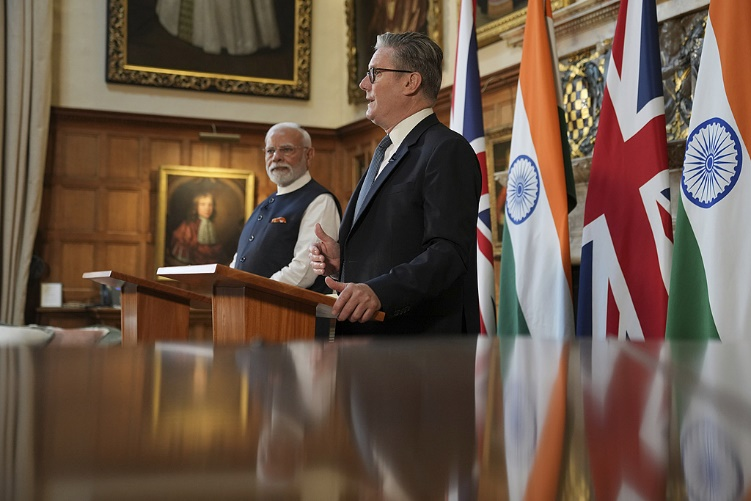
英印领导人联合记者会上,翻译员卡壳停顿,莫迪打圆场解围
Huan Qiu Wang· 2025-07-25 04:47
Group 1 - The signing of the India-UK Free Trade Agreement (FTA) is a significant milestone, witnessed by Indian Prime Minister Modi and UK Prime Minister Starmer in London [1][3] - The FTA is described as the largest agreement for the UK post-Brexit and one of the most important agreements for India in recent years [3] - The agreement will eliminate tariffs on 95% of Indian agricultural products and food items, such as turmeric, pepper, and cardamom, thereby increasing the income of Indian farmers [3] Group 2 - The UK government stated that the average tariff rate imposed by India on UK goods will decrease from 15% to 3% [3] - Under the agreement, 90% of UK goods exported to India will see a reduction in tariff rates, with 85% of goods achieving zero tariffs within 10 years [3] - Additionally, 99% of Indian goods exported to the UK will benefit from zero tariffs [3]
特朗普也没想到,莫迪手握3张“王牌”,决定在关税战中硬刚美国,印度胜算有多大?
Sou Hu Cai Jing· 2025-07-18 06:59
Group 1 - The core issue revolves around India's announcement to impose retaliatory tariffs on certain U.S. goods, escalating trade tensions between the two nations [1][4] - In 2024, the bilateral trade volume between the U.S. and India reached $195 billion, with a trade deficit of $38 billion for the U.S., indicating India's export advantage [3][5] - India's exports of electronic products to the U.S. accounted for 35.8% of its total electronic exports, valued at $14.4 billion in 2024, showcasing India's reliance on specific product categories [3] Group 2 - India has been actively signing free trade agreements (FTAs) with various countries, enhancing its market access and competitiveness in international trade [4][5] - The retaliatory tariffs are aimed at U.S. agricultural and industrial products, which could significantly impact U.S. exports and domestic political dynamics [5][7] - India's domestic market, with a population of 1.4 billion, presents a significant consumption potential that U.S. companies are keen to tap into, making it a crucial bargaining chip in negotiations [8] Group 3 - Despite India's assertive stance, there are internal challenges, including opposition from domestic parties and concerns from farmers about the impact of U.S. agricultural imports [7][9] - India's economic structure shows weaknesses, such as reliance on imports for high-end technology and a significant income disparity among its population, which could hinder its ability to withstand trade pressures [9][11] - The outcome of the trade conflict could lead to a potential decline in India's economic growth by 1.2-1.5 percentage points and a significant drop in foreign investment if negotiations fail [11]