
金融市场开放

Search documents
“互换通”运行机制持续优化 进一步提升互换通市场活力
Zheng Quan Ri Bao· 2025-09-26 15:37
Core Viewpoint - The optimization of the "Swap Connect" mechanism aims to enhance market vitality and better meet the demand of foreign investors for managing RMB interest rate risks [1][2]. Group 1: Mechanism Optimization - The establishment of a dynamic adjustment mechanism for quote providers and the expansion of the quote provider team will lead to more diversified financial institutions offering competitive quotes, improving pricing efficiency and fairness [1]. - The daily net limit will be raised to 45 billion RMB starting from October 13, 2025, directly addressing the growing demand from foreign investors for RMB interest rate risk hedging [1][2]. Group 2: Market Impact - The increase in the daily net limit not only expands the participation space for foreign investors in the RMB interest rate swap market but also enhances market liquidity and promotes the internationalization of China's domestic financial market [2]. - Since its launch on May 15, 2023, the "Swap Connect" has become an important channel for foreign institutional investors to manage RMB interest rate risks, with over 15 countries and regions participating and completing more than 15,000 transactions totaling a notional principal of 8.15 trillion RMB by the end of August 2025 [2]. Group 3: Future Outlook - There is significant potential for further expansion in product range, continuous optimization of mechanisms and processes, and strengthening of risk prevention and regulatory cooperation within the "Swap Connect" framework [3].
【新华解读】打通流动性管理渠道 外资参与债券回购业务迎新机遇
Xin Hua Cai Jing· 2025-09-26 14:22
Core Viewpoint - The recent announcement by the People's Bank of China, the China Securities Regulatory Commission, and the State Administration of Foreign Exchange to support foreign institutional investors in conducting bond repurchase transactions in the domestic bond market marks a significant step in China's financial market opening and aims to enhance the international attractiveness of China's bond market and RMB-denominated assets [1][2]. Group 1: Policy and Market Impact - The announcement expands the scope of foreign institutional investors eligible to participate in the bond repurchase market, now including commercial banks, insurance companies, asset management institutions, and pension funds, thereby unifying and clarifying the access standards [2][3]. - The new trading model aligns with international practices, allowing foreign investors to engage in buyout-style repurchase transactions, which reduces operational risks and enhances confidence among foreign participants [3][4]. - A closed-loop risk management framework has been established, ensuring that transactions, custody, settlement, and foreign exchange processes are subject to thorough oversight and quota management [3][4]. Group 2: Liquidity and Investment Efficiency - The introduction of bond repurchase transactions is expected to significantly enhance market liquidity and price discovery, benefiting both domestic and foreign investors [5][6]. - The repurchase business will provide foreign investors with efficient short-term financing tools, allowing them to manage liquidity without selling long-term bonds, thus increasing the flexibility and attractiveness of investing in China's bond market [5][6]. - The opening of the bond repurchase market is anticipated to promote the coordinated development of onshore and offshore markets, facilitating the internationalization of the RMB and reducing funding cost discrepancies between the two markets [6][7]. Group 3: Future Outlook - The ongoing opening of the bond market is seen as a crucial step in enhancing China's position as a key destination for global asset allocation, with the potential to increase the weight and influence of Chinese bonds in international indices [6][7]. - The gradual and controlled approach to market opening has been a consistent strategy, with the aim of building a multi-layered, comprehensive, and efficient bond market system [6][7]. - The recent developments in the bond market reflect China's commitment to high-level financial market openness and participation in global financial governance, with expectations for RMB bonds to play a more critical role in international capital flows [7][8].
“互换通”运行机制持续优化进一步提升互换通市场活力
Zheng Quan Ri Bao Wang· 2025-09-26 13:26
Core Viewpoint - The optimization of the "Swap Connect" mechanism aims to enhance market vitality and better meet the demand of foreign investors for managing RMB interest rate risks [1][2]. Group 1: Mechanism Optimization - The establishment of a dynamic adjustment mechanism for "Swap Connect" quote providers and the expansion of the quote provider team will lead to more diversified financial institutions offering competitive quotes, improving pricing efficiency and fairness [1]. - The daily net limit will be raised to 45 billion RMB starting from October 13, 2025, directly addressing the growing demand from foreign investors for RMB interest rate risk hedging [1][2]. Group 2: Market Impact - The Hong Kong Stock Exchange stated that the increase in the daily net limit not only expands the participation space for foreign investors in the RMB interest rate swap market but also enhances market liquidity and continues to promote the internationalization of China's domestic financial market [2]. - Since its launch on May 15, 2023, "Swap Connect" has become an important channel for foreign institutional investors to manage RMB interest rate risks, with over 15 countries and regions participating and completing more than 15,000 transactions totaling a nominal principal of 8.15 trillion RMB by the end of August 2025 [2]. Group 3: Future Outlook - There is significant potential for "Swap Connect" to expand its product range, continuously optimize mechanisms and processes, and strengthen risk prevention and regulatory cooperation in the future [3].
“互换通”运行机制再优化 便利投资者进行利率风险管理
Shang Hai Zheng Quan Bao· 2025-09-25 18:14
Core Insights - The People's Bank of China announced plans to expand the "Swap Connect" market, increasing the daily trading net limit from 20 billion to 45 billion yuan to facilitate interest rate risk management for investors [1] - The China Foreign Exchange Trading Center is optimizing the "Swap Connect" mechanism to enhance market vitality and better meet the needs of foreign investors in managing RMB interest rate risks [1] - The introduction of new interest rate swap contracts linked to the one-year Loan Prime Rate (LPR) under the "Northbound Swap Connect" indicates strong market demand and aims to improve liquidity and price discovery [2] Group 1 - The "Swap Connect" will expand its quoting bank team and improve the management mechanism, with a dynamic adjustment mechanism for quoting banks [1] - As of August 2025, 82 foreign investors from 15 countries and regions have participated in over 15,000 transactions, with a nominal principal of 8.15 trillion yuan [1] - The launch of LPR-linked interest rate swap contracts is expected to enhance the risk management toolbox for domestic and foreign investors [2] Group 2 - Standard Chartered Bank noted that the "Swap Connect" has undergone multiple optimizations, increasing its market attractiveness and participant numbers [3] - The continuous improvement of the "Swap Connect" since its launch in 2023 has led to a more comprehensive product system, addressing diverse risk management needs [2] - The collaboration between mainland and Hong Kong financial markets is expected to support global clients in participating in "Swap Connect" transactions [3]


央行副行长邹澜最新发声!四项举措加快离岸人民币市场发展
2 1 Shi Ji Jing Ji Bao Dao· 2025-09-25 12:58
Core Insights - The People's Bank of China (PBOC) is implementing measures to enhance cross-border investment and financing, aiming to accelerate the development of the offshore RMB market [3][4] Group 1: Measures to Enhance Cross-Border Investment - PBOC will support foreign institutional investors in conducting bond repurchase transactions in the Chinese bond market to improve the efficiency of RMB bonds [3] - The daily trading net limit for the swap market will be increased from 20 billion to 45 billion RMB, facilitating investors in managing interest rate risks [3] - More high-credit-rated RMB assets, such as offshore RMB government bonds, will be provided in the Hong Kong market to enrich the RMB product system [3] - PBOC is working towards the launch of RMB government bond futures in Hong Kong [3] Group 2: Growth of China's Bond Market - As of August, the total balance of China's bond market reached 192 trillion RMB, ranking second globally [3] - In the first eight months of this year, the bond issuance scale exceeded 59 trillion RMB, a year-on-year increase of 14% [3] - Net financing through bonds accounted for 44.5% of the total social financing increment during the same period, making it the second-largest financing channel for the real economy [3] Group 3: International Influence and Investor Confidence - Nearly 1,170 foreign institutional investors from around 80 countries have entered the Chinese bond market, with total holdings reaching approximately 3.9 trillion RMB, a nearly fourfold increase since the Bond Connect was launched [4] - China's bonds now account for the second-largest share in the FTSE Russell Global Government Bond Index and the third-largest in the Bloomberg Barclays Global Aggregate Index, reflecting strong global investor confidence [4][6] Group 4: Market Maturity and Development Potential - The proportion of net bond financing in total social financing has increased from around 30% five years ago to over 40% [5] - The annual turnover rate of government bonds has risen from 2.4 to 3.8 over the same period, indicating increased market activity [5] - Currently, foreign investors hold only 2% of the total bond market, suggesting significant potential for further opening [6] Group 5: Enhancements in Bond Connect Mechanisms - The Bond Connect "Southbound" initiative has seen significant growth, with the number of bonds under custody reaching 971 and a balance of 574.21 billion RMB, reflecting a more than 26-fold and 102-fold increase, respectively, since its launch [7][8] - Recent optimizations to the "Southbound" mechanism include extending settlement times and expanding the range of participating institutions to include non-bank entities [8]

“反超”日元,人民币成全球第4大货币?前3名是谁?
Sou Hu Cai Jing· 2025-09-24 05:27
Core Insights - The article highlights the significant transformation of the Renminbi (RMB) on the international stage, marking its rise to become the fourth largest payment currency globally, surpassing the Japanese Yen [1][2]. Group 1: RMB's Internationalization Progress - The RMB's share in global payments has increased from 1.88% in 2015 to 6.93% in July 2025, reflecting a rapid ascent in its international status [2]. - The RMB's rise is attributed to its surpassing the Yen, which has a payment share of 6.71% [1][2]. - The RMB is now positioned behind only the US Dollar (42.68%), Euro (33.15%), and British Pound (7.64%) in the global payment hierarchy [2]. Group 2: Drivers of RMB Internationalization - The cross-border trade settlement in RMB has seen a robust growth, with a reported amount exceeding 23.7 trillion yuan in the first half of 2025, a year-on-year increase of 15.8% [5]. - The attractiveness of RMB financial assets has grown, with overseas holdings of RMB-denominated assets reaching 10.2 trillion yuan, up 18.6% [5]. - China has signed currency swap agreements with 43 countries, totaling over 4 trillion yuan, facilitating RMB's international circulation [5]. - The development and pilot testing of digital RMB have expanded, with transaction amounts surpassing 1.5 trillion yuan and over 420 million personal wallets created [5]. Group 3: Implications of RMB's Rise - The increased internationalization of the RMB is expected to reduce exchange rate risks and transaction costs for Chinese enterprises, potentially saving hundreds of billions of dollars annually [8]. - The RMB's share in global foreign exchange reserves has reached 3.82%, positioning it as the third largest reserve currency, surpassing the Yen and Pound [8]. - The rise of the RMB contributes to a more diversified and stable global financial system, reducing reliance on the US Dollar and mitigating systemic risks [8]. Group 4: Future Outlook - Predictions indicate that the RMB may surpass the British Pound within the next 3-5 years, becoming the third largest payment currency globally [10]. - The expansion of digital RMB applications is anticipated to drive further internationalization of the currency [10]. - The RMB's usage is expected to grow in emerging markets, while its penetration in developed economies will focus on reserves and investment [12].

金融市场开放再进一步 “互换通”6个月后启动
Xin Hua Wang· 2025-08-12 06:25
Group 1 - The core viewpoint of the news is the launch of the "Swap Connect," which will facilitate the interconnection of the interest rate swap markets between Hong Kong and mainland China, marking a significant step in the opening of the domestic interbank interest rate derivatives market [1][2][5] - The "Swap Connect" will start in six months, initially opening the "Northbound" channel, with plans to explore the "Southbound" channel in the future [2][4] - The initiative aims to meet the demand for interest rate risk management from investors and enhance international investors' participation in the mainland bond market [2][3] Group 2 - The "Swap Connect" is designed to connect domestic and foreign investors through infrastructure in Hong Kong and mainland China, allowing participation in both financial derivatives markets [2][4] - The initial trading products under the "Swap Connect" will be interest rate swap products, with other varieties to be opened based on market conditions [4] - The transaction volume of RMB interest rate swaps has been steadily increasing, with a total transaction volume of 21.1 trillion yuan in 2021, indicating a robust development of the market [4] Group 3 - The launch of the "Swap Connect" is seen as a significant event in the deepening financial cooperation between Hong Kong and mainland China, following previous initiatives like "Bond Connect" [5][6] - The People's Bank of China supports the construction and development of Hong Kong as an international financial center, viewing it as a crucial window for the opening of the mainland financial market [5][6] - The initiative is expected to enhance the quality of the financial derivatives market and promote the internationalization of the RMB [3][5]
境外央行类机构开户材料简化
Huan Qiu Wang· 2025-08-12 04:36
Group 1 - The Central Securities Depository Company has announced the removal of the requirement for foreign central bank institutions to provide a signed commitment letter for market entry investment processes [1] - The announcement emphasizes the commitment to enhancing national financial infrastructure and improving core service capabilities to better serve the market and clients [1] - The National Interbank Funding Center has also simplified the account opening and networking materials for foreign central bank institutions, aiming to improve efficiency and convenience for these entities in the interbank bond market [3] Group 2 - The People's Bank of China is focused on steadily enhancing the internationalization of the Renminbi, supporting the construction of a "dual circulation" development pattern and high-quality economic growth [3] - The simplification of the investment process for foreign investors is part of a broader strategy to increase the liquidity of Renminbi financial assets and diversify the types of investable assets [3]
我国简化境外央行类机构入市流程 进一步提升债券市场开放水平
Huan Qiu Wang· 2025-08-12 02:22
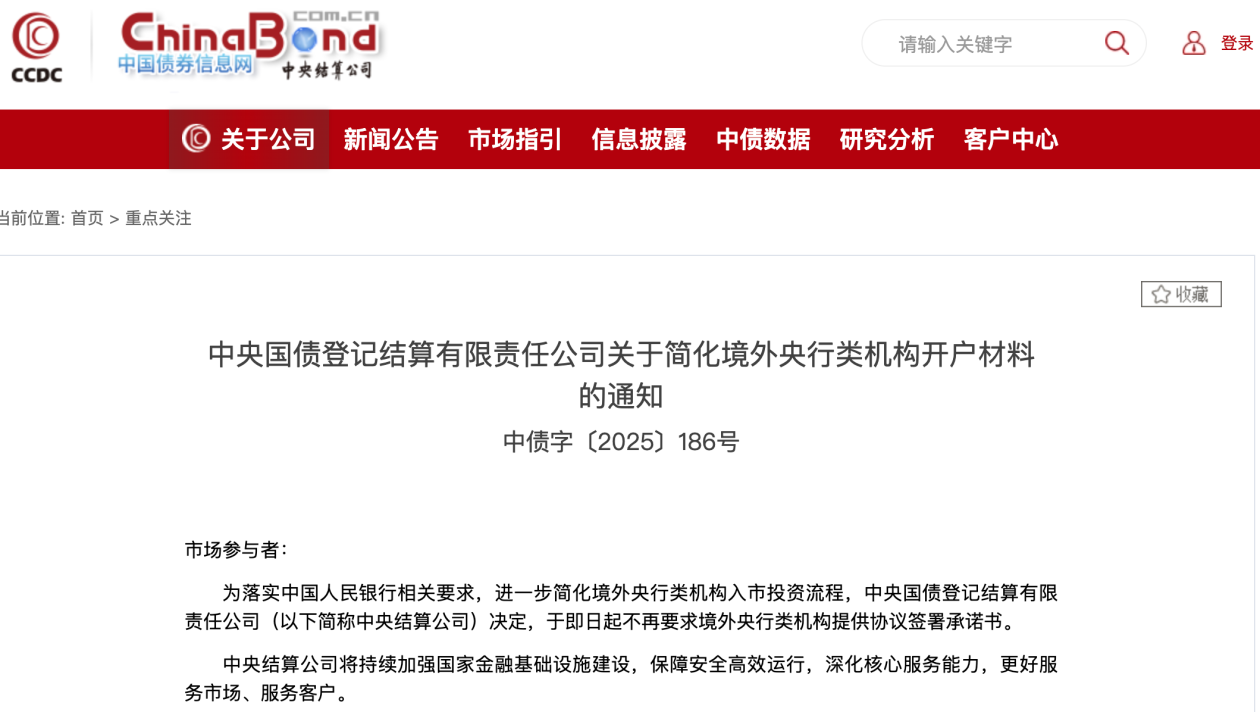
Group 1 - The Central Securities Depository Co., Ltd. announced the simplification of the investment process for foreign central bank institutions, eliminating the requirement for a signed commitment letter from August 11 [1][2] - The Interbank Market Clearing House also stated that it will no longer require a signed declaration for indirect settlement members from foreign central bank institutions starting on the same date [2] - These changes aim to enhance the efficiency and convenience for foreign central banks and sovereign wealth funds to participate in China's interbank bond market, contributing to the internationalization of China's bond market [2][3] Group 2 - Previously, foreign central bank institutions had to complete three main steps to enter the interbank bond market, including filing, signing an agency agreement, and account opening [2] - The People's Bank of China has emphasized its commitment to steadily increasing the internationalization of the Renminbi and simplifying the investment process for foreign investors [3] - The recent optimization of the entry process is a concrete implementation of measures to enhance the liquidity of Renminbi financial assets and facilitate the allocation of Renminbi assets by central bank institutions [3]
境外央行类机构参与银行间债市投资更便利了
Zheng Quan Shi Bao· 2025-08-11 17:50
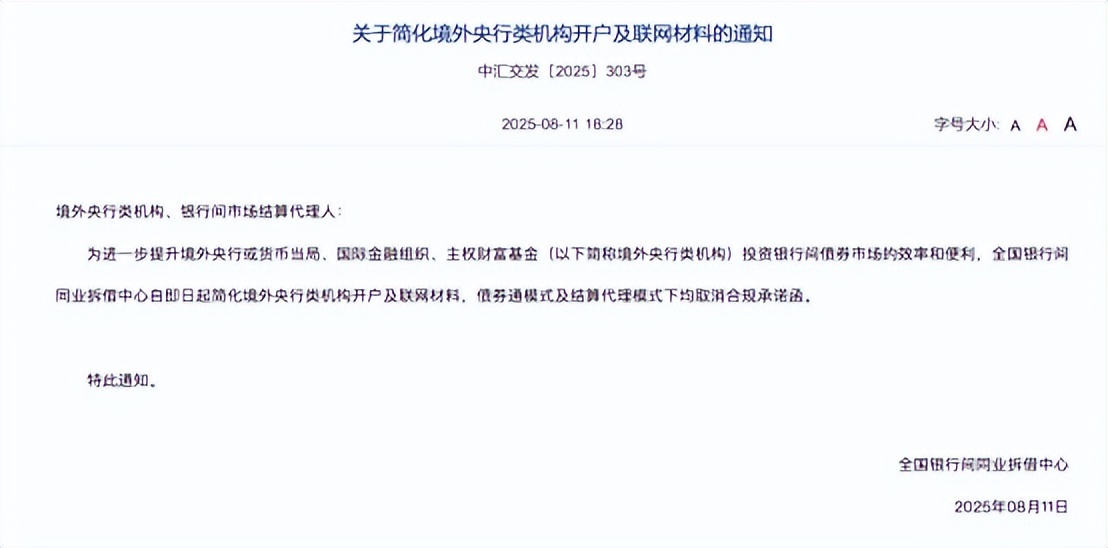
Core Viewpoint - The Central Securities Depository Co., Ltd. has announced the simplification of the investment process for foreign central bank-like institutions, effective from August 11, aiming to enhance the efficiency and convenience of their participation in China's interbank bond market [1][2]. Group 1 - The Central Securities Depository will no longer require foreign central bank-like institutions to provide a signed commitment letter, streamlining the entry process [1]. - The National Interbank Funding Center has also simplified the account opening and networking materials for foreign central bank-like institutions, eliminating the need for compliance commitment letters under both Bond Connect and settlement agency models [1]. - This initiative is expected to improve the convenience for foreign central bank-like institutions to invest in the interbank bond market, thereby increasing the internationalization of the domestic bond market and expanding financial market openness [1]. Group 2 - Previously, the process for foreign central bank-like institutions to enter the market involved three steps: registration, signing an agency agreement, and account opening [2]. - The People's Bank of China aims to steadily enhance the internationalization of the Renminbi and support the construction of a "dual circulation" new development pattern, which includes simplifying the investment process for foreign investors [2]. - The goal is to enrich the types of investable assets and facilitate the allocation and holding of Renminbi assets by central bank-like institutions [2].