
债务重组

Search documents
同方股份子公司同方吉兆对外债权处置 预计可实现债务重组收益9439.19万元
Zhi Tong Cai Jing· 2025-11-19 08:22
Group 1 - The core issue involves Tongfang Co., Ltd.'s subsidiary, Tongfang Jizhao, facing a debt recovery challenge with China Broadcasting Group, which has declared insolvency and is undergoing judicial reorganization [1][2] - Tongfang Jizhao has a total claim of 218.19 million yuan, which includes 117.64 million yuan in principal and 100.55 million yuan in overdue interest [1] - The court has terminated the enforcement procedures due to the lack of executable assets from China Broadcasting Group, which is unable to meet its financial obligations [1] Group 2 - Tongfang Jizhao plans to participate in the creditor meeting and agrees to the reorganization plan, which proposes different repayment methods based on the amount of debt [2] - For debts under 1 million yuan, a 50% cash repayment is proposed, while debts over 1 million yuan will receive 5% in cash and approximately 40% in equity of China Broadcasting Group [2] - After the successful implementation of the reorganization plan, Tongfang Jizhao is expected to recover approximately 98.24 million yuan, with 11.36 million yuan in cash and 86.88 million yuan in equity, representing about 4.57% of the restructured company [2]

同方股份(600100.SH)子公司同方吉兆对外债权处置 预计可实现债务重组收益9439.19万元
智通财经网· 2025-11-19 08:18
Core Viewpoint - Tongfang Co., Ltd. is facing potential losses due to its subsidiary Tongfang Jizhao's unrecovered debts from China Broadcasting Group, which is undergoing judicial reorganization to address its insolvency issues [1][2] Group 1: Debt Recovery Situation - Tongfang Jizhao has an outstanding debt of 117.64 million yuan that remains unrecovered, with three previous court applications for enforcement resulting in termination due to lack of executable assets [1] - The total claim submitted by Tongfang Jizhao amounts to 218.19 million yuan, which includes the principal and overdue interest [1] Group 2: Reorganization Plan - Tongfang Jizhao plans to participate in the creditor meeting and agrees to the reorganization plan, which proposes different repayment methods based on the debt amount [2] - For debts under 1 million yuan, a 50% cash repayment is proposed, while debts over 1 million yuan will receive 5% in cash and approximately 40% in equity of China Broadcasting Group [2] - The expected recovery for Tongfang Jizhao is approximately 98.24 million yuan, with 11.36 million yuan in cash and 86.88 million yuan in equity, representing about 4.57% of the restructured company’s equity [2] - If the reorganization is completed by the end of 2025, Tongfang Co., Ltd. anticipates a debt restructuring gain of approximately 94.39 million yuan for the fiscal year 2025 [2]
华夏幸福2025年11月19日涨停分析:债务重组+产业转型+保交楼进展
Xin Lang Cai Jing· 2025-11-19 05:51
Core Points - 华夏幸福's stock reached the daily limit of 3.64 yuan, with a rise of 9.37%, bringing its total market value to 14.168 billion yuan and circulating market value to 14.094 billion yuan, with a total transaction amount of 3.056 billion yuan as of the report date [1] Group 1 - The stock surge is attributed to significant debt restructuring, with 1,926.69 billion yuan of financial debt restructured, accounting for 87.9% of total debt, and interest reduction of 202.03 billion yuan, alleviating debt pressure and boosting market confidence in future development [2] - The "guarantee delivery" initiative is nearly complete, with residential projects delivered and only four apartment projects pending, stabilizing market expectations [2] - The company is advancing its transformation as an industrial new city service provider, with 18 new enterprises entering the park and a signed investment amount of 13.66 billion yuan, aligning with industry development trends supported by recent government policies [2] Group 2 - On November 18, the stock saw a trading volume of 3.466 billion yuan, with a net buying of 284 million yuan and net selling of 215 million yuan, indicating increased attention from funds [2] - Previous net buying by retail and foreign funds on November 13 also suggests growing interest in the stock [2] - Although technical patterns were not mentioned, the participation of substantial funds contributed to the stock's limit-up performance [2]

华夏幸福债务重组再推进,累计金额近2000亿
21世纪经济报道· 2025-11-18 10:51
11月17日晚,华夏幸福(600340.SH)发布公告称, 截至2025年10月31日,华夏幸福基业股 份有限公司《债务重组计划》中金融债务通过签约等方式实现债务重组的金额累计约为人民 币1926.69亿元(含公司及下属子公司发行的境内公司债券及境外间接全资子公司发行的境外 美元债券重组) 。 记者丨李益文 见习记者王达毓 编辑丨张楠 截至11月18日,华夏幸福股价在经历早盘一度接近跌停的波动后,迅速拉升并封住涨停板, 目前已连续四个交易日涨停。 (声明:文章内容仅供参考,不构成投资建议。投资者据此操作,风险自担。) 出品丨21财经客户端 21世纪经济报道 编辑丨金珊 实习生齐心淳 SFC 21君荐读 全球资产集体杀跌,黄金失守4000美元,加密货币超18万人爆仓 上市12年后,大悦城地产即将退市 医药巨头豪掷650亿,收购超级流感药 此次事件为2021年华夏幸福多只债券构成实质性违约的余波。2021年9月24日,华夏幸福公告 停牌,公告中披露其原因为流动性出现阶段性紧张。 随后在2021年10月8日的复牌公告中,华夏幸福公布了其2192亿元债务的清偿措施,包括出售 资产、展期、现金兑付等方式,并相应调低相关 ...

华夏幸福债务重组再推进 累计金额近两千亿
2 1 Shi Ji Jing Ji Bao Dao· 2025-11-18 08:42
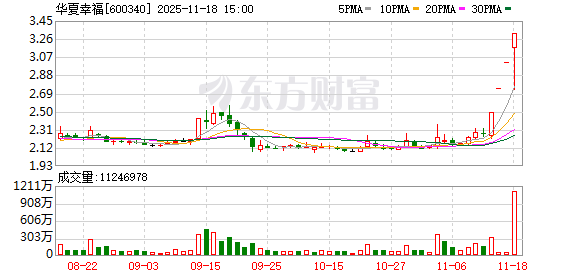
截至11月18日,华夏幸福股价在经历早盘一度接近跌停的波动后,迅速拉升并封住涨停板,目前已连续 四个交易日涨停。 (文章来源:21世纪经济报道) 随后在2021年10月8日的复牌公告中,华夏幸福公布了其2192亿元债务的清偿措施,包括出售资产、展 期、现金兑付等方式,并相应调低相关利率。 根据最新公告,华夏幸福债务重组计划已接近完成。主承销商招商证券及中信银行在公告中表示,后续 将督促发行人按照《银行间债券市场非金融企业债务融资工具违约及风险处置指南》的要求继续推进注 销协议签署工作、办理本期中期票据的注销手续,并根据《债务重组协议》的约定及时分配偿债资源。 11月17日晚,华夏幸福(600340.SH)发布公告称,截至2025年10月31日,华夏幸福基业股份有限公司 《债务重组计划》中金融债务通过签约等方式实现债务重组的金额累计约为人民币1926.69亿元(含公 司及下属子公司发行的境内公司债券及境外间接全资子公司发行的境外美元债券重组)。 此次事件为2021年华夏幸福多只债券构成实质性违约的余波。2021年9月24日,华夏幸福公告停牌,公 告中披露其原因为流动性出现阶段性紧张。 ...
前10月国有土地使用权出让收入24982亿元;荣盛发展与中国信达签署20亿元债务重组协议|房产早参
Mei Ri Jing Ji Xin Wen· 2025-11-17 23:11
Group 1: Government Land Use Rights Revenue - In the first ten months of 2025, the revenue from state-owned land use rights reached 24,982 billion yuan, a year-on-year decrease of 7.4% [1] - The overall government fund budget revenue was 34,473 billion yuan, reflecting a 2.8% decline compared to the previous year [1] - The decline in land use rights revenue indicates that the adjustment in the land market is ongoing, although it has shifted from a "cliff-like drop" to a "moderate decline," suggesting increased market resilience [1] Group 2: Qu Mei Home's Loan Guarantee - Qu Mei Home announced it would provide a guarantee for a bank loan of up to 2.3 billion Norwegian Krone for its overseas subsidiary, Ekornes QM Holding AS [2] - The guarantee involves pledging 100% equity of its wholly-owned subsidiary, Ekornes AS, aimed at optimizing the company's debt structure [2] - This move is seen as necessary for debt optimization, although it introduces exchange rate and operational risks [2] Group 3: Oppein Home's Cash Management - Oppein Home plans to invest 320 million yuan of idle raised funds into structured deposits to enhance fund utilization efficiency [3] - The investment will be split into two products with terms of 52 days, expected to yield annualized returns of 0.65% to 1.9% and 0.65% to 2.5% respectively [3] - This strategy aligns with the company's conservative management style and is expected to generate some returns while ensuring project construction is not affected [3] Group 4: Rongsheng Development's Debt Restructuring - Rongsheng Development signed a debt restructuring agreement with China Cinda Asset Management for approximately 2 billion yuan to alleviate company debt [4] - The agreement stipulates that if certain repayment conditions are met, the remaining debt will be waived, significantly reducing the company's liabilities [4] - This restructuring is a critical step in the company's debt resolution strategy, providing essential breathing space for operations [4] Group 5: Poly Developments' Convertible Bonds - Poly Developments announced the initiation of the conversion of its 8.5 billion yuan convertible bonds, with a maturity of six years and a tiered interest rate structure [5] - The latest conversion price is set at 15.92 yuan per share, with the total amount raised matching the bond issuance [5] - This action is part of a long-term strategy to optimize the financing structure and potentially convert debt into equity in the future [5]


荣盛房地产发展股份有限公司第八届董事会第十五次会议决议公告
Shang Hai Zheng Quan Bao· 2025-11-17 20:21
Group 1 - The core point of the announcement is the approval of a debt restructuring plan by the company's board of directors to alleviate financial pressure and promote stable operations [3][19]. - The board meeting was held on November 17, 2025, with all nine directors present, complying with legal and regulatory requirements [2]. - The debt restructuring involves a total amount of 200,077.44 million yuan, with a specific repayment plan that includes a debt waiver contingent upon timely payments [8][12]. Group 2 - The restructuring plan includes a debt of 148,671.52 million yuan, compensation of 40,116.35 million yuan, and penalties of 11,004.07 million yuan [12][15]. - The company will transfer physical assets valued at 35,000.00 million yuan as part of the debt repayment, which has been assessed at 35,704.41 million yuan [13][16]. - The restructuring is not classified as a related party transaction or a major asset restructuring under relevant regulations [8][9]. Group 3 - The counterparty in the restructuring is China Cinda Asset Management Co., Ltd. Hebei Branch, which has significant financial assets and liabilities [10]. - The restructuring is expected to impact over 10% of the company's latest audited net assets, indicating its significance to the company's financial health [19]. - The board believes that this restructuring will not harm the interests of the company or its shareholders and is a necessary step for sustainable development [19].
债台高筑!华夏幸福预重整获法院受理
Shen Zhen Shang Bao· 2025-11-17 14:42
Core Viewpoint - The company Huaxia Happiness (600340) is undergoing a pre-restructuring process due to its inability to repay debts on time and its significant lack of repayment capacity, despite having restructuring value [1] Group 1: Company Financial Performance - As of the announcement date, the company reported a revenue of 3.882 billion yuan for the first three quarters of 2025, representing a year-on-year decline of 72.09% [2] - The net profit attributable to the parent company for the same period was -9.829 billion yuan, indicating severe financial distress [2] - As of September 30, 2025, the company's equity attributable to shareholders was -4.738 billion yuan, highlighting ongoing operational and debt risks [2] Group 2: Debt Restructuring Efforts - As of October 31, 2025, the company has achieved a cumulative debt restructuring amount of approximately 192.669 billion yuan through agreements related to financial debts [2] - The company has also utilized equity from its subsidiaries, amounting to approximately 23.628 billion yuan, to offset financial and operational debts [3] - The total amount of debts that the company has failed to repay as of October 31, 2025, is approximately 24.569 billion yuan, excluding interest [3] Group 3: Legal and Operational Challenges - From October 1 to October 31, 2025, the company faced new litigation and arbitration cases with a total amount involved of approximately 438 million yuan, with uncertain outcomes [3] - The company is primarily engaged in the development and operation of industrial new cities, real estate development, property management, and investment consulting services [3]
又一家千亿房企被申请重整,创始人曾表示“愿赌服输”
第一财经· 2025-11-17 07:35
Core Viewpoint - The article discusses the ongoing debt restructuring process of Huaxia Happiness, a once-prominent real estate company, which is now facing a pre-restructuring application due to unpaid debts and financial difficulties [6][7][10]. Group 1: Company Background and Current Situation - Huaxia Happiness, once a leading real estate firm with a valuation exceeding 100 billion, has encountered significant operational misjudgments and financial distress, leading to debt defaults and restructuring efforts [3][6]. - The company has been in a debt restructuring phase since 2021, with a total of 2,192 billion yuan in financial debts, of which approximately 1,926.69 billion yuan has been restructured as of October 2025 [7][10]. Group 2: Debt Restructuring Process - Recently, Huaxia Happiness received a notice from creditor Longcheng Construction, which applied for the company's pre-restructuring due to an outstanding engineering payment of 417.16 million yuan [6][8]. - The pre-restructuring process allows for unified negotiations among creditors, but the transition to formal restructuring remains uncertain [7][10]. Group 3: Challenges and Market Conditions - The company faces challenges in its debt restructuring due to a changing market environment, which has made it difficult to meet previously agreed-upon conditions, leading to secondary defaults [9][10]. - The restructuring primarily addresses large financial debts, while smaller operational debts remain unresolved, resulting in a situation where the company is simultaneously restructuring and facing lawsuits [10][12]. Group 4: Future Outlook and Considerations - If the company enters formal restructuring, all debts, including financial and operational, will need to be re-evaluated, and existing restructuring agreements may be adjusted [13][15]. - The success of the restructuring will depend on various factors, including the company's asset situation, ability to generate sustainable cash flow, and the stance of creditors [15][16].

又一家千亿房企华夏幸福被申请重整,创始人曾表示“愿赌服输”
Xin Lang Cai Jing· 2025-11-17 07:32
Core Viewpoint - The debt restructuring of Huaxia Happiness is facing difficulties, with new developments indicating a potential move towards formal reorganization due to outstanding debts and ongoing financial challenges [2][3][6]. Group 1: Debt Restructuring Situation - Huaxia Happiness has been in a debt restructuring phase since 2021, following a significant debt default, and is now facing a new request for pre-reorganization from creditor Longcheng Construction due to an outstanding payment of 4.17 million yuan [2][4][5]. - The company has previously proposed a debt restructuring plan aimed at repaying 219.2 billion yuan in financial debts through various methods, but has struggled to meet these obligations, with 24.57 billion yuan in unpaid debts as of now [8][10]. - The court has accepted the pre-reorganization application, but this does not guarantee that the formal reorganization will be approved, leaving the company's future uncertain [6][10]. Group 2: Market Reaction and Stock Performance - Following the news of the pre-reorganization application, Huaxia Happiness's stock price experienced significant fluctuations, including a limit-up on November 17, with shares trading at 3.01 yuan each [2][3]. - The market sentiment reflects concerns about the company's potential transition into formal reorganization, which could lead to further financial instability [2][10]. Group 3: Challenges in Debt Restructuring - The restructuring efforts are complicated by the fact that the initial restructuring plan primarily addressed large financial debts, leaving smaller operational debts unresolved, which are now causing additional financial strain [8][10]. - Industry experts indicate that the current market environment poses challenges for real estate companies, making it difficult to generate sales revenue and maintain asset values, further complicating the debt restructuring process [8][10].