
猪肉制品

Search documents
光明肉业(600073) - 光明肉业2025年度经营数据公告
2026-03-30 14:00
| 渠道类别 | 2025 年 1-12 月 | 2024 年同期 | 同比变动 | | --- | --- | --- | --- | | 直营 | 4,687,856,787.91 | 5,090,919,097.98 | -7.92% | | 分销 | 15,979,563,480.47 | 15,103,701,939.45 | 5.80% | | 其他 | 1,462,552,923.97 | 1,792,271,469.91 | -18.40% | | 合计 | 22,129,973,192.35 | 21,986,892,507.34 | 0.65% | 1 / 2 证券代码:600073 证券简称:光明肉业 公告编号: 2026-017 上海光明肉业集团股份有限公司 2025 年度经营数据公告 本公司董事会及全体董事保证本公告内容不存在任何虚假记载、误导性陈述或者重大遗漏, 并对其内容的真实性、准确性和完整性承担个别及连带责任。 根据《上海证券交易所上市公司行业信息披露指引第十四号——食品制造》第 十四条相关规定,现将上海光明肉业集团股份有限公司(以下简称"公司")2025 年度主要经营数据( ...

牧原股份-垂直整合的生猪行业龙头:首次覆盖,给予超配
2026-03-26 13:20
Summary of Muyuan Foodstuff Co. Ltd. Conference Call Company Overview - **Company**: Muyuan Foodstuff Co. Ltd. (牧原股份) - **Industry**: Hog Farming in China - **Stock Ratings**: Overweight (OW) for both A-shares and H-shares Key Points Industry Insights - **Pork Price Trends**: Current hog prices are below RMB 11/kg, with limited downside potential. A price turning point is expected in the second half of 2026, driven by a decline in breeding sow inventory since September 2025 due to industry losses [2][13] - **Supply Dynamics**: The industry is anticipated to see a significant reduction in hog supply, with a projected average price of RMB 13.0/kg in 2026, a 10% year-on-year decrease. The first half of 2026 is expected to average RMB 12.2/kg, while the second half may rise to RMB 14.0/kg [2][14] Company Performance - **Cost Efficiency**: Muyuan is recognized as a cost leader in the hog farming sector, with a projected cost reduction from RMB 12.1/kg in 2025 to RMB 10.9/kg in 2026. The company’s gross profit from hog farming is expected to be RMB 20.6 billion in 2026, increasing to RMB 32.4 billion in 2027 [3][21] - **Downstream Expansion**: Muyuan has expanded into downstream processing, becoming the largest slaughterhouse in China by volume in 2024. The slaughter volume is expected to increase from 27 million heads in 2025 to approximately 35 million heads in 2026, contributing about 3% to net profit [3][21] Financial Projections - **Earnings Growth**: The company anticipates a compound annual growth rate (CAGR) of 34% in earnings from 2025 to 2027. The target price is set at RMB 58 for A-shares and HKD 59 for H-shares, based on a P/E ratio of 18x for A-shares and 16x for H-shares [4][22] - **Revenue Outlook**: Revenue growth is expected to be flat from 2025 to 2027, primarily due to fluctuations in hog prices and stable sales volumes. However, the expansion into downstream operations is expected to provide some support [21] Risks and Considerations - **Market Risks**: Key risks include slower-than-expected inventory reduction, rising costs, and potential outbreaks of diseases affecting hog production. Additionally, the market may not fully account for the upcoming price recovery in the hog sector [4][22][27] Conclusion - **Investment Recommendation**: The report recommends an overweight position on Muyuan Foodstuff Co. Ltd., highlighting its cost-saving capabilities and potential for growth as the hog market transitions from a downturn to an upturn [1][4]

鲁、豫生猪饲料市场调研报告
Guang Fa Qi Huo· 2026-03-17 10:58
1. Report Industry Investment Rating No information provided. 2. Core Viewpoints of the Report - The current pig industry is in a bottom - oscillating adjustment period, with the overall trend of "short - term stabilization and decline, medium - term slight recovery, and further pressure release in the second half of the year". Industry reshuffle is accelerating, and cost control and model innovation are the keys for enterprises to break through [16]. - The long - term industry losses will lead to a reshuffle, and enterprises with sufficient funds and good cost - control capabilities will stand out. The pig price is expected to struggle at the bottom for a long time, and it is recommended to mainly use reverse hedging operations in the futures market, and long - term allocation can focus on high - quality breeding stocks [20]. 3. Summary by Directory 3.1. Research Summary 3.1.1. Feed Link - Some feed enterprises face the pressure of declining sales. The core reasons are the recurrence of diseases in Shandong from mid - October to early November last year, which led to an early increase in pig slaughter volume, reducing feed demand. Coupled with the low pig price and rising feed price, the breeding end is cautious about restocking, further suppressing feed consumption. Enterprises expect feed sales to gradually recover after April [5]. - In terms of raw material procurement, affected by the mildew of North China corn, enterprises mainly purchase corn from the Northeast, with a transportation cost of 200 - 300 yuan/ton. To reduce the impact of toxins, enterprises implement refined proportioning. Piglet feed uses all Northeast corn, and medium and large pig feed uses a combination of Northeast and local corn. The overall inventory is relatively sufficient, and the current enthusiasm for restocking is limited [5]. - Affected by the increase in raw material prices after the Spring Festival, the feed price has been raised synchronously. The sales volume in March is expected to decline by 30% year - on - year, which is in line with the historical trend after the Spring Festival. However, the sales volume of teaching and protection feed is expected to improve slightly month - on - month, indicating that the inventory of piglets in the market is still at a high level [5]. - For raw material price prediction, enterprises believe that soybean meal is supported by the cost of US soybeans and international freight in the short term and has increased in price, but the overall supply is loose, so they do not blindly expect a high price. Corn still has room for price increase, and the subsequent price is expected to reach 2600 - 2700 yuan/ton [5]. 3.1.2. Breeding Link - The breeding end is currently facing multiple pressures such as low pig prices, increased costs, and high inventory. The enthusiasm for restocking is differentiated, and enterprises of different scales show different business situations. Although the industry is generally in a loss state, the adjustment of production capacity is very cautious [7]. - In terms of production capacity, the current industry production capacity is still at a high level. Although the data from the Ministry of Agriculture shows that the number of fertile sows in the country has decreased to 39.6 million, the absolute value is still high. The impact of losses and diseases at the end of last year on production capacity is relatively limited. Breeding enterprises have no obvious intention to actively reduce production capacity, only those with financial difficulties reduce production capacity passively. The reduction of production capacity by leading enterprises is mostly for capacity transfer, and the actual slaughter volume of sows has not increased significantly, and the price of culled sows is stable [7]. - In terms of restocking, the current enthusiasm for secondary fattening is not high. Affected by factors such as low pig prices, rising feed costs, and the inversion of standard and fat pig prices, secondary fattening households mostly adopt a wait - and - see attitude. Most stocking enterprises' pens are empty. It is expected that the enthusiasm for purchasing 15kg piglets is higher than that for 7kg piglets. Enterprises are optimistic about the price before the Zhongyuan Festival and believe that the decline space of piglet prices is limited because the restocking demand in Shandong from March to May is relatively high. In Henan, there is a situation of "high piglet prices and cautious restocking", and only a small number of secondary fattening households buy at the bottom [9]. - In terms of cost and profit, there are differences among enterprises. The current fattening cost of individual farmers in Shandong is about 5.5 yuan/jin, the fattening cycle is 5 - 5.5 months, and the daily weight gain is 1.6 jin. The daily weight gain of secondary fattening is about 2 jin. The slaughter cost of stocking enterprises is about 5.6 yuan/jin (excluding disease losses), and the cost after disease losses exceeds 6 yuan/jin. The current pig price is about 5 yuan/jin, and the industry is in a loss state. In addition, slaughterhouses have increased the deduction for large pigs, and the supply of pigs in the 125 - 150KG weight range is sufficient, and the price decline is greater than that in the 105 - 125KG range. Breeding enterprises have difficulties in selling and are forced to reduce prices, and the pressure of slaughtering large pigs is relatively large. Group enterprises are still further reducing costs and will further lower the target cost in 2026, achieving cost - control advantages through integrated layout [10]. - In terms of diseases and hedging, there are still sporadic epidemics, which increase the breeding cost and risk. The current full - industry loss state and the investment in disease prevention and control costs undoubtedly increase the burden on enterprises. If there is a high - incidence period of epidemics in the future, it may increase the risk of concentrated outbreaks of diseases at the breeding end. In terms of hedging, enterprises in Shandong and Henan have a high enthusiasm for hedging, and the model is mature. They are more enthusiastic about hedging in the piglet fattening link. The large - scale participation of the breeding end industry also has a profound impact on the futures market trend [13]. 3.1.3. Slaughter and Trade Link - In the slaughter link, it is currently facing problems such as weak demand, seasonal decline in sales volume, and financial pressure. Although the pig price is at a low level, the current enthusiasm for segmentation and warehousing is not high. However, some more radical enterprises believe that the risk of making frozen products at a pig price of about 5 yuan/jin is low and are gradually segmenting and warehousing. The weak performance of the consumer end is the core problem faced by slaughter enterprises. The current low pork price has an insignificant effect on stimulating consumption, and the willingness of terminal consumers to switch from beef and poultry to pork is not strong, which is in line with the situation where the decline in poultry prices affects the demand for pig products. At the same time, the industry has over - capacity and a long payment period, which further increases the pressure on slaughter enterprises. Therefore, the current overall warehousing rhythm is still relatively slow [14]. - In the trade link, single transportation businesses have mostly transformed due to financial pressure, and enterprises mostly adopt the "transportation + stocking" model. Slaughterhouses generally have a long payment period, and traders face prominent financial pressure. Large pigs in Shandong mainly flow to Anhui and Zhejiang, but affected by the sufficient supply of large pigs in the South, the number of large pigs transported from the North to the South has decreased, which is consistent with the current situation of the structural mismatch between the supply and demand of pigs in the North and the South. Although there is a gap in the main sales areas in the South, the current supply is sufficient, resulting in a decline in cross - regional transportation volume [15]. 3.1.4. Market Outlook - The current pig industry is in a bottom - oscillating adjustment period. Although there are differences in market predictions among all parties, the overall trend is "short - term stabilization and decline, medium - term slight recovery, and further pressure release in the second half of the year". At the same time, the industry reshuffle is accelerating, and cost control and model innovation are the keys for enterprises to break through [16]. - In terms of market prediction, most enterprises believe that March - April is the low - price range of pig prices in the first half of the year, and the probability of the price being lower than this level in the future is small and the duration is short. From May to June, the price is expected to rise with the decrease in supply. It is difficult to judge the annual high point, and it is expected that reaching 7 yuan/jin is already good. Regarding the market in the second half of the year, there are different views in the market. Some believe that it is expected to recover, but some enterprises believe that there is no substantial reduction in production capacity at present. Although the industry is in a loss state, the time and space of the loss are limited, the breeding end has sufficient funds, and it is difficult to reduce production capacity, so the expectations for the second half of the year have been lowered [16]. 3.2. Research Minutes 3.2.1. Shandong Enterprise A - The enterprise mainly engages in pig feed (with a small amount of ruminant feed). The designed production capacity of pig feed is 180,000 tons, and the current output is about 60,000 tons. It has 20,000 fattening pens, and the scale of the cooperative fattening pig enterprise reaches 100,000 heads. In terms of feed sales, the pig feed sales volume in February was about 3,000 tons, a significant halving month - on - month, and the sales volume from December to February continued to decline month - on - month. It is expected to start to recover in April, mainly because the recurrence of diseases in Shandong from mid - October to early November last year led to an increase in pig slaughter volume, resulting in an early decline in pig feed sales [21]. - In terms of restocking, the enthusiasm for secondary fattening in Linyi is not high. Affected by low pig prices, rising feed costs, and the inversion of standard and fat pig prices, secondary fattening households mostly adopt a wait - and - see attitude. The enterprise's 20,000 pens and most of its cooperative customers' pens are currently empty. It plans to purchase 15kg piglets recently and slaughter them before the Zhongyuan Festival on August 27 (with a slaughter weight of 270 - 280 jin). It is optimistic about the price before the festival and believes that the decline space of piglet prices is limited because the restocking demand in Shandong from March to May is relatively high [21]. - In terms of fattening cost, the enterprise indicates that the current cost from purchasing 15kg piglets (450 yuan/head) to slaughter is about 6 yuan/jin, and the fattening cost of individual farmers is about 5.5 yuan/jin. The fattening cycle is 5 - 5.5 months, and the daily weight gain is 1.6 jin. The daily weight gain of secondary fattening is about 2 jin [21]. - In terms of circulation, large pigs in Shandong mainly flow to Anhui and Zhejiang. Affected by the sufficient supply of large pigs in the South, the number of large pigs transported from the North to the South has decreased [22]. - In terms of hedging, it is recommended to use over - the - counter options for hedging, which can be combined with on - exchange hedging to reduce risks. Enterprises in Shandong have a high enthusiasm for hedging [22]. - In terms of feed raw materials, the enterprise's corn inventory is maintained for more than one month, with daily rotation in and out. Affected by the mildew of North China corn, it mainly purchases corn from the Northeast, with a transportation cost of 200 - 300 yuan/ton. It proportions corn for different pig feed stages to reduce toxins. Piglet feed uses all Northeast corn, and medium and large pig feed uses a combination of Northeast and local corn. The enterprise is optimistic about the domestic corn price and expects it to reach 2600 - 2700 yuan/ton [22]. - In the future, the enterprise will focus on promoting piglet procurement, hedging operations, and raw material procurement, strengthen market monitoring, and pay attention to the trends of pig prices and raw material prices. In terms of the market, the short - term pig price is expected to improve in April, stabilize in May, improve in June, and may decline in July, and the long - term upward space is limited [22]. 3.2.2. Shandong Enterprise B - The enterprise mainly engages in the sales of segmented products. The current daily slaughter volume is more than 5,000 heads, half of the peak of more than 10,000 heads before the Spring Festival. The average weight of purchased pigs is 100 - 110 kg, the same as the same period. The pig sources mainly come from local Shandong and northern Jiangsu. In terms of pig prices, the enterprise believes that March - April may be the low price of the year, and the probability of the price being lower than this level in the future is small and the duration is short. It is relatively optimistic about the pig price in the second half of the year. The short - term average price in March is 5.2 - 5.4 yuan/jin, slightly rising to about 5.6 yuan/jin in April. The supply is expected to decrease from May to June, and the price is expected to rise. It is difficult to judge the annual high point, and it is expected that reaching 7 yuan/jin is already good [23]. - In terms of enterprise operation, the fresh - sales rate is about 50%, down from 70 - 80% before the Spring Festival. Warehousing is mainly order - based, with 25% being customer orders and 25% being active + passive warehousing. In terms of product cost, the price of No. 4 meat is 15,500 - 16,000 yuan/ton, and the price of No. 2 meat is 15,000 - 15,500 yuan/ton. In the frozen - product storage cost, the daily rent per ton of goods is 1 yuan (30 yuan/ton per month). Coupled with handling and transfer fees, the monthly fixed cost is about 100 yuan/ton. The enterprise's designed frozen - product storage capacity is about 10,000 tons, and the current inventory is 3,000 - 4,000 tons (including customer orders and the amount of active segmentation and warehousing). It believes that the risk of making frozen products at a pig price of about 5 yuan/jin is low and is gradually segmenting and warehousing, planning to complete the target volume in about three months. At the same time, the enterprise pays attention to production refinement and channel construction, and some enterprises avoid payment - period risks [23]. - In terms of supply and demand, the decline in poultry prices affects the demand for pig products. The prices of frozen and fresh meat are close, and the discount situations are different for different uses. The industry has over - capacity, and there are differences in the management and production capacity of slaughterhouses in the North and the South. Some southern enterprises rely on contract slaughtering. The enterprise improves its competitiveness by optimizing production and sales and cooperating to stabilize customers [24]. - In terms of inventory, deep - processing enterprises increase inventory moderately as needed. In terms of funds, supply - chain finance provides support, and the enterprise uses funds carefully. Looking forward to the future, the short - term price will rise slowly, and the medium - term demand is expected to increase. The enterprise will optimize inventory, expand channels, and strictly control costs [25]. 3.2.3. Shandong Enterprise C - The enterprise is a large - scale pig trading enterprise in the local area, with business covering the whole country. The average daily trading volume is about 50 trucks, reaching 120 trucks at the peak before the Spring Festival. Each truck is 15 - 18 tons, and the weight of each truck of large - weight pigs exceeds 16 tons. The purchased pig sources are mainly from provinces in the Northwest and the South with low prices and price - difference advantages [26]. - Currently, the stocking volume in the Shandong region is large, and the local fattening supply is sufficient. The enterprise's own stocking volume is about 30,000 heads, which is relatively small among large - scale stocking enterprises in the local area. Shandong stocking enterprises had a long - term profit in the early stage and increased the volume rapidly last year. They have been in a loss state since September last year. The agency - raising fee is 200 - 240 yuan/head. Because the average weight per head is lower than that in the South, the agency - raising fee is lower than that in the South [26]. - At the breeding end, the slaughter cost of stocking enterprises is about 5.6 yuan/jin (excluding disease losses), and the cost after disease losses exceeds 6 yuan/jin. The current pig price is about 5 yuan/jin, and the industry is in a loss state. Shandong slaughterhouses have increased the deduction for large pigs, 80 - 100 yuan per head. The supply of pigs in the 125 - 150KG weight range is sufficient, and the price decline is greater than that in the 105 - 125KG range. Breeding enterprises have difficulties in selling and are forced to reduce prices [26]. - At the industry level, single transportation businesses have mostly transformed due to financial pressure, and enterprises mostly adopt the "transportation + stocking" model. Slaughterhouses generally have a long payment period, and traders face prominent financial pressure [26]. - The process of taking delivery in the futures market is cumbersome. In the North, 72 - hour disinfection is required in advance for delivery, and the intangible cost is high. Slaughterhouses have a low participation rate and are prone to losses [26]. - All parties believe that the current bottom - oscillating of pig prices has just started and is expected to last for about three months. Enterprises need to have sufficient funds and good cost - control capabilities to survive the difficult period [27]. 3.2.4. Henan Enterprise A - The
集市直通全球购 年货一站全购齐
Xin Lang Cai Jing· 2026-02-15 22:17
Core Insights - The "Spring Shopping Festival" at Guiyang Comprehensive Bonded Zone attracted significant local participation, featuring over 200 global and local products for consumers [1] - The event emphasized "bonded imports," with over 60% of the showcased products being overseas imports, providing competitive pricing for consumers [1] Group 1: Event Overview - The shopping festival was held on February 10, drawing large crowds to the Guiyang Comprehensive Bonded Zone [1] - Local residents expressed satisfaction with the pricing, noting that many items were cheaper than usual [1] Group 2: Product Highlights - Popular products included Danish cookies, Italian chocolates, and Vietnamese dried fruits, with sales exceeding 10,000 yuan within the first two hours [1] - Local specialties such as fried potato chips and pork products also saw high demand, with significant sales reported [1] Group 3: Business Model - The event featured over 10 quality trading companies, utilizing a "front store and back warehouse" model for bonded direct supply [1] - This model ensures 100% authenticity of products and allows consumers to benefit from competitive "bonded prices" [1]
贵州年货新风景,集市直通全球购
Sou Hu Cai Jing· 2026-02-11 10:24
Core Insights - The "Good Goods Selection and New Year Goods Festival" in Guiyang Comprehensive Bonded Zone has successfully attracted a large number of visitors, showcasing a variety of products from local specialties to international imports [1][3] Group 1: Event Overview - The shopping festival features over 10 quality trading companies and hundreds of product categories, with more than 60% of the goods being imported [3] - The event emphasizes the "bonded import" attribute, allowing consumers to experience a new shopping model of "buying global at their doorstep" [3] Group 2: Consumer Experience - Local residents have expressed satisfaction with the pricing, noting that some items are significantly cheaper compared to supermarkets, enhancing the convenience of shopping [3] - Popular products include Danish cookies, Italian chocolates, and Vietnamese dried fruits, with sales exceeding 10,000 yuan within the first two hours of the event [5] Group 3: Local Products - Local flavors are also in high demand, with products like spicy potato chips and Guizhou-style pork attracting considerable attention from shoppers [5] - The event allows local businesses to expand their sales channels while providing consumers with a wide range of quality goods [7] Group 4: Government and Business Collaboration - The shopping festival is a practical implementation of the Guiyang Comprehensive Bonded Zone's policy advantages, aimed at boosting domestic demand and benefiting the public [7] - The initiative is characterized by a "government platform, business performance" approach, facilitating a one-stop shopping experience for consumers while supporting local enterprises [7]


Muyuan Foods Co., Ltd.(H0164) - PHIP (1st submission)
2026-01-15 16:00
The Stock Exchange of Hong Kong Limited and the Securities and Futures Commission take no responsibility for the contents of this Post Hearing Information Pack, make no representation as to its accuracy or completeness and expressly disclaim any liability whatsoever for any loss howsoever arising from or in reliance upon the whole or any part of the contents of this Post Hearing Information Pack. Post Hearing Information Pack of MUYUAN FOODS CO., LTD. 牧原食品股份有限公司 (A joint stock company incorporated in the Pe ...
中国与西班牙农产品贸易按下“加速键”
Zhong Guo Jing Ying Bao· 2025-12-30 17:18
Group 1 - The demand for high-quality meat products in China is rapidly increasing, with a nearly threefold growth in pork import-export trade deficit from 2015 to 2024, reflecting a compound annual growth rate of approximately 12.63% [1] - Spain has become a significant supplier of agricultural products, including wine, olive oil, and pork, to the Chinese market, with agricultural products now serving as a crucial "cooperation anchor" in Sino-Spanish trade [1] - China ranks as the ninth-largest market for Spanish agricultural and food product exports, and the third-largest non-EU export destination after the UK and the US [1] Group 2 - The pork products sector is the most substantial area of cooperation in Sino-Spanish agricultural trade, with Spain's pork exports to China expected to reach 540,000 tons and over €1.097 billion in 2024, accounting for nearly 20% of Spain's total pork exports [2] - In April 2025, an agricultural cooperation agreement was signed to expand market access for Spanish pork products in China over the next five years, further solidifying trade relations [2] - By July of this year, Spain's pork export value to China reached €700 million, indicating a significant increase compared to the previous year, with expectations for the total annual export to exceed 2024 figures [2] Group 3 - Beyond pork, Spain is also promoting the export of other specialty agricultural products such as fresh cherries and olive oil to China, driven by policy guidance and market demand [3] - Grupo Jorge, one of Spain's largest meat companies, has been a key supplier of pork products to China since entering the market in the 2010s, focusing on fresh pork and traditional Spanish ham [3] - The company's operations also extend to organic agriculture and renewable energy, showcasing a commitment to carbon neutrality and providing a model for Sino-Spanish cooperation in addressing climate change and promoting green transformation [3]

马克龙威胁加税后,中国一周内对欧盟连出两记重拳,法国最受伤
Sou Hu Cai Jing· 2025-12-28 13:15
Group 1 - Macron's visit to China was met with high-level reception, but he later criticized China regarding trade imbalances, threatening EU protectionist measures similar to US tariffs on China [1] - China has implemented temporary countervailing measures on EU dairy products, with subsidy rates ranging from 21.9% to 42.7%, primarily affecting French companies [1][3] - The EU's imposition of tariffs on Chinese electric vehicles has led to China's retaliatory measures, including anti-dumping duties on EU pork products ranging from 4.9% to 19.8% [3] Group 2 - The EU's leadership, including Macron, lacks a fundamental understanding of the dynamics in EU-China trade relations, particularly regarding the electric vehicle market where China holds a dominant position [3][5] - Chinese electric vehicles remain popular in the EU market despite high tariffs, while EU dairy and pork products face significant competition from other suppliers, indicating a potential vulnerability for the EU [5] - Strengthening trade relations with China could benefit the EU by providing access to affordable goods and a large consumer market, as well as stable supplies of critical materials [7]

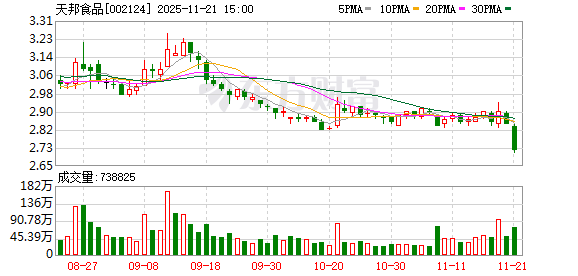
天邦食品:目前公司主营业务为生猪养殖和猪肉制品加工,已无水产品相关业务
Mei Ri Jing Ji Xin Wen· 2025-11-21 13:34
Group 1 - The company, Tianbang Food (002124.SZ), confirmed that Yancheng Bonny Aquatic Food Technology Co., Ltd. is a wholly-owned subsidiary [2] - The main business of the company is pig farming and pork product processing, and it no longer has any seafood-related business [2]

预重整一拖再拖 天邦食品的“多事之秋”
Bei Jing Shang Bao· 2025-11-10 16:06
Core Viewpoint - Tianbang Food's pre-restructuring period has been extended to May 9, 2026, marking the third extension since the process began in August 2024, indicating ongoing financial difficulties and the need for more time to address complex issues [1][3]. Company Overview - Tianbang Food, founded in 1996 and listed in 2007, initially focused on special aquatic feed before entering the pig farming sector in 2013 through the acquisition of assets from Aigefei Agriculture [2]. - The company has faced significant challenges in the pig farming industry, which has entered a downward cycle from 2021 to 2023, leading to substantial losses and a high debt burden [2]. Financial Performance - In 2023, Tianbang Food reported a net profit of -28.83 billion yuan, with a year-end debt-to-asset ratio of 86.73% [2]. - For the first three quarters of 2025, the company achieved revenue of 67.19 billion yuan, a year-on-year decrease of 5.98%, and a net profit of 2.6 billion yuan, down 80.65% [4]. - The third quarter of 2025 saw a revenue of 20.26 billion yuan, a decline of 28.39% year-on-year, and a net profit of -924.85 million yuan [4]. Restructuring Process - Tianbang Food applied for pre-restructuring in March 2024 due to an inability to repay debts, and the initial six-month period has now been extended to a total of 22 months [2][3]. - The extensions are aimed at maximizing asset value and protecting the rights of creditors and debtors, indicating ongoing negotiations and adjustments in the restructuring plan [3]. Management Changes - The company has experienced management changes, including the resignation of Vice President Yan Xiaoming in September 2025, which may impact the strategic execution of its pork processing business, a key revenue source [5]. - Yan's departure could lead to increased communication costs and may be perceived as a lack of confidence internally, potentially affecting negotiations with creditors and investors [5]. Industry Context - The pig farming industry is currently undergoing a deep adjustment phase, with prices for pigs declining since the third quarter of 2025, which has negatively impacted Tianbang Food's sales [4][5]. - The company's sales of live pigs reached 686,000 heads in October 2025, a month-on-month increase of 11.95%, but sales revenue fell by 4.25% to 607 million yuan, with an average selling price down 13.98% [5].