
基层治理

Search documents
临高推行“乡镇吹哨、部门报到”机制,提升为民办事质效
Hai Nan Ri Bao· 2025-10-10 01:29
时间倒回至9月初,在东英镇政府会议室,张斌带着项目推进中的难题找到镇干部。"池塘灌溉需要 接入市政水管,生产监控得通网络,还有部分用地手续没完善,这些问题涉及多个部门,我们自己跑了 好几次都没理顺。" 听着张斌的诉求,东英镇干部当即决定启动"乡镇吹哨、部门报到"机制——这是临 高今年创新推出的新举措,赋予乡镇根据实际需求发起"吹哨"的权力,县直相关部门必须在规定时间 内"报到"响应。 哨声一响,各部门迅速行动。临高县资规局工作人员立即赶到项目现场,对照用地规划图纸逐一核 实细节,现场出具审批意见;县科工信局得知项目急需网络保障,连夜协调通信企业铺设线路,不到3 天就完成网络接通;县水务局开通绿色通道,压缩审批流程,原本需要一周的灌溉用水审批,仅用2天 就办理完毕。"每天都有部门工作人员来现场对接,有问题当场沟通、当场解决,这种'围着企业转、盯 着问题办'的服务,让我们扎根临高的信心更足了。" 张斌感慨道。 这样高效的基层治理实践,不仅体现在企业服务中,也延伸到民生服务中。9月25日,在全国"2025 县(市、区)12345热线发展大会"上,临高县营商环境建设局凭借案例《以 12345热线支点撬动基层治 理现代 ...
【宝鸡】社区志愿服务温暖群众“心窝窝”
Shan Xi Ri Bao· 2025-10-09 22:34
理发师傅反复擦拭剪刀,医生仔细摆好血压计与听诊器,磨刀匠熟练支起砂轮调试转速……9月25 日上午,宝鸡市金台区石油东山社区人头攒动、热闹非凡,"心窝窝"集市再次开锣。 从2023年初创时的10余个零散摊位,到如今涵盖11类志愿服务的惠民盛宴,这个小集市不仅成了居 民家门口的"生活百宝箱",还以"专业社工+志愿服务"深度融合的创新模式,绘就基层治理新图景。 去年底,石油东山社区被确定为我省党建引领"社志融合"试点社区之一。社区党支部书记焦虎兵表 示:"我们积极探索专业社工带领志愿者、志愿者协助专业社工融合发展模式,将党建所向、社工所 能、志愿者所长、居民所需紧密结合起来,推动志愿服务在助力基层治理中发挥更大作用。" 多维联动: 从"独角戏"到"大合唱"的蜕变 石油东山社区是典型的单位型转板块型社区,13个小区61栋楼多为旧式楼梯房,3248户居民中老年 人、特殊群体占比超三成。曾经,社区治理陷入"干部干、群众看"的困境——想办义诊缺医生,想搞义 剪少师傅,即便组织活动,居民参与热情也不高。如何优化服务模式、创新活动载体、激发居民参与热 情,成为社区"两委"班子需要解决的难题。 社区虽小,却连着千家万户。金台区委 ...
聚焦“两高四着力”·一“县”观察丨鹤山区 小院里多元解纷好事多
He Nan Ri Bao· 2025-10-06 23:20
Core Insights - The article highlights the innovative community governance model in Hebi City, focusing on the establishment of multi-dimensional discussion platforms and the promotion of welfare policies to enhance community engagement and problem-solving [1][2]. Group 1: Community Initiatives - The "Small Courtyard Story" initiative in Xinhua Street has effectively addressed community issues, such as road repairs and lighting improvements, demonstrating the power of local engagement [1][2]. - The "Small Courtyard" serves as a new office space and a vital platform for addressing residents' needs, fostering a sense of community and collaboration [1][2]. Group 2: Resident Participation - The East Lane Community's "Comfort Tea House" has become a hub for residents to discuss and resolve issues, utilizing a "menu-style" mediation approach to address conflicts and community concerns [3]. - Since its inception in early 2024, the "Comfort Tea House" has successfully resolved multiple disputes and improved community satisfaction through organized discussions and activities [3]. Group 3: Governance Goals - The innovative practices of utilizing spaces like courtyards and tea houses have revitalized existing resources, making grassroots governance more accessible and effective for residents [3]. - The local government aims to strengthen grassroots party organizations to enhance efficient governance and ensure that minor issues are resolved locally, preventing escalation [3].
聚焦“两高四着力”·一“县”观察丨源汇区 小网格织就民生幸福网
He Nan Ri Bao· 2025-10-06 23:20
Core Viewpoint - The article highlights the innovative governance model implemented in the Yuanhui District of Luohe City, which focuses on community engagement and efficient problem-solving through a grid management system and digital platforms [1][2][3] Group 1: Governance Model - Yuanhui District has established a flat grid governance system that emphasizes "horizontal to the edge, vertical to the bottom" to enhance community services [1] - The district employs a service model termed "one leader + multiple specialists + N part-time roles," integrating over 3,000 community workers and local volunteers into the grid management [2] - The district has set up 535 residential grids and 234 specialized grids in key areas to facilitate better community engagement and problem resolution [1][2] Group 2: Problem Resolution Mechanism - A three-tiered problem resolution mechanism has been implemented, allowing simple issues to be handled on-site, while complex issues are escalated to street-level coordination or the 12345 government service hotline for resolution [2] - The district has successfully resolved over 12,000 grassroots issues through a closed-loop mechanism that integrates problem reporting, processing, supervision, and feedback [2] Group 3: Digital Empowerment - The district has merged various public service hotlines into a single smart city operation center, enhancing data management and operational efficiency [3] - A total of 9,800 public service requests have been processed this year with a 100% on-time completion rate and over 97% satisfaction among residents [3] - The district aims to further develop its governance model by focusing on socialization, rule of law, intelligence, and professionalism in grassroots governance [3]
热辣滚烫!一场“村BA”让无数人跨越山海奔赴家乡
Yang Shi Wang· 2025-10-03 22:47
Core Insights - The article highlights the vibrant community engagement in basketball through the "Village BA" league in Zhuji, Zhejiang, which has revitalized local culture and social interactions [1][5][23] Group 1: Community Engagement - Zhuji has over 2,000 standard basketball courts, fostering high participation in local basketball leagues, particularly the "Village BA" [1][18] - The "Village BA" has attracted over 4,500 athletes and 327 teams, with more than 850 matches held this year, showcasing the league's popularity [5][18] - The league serves as a gathering point for villagers, with many returning from afar to participate, enhancing community bonds [9][11][28] Group 2: Cultural Significance - The league has become a cultural phenomenon, with local residents passionately supporting their teams, creating a festive atmosphere during matches [4][24] - The "Village BA" has transformed from a local event to a significant cultural activity, promoting neighborly harmony and social cohesion [23][30] - Historical context is provided, noting that Zhuji's basketball roots date back to the 1950s, with the local team winning championships and inspiring a basketball culture [14][16] Group 3: Infrastructure and Development - The local government has invested in basketball facilities, resulting in Zhuji being recognized as the county-level city with the most standard basketball courts in China [18][32] - The establishment of a basketball organization network has led to an increase in youth participation in basketball training and competitions [22][32] - The league has prompted improvements in local infrastructure, with villages enhancing their facilities to support basketball events, reflecting a shift in community priorities [28][32]


奔赴田野 触摸基层
Zhong Guo Qing Nian Bao· 2025-09-30 18:31
Core Insights - The article discusses a practical research initiative by a multidisciplinary team from Beijing Normal University, focusing on community charity and grassroots governance in rural China [1][10] - The team conducted field investigations in Chengdu and Jiuquan, aiming to understand the real needs of local communities and enhance social governance through charity [2][8] Group 1: Research Methodology - The team divided into five specialized groups to explore community charity activities, coverage, and resident satisfaction, engaging with over 100 households and distributing 150 questionnaires [2][4] - The research involved in-depth interviews with local authorities, community leaders, and social organizations to gain a comprehensive view of community charity development [3][4] Group 2: Community Engagement - The team faced language barriers, prompting the recruitment of local youth to assist in communication, which led to the creation of the "Youth Mutual Assistance Plan" [5][6] - The initiative included organizing experience-sharing sessions for local youth, enhancing their educational aspirations and community involvement [7][9] Group 3: Findings and Recommendations - The research revealed challenges such as an aging volunteer demographic and insufficient mobilization of community service, leading to suggestions for mutual assistance among different age groups [8][9] - The team identified unique cultural traits in Jiuquan that could be leveraged to enhance community charity efforts, emphasizing the importance of local characteristics in charity development [9][10] Group 4: Impact and Future Collaboration - The initiative received positive feedback from local government and residents, highlighting the value of integrating academic insights with grassroots practice [9][10] - The project is seen as a model for future collaborations between universities and local communities, aiming to foster sustainable charity practices [9][10]
海州“三位一体”服务暖新 新就业群体变身“城市合伙人”
Yang Zi Wan Bao Wang· 2025-09-29 11:34
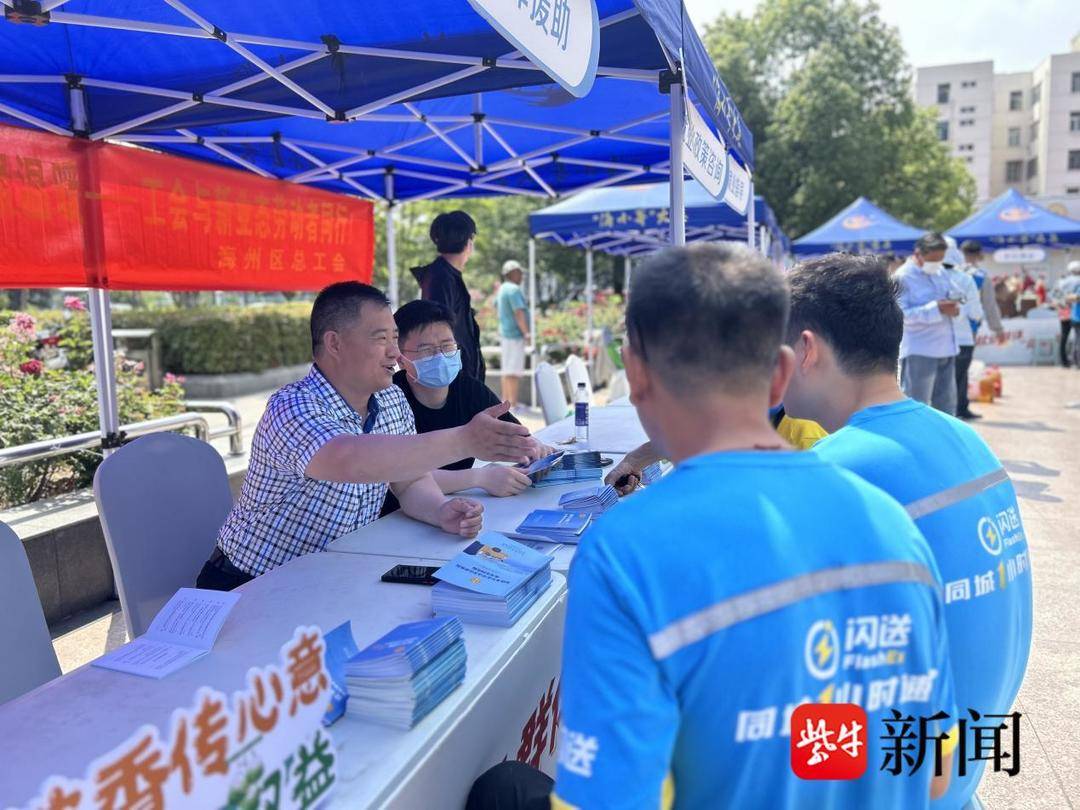
Core Viewpoint - The article highlights the transformation of new employment groups in Haizhou District from being passive recipients of services to active participants in urban governance, facilitated by a comprehensive support system and community engagement initiatives [1][4][7]. Group 1: Community Support Initiatives - Haizhou District has established a "three-in-one" service framework focusing on new employment groups such as delivery riders and truck drivers, creating a supportive environment that encourages their integration into urban life and governance [1][3]. - The district has built multiple service stations, including six industry comprehensive stations and 219 community service stations, providing essential amenities and affordable meal options for over 8,000 individuals this year [3][4]. Group 2: One-Stop Service Mechanism - A "one-stop" service mechanism has been introduced to streamline access to various services, consolidating resources from over ten agencies and offering 60 service items, including policy consultation and dispute resolution [4][5]. - Regular outreach and communication initiatives have been established to ensure that the needs and concerns of new employment groups are addressed effectively [4][7]. Group 3: Empowerment and Skill Development - New employment groups are being empowered to contribute to urban governance, with over 1,200 volunteers formed into a "Red Rhythm Courier" team, enhancing community problem-solving through a reporting platform [7]. - The district offers vocational training programs, including courses on drone operation and community emergency guidance, enabling participants to gain certifications and improve their career prospects [7][8].
以高质量发展助力强国建设民族复兴伟业
Shan Xi Ri Bao· 2025-09-24 23:03
Group 1 - The core message emphasizes the importance of technological innovation and integration with industry to promote high-quality development in the context of Chinese modernization [1] - The focus on ecological civilization and environmental protection is highlighted, with a commitment to enhancing ecosystem conservation and promoting green transformation in economic and social development [1] - The prioritization of improving and safeguarding people's livelihoods is underscored, with strategies to prevent poverty and ensure that all ethnic groups participate in and benefit from development [1] Group 2 - The necessity of strengthening grassroots organizations and enhancing their political and organizational functions is stressed, indicating a direction for improving community governance and effectiveness [1] - Continuous efforts in building a clean political environment and adhering to the central eight regulations are emphasized as essential for sustainable development [2] - The commitment to fostering a culture of discipline and integrity among party members is highlighted as a means to support high-quality development in the region [2]
基层散记:没钱怎么办?
Hu Xiu· 2025-09-22 10:02
Group 1: Governance and Management Issues - The reliance on satellite remote sensing technology for governance has severely impacted grassroots management, with local authorities often having no negotiation space despite having factual evidence for their cases [1] - The treatment of grassroots officials has become more uniform across regions, with those in financially autonomous areas facing significant income reductions, while poorer areas have seen little change in compensation [2][3] - There is a notable increase in grassroots debt primarily due to project construction, with many localities incurring substantial liabilities from initiatives that did not yield expected results [4] Group 2: Operational Challenges - Grassroots burdens have fundamentally reversed, with a significant reduction in meetings and inspections, although some officials attribute this to financial constraints rather than genuine reform [2] - Many grassroots leaders are hesitant to apply for new projects due to fears of incurring unmanageable debt, particularly in urban renewal initiatives [4] - The current environment has led to a culture of "doing the bare minimum," where accountability remains high despite reduced operational burdens [6] Group 3: Financial Constraints and Community Expectations - There is a growing trend of "bottom-line governance," where local governments are expected to manage community issues without adequate funding or resources [7] - The satisfaction ratings from the public can sometimes lead to unrealistic expectations, with citizens often shifting their responsibilities onto local governments [8] - Overall, the grassroots sector is experiencing a new normal characterized by a lack of financial resources and uncertainty in operations, leading to diminished vitality despite reduced burdens [9]
“十格共治”激活基层善治创新实践
Su Zhou Ri Bao· 2025-09-22 00:41
Core Insights - The article highlights the effective collaboration in community governance demonstrated by the Wu Men Qiao Street, where a safety hazard was reported and resolved within 2 hours, showcasing the innovative mechanisms in place for grassroots governance [1] Group 1: Governance Mechanism - Wu Men Qiao Street has implemented the "Ten Grid Co-Governance" mechanism, which divides the area into 10 grid sections for better resource allocation and problem-solving, resulting in the efficient handling of 8,679 community issues [2][9] - The governance model aims to transform from passive response to proactive engagement, addressing community needs more effectively [9] Group 2: Efficiency and Satisfaction - The introduction of a color-coded urgency system for community issues has improved response times, with urgent matters being prioritized and resolved quickly, enhancing overall resident satisfaction to 98.7% [4][9] - The new governance structure has led to a significant reduction in processing times for community issues, with some cases being resolved 80% faster than traditional methods [5] Group 3: Community Engagement - The establishment of a comprehensive feedback system, including online platforms and regular community engagement days, has allowed for real-time communication of resident concerns, leading to effective resolutions [8][9] - The initiative has successfully transformed community pain points into positive outcomes, enhancing the overall sense of happiness and security among residents [8][9] Group 4: Talent Development - To support the governance model, Wu Men Qiao Street has initiated training programs for community workers, focusing on skills such as conflict resolution and resource integration, thereby strengthening the grassroots governance team [6]