
绿色低碳转型

Search documents
利好来了,五部门联合发布
中国基金报· 2026-01-19 06:23
Core Viewpoint - The article discusses the release of the "Guiding Opinions on the Construction of Zero Carbon Factories" by five Chinese government departments, emphasizing the importance of reducing carbon emissions in industrial sectors and promoting green transformation through zero carbon factory initiatives [2][3]. Group 1: Overall Requirements - The initiative is guided by Xi Jinping's thoughts on ecological civilization and aims to enhance industrial efficiency and promote green transformation across the entire industrial chain [7]. - The construction of zero carbon factories will follow principles such as tailored strategies for different industries, innovation-driven approaches, continuous improvement, and transparency in carbon emissions reporting [8][9]. Group 2: Main Goals - The plan includes a phased approach, starting with industries that have urgent decarbonization needs and are primarily electricity consumers, with a goal to select a batch of zero carbon factories by 2026 [10]. - By 2027, the initiative aims to establish zero carbon factories in sectors like automotive, lithium batteries, photovoltaics, electronics, light industry, machinery, and computing facilities, with further expansion to high carbon intensity industries by 2030 [10]. Group 3: Construction Pathways - Establishing a carbon emission accounting management system is crucial for accurate data support in zero carbon factory construction [11]. - Transitioning to a green and low-carbon energy structure is essential, encouraging the use of renewable energy sources and technologies such as distributed solar and wind power [12]. - Improving energy efficiency through systematic optimization of production processes and adopting advanced technologies is a key focus [13]. - Promoting zero carbon supply chain management and conducting carbon footprint analysis for key products will drive collaborative decarbonization across the industry [14]. - Enhancing digital and intelligent management capabilities will facilitate precise measurement and control of energy consumption and carbon emissions [14]. - Carbon offsetting and information disclosure are necessary to achieve and maintain near-zero carbon emissions [14]. Group 4: Work Requirements - Local industrial and information departments are encouraged to develop specific implementation plans for zero carbon factory construction, promoting collaboration among government, enterprises, and markets [15]. - A comprehensive standard system for zero carbon factories is to be established, providing scientific and practical guidelines for management and evaluation [16]. - The promotion of comprehensive services for energy saving and carbon reduction is essential, including technology transfer and international cooperation [17].


行业聚焦:全球聚乙烯行业头部生产商市场份额及排名调查
QYResearch· 2026-01-19 04:50
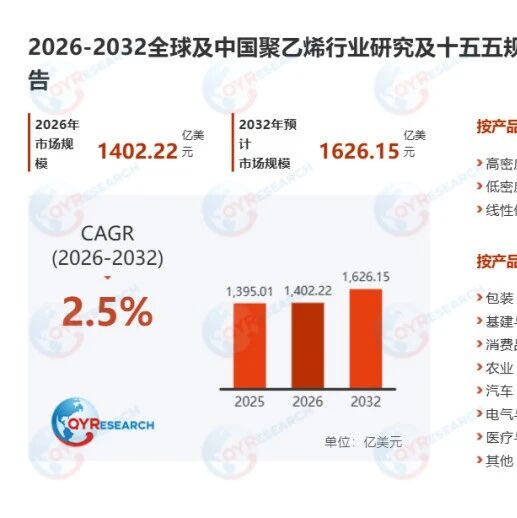
Core Viewpoint - Polyethylene (PE) is a widely used thermoplastic resin with a stable global consumption of approximately 120 million tons, growing at an annual rate of about 3% [4][5]. Market Overview - Polyethylene is a fundamental component of the petrochemical industry, with China being the largest consumer, accounting for about one-third of global consumption [4]. - The industry is transitioning from rapid expansion to a phase of supply-demand rebalancing, characterized by cyclical fluctuations in market conditions [4]. - Production is concentrated in regions with cost advantages, such as the Middle East and North America, while Asia-Pacific, particularly China, is a key center for demand and new capacity [4][7]. Application Structure - The primary applications of polyethylene are in various types of films and flexible packaging, which account for nearly half of total consumption [5]. - Other significant applications include pipes, containers, electrical insulation, and automotive parts, with different polyethylene types serving specific roles [5]. Cost Structure and Equipment Characteristics - The main cost driver for polyethylene production is the upstream ethylene monomer, which can be derived from various sources [6]. - Raw material and energy costs typically account for 60% to 70% of total costs, while the remaining costs include depreciation, labor, and environmental compliance [6]. - New world-class facilities often utilize integrated refining and petrochemical processes, achieving production capacities of 300,000 to 700,000 tons per year [6]. Industry Chain and Competitive Landscape - Polyethylene serves as a crucial link between upstream resources and downstream industries such as packaging, construction, and automotive [7]. - The industry is characterized by high concentration, with major players including Sinopec, ExxonMobil, and Dow, among others [10][7]. - Future capacity is expected to concentrate in regions with resource advantages, and competition will intensify as companies shift towards high-performance materials and sustainable practices [7]. Market Competition and Scale - The top 10 polyethylene producers globally hold approximately 46% of the market share [10]. - High-density polyethylene (HDPE) is the leading product type, accounting for 43.80% of the market [11][13]. Future Outlook - The report anticipates that during the 14th Five-Year Plan, China will focus on high-quality development and technological innovation, which will influence the polyethylene market dynamics [23]. - The analysis includes projections for supply and demand, competitive landscape, and potential opportunities along the Belt and Road Initiative [23].
国家统计局:2025年规模以上工业发电量97159亿千瓦时,比上年增长2.2%
Guo Jia Tong Ji Ju· 2026-01-19 04:33
Group 1: Energy Production and Supply - In 2025, energy production in China continues to grow steadily, with major energy products such as coal, oil, gas, and electricity reaching historical highs, enhancing energy supply security [1] - The industrial raw coal output reached 4.83 billion tons, marking a 1.2% increase from the previous year [1] - The crude oil output from industrial enterprises reached 21.6 million tons, a 1.5% increase year-on-year, maintaining over 200 million tons for four consecutive years [2] Group 2: Clean Energy Development - The construction of clean energy is accelerating, with hydropower, nuclear, wind, and solar power installations continuously increasing, and coal-fired power units undergoing significant upgrades [2][3] - Renewable energy generation reached 34,213 billion kilowatt-hours, an 8.8% increase from the previous year, accounting for 35.2% of total industrial power generation, up 2.1 percentage points [3] Group 3: Green Transition and Energy Efficiency - Under the "dual carbon" goals, China is actively promoting a green and low-carbon energy transition, with the proportion of coal consumption continuing to decline and clean energy consumption steadily increasing [3] - By 2025, the share of non-fossil energy in total energy consumption increased by approximately 2 percentage points, surpassing oil to become the second-largest energy type [3] - The total energy consumption in society is projected to grow by 3.5% year-on-year, with energy consumption per unit of GDP expected to decrease by over 5% [3]
王有捐:2025年CPI总体平稳 PPI低位回升
Guo Jia Tong Ji Ju· 2026-01-19 03:35
Group 1: Consumer Price Index (CPI) Trends - The overall consumer market in 2025 is stable and gradually improving, with CPI showing monthly fluctuations and a year-on-year increase of 0.8% in December, the highest since March 2023 [2] - Food prices decreased by 1.5% for the year, impacting CPI by approximately 0.27 percentage points, with significant declines in pork and egg prices [3] - Core CPI has been rising since March 2025, maintaining a year-on-year increase of over 1% for four consecutive months, reaching 1.2% in December [4] Group 2: Producer Price Index (PPI) Trends - The PPI for 2025 decreased by 2.6%, but the decline narrowed in the second half of the year, with a year-on-year decrease of only 1.9% in December [5] - The optimization of market competition and capacity management in key industries has led to a recovery in prices, particularly in coal and new energy sectors [6] - External factors, such as rising international metal prices, have contributed to price increases in related domestic industries, with non-ferrous metal mining prices up by 17.2% [7]
胡汉舟:能源供应保障有力 绿色转型加速推进
Guo Jia Tong Ji Ju· 2026-01-19 03:35
2025年,我国经济延续稳中有进发展态势,能源供给稳定增长,有力支撑经济社会平稳健康运行。能源 供应保障能力持续增强,煤油气电产量均创历史新高,电力供应安全稳定,能源自给率稳步提升;绿色 低碳转型步伐不断加快,可再生能源跃升发展,非化石能源消费比重持续提高,为推进能源强国建设奠 定坚实基础。 一、能源生产稳步增长,保供基础不断夯实 原煤产量再创新高。2025年,煤炭先进产能有序释放,稳产稳供稳价措施深入实施,煤炭供应保持稳定 充裕。规模以上工业原煤产量48.3亿吨,创历史新高,比上年增长1.2%。 三、绿色转型步伐加快,能效水平不断提升 "双碳"目标下,我国积极推进能源绿色低碳转型,煤炭消费比重持续下降,清洁能源消费占比稳步攀 升,消费结构进一步优化。2025年,非化石能源占能源消费总量比重比上年提高约2个百分点,超过石 油成为第二大能源类型,成为能源增量主体。 油气增储上产持续推进。近年来,我国油气生产企业持续加强勘探开发和增储上产力度,增储上 产"七年计划"胜利收官,油气稳产增产势头良好,油气供应保障能力持续提升。2025年,规模以上工业 原油产量2.16亿吨,创历史新高,比上年增长1.5%,连续四年稳产 ...
这个“10万亿”,意味着什么
Ren Min Ri Bao· 2026-01-19 02:42
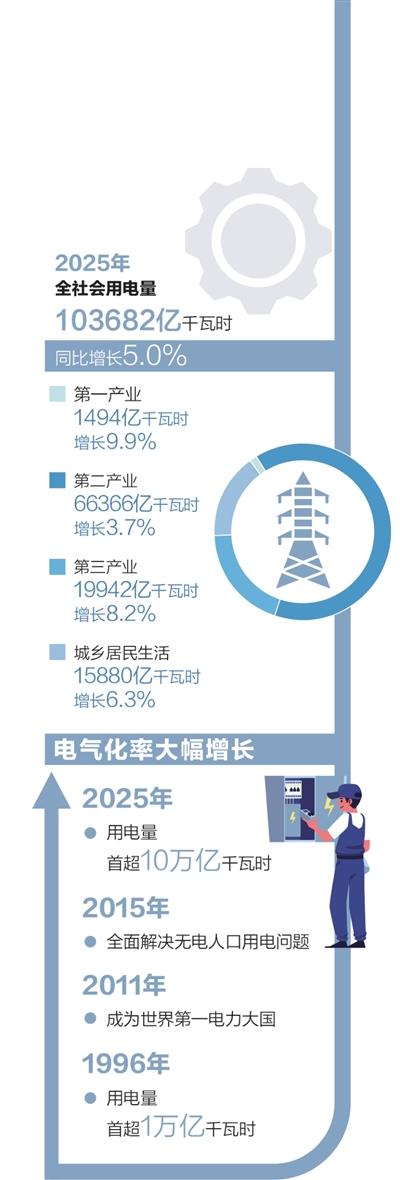
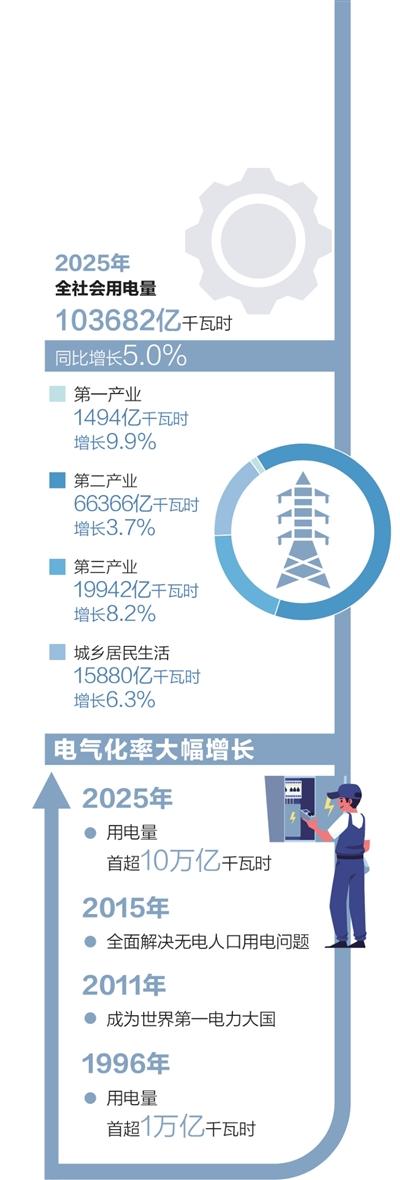
Core Insights - In 2025, China's total electricity consumption will exceed 10 trillion kilowatt-hours for the first time, marking a significant milestone in global energy consumption [2][11] - This consumption level is more than double that of the United States and surpasses the total consumption of the EU, Russia, India, and Japan combined [2] - The growth in electricity consumption reflects China's robust manufacturing capabilities and enhanced energy security [2] Electricity Consumption by Sector - The total electricity consumption in 2025 is projected to be 10,368.2 billion kilowatt-hours, with the primary industry consuming 149.4 billion kilowatt-hours (up 9.9%), the secondary industry 66,366 billion kilowatt-hours (up 3.7%), and the tertiary industry 19,942 billion kilowatt-hours (up 8.2%) [1][3] - The secondary industry remains the largest consumer, accounting for approximately 64% of total consumption, with significant growth in high-value and technology-intensive sectors [3][4] - The tertiary industry is also a key driver of electricity consumption, with notable growth in data centers and information technology services [4] Electrification and Energy Efficiency - The electrification rate of end-use energy is around 30%, which is higher than that of major developed economies, contributing to increased electricity consumption [6][5] - Rural electrification efforts have led to a narrowing gap in electricity consumption between urban and rural residents, supported by significant investments in rural power infrastructure [6][5] Renewable Energy and Power Supply - China has the world's largest power supply system, with renewable energy sources like wind and solar surpassing traditional coal power in installed capacity [8][9] - The country has made substantial investments in clean energy and grid infrastructure, with over 46 ultra-high voltage projects completed to enhance energy distribution [9][10] - The national electricity market has seen a significant increase in trading volume, reflecting a more dynamic and integrated energy market [10] Industry Trends - The shift towards high-end, intelligent, and green development is evident, with new electricity growth points emerging from high-tech manufacturing and renewable energy sectors [4][3] - The demand for electricity in the artificial intelligence sector and data centers is driving substantial increases in consumption, particularly in regions like Zhejiang and Jiangsu [3][4] Conclusion - The anticipated growth in electricity consumption to over 10 trillion kilowatt-hours by 2025 signifies not only an upgrade in power supply capabilities but also a transition towards a more modern and efficient economy [11]
《中国发电企业与世界同类能源企业对标分析报告2025》政策解读:中国发电企业在全球能源转型中稳健前行
Zhong Guo Dian Li Bao· 2026-01-19 01:41
Core Insights - The report highlights the resilience and comprehensive strength of Chinese power generation companies in 2024, particularly in asset scale, green low-carbon transition speed, and technological innovation investment, indicating a steady increase in overall competitiveness and influence in the global energy landscape [1][5]. Group 1: Comparative Strengths - Chinese power generation companies occupy five out of the top eight positions in the comparative ranking, with State Grid, China Three Gorges, China Huaneng, and State Power Investment following France's Electricité de France [2]. - Chinese companies show significant advantages in installed capacity and generation volume, with State Energy Group leading globally with over 350 million kW of installed capacity and 12.6 trillion kWh of generation [3]. Group 2: Brand and Revenue Performance - Both domestic and foreign companies experienced declines in revenue, with Chinese companies generating $412.2 billion and foreign companies $552.3 billion, reflecting a year-on-year decrease of 1.6% and 13.8% respectively [3]. - Chinese companies have shown impressive growth in asset scale but still need to enhance international revenue and global brand influence [3]. Group 3: Innovation and Governance - Domestic companies lead in technological innovation, with a higher technology investment ratio of 1.0% compared to 0.5% for foreign companies, and a technology innovation efficiency index of 7.3 versus 6.5 [4]. - Chinese companies maintain robust performance in asset-liability ratio and operating cash flow, with State Energy Group and China Three Gorges ranking high in governance metrics [4]. Group 4: Highlights of Domestic Power Generation Companies - By the end of 2024, domestic companies' total installed capacity reached 1.86 billion kW, 2.3 times that of foreign counterparts, with a net increase of 18.5 million kW, 17.6 times that of foreign companies [5]. - The share of non-fossil energy installed capacity increased by 3.8 percentage points to 54.3%, with companies like China General Nuclear Power and China Three Gorges achieving high levels of clean energy [5]. Group 5: Global Industry Dynamics - The report identifies new challenges in the global energy transition, such as the systemic safety risks associated with high proportions of renewable energy integration, urging Chinese companies to enhance their grid support capabilities [7]. - The report notes a global trend of energy companies focusing on stable markets and divesting from less stable regions, highlighting the need for Chinese companies to assess country-specific risks in their overseas investments [8]. Group 6: Future Directions for 2026 - The report outlines five key focus areas for Chinese power generation companies in 2026: strengthening energy security, adapting to the market entry of renewable energy, upgrading coal power, exploring new industrial scenarios, and embracing AI technologies [9][10]. - Companies are encouraged to enhance their capabilities in power security, green development, technological innovation, and international influence to support the construction of a new energy system [9][10].

这个“10万亿”,意味着什么(经济新方位)
Ren Min Ri Bao· 2026-01-18 23:47
Core Insights - In 2025, China's total electricity consumption is projected to exceed 10 trillion kilowatt-hours for the first time, marking a significant milestone in global energy consumption [3][4] - This consumption level is more than double that of the United States and surpasses the total consumption of the European Union, Russia, India, and Japan combined [3] - The growth in electricity consumption reflects China's robust manufacturing capabilities and enhanced energy security [3] Electricity Consumption by Sector - The primary industry is expected to consume 149.4 billion kilowatt-hours, showing a growth of 9.9% [1] - The secondary industry will account for 66,366 billion kilowatt-hours, with a growth rate of 3.7%, maintaining its status as the main consumer [1][4] - The tertiary industry is projected to consume 19,942 billion kilowatt-hours, growing by 8.2% [1][5] - Urban and rural residential electricity consumption is expected to reach 15,880 billion kilowatt-hours, with a growth of 6.3% [1][6] Industrial and Technological Developments - The electricity consumption in the industrial sector is increasingly driven by high-value-added and technology-intensive industries [5] - In Jiangsu, the semiconductor industry is experiencing significant growth, with companies like Huahong Semiconductor reporting over 43% year-on-year increase in electricity consumption [4] - The computer and communication equipment manufacturing sector has surpassed traditional industries like steel and chemicals in electricity consumption, indicating a shift in industrial structure [4] Electrification and Energy Efficiency - The electrification rate of end-use energy is approximately 30%, which is higher than that of major developed economies [6] - Innovations in agriculture, such as smart irrigation systems, are contributing to increased electricity consumption in rural areas [6][7] - The "14th Five-Year Plan" includes significant investments in rural power grid improvements, enhancing electricity access and reducing consumption disparities between urban and rural areas [6] Power Supply and Infrastructure - China's power supply system is the largest globally, with renewable energy sources like wind and solar surpassing traditional coal power [8][9] - The country has built 46 ultra-high voltage transmission lines to efficiently transport clean energy from resource-rich regions to consumption centers [9] - The national grid's investment has reached historical highs, ensuring robust electricity supply and infrastructure development [9][10] Market Dynamics and Energy Transition - The establishment of a unified national electricity market has significantly increased market transaction volumes, doubling from the previous five-year period [11] - The energy sector is actively transitioning towards a new energy system, focusing on green and low-carbon development [11] - The growth in electricity consumption is indicative of China's economic transformation and improvement in living standards [11]
全球首次,2025年我国全社会用电量超10万亿千瓦时——这个“10万亿”,意味着什么
Xin Hua Wang· 2026-01-18 23:41
Core Insights - In 2025, China's total electricity consumption is projected to exceed 10 trillion kilowatt-hours for the first time, marking a significant milestone in global energy consumption [1] - This consumption level is more than double that of the United States and surpasses the combined total of the EU, Russia, India, and Japan [1] - The growth in electricity consumption reflects China's robust manufacturing capabilities and enhanced energy security [1] Group 1: Industrial Electricity Consumption - In 2025, the secondary industry is expected to consume 66,366 billion kilowatt-hours, accounting for approximately 64% of total electricity consumption [2] - The semiconductor industry, driven by AI applications, is experiencing a surge in demand, with companies like Huahong Semiconductor reporting over 43% year-on-year growth in electricity consumption [2] - The electricity consumption structure in Jiangsu is shifting, with the computer and communication equipment manufacturing sector surpassing traditional industries like steel and chemicals for the first time [2] Group 2: High-End and Green Development - The high-end manufacturing sector, including new energy vehicles and wind power equipment, is projected to grow electricity consumption by over 20% and 30% respectively [3] - The service sector is also becoming a significant driver of electricity consumption, with the data industry in Guizhou showing rapid growth [3] - By 2025, the tertiary sector's electricity consumption is expected to reach nearly 2 trillion kilowatt-hours, growing by 8.2% year-on-year [3] Group 3: Electrification Trends - The electrification rate of end-use energy is around 30%, surpassing that of major developed economies [4] - In Yunnan, smart irrigation systems have improved efficiency by approximately 65%, reflecting advancements in agricultural electricity consumption [5] - The gap in electricity consumption between urban and rural residents is gradually narrowing due to investments in rural power grid improvements [5] Group 4: Power Supply and Infrastructure - China's power generation capacity accounts for one-third of the global total, with over 50% of coal-fired power plants capable of deep peak regulation [6] - The country has built the world's largest power supply system and clean energy generation framework, with renewable energy sources surpassing thermal power for the first time [6] - The construction of ultra-high voltage transmission lines has strengthened the energy supply network, facilitating the transfer of clean energy from the west to the east [7] Group 5: Market Dynamics - The establishment of a unified national electricity market has significantly increased electricity trading volume, doubling from 10.7 trillion kilowatt-hours to 23.8 trillion kilowatt-hours [8] - The market's role as a regulator and price guide has become more pronounced, enhancing the efficiency of electricity resource allocation [8] - The ongoing transition towards a new energy system is expected to support high-quality development in renewable energy and contribute to China's modernization efforts [8]
北京市10个新能源供热项目投用
Xin Lang Cai Jing· 2026-01-18 23:36
Core Viewpoint - Beijing is advancing its green and low-carbon energy transition by implementing 10 new energy heating projects, expected to significantly reduce carbon emissions and promote the use of renewable energy heating technologies [1][2] Group 1: Project Overview - Ten new energy heating projects in Beijing will be operational by the 2025 heating season, covering nearly 1 million square meters and expected to reduce carbon dioxide emissions by 29,800 tons annually [1] - The projects utilize shallow geothermal heat pumps and medium-deep geothermal technology, replacing approximately 7.5 million cubic meters of gas and saving 11,400 tons of standard coal each year [1] - The Haidian North Medical Center project integrates geothermal heat pumps with electricity, solar energy, natural gas, and medical waste heat recovery, providing comprehensive energy services for a building area of 183,000 square meters [1] Group 2: Additional Projects and Initiatives - In the Beijing Urban Sub-center, a geothermal heating pilot project has been established to provide clean heating for over 350,000 square meters of affordable housing through five geothermal wells [2] - The Jinyu Xingfa research building project in Huairou District achieves 100% renewable energy heating and cooling for nearly 50,000 square meters of research space, demonstrating zero-carbon temperature control [2] - Various projects across Haidian, Shunyi, Daxing, and Xihongmen Town are employing geothermal heat pump systems, serving areas ranging from 17,000 to 61,000 square meters, providing reliable green heating and cooling solutions for diverse building types [2] Group 3: Policy Support - Since 2023, multiple departments in Beijing have been promoting high-quality development of renewable energy heating, offering 30% fixed asset investment support for new and expanded projects with over 60% renewable energy heating capacity [2] - The implementation of these policies effectively reduces the initial investment pressure for renewable energy heating projects and encourages social capital participation in renewable infrastructure development [2]