
AI医疗

Search documents
14天赚超去年全年!AI医疗基金,被“带飞”
券商中国· 2026-01-14 12:31
2026年开年仅半个月,一批踏空2025年行情的"另类医疗主题基金",在新年不久就迎来业绩红包,多只产 品两周收益远超去年全年。 券商中国记者注意到,这波医疗主题基金行情的核心并非"创新药",而是重仓AI医疗科技方向的基金,这些产 品大多在去年踏空医药赛道行情,但凭借AI应用的叙事延伸到医疗互联网科技赛道,不少基金经理仅凭少数 几只个股的大涨即带动整只产品净值的逆袭。 医疗基金业绩开门红 开年短短半个月,医疗主题基金就再次拥抱高弹性。Wind数据显示,截至2026年1月14日,全市场30强业绩产 品中,医疗主题基金的占比占据半壁江山,包括银河康乐混合、招商前沿医疗保健、金鹰医疗健康、万家健康 产业等一批新年内绩优产品。 券商中国记者注意到,方舟健客是一只融合AI技术的慢性病管理类移动互联网APP,其医疗APP下载量长期排 名同类产品前列,在2026年1月12日—13日,方舟健客股价从2.090港元迅猛飙升到最高4.18港元,两天时间的 股价涨幅超100%,一举推动泰康医疗健康基金净值排名进入全市场前列。 基金判断AI医疗变现在即 关于AI医疗赛道是故事还是现实的判断,多位基金经理认为一两年内可看到AI医疗的业 ...


医飞冲天!港股通医疗9连阳创纪录
Xin Lang Cai Jing· 2026-01-14 12:09
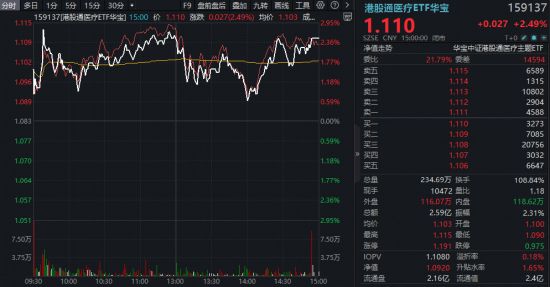
Core Viewpoint - The Hong Kong Stock Connect medical sector has experienced a significant rally, with the Hong Kong Stock Connect Medical Theme Index achieving a record nine consecutive days of gains as of January 14, 2026, marking the longest winning streak in history [1]. Group 1: ETF Performance - The Huabao Hong Kong Stock Connect Medical ETF (159137) has seen substantial growth since its listing on January 12, 2026, with daily increases of 4.7%, 3.44%, and 2.49%, and a total trading volume reaching 259 million yuan today [1][3]. - The ETF covers 50 leading stocks across various medical fields, with notable performances from Alibaba Health, which surged by 18.96%, and other stocks like Yimai Sunshine and MicroPort Scientific, which rose by 9.98% and 8.62% respectively [3][4]. Group 2: Market Catalysts - Three main catalysts are driving the momentum in the Hong Kong Stock Connect medical sector: 1. The brain-computer interface (BCI) industry is entering a rapid industrialization phase, with companies like Neuralink and Brain Tiger Technology making significant advancements and investments [5][6]. 2. Major players are entering the AI medical field, with partnerships such as NVIDIA and Eli Lilly committing $1 billion to AI drug development, indicating a shift towards AI-driven healthcare solutions [6][7]. 3. The CXO (Contract Research Organization) sector is showing signs of recovery, with WuXi AppTec forecasting a net profit of 19.151 billion yuan for 2025, reflecting a year-on-year increase of approximately 102.65% [7][8]. Group 3: Industry Trends - The demand for CRO and CDMO services is gradually recovering, supported by a reduction in supply over the past three years, which may lead to simultaneous profit and valuation increases in the sector [8].
抢占脑机接口、AI医疗新机遇!关注高弹性T+0利器——港股通医疗ETF华宝(159137)
Sou Hu Cai Jing· 2026-01-14 11:20
Group 1 - The core viewpoint of the article highlights the investment opportunity in the Hong Kong Stock Connect Medical ETF managed by Huabao (159137), focusing on sectors like brain-computer interfaces and AI healthcare, which are gaining traction in the market [1] - Since the opening of the Hong Kong Stock Exchange in 2026, the brain-computer interface and AI healthcare sectors have seen significant growth, with the Hong Kong Stock Connect Medical Theme Index experiencing continuous upward movement [1] - As of January 14, the index achieved a record of nine consecutive days of gains, marking the longest winning streak in its history [1]
炮轰张文宏拒绝AI“屁股决定脑袋”后,王小川拿出了自己的AI医疗大模型
Guan Cha Zhe Wang· 2026-01-14 10:31
Core Insights - Baichuan Intelligent has officially launched its new medical model, Baichuan-M3, which aims to enhance the interaction between doctors and patients through advanced AI capabilities [1][3] - The company is shifting its focus from traditional hospital settings to outpatient services, emphasizing patient empowerment and decision-making in healthcare [2][5] Group 1: Product Development - The Baichuan-M3 model represents a significant technological advancement, transitioning from "language" to "mathematics" and "life sciences," with a key improvement in dynamic reinforcement learning [3][11] - The updated "Bai Xiao Ying" app features distinct modes for doctors and patients, providing evidence-based research support for medical professionals and simplifying medical terminology for patients [4][3] Group 2: Market Strategy - Baichuan Intelligent plans to commercialize its services primarily through direct-to-consumer (To C) strategies, focusing on health management and decision support for patients [2][6] - The company has a financial reserve of 3 billion yuan and aims to go public by 2027, indicating confidence in its business model despite the long-term investment nature of the healthcare sector [5][6] Group 3: Industry Perspective - The CEO, Wang Xiaochuan, critiques the current state of the AI healthcare industry, suggesting that many existing models lack a clear understanding of their purpose and emphasizing the importance of algorithms and evaluation systems [1][7] - Wang expresses skepticism towards the trend of multi-modal AI, asserting that logical reasoning and decision-making are more critical than visual perception in medical applications [11][10]

抢占脑机接口、AI医疗新机遇!关注高弹性T+0利器—— 港股通医疗ETF华宝(159137)
Xin Lang Cai Jing· 2026-01-14 09:54
Group 1 - The article discusses the performance of stocks within the Hong Kong Stock Connect Medical ETF, highlighting the positive momentum indicated by the MACD golden cross signal [4][9]. - It mentions specific sectors of interest, including brain-computer interfaces, brain dynamics, AI healthcare, and AI pharmaceuticals, which are part of the thematic index of the ETF [1]. Group 2 - The Hong Kong Stock Connect Medical ETF, managed by Huabao, is referenced as a key investment vehicle for exposure to the medical sector [3]. - The article emphasizes that the stocks listed are part of the Hong Kong Stock Connect Medical Theme Index, serving as a showcase rather than investment advice [2].
港股收涨0.56%至26999点,阿里健康领涨
Jin Rong Jie· 2026-01-14 09:29
板块方面,AI医疗概念股表现强势。除阿里健康外,微创机器人-B、医渡科技等个股也录得上涨。大 型科技股走势出现分化,阿里巴巴-W、哔哩哔哩-W、快手-W收盘上涨,而美团-W、京东集团-W等则 出现下跌。 其他市场动态方面,全球智能产品设计与制造服务提供商龙旗科技于1月14日启动招股,计划全球发售 5225.91万股H股,预计于1月22日在联交所开始买卖。 港股市场于1月14日收盘上涨。恒生指数收报26999.81点,上涨151.34点,涨幅为0.56%;恒生科技指数 收报5908.26点,上涨38.47点,涨幅为0.66%。 在主要指数成分股中,阿里健康成为当日涨幅最高的恒指成分股。该股当日大幅上涨。消息面上,阿里 健康于1月13日宣布,与北京梅尔森医药技术开发有限公司达成战略合作,推动全球首款获批用于治 疗"增殖期浅表性婴儿血管瘤"的外用创新药"贝美净"在其平台全网独家首发。此外,公司重要股东阿里 巴巴集团将于1月15日举办其人工智能应用"千问"的发布会。另一方面,阿里健康作为持股5%以上的股 东,于1月13日公告计划减持A股上市公司漱玉平民不超过2%的股份,减持原因为自身资金需求。 另一家科技公司携程集团 ...

港股收盘 | 恒指收涨0.56% AI医疗延续近期涨势 阿里巴巴-W放量走强
Zhi Tong Cai Jing· 2026-01-14 09:22
Market Overview - The Hong Kong stock market experienced fluctuations, with the Hang Seng Index closing up 0.56% at 26,999.81 points and a total trading volume of HKD 340.39 billion [1] - The Hang Seng Tech Index rose by 0.66%, while the Hang Seng China Enterprises Index increased by 0.32% [1] Investment Insights - CICC noted that the liquidity environment for Hong Kong stocks is facing multiple constraints, with current popular sectors lacking highlights [1] - The firm believes that four key sectors—dividends, internet, innovative pharmaceuticals, and new consumption—offer unique investment value in Hong Kong stocks [1] - The potential for Hong Kong IPOs and funding needs is significant, especially with the anticipated easing of U.S. monetary policy benefiting the market [1] Blue-Chip Performance - Alibaba Health (00241) led blue-chip gains, rising 18.96% to HKD 7.78, contributing 12.73 points to the Hang Seng Index [2] - Other notable blue-chip performances included Haidilao (06862) up 9.15% and Alibaba Group (09988) up 5.69% [2] Sector Highlights - AI healthcare stocks continued their upward trend, with Alibaba Health and other related companies showing significant gains [3] - The cryptocurrency sector saw substantial increases, with Bitcoin surpassing USD 95,000, contributing to the rise of related stocks [5] - The restaurant sector, particularly Haidilao, benefited from the return of its founder as CEO, signaling potential growth [6][7] Technology Developments - Nvidia showcased its Rubin platform at CES 2026, which is expected to significantly reduce costs for generating tokens, marking a milestone in large-scale AI industrialization [8] - The AI healthcare sector is receiving boosts from both domestic policy support and high growth from overseas companies, indicating a promising future for AI applications in healthcare [4] Regulatory Environment - The U.S. SEC Chairman emphasized the importance of regulatory clarity for the cryptocurrency industry, with new legislation expected to be introduced [6] - Ctrip Group (09961) faced scrutiny from regulators for alleged monopolistic practices, leading to a significant drop in its stock price [12]



马斯克预言机器人3年干翻外科医生?AI医疗股5天悄悄翻倍
Sou Hu Cai Jing· 2026-01-14 08:42
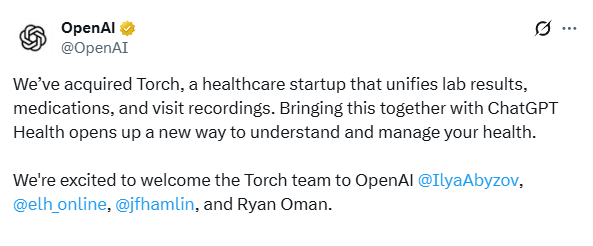
Group 1 - Elon Musk has made bold claims about the potential of AI robots, specifically the Optimus robot, to outperform top surgeons within three years, suggesting that studying medicine may become obsolete [1] - The medical community, represented by figures like Dr. Zhang Wenhong, has expressed skepticism about the feasibility of such predictions, highlighting the ongoing debate over the role of AI in healthcare [2] - Despite the uncertainty, the stock market has reacted positively to the AI healthcare sector, with companies like Hongbo Pharmaceutical and Dean Diagnostics seeing their stock prices double within five days, indicating strong investor interest [2] Group 2 - Major players in the tech industry are heavily investing in AI healthcare, with Nvidia committing $1 billion to AI drug development and OpenAI acquiring a medical data company to enhance healthcare data integration [2] - The competition for dominance in the AI healthcare space is likened to a race for essential resources, with data being referred to as the "water, electricity, and coal" of the new era [2] - The capital market tends to move faster than technological advancements, suggesting that investors are eager to capitalize on the potential of AI in healthcare, regardless of the eventual outcome [2]


AI医疗“造富神话”!OpenAI 1亿美元买了家只有4人的公司
Guan Cha Zhe Wang· 2026-01-14 08:31
Core Insights - OpenAI has officially announced the acquisition of healthcare technology startup Torch for a valuation of $100 million, with $60 million paid upfront and $40 million reserved for retention incentives [1][2] - Torch aims to address the fragmentation of health information by creating a "unified medical memory" system, which will help users gain a comprehensive understanding of their health status [2][4] - The acquisition comes shortly after OpenAI launched its personal health assistant, ChatGPT Health, which allows users to connect their medical records and health apps to receive AI-driven health management advice [6][7] Company Summary - Torch was founded in January 2025 and consists of four core members, including CEO Ilya Abyzov, who have developed technology to structure personal health data from various platforms into a "medical memory database" [4] - The Torch team previously co-founded another healthcare startup, Forward, which ceased operations in 2024 after raising $400 million, leading them to explore a lighter "AI + healthcare" model [6] - OpenAI plans to integrate Torch's capabilities with ChatGPT Health to enhance health management and analysis tools, leveraging the expertise of the Torch team [7] Industry Summary - The global healthcare AI market is projected to grow from $56.01 billion in 2026 to $1,033.27 billion by 2034, with a compound annual growth rate (CAGR) of 43.96% [8] - North America is expected to dominate the healthcare AI market, holding a 44.50% market share by 2025 [8] - In China, Ant Group has launched an independent healthcare AI application, "Afu," which has already surpassed 30 million monthly active users [8]
港股收评:恒指涨0.56%、科指涨0.66%,科网股走势分化、AI医疗、黄金股及加密货币概念股集体走高
Jin Rong Jie· 2026-01-14 08:23
Market Overview - The Hong Kong stock market experienced fluctuations on January 14, with the Hang Seng Index closing up 0.56% at 26,999.81 points, the Hang Seng Tech Index up 0.66% at 5,908.26 points, and the National Enterprises Index up 0.32% at 9,315.56 points. The Red Chip Index fell by 0.2% to 4,137.69 points [1] Company News - **Q Technology (01478.HK)**: Announced an expected net profit growth of approximately 400% to 450% for the year ending December 31, 2025 [2] - **China Coal Energy (01898.HK)**: Projected a 10.2% decrease in coal sales volume to approximately 256 million tons for 2025, with December sales down 23% year-on-year to 21.88 million tons [2] - **Keenovo Technology (01274.HK)**: Selected as a supplier for a Korean automotive group's driver assistance solutions for four vehicle models [2] - **Kanzai Real Estate (00832.HK)**: Reported a 16.3% decrease in property contract sales to 8.467 billion yuan for 2025 [3] - **China Resources Land (00754.HK)**: Estimated total contract sales of approximately 15.607 billion yuan for 2025, a decrease of 6.15% [4] - **Suteng Juchuang (02498.HK)**: Forecasted laser radar product sales of approximately 912,000 units for 2025 [5] - **Xiaocai Garden (00999.HK)**: Plans to establish a joint venture for online shopping and "community ready-to-eat stores" [6] - **GDS Holdings (09698.HK)**: Recovered approximately 95% of the investment principal from DayOne, with an investment return rate of nearly 6.5 times [7] - **China Biologic Products (01177.HK)**: Proposed to acquire 100% of Hejiya for a maximum base price of 12 million yuan to accelerate the development of the siRNA liver delivery platform [7] - **Fuhong Hanlin (02696.HK)**: Received acceptance from the FDA for the biological product license application for Hanbeitai® (Bevacizumab injection) [7] - **Xiaomi Group (01810.HK)**: Repurchased 4 million shares for 152 million HKD at prices between 37.94 and 38.04 HKD [8] - **Tencent Holdings (00700.HK)**: Repurchased 1.012 million shares for 636 million HKD at prices between 623 and 638 HKD [9] - **Sunny Optical Technology (02382.HK)**: Repurchased 640,000 shares for 41.78 million HKD at prices between 64.55 and 65.8 HKD [10] Institutional Insights - **Dongwu Securities**: Suggests that the window for the Federal Reserve to cut interest rates is limited this year, and the rebound of the Hong Kong stock market will depend on fundamental conditions. The overall strategy remains a barbell approach, focusing on value dividends and sectors like AI technology, non-ferrous metals, and innovative pharmaceuticals [11] - **CITIC Securities**: Notes that the Hong Kong market has lagged behind A-shares due to overseas liquidity dynamics. The US unemployment rate drop supports a pause in rate cuts, and the stabilization of the Shanghai Composite Index at 4,000 points limits downward pressure on Hong Kong stocks. Anticipates a rebound in tech stocks driven by sentiment recovery and southbound capital [12] - **Industrial Securities**: Recommends leading internet companies in the AI sector, expecting a resonance in buying from domestic and foreign investors. Also suggests focusing on dividend assets in a low-interest-rate environment, including insurance, banking, energy, and public utilities [12] - **Zheshang International**: Optimistic about sectors benefiting from policy support, such as new energy, innovative pharmaceuticals, and AI technology. Expects the Hong Kong market's performance in spring 2026 to be driven by "AI applications + PPI improvement + expanded domestic demand" [13]

