
普惠金融

Search documents
平安融易谱写“五篇大文章”时代答卷
Zhong Zheng Wang· 2026-01-19 11:01
Core Viewpoint - The article emphasizes the commitment of Ping An Rongyi to support the real economy through various financial services, aligning with national strategies for inclusive, digital, technological, and green finance [1]. Group 1: Inclusive Finance - Inclusive finance is described as the "source of vitality" for small and micro enterprises, breaking traditional financial service barriers to provide accessible and effective support [2]. - Specific examples illustrate how Ping An Rongyi has provided timely financial assistance to small businesses, such as a 74.7 million yuan financing support in Jiangsu and a 10 million yuan loan in Chongqing, demonstrating the impact of AI technology in credit assessment [2][3]. - By the third quarter of 2025, 13.68 million customers had received financing guarantees, with significant funds allocated to agricultural support and the restaurant industry in various regions [3]. Group 2: Digital Finance - Digital finance is highlighted as a key driver for enhancing the accessibility and convenience of financial services, with Ping An Rongyi leveraging digital transformation to create a smart financial ecosystem [4]. - The "Prism" project focuses on local industry needs, delivering 3.8 billion yuan in financial support through data-driven risk control [4]. - The "Xingyun 2.0" AI loan system allows small business owners to apply for loans with minimal input, while the "Yunfan AI" solution has significantly reduced costs and improved productivity [4]. Group 3: Technological Finance - Technological finance is positioned as essential for facilitating innovation, with Ping An Rongyi utilizing AI, big data, and blockchain to enhance financial service models [6]. - Examples include a 40 million yuan no-collateral loan for a crab farmer and a 1 million yuan loan for a cooperative affected by flooding, showcasing the rapid response capabilities of Ping An Rongyi's smart risk control systems [7]. Group 4: Green Finance - Green finance is framed as crucial for achieving high-quality development, with Ping An Rongyi integrating green development principles into its business strategy [8]. - Specific initiatives include providing 250,000 yuan in loans to support a transition from plastic recycling to green planting, and assisting farmers with funding for deep processing projects that increased their income [8][9]. - The company has also launched a "Che e-loan" program for new energy vehicle owners, facilitating over 4.22 billion yuan in preferential loans by September 2025 [8]. Group 5: Future Directions - Looking ahead to 2026, Ping An Rongyi aims to deepen its commitment to serving the real economy, enhancing its AI strategy, and continuing to innovate in inclusive, technological, and green finance [10]. - The company plans to strengthen its financial services for small and micro enterprises, support technological innovation, and contribute to the realization of carbon neutrality goals [10].
金融“活水”润泽文旅小微,多方聚力共绘发展新篇
Zheng Quan Shi Bao Wang· 2026-01-19 10:36
Core Insights - The "Jinqi Project - Visa Promotes Cultural and Tourism Consumption, Micro and Small Enterprises Financial Empowerment Program" aims to enhance the financial resilience of micro and small enterprises in the cultural and tourism sectors, promoting high-quality development of the private economy in these industries [1][2] Group 1: Project Overview - The project was launched in 2025 and focuses on financial empowerment for high-quality development in the cultural and tourism sectors, utilizing both online and offline methods [1] - It has conducted over ten thematic activities tailored to local cultural and tourism development characteristics, emphasizing areas such as "Cultural Tourism + Foreign Trade" and "Cultural Tourism + AI" [1][2] - The initiative has reached over 30,000 enterprises and merchants across approximately 20 major inbound tourism cities, enhancing its influence and audience coverage [2] Group 2: Implementation and Impact - The project has received support from local governments, industry organizations, and social enterprises, demonstrating effective collaboration [2] - Visa has shared insights on enhancing the digital and financial capabilities of micro and small enterprises globally, and plans to continue its partnership with the foundation to promote financial education and skills training in 15 pilot cities [2][3] - A research report on the growth of micro and small enterprises in the cultural tourism sector has been developed, along with a knowledge manual focusing on financial services and inbound tourism reception [3]
深圳工行正式“换将”,科技金融或是新行长熊焘的关键考卷
Nan Fang Du Shi Bao· 2026-01-19 09:49
按照公开履历,熊焘2002年加入工商银行广东省分行,职业履历路径也比较清晰。2007年前后,他从授 信审批部转岗至投资银行部,并逐步升任该部副总经理、总经理。他也有二级分行的历练,曾先后担任 河源分行行长、东莞分行行长等职。2023年,他出任工行广东省分行副行长,期间曾兼任广州分行行 长。 南都湾财社记者注意到,熊焘是一位从工行成长起来、拥有丰富的对公业务和分行管理经验,其任命成 为工行在关键区域进行的一次重要人事布局。 实际上,工行广东省分行是工行体系的一面旗帜。按照其官网描述,广东省分行是工行系统最大的省级 分行,个人客户接近8000万,对公客户为138万。 一纸批复,意味着"宇宙行"在深圳有了新动作。1月中旬,深圳金融监管局批复了"熊焘中国工商银行深 圳市分行行长任职资格",这意味着深圳工行"掌门人"正式落定。南都湾财社记者注意到,早在2025年 底,深圳工行已经"换将",原分行行长董建军调任总行战略管理与投资者关系部总经理,其职位由工行 广东省分行副行长熊焘接任。 截至2025年2月末,深圳工行科技企业投融资余额超1500亿元,累计为超15000家科技企业提供全方位金 融支持,聚焦机器人、人工智能等硬 ...

支付赋能 + 场景深耕,银联商务持续书写普惠金融大文章
Sou Hu Cai Jing· 2026-01-19 09:38
作为金融"五篇大文章"的关键篇章之一,普惠金融关注的核心课题一直以来都聚焦于如何打破服务壁垒,让金融资源精准触达传统金融服务覆盖不足的群 体;以及如何依托科技赋能,持续提升金融服务的可得性与体验感。 银联商务是中国银联旗下专业从事综合支付和信息服务的运营机构,深耕行业二十余载,始终秉持"支付为民"理念,依托其覆盖全国所有地级以上城市和 96%县域的实体服务网络,以支付为基础、以科技为驱动,将普惠金融活水精准灌溉至乡村振兴、支付便利、中小微经营、民生服务等系列场景,绘就出一 幅覆盖面广、可得性强、体验优良的普惠金融新画卷。 聚焦乡村:破解农村金融服务"最后一公里" 广袤的农村地区长期面临着金融服务供给不足、触达困难的现实挑战。依托层出不穷的信息化技术、互联网基建红利的溢出效应,将现代金融活水引向田间 地头,精准灌溉农业产业与农民生活,是当前普惠金融重点发力的主战场之一。 作为最早响应并投入落实国家乡村振兴战略的支付机构,银联商务凭借深入到县乡村镇的实体服务网络,及时了解农业融资、乡村景区运营、数字化农村治 理、村民医保结算等各个场景的金融服务需求,通过"支付+科技+产业"的一体化服务模式,有效破解了农村金融服务 ...

四中全会精神在基层丨金融“贷”动农民增收
Jing Ji Ri Bao· 2026-01-19 04:01
Group 1 - The "Credit Village" initiative by Agricultural Bank of China in Tianjin addresses financing challenges for farmers by providing timely loans and flexible repayment plans, enhancing agricultural productivity [1][2] - In 2025, a farmer in Baodi District received 3 million yuan in credit loans, allowing for an expansion of 2,000 acres in grain cultivation due to improved credit access [1] - The bank's approach includes collaboration with local party committees, on-site visits, and mobile technology for efficient loan processing, significantly improving service timeliness [1] Group 2 - Agricultural Bank of China has increased credit support for rice farmers, addressing the need for upfront investment in quality production processes, with a specific loan of 500,000 yuan issued to a rice grower in 2025 [2] - The bank's financial support also extends to the grain circulation sector, with a company receiving 4.9 million yuan in credit to ensure stable market supply during peak sales periods [2] - The bank emphasizes the importance of financial support throughout the agricultural value chain, aligning with national policies promoting various forms of finance to enhance agricultural stability and farmer income [3]

卸下“包袱”,信用修复显温度(财经观)
Xin Lang Cai Jing· 2026-01-19 00:37
作者:赵展慧 "心心念念的1月1日终于来了,别人都在等跨年,只有我在蹲守查征信。新的政策,新的一年,新的征 途,越来越好。"2026年的第一天,有网友在社交平台分享,去年底前偿还了逾期欠款,今年喜提逾期 记录"清零",评论区引来网友纷纷截屏晒出自己的征信报告回应:"第一批征信记录更新的人里有我"。 一条条充满新年期待的话语与近期出台的一项新政策有关。新年伊始,一次性信用修复政策正式落地, 符合相关条件的逾期信息,将不会在个人信用报告中予以展示。 这项新政策,是个人信用修复的"一小步",也是诚信社会建设的"一大步",体现出新时代金融业发展、 市场体系建设、社会治理等方方面面的跃升和进步。 政策细节传递金融温度。先看政策适用条件,逾期信息只有产生于2020年1月1日至2025年12月31日期间 才能适用,意味着受疫情等因素影响违约的非恶意失信者,只要是小额逾期、并在规定时间内偿还,就 能"抹平"不良记录,获得一次信用重启的机会。 再看政策实施方式,"免申即享",不收取任何费用,还可额外免费查询本人信用报告两次。精准纾困、 简化流程、减免费用,每个政策细节都是对特殊时期民生困境的温暖回应。 政策取向彰显人民立场。信 ...
上海“十五五”规划建议:支持科创板和债券市场“科技板”发展
Zheng Quan Shi Bao Wang· 2026-01-18 23:49
Core Viewpoint - The Shanghai Municipal Committee emphasizes enhancing financial services for the real economy, focusing on the development of technology finance and green finance, as well as improving financial inclusivity and innovation in financial products [1] Group 1: Financial Services for Real Economy - The proposal highlights the need to improve financial services for the real economy, particularly through the development of technology finance [1] - It supports early, small, long-term, and hard technology investments by equity investment institutions [1] - The initiative aims to promote the development of the Sci-Tech Innovation Board and "technology board" in the bond market, as well as innovations in technology credit and insurance [1] Group 2: Support for Investment Funds - The plan encourages the development of market-oriented merger and acquisition funds, corporate venture capital funds, and foreign venture capital funds [1] - It aims to enhance the pricing mechanism and exit channels for equity investment transactions [1] - A comprehensive, diversified, and relay-style technology financial service system is to be constructed [1] Group 3: Green Finance Development - The proposal calls for accelerating the development of green finance and enriching carbon trading products [1] - It emphasizes the optimization of the green finance standard system [1] Group 4: Financial Inclusivity - The initiative focuses on actively developing inclusive finance to address the financing difficulties and high costs faced by small and medium-sized enterprises [1] - It aims to improve support policies such as financing guarantees, loan interest subsidies, and risk compensation [1] - Increased support for first-time and renewed loans is also a priority [1] Group 5: Pension and Digital Finance - The plan emphasizes the development of diversified pension financial products and enhancing financial services for the elderly [1] - It promotes innovation in digital finance, including the deepening of digital RMB applications and advancements in digital credit, asset management technology, and intelligent investment advisory [1] - The goal is to create a new type of intelligent asset management service platform and accelerate the development of financial technology [1]
工银普惠金融跑进海盐
Xin Lang Cai Jing· 2026-01-18 23:37
Core Viewpoint - The article highlights the role of the Industrial and Commercial Bank of China (ICBC) in promoting rural revitalization and financial inclusion through community engagement and innovative financial products aimed at supporting agricultural development and enhancing the quality of life in rural areas [7][8][9]. Group 1: Financial Initiatives and Community Engagement - ICBC Jiaxing Branch actively participates in community events, such as the "Rural Health Run," to integrate financial services into rural life, thereby enhancing communication with local residents [8]. - The bank has developed the "Xingnongtong" app, which has served over 73,000 agricultural clients and established 23 service points to improve financial service efficiency in rural areas [9]. - In 2025, ICBC launched the "Food Security Loan," with a total credit of 1.6 billion yuan and a loan balance exceeding 700 million yuan, to address seasonal funding challenges in agriculture [9][10]. Group 2: Tailored Financial Products for Agriculture - ICBC Haiyan Branch has introduced customized credit products, such as "Farmer e-loan" and "Village Cooperative e-loan," to alleviate financial pressures on farmers and support new rural construction [11]. - The bank has also implemented a green credit channel to ensure timely funding for agricultural production, particularly during critical planting seasons [11]. - The "Qinglian Breeding Loan," a unique product in the province, allows for flexible collateral based on live pigs, addressing financing challenges in the livestock sector [12]. Group 3: Impact on Rural Development - The financial support from ICBC has led to stable grain production and a thriving livestock industry, contributing to increased income for farmers [12]. - The bank's initiatives reflect a commitment to rural revitalization and the broader goal of achieving common prosperity through targeted financial services [10][12].

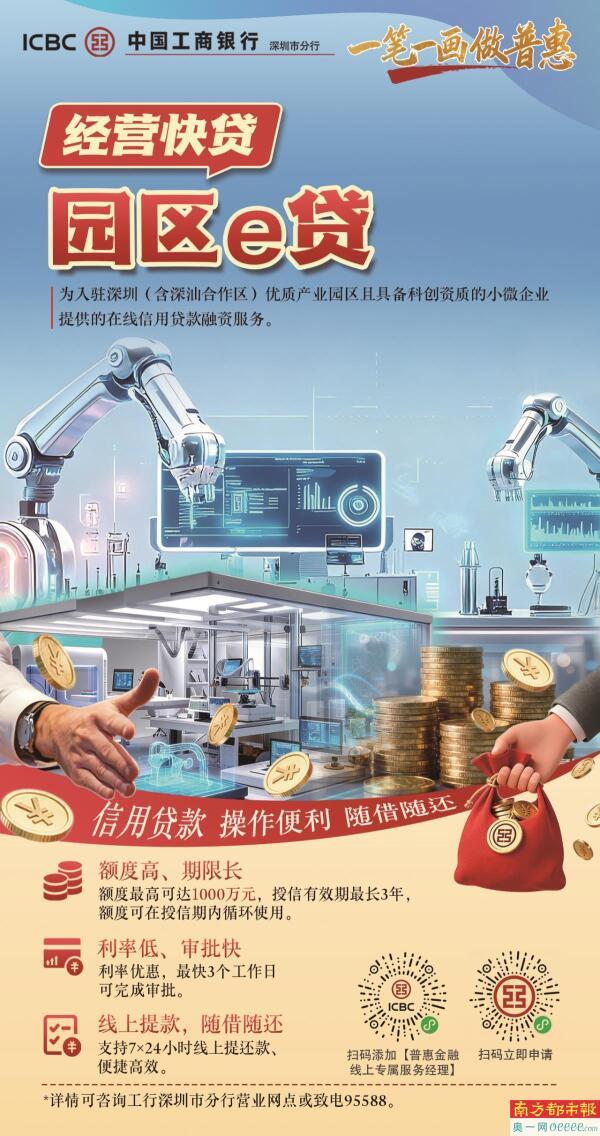
工行深圳市分行“园区e贷”金融创新服务方案斩获2025深圳金融创新大赛殊荣
Nan Fang Du Shi Bao· 2026-01-18 23:13
ICBC (E) 中国工商银行 深圳市分行 为入驻深圳(含深汕合作区)优质产业园区且具备科创资质的小微企业 提供的在线信用贷款融资服务。 g 用贷款 操作便利 随借随处 额度高、期限长 额度最高可达1000万元,投信有效期最长3年, 额度可在投信期内循环使用。 利率低、审批快 利率优惠,最快3个工作日 可完成审批。 线上提款,随借随还 支持7×24小时线上提还款、 班由部位BTF 雷分曲博】最明语 "这笔资金不仅解了燃眉之急,更让我们有底气承接更大订单。"在深圳南山科技园里,某智能驾驶系统 集成企业负责人如此感慨。在原材料采购、设备升级等关键节点上,该企业面临资金流不足难题,好在 工商银行深圳市分行为其提供了园区企业专属的"园区e贷",贷款仅在3个工作日内就到账了,妥善解决 了资金难题。 在深圳这座创新之城,像这样深耕前沿科技的小微企业如同城市经济的"毛细血管",支撑着产业活力与 创新动能。但它们同时受困于轻资产、弱管理、缺市场的发展瓶颈,传统金融服务难以精准匹配其需 求。工商银行深圳市分行(以下简称"工行深圳市分行")积极响应深圳市政府和监管机构推广园区贷的号 召,创新推出"园区e贷"综合金融服务方案,以" ...
【四中全会精神在基层】金融“贷”动农民增收
Zhong Guo Jing Ji Wang· 2026-01-18 23:09
Group 1 - The core idea of the news is the innovative "credit village" model introduced by Agricultural Bank of China in Tianjin to address financing challenges for farmers, enabling timely access to funds for land contracting and agricultural inputs [1][2] - The "credit village" initiative involves collaboration with village committees to establish credit records and provide loans to eligible farmers, thereby reducing loan costs and improving production efficiency [1] - In 2025, a farmer in Baodi District received 3 million yuan in credit loans, allowing for an expansion of 2,000 acres in grain cultivation due to the good credit standing of his farm [1] Group 2 - Agricultural Bank of China has increased its agricultural credit support by simplifying processes and optimizing credit granting methods, ensuring stable financial backing for farmers [2] - A rice grower received a 500,000 yuan "Rural Revitalization e-loan" in 2025, which alleviated his financial concerns regarding the long repayment cycle associated with rice cultivation [2] - The bank's provision of 4.9 million yuan in credit to a trading company facilitated timely storage and processing of grain, ensuring stable market supply during peak sales periods [2] Group 3 - The entire agricultural production chain, from preparation to harvest and value addition, relies heavily on financial support, highlighting the importance of financial services in agriculture [3] - The 20th National Congress of the Communist Party of China emphasized the need for the development of various financial sectors, including technology finance and inclusive finance, which raises expectations for commercial banks to innovate in providing quality financial services [3] - Agricultural Bank of China aims to continue supporting grain production stability and farmers' income growth through financial initiatives [3]