生成式AI

Search documents
MINIMAX-WP早盘涨近10% 公司近期发布MiniMax Music 2.5音频生成模型
Zhi Tong Cai Jing· 2026-02-03 02:13
消息面上,1月29日,MiniMax于1月29日正式发布MiniMax Music2.5音频大模型。相较于上一代,该模 型在"段落级强控制"与"物理级高保真"两大技术难题上实现突破。据介绍,新版本能够实现对音乐结构 更精准的把控,并显著提升了生成音频的音质水平。是行业重要趋势。 中信建投(601066)此前指出,在生成式AI浪潮席卷全球的当下,MINIMAX以"反共识"的战略定力, 聚焦模型智力突破,正从行业竞争中脱颖而出。作为上海首批获得大模型备案的企业,公司凭借技术深 耕与商业化远见,展现出强劲的发展潜力。该行预测,2025-2027年公司营收将保持90%以上的高速增 长,Non-GAAP毛利率有望提升至55%,净亏损率持续收窄。随着推理成本优化与新一代多模态模型落 地,公司有望在AI原生应用领域开辟更大市场空间。 MINIMAX-WP(00100)早盘涨近10%,截至发稿,涨9.26%,报572港元,成交额2.85亿港元。 ...
AI红包大战引股民连问,AI应用板块公司业绩分化
第一财经· 2026-02-02 15:31
Core Viewpoint - The article discusses the competitive landscape of the "AI Red Packet" initiative during the Spring Festival, highlighting the strategic positioning of major tech companies like Tencent, Alibaba, Baidu, and ByteDance in leveraging AI to enhance user engagement and ecosystem integration [2][4]. Group 1: AI Red Packet Battle - The total amount of red packets distributed by major companies exceeds 4 billion yuan, marking a significant strategic move to enhance AI user engagement [2]. - Alibaba's "Spring Festival Treat Plan" involves a record investment of 3 billion yuan, while Tencent contributes 1 billion yuan through its "Yuanbao" initiative, and Baidu allocates 500 million yuan for its "Wenxin Assistant" [3]. - The competition is not just about monetary distribution but also about integrating AI into social interactions and commercial ecosystems [4]. Group 2: Market Reactions and Company Performance - Investor interest in AI applications has surged, with numerous inquiries about companies' involvement in the AI red packet initiatives, indicating a strong market response [3]. - As of February 2, 72 companies in the AI application sector have released performance forecasts, with 20 expecting growth, 12 turning profitable, and 25 continuing to report losses [5]. - Companies with strong technological foundations and clear application scenarios are beginning to see positive financial results, while those in transition face challenges [5]. Group 3: Future of AI Applications - The year 2026 is anticipated to be a pivotal moment for AI applications, with the current red packet initiatives serving as a critical turning point for commercializing AI technology [5]. - Companies like iFlytek are projecting significant profit growth, attributing success to the integration of AI models into existing solutions, which address customer pain points [6]. - The article emphasizes that not all companies will benefit from the AI boom, as many traditional firms may struggle to adapt to the evolving technological landscape [8].




第一财经“科创未来行”AI新生产力沙龙与会嘉宾金句集锦
Di Yi Cai Jing· 2026-02-02 12:01
Core Insights - The article emphasizes that in the era of generative AI, AI is fundamentally restructuring productivity and business logic, with deep applications of GEO and intelligent agents becoming the core engine for companies to achieve growth [1] Group 1 - Generative AI is transforming the foundational aspects of productivity and business operations [1] - The integration of GEO and intelligent agents is highlighted as essential for driving corporate growth [1]
AI是人的延伸,人是AI的尺度
3 6 Ke· 2026-02-02 09:59
作者注:本文为"AI观"系列思考的第三篇文章。此前两篇为:《AI不是平庸的推手》、《人应成为AI 发展的尺度》 在漫长的进化光谱中,人类始终通过工具来定义自身。 从原始社会到工业时代,我们发明各种工具和大机器,来延伸肢体的力量。而人工智能的出现,意味着 一种根本性的断裂与飞跃,它不再仅是肉体的延伸,而是神经系统和认知功能的外化。 而在AI时代,人类的本质,也将不再简单地由"能力"来定义了。 进化的新尺度 人类的进化史,也是一部对自己的身体能力持续"不满"的历史。 相关研究机构的报告也指出了这一趋势:与工业革命不同,生成式AI并没有优先冲击蓝领工作,而是 直指那些高学历、高薪资的"知识型工作"。 [1] 程序员、律师、创意总监,这些曾被认为最安全、最需 要智力参与的岗位,如今反而在变革的最前沿。 如果不理解这一层,就无法理解当下整个社会的焦虑。当机器只是肉体的延伸时,人类仍然担当指挥 的"大脑";但当机器开始成为大脑的延伸时,我们不仅感到了主权的丧失,更感到了本体论层面的威 胁。 但这种威胁感,很可能源于视角的错位。AI其实更像是人自我锻造的一副智识义肢。如同蒸汽机解放 体力一样,AI正在把人类从繁重的记忆检索 ...
构建 AI 新生产力:第一财经 “科创未来行” 2026 AI 产业主题沙龙圆满举办
Di Yi Cai Jing· 2026-02-02 09:21
Core Insights - The AI industry is experiencing a transformation that redefines productivity and business logic, driven by the integration of AI technologies such as GEO (Generative Engine Optimization) and Agents [1][18] - The event gathered over 150 participants from academia, industry, and investment sectors to discuss the implications of AI on productivity, industry restructuring, and business model innovation [1] Group 1: AI's Impact on Productivity - AI is breaking traditional boundaries of productivity by merging the roles of production tools and labor, thus becoming a crucial carrier of production resources [3] - The trend towards automated decision-making and execution in AI is seen as inevitable, with AI reshaping attention distribution and value capture mechanisms [3][4] - AI is significantly influencing decision-making processes in over 70% of scenarios, leading to a reduction in decision costs for enterprises [4] Group 2: Competitive Landscape and Market Dynamics - The emergence of AI is reshuffling the competitive landscape, with companies not included in AI recommendation lists facing exclusion from competition [4] - The current phase of AI recommendations presents opportunities for small and emerging brands to optimize their entry into AI recommendation sequences [4][5] - Companies are advised to clarify their core product logic to be recognized as benchmark enterprises by AI systems [5] Group 3: Practical Applications and Industry Insights - AI is recognized as an effective tool for enhancing quality and efficiency across various vertical industries, with successful implementation being a shared consensus [6][8] - The integration of AI into business operations is seen as a necessity, with organizations needing to adapt to new technologies and changing user habits [8] - The concept of GEO is becoming a core KPI across industries, indicating a shift in how productivity and resources are managed [8][10] Group 4: Future Trends and Strategic Recommendations - The next 5-10 years are predicted to be a golden opportunity for enterprise-level AI development, necessitating proactive engagement with AI technologies [13] - Companies must embrace organizational changes and learn to interact effectively with AI to unlock its full potential [9][17] - The balance between consumer experience and AI technology value is crucial for successful AI implementation in retail and other sectors [9][10]

汉仪股份(301270.SZ):WorkMagic是一款基于生成式AI智能驱动的营销SaaS平台
Ge Long Hui· 2026-02-02 07:54
Core Viewpoint - Han Yi Co., Ltd. (301270.SZ) has introduced WorkMagic, a generative AI-driven marketing SaaS platform aimed at providing cross-platform marketing analysis, management, and optimization solutions for merchants on e-commerce platforms like Shopify [1] Group 1: Company Overview - WorkMagic focuses on delivering marketing solutions centered around "real marketing effectiveness" [1] - The company also highlights its main product, ARKIE, which is an enterprise-level intelligent marketing content platform [1] Group 2: Product Features - ARKIE is designed to automate and batch-generate marketing content such as design images, posters, and social media materials through templating, rule engines, and AI capabilities [1] - The platform allows for online editing of marketing materials, enhancing efficiency for businesses [1]

中途退学的艺术生,开发Web 3D项目,周下载量破400万
机器之心· 2026-02-02 06:14
Core Viewpoint - Three.js, an open-source JavaScript 3D graphics library, has recently achieved a record weekly download of over 4 million, driven by the rise of generative AI and its ability to simplify 3D content creation for developers [2][8][9]. Group 1: Three.js Overview - Three.js is a JavaScript library based on WebGL, created by Ricardo Cabello in 2010, aimed at enabling developers to easily create and display 3D content in browsers without dealing with complex WebGL APIs [5]. - The library has become integral to various web applications, including interactive 3D product displays and data visualizations, often without users realizing it [4]. Group 2: Download Growth and AI Influence - The download growth of Three.js has shown an exponential curve from 2016 to 2026, with significant acceleration noted post-2022, coinciding with the emergence of generative AI technologies like ChatGPT [8][11]. - Prior to the influence of AI, the complexity of 3D development with Three.js deterred many front-end developers, but AI has lowered the entry barrier, allowing more developers to engage in 3D projects [9]. Group 3: Historical Download Data - The download statistics for Three.js from 2016 to 2026 are as follows: - 2016-2018: Low download numbers - 2019-2020: Slow growth to approximately 200,000 to 500,000 downloads per week - 2021-2022: Significant acceleration, surpassing 1 million downloads - 2023-2024: Rapid growth from 1 million to 2 million downloads - 2025-2026: Explosive growth from 2 million to 4 million downloads [11]. Group 4: Ricardo Cabello's Background - Ricardo Cabello, known as Mr.doob, is the founder and core maintainer of Three.js, significantly influencing the understanding of 3D on the web [12]. - His unconventional educational path included experiences in demoscene culture, which shaped his creative style and technical understanding, merging art and code [14][15]. Group 5: Three.js Design Philosophy - Cabello emphasizes a clear structure and consistent design philosophy in Three.js, avoiding the common pitfalls of complexity and fragmentation seen in many large open-source projects [16]. - The motivation behind creating Three.js was both a curiosity about building a 3D engine and a desire to create a reusable, evolving tool for developers, influenced by his experiences in the demoscene [16]. Group 6: Current Relevance - Today, Three.js remains a key player in the web technology stack, especially with the rise of AI-generated content, WebXR, and 3D visualization [17].

Omdia:至2029年零售商将控制北美电视操作系统市场份额的47%
Zhi Tong Cai Jing· 2026-02-02 02:55
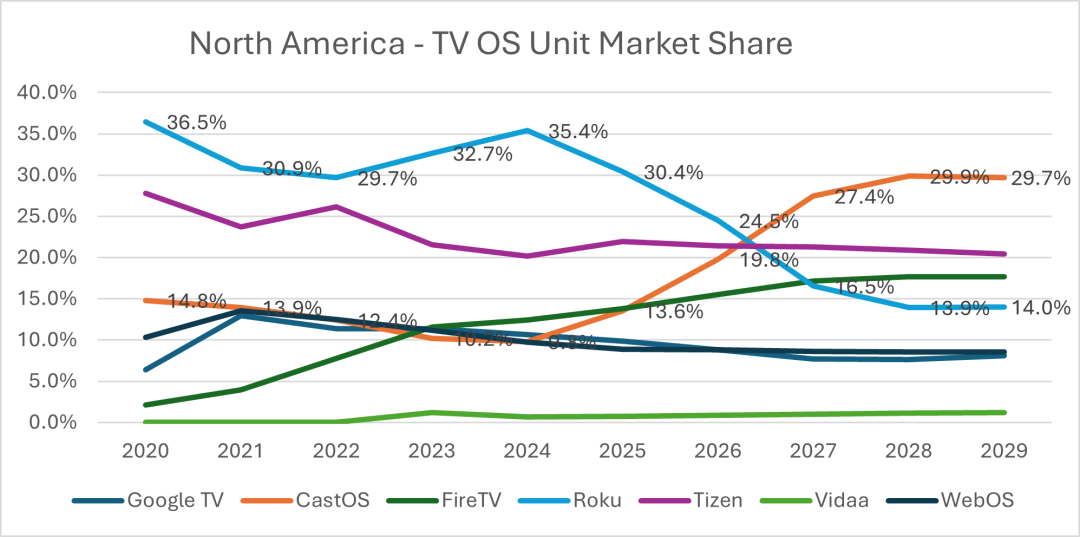
Core Insights - Omdia's report predicts that by 2029, retailers will control 47% of the North American TV operating system (OS) market share, up from 27% in 2025, indicating a shift towards retail media advertising driven by e-commerce rather than traditional TV sales [1] - The global TV OS market is evolving into three distinct segments, with localized Android ecosystems in China maintaining a dominant 96% market share, while Google TV leads in other regions with a 40% share, which is expected to be gradually divided among competitors Vidaa, Titan, and TiVo [1] Group 1 - By 2027, North America is expected to reach a turning point, with Walmart's CastOS devices projected to ship 14 million units, benefiting from Walmart's acquisition of Vizio and the expansion of its CastOS platform [4] - Following the acquisition, Walmart is expected to increase Vizio's shipments from 4.8 million units in 2024 to 6.6 million units in 2025, a growth of 37.5%, while Amazon's FireTV shipments are projected to rise from 6.1 million units in 2024 to 6.8 million units in 2025, an increase of 11.5% [4] - By 2029, Walmart's CastOS devices are expected to reach 14.8 million units, while Amazon's FireTV is projected to reach 8.8 million units, resulting in a total shipment of 23.6 million units and a market size of 50 million units [4] Group 2 - At the 2026 CES, VIDAA OS will undergo significant changes, rebranding to V Home OS to reflect its broader role beyond just television, and announcing a partnership with Microsoft to integrate Copilot generative AI features into the platform [4] - Google has integrated Gemini AI into Google TV, launching interactive shoppable video features at CES, which aim to seamlessly connect viewing and purchasing experiences through AI recognition of products on screen [4] - The emphasis on "conversational shopping" allows users to inquire about products while watching, with the TV identifying brands and providing options to add items to a shopping cart, highlighting the growing importance of shopping functionalities across multiple TV OS platforms [4]




Omdia:随着广告策略的转变, 至2029年零售商将控制北美电视操作系统市场份额的47%
Canalys· 2026-02-02 02:32
Core Insights - By 2029, retailers are expected to control 47% of the North American TV operating system (OS) market share, up from 27% in 2025 according to Omdia [1] Retail Media and Advertising - The latest "TV Design and Function Insights" report indicates that retailers are prioritizing the development of e-commerce-driven retail media advertising over traditional TV shipment leadership [2] Market Trends and Predictions - Omdia forecasts that the global TV OS market is evolving into three distinct segments. In China, a localized Android ecosystem without Google services continues to dominate with a stable 96% market share, which is expected to persist. In other global regions (excluding North America and China), Google TV currently leads with a 40% market share, but this is anticipated to be gradually divided among three competitors: Vidaa, Titan, and TiVo [3] North American Market Developments - Omdia predicts a turning point in the North American market by 2027, with shipments of Walmart's CastOS devices reaching 14 million units. This growth is attributed to Walmart's acquisition of Vizio and the expansion of its CastOS platform. Following the acquisition, Walmart is expected to increase Vizio's shipments from 4.8 million units in 2024 to 6.6 million units in 2025, a growth of 37.5%. Meanwhile, Amazon is projected to raise FireTV shipments from 6.1 million units in 2024 to 6.8 million units in 2025, an increase of 11.5% [6] Future Projections - By 2029, Omdia anticipates that shipments of Walmart's CastOS devices will reach 14.8 million units, while Amazon's FireTV will reach 8.8 million units. Consequently, the total shipments from these two retailers will amount to 23.6 million units, with the market size expected to reach 50 million units [6] AI Integration and User Experience - At the 2026 CES, VIDAA OS underwent significant changes, rebranding to V Home OS to reflect its broader role beyond just television. The company announced a key partnership with Microsoft to integrate Copilot generative AI features into the platform, enhancing user experience through advanced AI services. This rebranding is part of a strategy to evolve the OS to support AI and ultimately serve as a shopping gateway [6] - Google has integrated Gemini AI into Google TV and introduced interactive shoppable video features at CES. AI-driven "shoppable" prompts are linked to screen content, aiming to create a seamless experience between viewing and purchasing. Google emphasized a direct path from discovery to checkout without leaving the interface, allowing users to engage in conversational shopping [6]

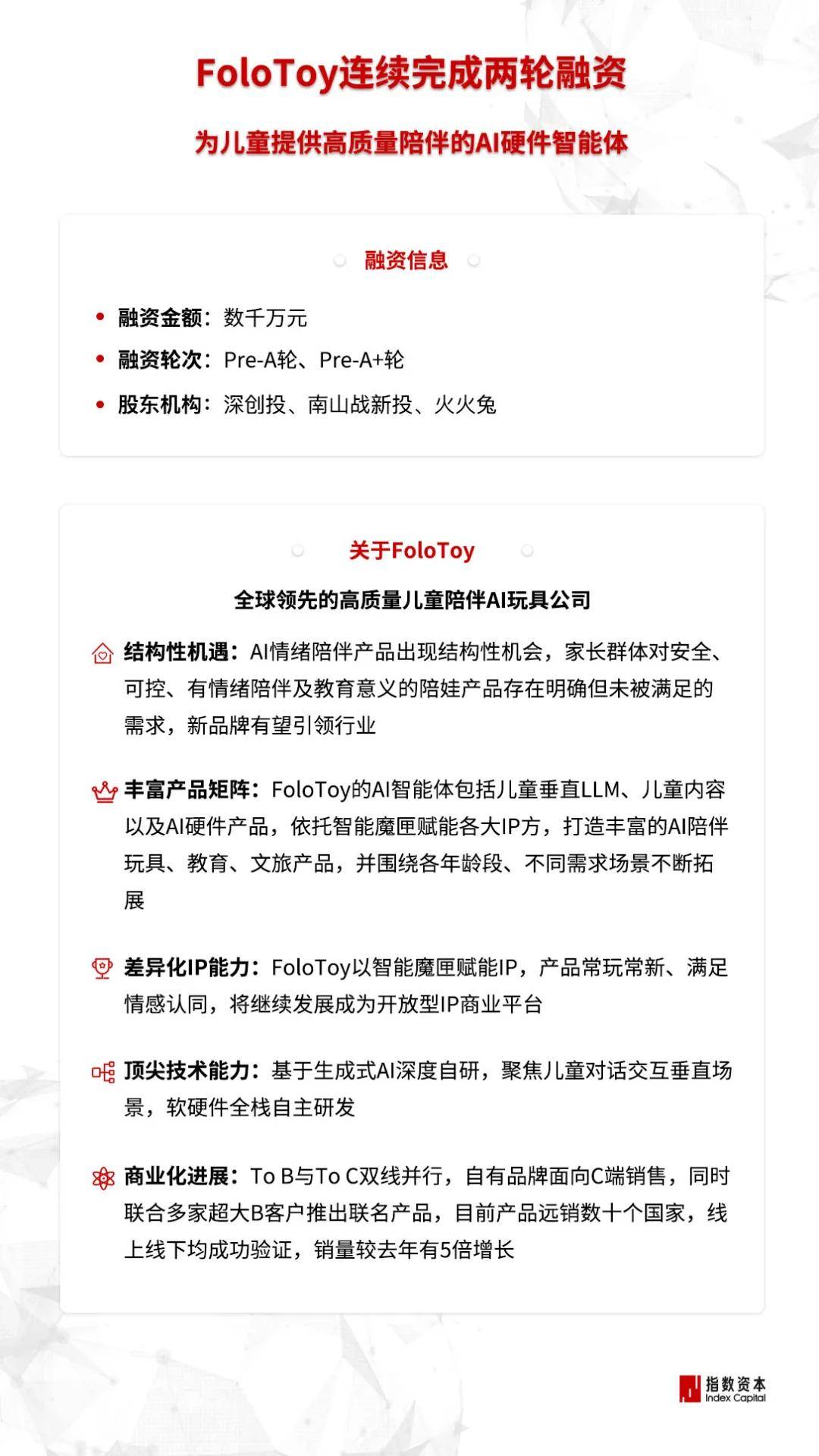
FoloToy连续获得两轮融资,指数资本担任独家财务顾问
Sou Hu Cai Jing· 2026-02-02 02:22
Core Viewpoint - FoloToy has successfully completed two rounds of financing, raising several tens of millions of yuan to enhance its brand influence and channel development in the high-quality AI companionship toy market for children [3][6]. Financing Information - The financing amount is several tens of millions of yuan, with Pre-A and Pre-A+ rounds completed [3][6]. - Investors include Shenzhen Capital Group, Nanshan Innovation Investment, and existing shareholder Huo Huo Tu [3][6]. Market Opportunity - There is a structural opportunity in the AI emotional companionship product market, as parents have unmet needs for safe, controllable, and emotionally supportive educational products for their children [4][8]. - The domestic population of children aged 3-9 is approximately 110 million, with no brand currently holding more than 5% market share in the high-quality companionship AI toy category, indicating a clear market gap [9]. Product Matrix and Technology - FoloToy's AI products include vertical LLMs for children, educational content, and AI hardware, continuously expanding to meet various age groups and needs [4][11]. - The company utilizes a self-developed AI dialogue model and real-time risk control system, focusing on specific pain points for both parents and children [10][11]. Unique Advantages - FoloToy offers a rich product matrix targeting different scenarios, including AI toys for companionship and learning, with features like bilingual support and real-time content filtering [11][12]. - The company has a unique approach to IP collaboration, allowing for dynamic updates to characters and stories, enhancing emotional engagement and brand differentiation [12][13]. Commercial Progress - FoloToy's products have achieved significant sales growth, with domestic sales projected to increase fivefold by 2025 compared to 2024, and successful market entry in countries like the USA, Sweden, Germany, and Japan [16].