
生态文明建设

Search documents
“两山”理念20年丨浙江湖州:从“因矿而生”到“因矿重生”
Zhong Guo Zi Ran Zi Yuan Bao· 2025-11-05 22:40
Core Viewpoint - Huzhou has transformed from a mining city with ecological scars into a model of green development, embodying the principle that "lucid waters and lush mountains are invaluable assets" through systematic ecological restoration and innovative practices [1][3][7]. Group 1: Historical Context and Policy Initiatives - Huzhou was known for its mining industry, which led to significant ecological damage due to high-intensity extraction practices [1]. - The concept of "lucid waters and lush mountains are invaluable assets" was introduced by Xi Jinping during a visit in 2005, marking a pivotal shift towards ecological civilization [1]. - Over the past 20 years, Huzhou has implemented the "Two Mountains" concept, focusing on ecological restoration and sustainable development [1][3]. Group 2: Phased Development of Green Mining - The transition to green mining occurred in four stages: 1. **Pilot Exploration (2005-2010)**: Initiated green mining construction trials and established standards for resource utilization and environmental protection [3]. 2. **Comprehensive Promotion (2011-2015)**: Expanded green mining initiatives citywide, creating a regulatory framework for sustainable practices [3]. 3. **Demonstration Creation (2016-2020)**: Huzhou became a national model for green mining, integrating local regulations and standards [3]. 4. **Intelligent Enhancement (2021-Present)**: Focused on integrating smart technology with green practices, establishing intelligent green mines [4]. Group 3: Systematic Innovations in Ecological Restoration - Huzhou's ecological restoration has evolved from merely addressing past damages to creating economic value through sustainable practices [5]. - The approach shifted from isolated repairs to a comprehensive planning strategy that integrates land use and ecological restoration [5]. - A scientific evaluation system was developed to ensure precise management of mining sites, moving from experience-based to data-driven governance [5]. Group 4: Achievements and Impact - Huzhou has successfully reduced the number of mining operations from over 1,000 to 28, achieving a "zero death" safety record since 2016 [7]. - The city boasts a 100% completion rate for green mines, with 15 recognized nationally, transforming ecological scars into environmental assets [7]. - Resource utilization efficiency has reached over 99%, with numerous patents filed, showcasing innovation in the mining sector [7]. - Successful case studies include the transformation of abandoned mines into parks and industrial hubs, attracting significant investments and tourism [8].
“在这里,我们看到了应对气候变化的中国方案与力量”
人民网-国际频道 原创稿· 2025-11-05 07:51
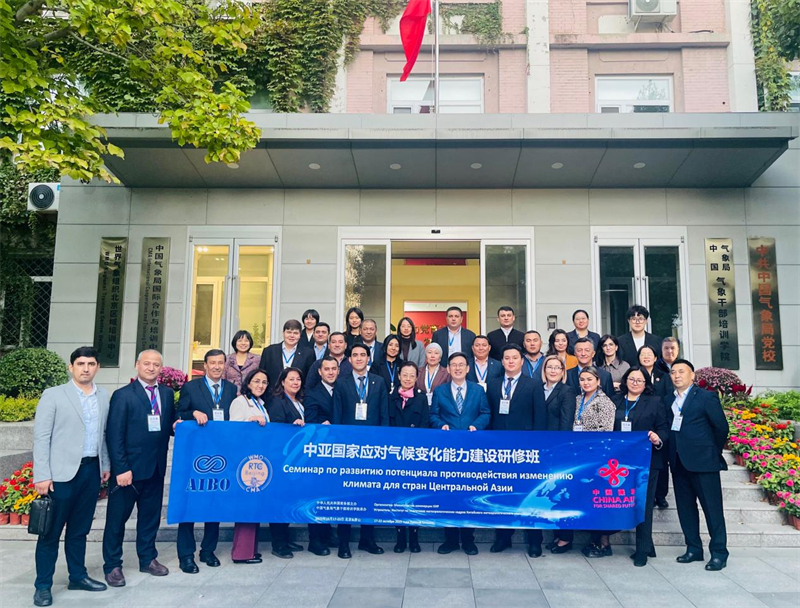
Core Viewpoint - The training program for Central Asian countries on climate change capacity building highlights China's role as a key partner in promoting green technology, renewable energy, and sustainable investment, addressing the urgent challenges faced by the region [1][3][4]. Group 1: Training Program Overview - The training program was organized by the National International Development Cooperation Agency and hosted by the Ministry of Commerce, with participation from 26 officials, scholars, and entrepreneurs from Uzbekistan, Kyrgyzstan, and Turkmenistan [1]. - Participants expressed that their firsthand experience in China exceeded their expectations, providing a vibrant and dynamic understanding of the country [1]. Group 2: China's Modernization and Environmental Approach - The program emphasized that China's modernization is characterized by harmonious coexistence between humans and nature, which is crucial for addressing challenges like glacial retreat and water scarcity in Central Asia [3][4]. - The training included insights into China's ecological civilization construction and how green development is integrated into national strategy, leaving a significant impression on the participants [3]. Group 3: Technological Advancements - Participants were impressed by China's technological capabilities, particularly in meteorology, which they believe can accelerate responses to climate change [6][7]. - The training showcased advanced meteorological equipment and real-time weather satellite imagery, highlighting China's commitment to enhancing disaster prevention and mitigation capabilities [6][7]. Group 4: Cultural Exchange and Friendship - The program fostered a sense of friendship and cultural exchange, with participants appreciating the warmth and hospitality of the Chinese people throughout their journey [8][12]. - The discussions and cultural activities allowed participants to engage deeply with Chinese traditions, enhancing their understanding of the country [11][12].

深刻理解统筹山水林田湖草沙系统治理(深入学习贯彻习近平新时代中国特色社会主义思想·原创性概念标识性概念纵横谈)
Ren Min Ri Bao· 2025-11-04 22:12
Core Viewpoint - The article emphasizes the importance of a holistic approach to ecological governance, integrating various natural elements to enhance ecosystem stability and sustainability, as articulated by General Secretary Xi Jinping [1][2]. Summary by Relevant Sections Understanding Scientific Theory - The concept of "mountains, rivers, forests, fields, lakes, grass, and sand" represents a life community, highlighting the need for integrated ecological governance that considers the integrity of ecosystems and sustainable socio-economic development [2]. Element Coordination - Emphasizes the need for element coordination, viewing natural elements as an organic whole, and breaking away from isolated governance models to restore ecological integrity and stability [3]. Goal Coordination - Stresses that ecological protection and socio-economic development should mutually promote each other, advocating for a green development model that does not sacrifice ecological health for short-term economic gains [4]. Regional Coordination - Highlights the necessity of cross-regional ecological protection and governance, addressing the interconnectedness of ecological systems that transcend administrative boundaries [5]. Policy Coordination - Discusses the importance of diverse governance subjects and tools in ecological governance, advocating for collaboration among government, enterprises, and civil society to create a robust governance framework [6][7]. Innovative Contributions - The governance approach is characterized as a comprehensive innovation that integrates traditional ecological culture with contemporary Marxist ecological thought, promoting a systemic view of ecological governance [8][9]. Institutional Improvement - The process of integrated governance is linked to the enhancement of ecological governance systems, with recent laws and policies reflecting a commitment to ecological prioritization and comprehensive governance [10]. Practical Exploration - Describes various initiatives and projects aimed at ecological restoration, showcasing China's efforts in integrated governance and its contributions to global ecological civilization [11]. Important Relationships - Discusses the need to balance various relationships in governance, including current vs. long-term goals, protection vs. development, natural recovery vs. artificial restoration, and the relationship between the whole and its parts [12][13][14][15][16][17].
新华时评·聚焦“十五五”规划建议丨加快全面绿色转型 建设美丽中国
Xin Hua Wang· 2025-11-02 23:28
Core Viewpoint - The articles emphasize the importance of green development as a fundamental aspect of China's modernization, highlighting the government's commitment to ecological civilization and sustainable economic growth [1][2]. Group 1: Green Development Goals - The "14th Five-Year Plan" aims for significant progress in building a "Beautiful China," focusing on accelerating the green transformation of the economy and society [1]. - Key achievements include the establishment of the world's largest carbon trading market, a clean electricity supply system, and a reduction in water usage per unit of GDP to below 50 cubic meters [1]. - National forest coverage has increased to over 25%, and the proportion of days with good air quality in cities is stable at around 87% [1]. Group 2: Pollution Prevention and Ecological Protection - The government plans to enhance pollution prevention and ecological system optimization through coordinated efforts in pollution reduction and ecological protection [1]. - Specific strategies include strengthening multi-pollutant control, regional governance, and large-scale land greening initiatives [1]. - The focus is on improving the ecological environment to enhance public well-being and safety [1]. Group 3: Energy Transition and Carbon Neutrality - The construction of a new energy system is crucial for promoting green low-carbon transformation and ensuring national energy security [2]. - The "15th Five-Year Plan" outlines measures to achieve carbon peak and neutrality, including dual control of total carbon emissions and intensity, energy-saving renovations, and the establishment of zero-carbon factories [2]. - The plan aims to foster a green production and lifestyle, optimizing industrial layout and promoting low-carbon transitions in key sectors such as industry, urban construction, and transportation [2].
把绿色发展理念进一步贯穿于经济社会发展全过程各方面
Jing Ji Ri Bao· 2025-11-02 06:30
Group 1 - The core viewpoint emphasizes that high-quality development is the primary task for building a modern socialist country, with green development as a fundamental aspect [1][2][3] - The new development concept includes innovation, coordination, green, openness, and sharing, guiding the solid advancement of high-quality development [1][2] - Green development focuses on achieving harmony between humans and nature, which is essential for meeting the growing needs of the people for a better life [1][3] Group 2 - High-quality development aims to satisfy the people's increasing demand for a beautiful living environment, highlighting the importance of ecological protection and pollution prevention [2][3] - The public's expectations have shifted from mere availability of resources to the quality of the environment, indicating a growing urgency for ecological improvements [3][4] - The need for structural and fundamental changes in ecological protection remains, with ongoing pressures in resource-based regions and the necessity for improved mechanisms for ecological compensation and carbon trading [3][4] Group 3 - Implementing the green development concept is crucial for enhancing public welfare and achieving high-quality development, necessitating a shift away from environmentally damaging growth models [4][5] - A green, low-carbon, and circular production system must be established to fundamentally address environmental pollution and improve ecological quality [4][5] - The integration of ecological protection into economic development is essential, promoting a balance between material and ecological civilization [4][5] Group 4 - The report from the 20th National Congress emphasizes that promoting green and low-carbon economic development is a key aspect of achieving high-quality growth [5][6] - The green development concept encourages the optimization and upgrading of industrial structures, moving away from traditional growth models focused solely on GDP [5][6] - The cultivation of new productive forces aligned with green development is necessary for achieving low resource consumption and minimal environmental pollution [6][7] Group 5 - The green development concept should be integrated across all sectors, including production, distribution, circulation, and consumption, to ensure efficient resource use and strict ecological protection [7][8] - There is a need for comprehensive assessments of industrial energy consumption and ecological impacts while promoting the development of green low-carbon industries [7][8] - Strengthening institutional frameworks and policies that support green transformation is essential for fostering a conducive environment for sustainable development [7][8]
十四五”时期广西筑牢南方生态安全屏障 生态“高颜值”转化为发展“高价值
Zhong Guo Fa Zhan Wang· 2025-10-31 03:47
Core Viewpoint - The Guangxi Zhuang Autonomous Region government emphasizes the importance of ecological environment protection and sustainable development, showcasing significant achievements in ecological civilization construction during the "14th Five-Year Plan" period [3][4][5]. Group 1: Achievements in Ecological Civilization - Guangxi has created 19 national ecological civilization demonstration zones and 6 "Green Mountains and Clear Waters are Invaluable Assets" innovation bases, enhancing its ecological brand [3]. - The region's ecological environment quality remains in the "first tier" nationally, with air quality good days ratio above 95.1% since 2021, projected to reach 97.1% in 2024, and PM2.5 concentration decreasing to 25.4 µg/m³ by 2024 [4]. - The proportion of good surface water quality remains stable at over 98.2%, with several cities ranking high nationally in water quality [4]. Group 2: Green Development Initiatives - Over 17,000 environmental impact assessments have been approved since the start of the "14th Five-Year Plan," with total investments exceeding 4.2 trillion yuan [5]. - Clean energy accounts for over 70% of installed capacity, with 2 out of every 3 kilowatt-hours consumed coming from clean energy sources [5]. - The region has established 105 national-level green factories and 11 green parks, with green investment agreements totaling approximately 75 billion yuan [5]. Group 3: Biodiversity and Regional Cooperation - Guangxi has implemented a positive and negative list for ecological protection, showing zero tolerance for illegal activities, and ranks third nationally in biodiversity richness [5]. - The region has discovered 249 new animal species during the "14th Five-Year Plan," with significant population growth in endangered species like the white-headed leaf monkey and the eastern black-crowned gibbon [5]. - Guangxi has deepened environmental cooperation with the Guangdong-Hong Kong-Macao Greater Bay Area and neighboring provinces, signing a memorandum of understanding with Vietnam for environmental protection [5]. Group 4: Future Plans - The government aims to ensure the successful completion of the "14th Five-Year Plan" and lay a solid foundation for the "15th Five-Year Plan," focusing on harmonious coexistence between humans and nature [6].
“十四五”时期广西筑牢南方生态安全屏障 生态“高颜值”转化为发展“高价值”
Zhong Guo Fa Zhan Wang· 2025-10-31 03:42
Core Insights - The Guangxi Zhuang Autonomous Region government emphasizes the importance of ecological protection and sustainable development during the "14th Five-Year Plan" period, aiming to transform ecological advantages into economic value [3][4][5] Group 1: Achievements in Ecological Civilization Construction - Guangxi has established 19 national ecological civilization demonstration zones and 6 "Green Mountains and Clear Waters are Invaluable Assets" innovation bases, enhancing its ecological brand [3] - The region's air quality has remained in the top tier nationally, with a 95.1% rate of good air quality days since 2021, projected to reach 97.1% in 2024 [4] - The proportion of surface water with good quality has stabilized at over 98.2%, with several cities ranking among the best in the country for water quality [4] Group 2: Green Development Initiatives - Over 17,000 environmental impact assessments have been approved since the start of the "14th Five-Year Plan," with total investments exceeding 4.2 trillion yuan [5] - Clean energy now accounts for over 70% of installed capacity, with 2 out of every 3 kilowatt-hours consumed coming from clean energy sources [5] - The region has created 105 national-level green factories and 11 green parks, with green investment agreements totaling approximately 75 billion yuan [5] Group 3: Biodiversity and Environmental Protection - Guangxi has implemented a positive and negative list for ecological protection, demonstrating zero tolerance for violations, and ranks third nationally in biodiversity richness [5] - The region has discovered 249 new animal species during the "14th Five-Year Plan," with significant population increases in endangered species such as the white-headed leaf monkey and the eastern black-crowned gibbon [5] Group 4: Regional Cooperation - Guangxi has deepened environmental cooperation with the Guangdong-Hong Kong-Macao Greater Bay Area and surrounding provinces, and has signed a memorandum of understanding with Vietnam for environmental protection [5] - The region has successfully hosted 14 sessions of the China-ASEAN Environmental Cooperation Forum, promoting ecological collaboration [5] Future Outlook - The government plans to continue focusing on building a beautiful Guangxi, ensuring the successful completion of the "14th Five-Year Plan" and laying a solid foundation for the "15th Five-Year Plan" [6]
重庆用实干守护山城绿水青山
Zhong Guo Huan Jing Bao· 2025-10-31 00:10
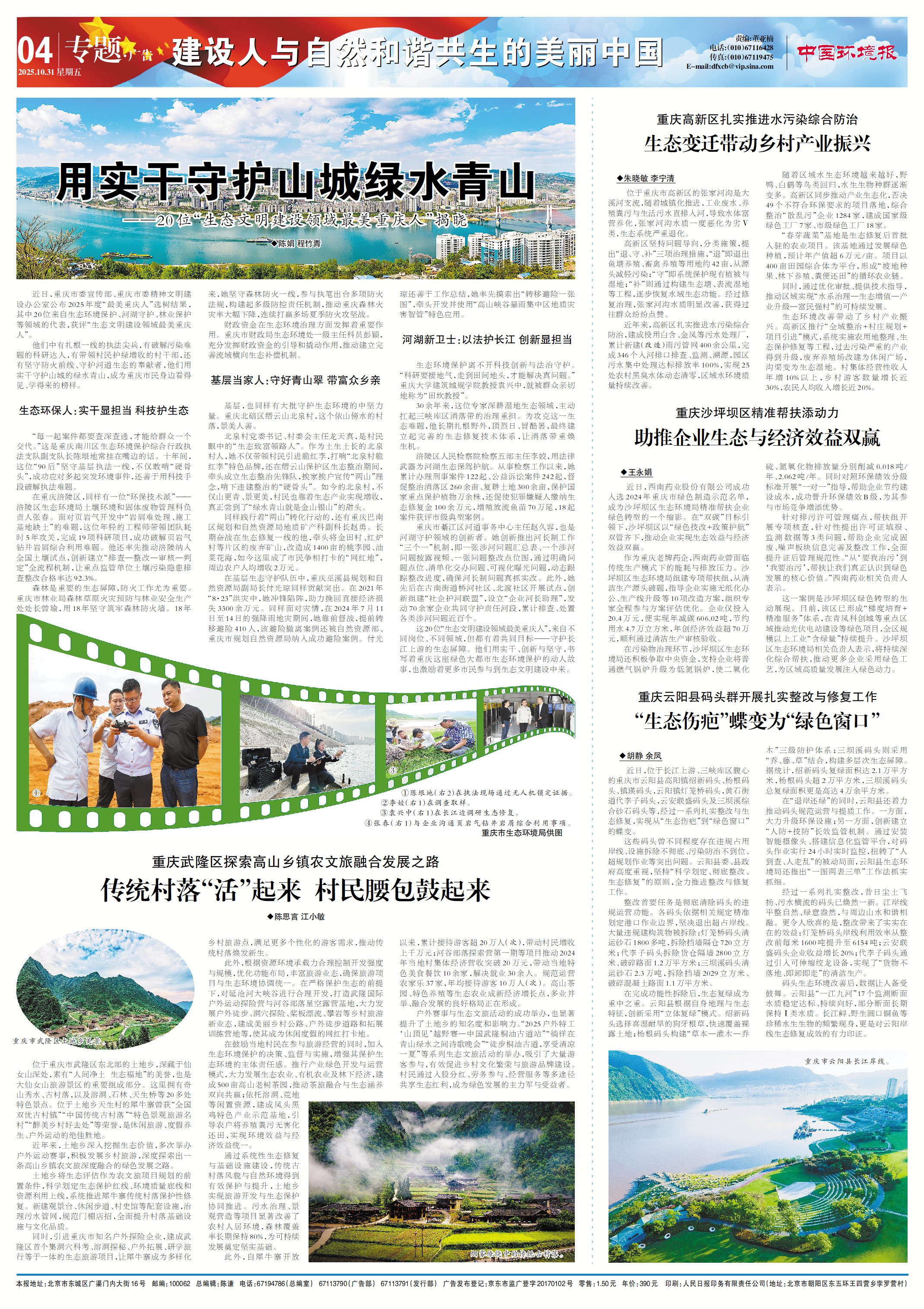
Core Viewpoint - The article highlights the recognition of 20 individuals as the "Most Beautiful Chongqing People" in the field of ecological civilization construction, showcasing their contributions to environmental protection, community engagement, and sustainable development in Chongqing [2][13]. Group 1: Environmental Protection Efforts - Chen Yandi, deputy head of the ecological environment protection team in Nanchuan District, emphasizes thorough investigations in environmental cases, demonstrating commitment to grassroots enforcement [3][14]. - Zhang Chun, head of soil and solid waste management in Fuling District, led a team to solve challenges in shale gas development, completing 19 research projects and achieving a soil pollution remediation compliance rate of 92.3% [3][14]. - Zeng Yu, director of the Forest Fire Prevention and Forestry Safety Production Department, has dedicated 18 years to forest fire prevention, significantly reducing fire incidents in Chongqing [3][14]. Group 2: Community Engagement and Economic Development - Long Tianzhen, the village head of Beiquan Village, has successfully introduced a local specialty brand and led ecological restoration efforts, resulting in increased income for villagers [5][16]. - Zhao Yong, deputy section chief in the Planning and Natural Resources Bureau of Banan District, transformed abandoned mines into 1,400 acres of fruit gardens, boosting local farmer incomes by 20,000 yuan per person [5][16]. Group 3: Disaster Response and Risk Management - Fu Guangqiong, deputy director of the Planning and Natural Resources Bureau in Wuxi County, played a crucial role in disaster response during severe weather events, helping to prevent economic losses of over 33 million yuan [6][17]. - She developed a disaster management application to enhance risk assessment and response strategies [6][17]. Group 4: Legal and Technological Innovations - Professor Yuan Xingzhong from Chongqing University has focused on wetland ecology and established a comprehensive ecological restoration system for the Three Gorges Reservoir area [7][18]. - Li Jiao, head of the Fifth Department of the Fuling District People's Procuratorate, has handled numerous environmental cases, promoting ecological restoration and legal accountability [7][18]. Group 5: Collaborative Initiatives - Zhao Jiurong, director of the River Affairs Center in Qijiang District, implemented a "three-in-one" mechanism for river management, enhancing transparency and accountability in environmental governance [7][19]. - The establishment of the "Community-Enterprise River Protection Alliance" has mobilized over 70 companies to participate in river conservation efforts [7][19].
李维明:为高质量发展打造强劲绿色引擎
Jing Ji Ri Bao· 2025-10-31 00:09
Core Points - The 20th Central Committee of the Communist Party of China has approved the proposal for the 15th Five-Year Plan, emphasizing the importance of ecological civilization and the commitment to building a "Beautiful China" [1][2] - The plan outlines significant achievements in ecological and environmental quality, including a 16.3% reduction in PM2.5 concentration by 2024 compared to 2020, and a water quality improvement with over 90% of surface water meeting good quality standards [2][3] - The integration of ecological protection and economic development is highlighted as a key strategy, demonstrating that a good ecological environment is essential for high-quality development [3][4] Summary by Sections Economic and Environmental Goals - The plan aims for a comprehensive green transformation of the economy and society, with a focus on achieving carbon peak and carbon neutrality [4] - The proportion of non-fossil energy consumption is projected to increase from 15.9% in 2020 to 19.8% by 2024, indicating a shift towards cleaner energy sources [2][4] Achievements in Ecological Protection - The area of ecological protection and restoration has exceeded 1.2 million acres, with forest coverage steadily increasing to over 25% [2][3] - The number of national-level green factories has risen to 6,430, contributing approximately 20% to the total output value of the manufacturing sector [2][4] Future Directions - The plan emphasizes the need for continuous enhancement of green development momentum, focusing on balancing economic growth with environmental protection [4] - Key tasks include advancing pollution prevention, optimizing ecosystems, and constructing a new energy system to ensure energy security while promoting renewable energy [4]
“大美青海”走进澳门
Xin Hua Wang· 2025-10-30 05:52
Group 1 - The event "2025 Qinghai-Macau Economic and Trade Exchange Promotion Conference" aims to strengthen resource alignment between Qinghai and Macau, and expand cooperation with Portuguese-speaking countries to promote high-quality development through high-level openness [1][2] - Qinghai's Governor Luo Dongchuan highlighted the vast prospects for cooperation, emphasizing ecological civilization construction, cultural tourism development, and green energy integration as key areas for collaboration [1][2] - The event featured a thematic exhibition showcasing Qinghai's achievements in ecological civilization and green energy development, resulting in 22 cooperative projects across various sectors including trade, education, culture, traditional Chinese medicine, and finance [2] Group 2 - Macau's Secretary for Economy and Finance, Dai Jianye, expressed that Macau is committed to providing comprehensive and high-quality services to facilitate Qinghai enterprises in expanding their reach and attracting investments [2] - The Permanent Secretariat of the China-Portuguese-speaking Countries Forum, represented by Ji Xianzheng, will work with Qinghai's relevant departments to implement key cooperation areas as per the newly signed cooperation framework agreement [2]