稳定币

Search documents
央行:继续坚持对虚拟货币的禁止性政策,持续打击虚拟货币相关非法金融活动|快讯
Sou Hu Cai Jing· 2025-11-29 10:43
Core Viewpoint - The People's Bank of China (PBOC) is intensifying efforts to combat virtual currency trading speculation and illegal activities, emphasizing that virtual currencies do not hold legal status equivalent to fiat currencies and should not circulate in the market [1] Group 1: Regulatory Actions - A meeting was held on November 28 by the PBOC to coordinate efforts against virtual currency trading speculation [1] - The PBOC highlighted that recent factors have led to a resurgence in virtual currency speculation and related illegal activities, presenting new challenges for risk prevention [1] - The meeting reaffirmed the commitment to a prohibitive policy on virtual currencies and the continuous crackdown on illegal financial activities related to them [1] Group 2: Legal and Compliance Issues - The PBOC stated that virtual currencies, including stablecoins, do not meet requirements for customer identity verification and anti-money laundering, posing risks for illegal activities such as money laundering and fundraising fraud [1] - The meeting called for enhanced collaboration among various regulatory bodies to improve regulatory policies and legal frameworks, focusing on key areas such as information flow and capital flow [1][2]
打击虚拟货币交易炒作!央行,重要会议!
证券时报· 2025-11-29 10:43
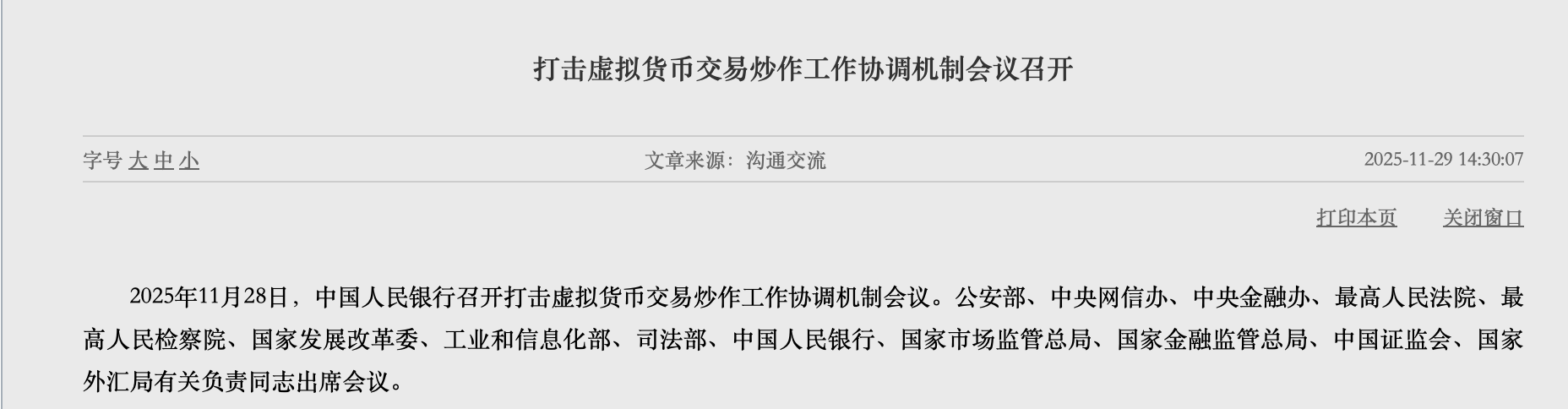
打击虚拟货币交易炒作工作协调机制会议召开。 2025年11月28日,中国人民银行召开打击虚拟货币交易炒作工作协调机制会议。公安部、中央网信办、中央金 融办、最高人民法院、最高人民检察院、国家发展改革委、工业和信息化部、司法部、中国人民银行、国家市 场监管总局、国家金融监管总局、中国证监会、国家外汇局有关负责同志出席会议。 会议指出,近年来各单位认真贯彻落实党中央、国务院决策部署,按照2021年中国人民银行等十部门联合发布 的《关于进一步防范和处置虚拟货币交易炒作风险的通知》要求, 坚决打击虚拟货币交易炒作,整顿虚拟货 币乱象,取得明显成效。近期,受多种因素影响,虚拟货币投机炒作有所抬头,相关违法犯罪活动时有发生, 风险防控面临新形势、新挑战。 会议强调,虚拟货币不具有与法定货币等同的法律地位,不具有法偿性,不应且不能作为货币在市场上流通使 用,虚拟货币相关业务活动属于非法金融活动。稳定币是虚拟货币的一种形式,目前无法有效满足客户身份识 别、反洗钱等方面的要求,存在被用于洗钱、集资诈骗、违规跨境转移资金等非法活动的风险。 会议要求,各单位要坚持以习近平新时代中国特色社会主义思想为指导,全面落实党的二十大和二十届 ...


我国将持续打击虚拟货币相关非法金融活动
Xin Hua She· 2025-11-29 08:50
2021年中国人民银行等十部门联合发布《关于进一步防范和处置虚拟货币交易炒作风险的通知》要 求,坚决打击虚拟货币交易炒作,整顿虚拟货币乱象。 新华社北京11月29日电(记者吴雨、任军)记者11月29日从中国人民银行获悉,我国将继续坚持对 虚拟货币的禁止性政策,持续打击虚拟货币相关非法金融活动,保护人民群众财产安全。 记者了解到,中国人民银行日前召开打击虚拟货币交易炒作工作协调机制会议。会议指出,近期, 受多种因素影响,虚拟货币投机炒作有所抬头,相关违法犯罪活动时有发生,风险防控面临新形势、新 挑战。 会议强调,虚拟货币不具有与法定货币等同的法律地位,不具有法偿性,不应且不能作为货币在市 场上流通使用,虚拟货币相关业务活动属于非法金融活动。 针对稳定币,会议明确指出,目前稳定币无法有效满足客户身份识别、反洗钱等方面的要求,存在 被用于洗钱、集资诈骗、违规跨境转移资金等非法活动的风险。 会议要求各单位要深化协同配合,完善监管政策和法律依据,聚焦信息流、资金流等重点环节,加 强信息共享,进一步提升监测能力,严厉打击违法犯罪活动,维护经济金融秩序稳定。 ...
打击炒币,央行召开重磅会议
21世纪经济报道· 2025-11-29 08:28
Core Viewpoint - The People's Bank of China (PBOC) is intensifying efforts to combat virtual currency trading and speculation, emphasizing that virtual currencies do not hold legal status equivalent to fiat currencies and are considered illegal financial activities [3][4]. Group 1: Meeting Outcomes - The meeting highlighted that various departments have effectively implemented the directives from the central government to combat virtual currency trading and speculation, achieving notable results [3]. - Recent factors have led to a resurgence in virtual currency speculation and related illegal activities, presenting new challenges for risk management [3]. - The PBOC reiterated that stablecoins, a form of virtual currency, currently fail to meet essential requirements for customer identity verification and anti-money laundering, posing risks for illegal activities such as money laundering and cross-border fund transfers [3][4]. Group 2: Regulatory Framework - Since 2017, the PBOC and relevant departments have issued multiple policy documents to prevent and address risks associated with domestic virtual currency trading, which remain effective [4]. - The PBOC plans to continue its crackdown on domestic virtual currency operations and speculation, while closely monitoring the development of overseas stablecoins [4]. - The meeting called for comprehensive implementation of the Party's 20th National Congress and subsequent plenary session directives, maintaining a prohibitive stance on virtual currencies and enhancing collaboration among regulatory bodies to improve monitoring capabilities [4].

央行牵头多部门联合部署 持续严打虚拟货币交易炒作
2 1 Shi Ji Jing Ji Bao Dao· 2025-11-29 08:15
Core Viewpoint - The People's Bank of China (PBOC) is intensifying efforts to combat virtual currency trading speculation, highlighting the need for strict regulatory measures and collaboration among various government departments to address emerging risks in the sector [3][6]. Group 1: Regulatory Actions and Policies - The meeting emphasized the importance of adhering to the directives from the Central Committee and the State Council, focusing on the implementation of the 2021 notice aimed at preventing and addressing risks associated with virtual currency trading [3]. - The PBOC and other relevant departments have previously issued multiple policy documents since 2017 to mitigate risks related to domestic virtual currency trading, which remain effective [5]. - The PBOC plans to continue its crackdown on illegal virtual currency operations and trading, while also monitoring the development of overseas stablecoins [5]. Group 2: Risks and Challenges - Recent trends indicate a resurgence in speculative trading of virtual currencies, leading to an increase in related illegal activities, thus presenting new challenges for risk management [3]. - Virtual currencies do not hold the same legal status as fiat currencies and are classified as illegal financial activities, with stablecoins posing specific risks related to anti-money laundering and customer identification [3][5]. - The international community has expressed growing concern over the potential risks associated with virtual currencies, particularly regarding their impact on financial stability and regulatory gaps [5]. Group 3: Future Directions - The meeting called for a comprehensive implementation of the Party's 20th National Congress directives, emphasizing risk prevention as a perpetual theme in financial work [6]. - There is a need for enhanced collaboration among various regulatory bodies to improve monitoring capabilities and information sharing, aiming to protect public assets and maintain financial order [6].
央行:持续打击虚拟货币相关非法金融活动
Huan Qiu Wang Zi Xun· 2025-11-29 07:28
来源:央视新闻客户端 记者今天从中国人民银行了解到,近期,受多种因素影响,虚拟货币投机炒作有所抬头,相关违法犯罪 活动时有发生,风险防控面临新形势、新挑战,未来央行等部门将持续打击虚拟货币相关非法金融活 动。 持续打击虚拟货币相关非法金融活动 未来央行等部门将继续坚持对虚拟货币的禁止性政策,持续打击虚拟货币相关非法金融活动,进一步提 升监测能力,严厉打击违法犯罪活动,保护人民群众财产安全,维护经济金融秩序稳定。 (总台央视记者 孙艳) 稳定币存在被用于洗钱、集资诈骗等非法活动的风险 央行等部门表示,虚拟货币不具有与法定货币等同的法律地位,不具有法偿性,不应且不能作为货币在 市场上流通使用,虚拟货币相关业务活动属于非法金融活动。稳定币是虚拟货币的一种形式,目前无法 有效满足客户身份识别、反洗钱等方面的要求,存在被用于洗钱、集资诈骗、违规跨境转移资金等非法 活动的风险。 ...
央行:近期虚拟货币投机炒作有所抬头,风险防控面临新挑战
Xin Jing Bao· 2025-11-29 06:55
会议强调,虚拟货币不具有与法定货币等同的法律地位,不具有法偿性,不应且不能作为货币在市场上 流通使用,虚拟货币相关业务活动属于非法金融活动。稳定币是虚拟货币的一种形式,目前无法有效满 足客户身份识别、反洗钱等方面的要求,存在被用于洗钱、集资诈骗、违规跨境转移资金等非法活动的 风险。 新京报讯据中国人民银行消息,2025年11月28日,中国人民银行召开打击虚拟货币交易炒作工作协调机 制会议。公安部、中央网信办、中央金融办、最高人民法院、最高人民检察院、国家发展改革委、工业 和信息化部、司法部、中国人民银行、国家市场监管总局、国家金融监管总局、中国证监会、国家外汇 局有关负责同志出席会议。 会议指出,近年来各单位认真贯彻落实党中央、国务院决策部署,按照2021年中国人民银行等十部门联 合发布的《关于进一步防范和处置虚拟货币交易炒作风险的通知》要求,坚决打击虚拟货币交易炒作, 整顿虚拟货币乱象,取得明显成效。近期,受多种因素影响,虚拟货币投机炒作有所抬头,相关违法犯 罪活动时有发生,风险防控面临新形势、新挑战。 会议要求,各单位要坚持以习近平新时代中国特色社会主义思想为指导,全面落实党的二十大和二十届 历次全会精神 ...
Explained: What is a stablecoin?
Yahoo Finance· 2025-11-28 22:50
Core Insights - The volatility of cryptocurrency prices creates a demand for more stable digital currencies, akin to cash [1][2] - Stablecoins are designed to maintain a stable value, typically pegged to real-world assets like the US dollar, providing benefits such as fast global payments and reduced price volatility [2][7] Types of Stablecoins - **Fiat-backed stablecoins**: These are backed 1:1 by actual money held in reserves, with Tether's USDT and Circle's USDC being prominent examples [4] - **Crypto-backed stablecoins**: These utilize cryptocurrency as collateral, often requiring overcollateralization to mitigate volatility, with DAI from MakerDAO as a notable example [5] - **Algorithmic stablecoins**: These rely on algorithms and incentives to maintain their value peg, but can fail under extreme market conditions [6] Importance of Stablecoins - Stablecoins have become essential in the crypto ecosystem, driven by their real-world utility rather than speculation, enabling users to conduct cross-border transactions quickly and earn yields in decentralized finance markets [7][8] - They serve as a financial lifeline for individuals in regions experiencing rapid currency depreciation or inflation [8][9]
稳定币发行商买了上百吨黄金
Bei Jing Shang Bao· 2025-11-27 14:25
Core Insights - Tether, a major player in the cryptocurrency market, has emerged as a significant buyer of gold, holding 116 tons valued at approximately $14 billion, surpassing some national central banks [3][4] - The price of gold has surged by 56% in 2025, with Tether's purchases coinciding with this increase, particularly during the second wave of price growth from mid-August to mid-October [3][4] - The rise of gold-backed stablecoins is gaining traction, with Tether's USDT and XAUt contributing to this trend, reflecting a shift in the stablecoin market [4][7] Tether's Gold Purchases - Tether's gold purchases accounted for about 2% of global gold demand in Q3 and 12% of known central bank purchases during the same period [3] - In Q2, Tether's gold buying represented 14% of global central bank purchases, indicating its growing influence in the gold market [3] - Tether holds 104 tons of gold as reserves for USDT and an additional 12 tons for XAUt, suggesting a strategic move to bolster its asset backing [4] Market Dynamics - The gold price increase has occurred in two phases, with the first phase seeing a nearly $1,000 rise before April and the second phase mirroring this increase from August to October [3] - Tether's demand for gold may have tightened supply and influenced market sentiment, driving speculative investments into gold [4][6] - The stablecoin market is evolving, with gold-backed stablecoins becoming a new category, currently valued at $1.6 billion, representing 0.67% of the total stablecoin market [7] Regulatory Considerations - Tether's use of gold as a reserve asset contrasts with new U.S. regulations that prohibit compliant issuers from using gold as backing, leading Tether to plan a new stablecoin, USAT, that will not be gold-backed [5] - The intertwining of gold and cryptocurrency ecosystems raises questions about the stability and regulatory compliance of such assets [5][6] Future of Digital Gold - The development of digital gold is seen as timely, with potential for innovation in financial products, provided regulatory frameworks are established [7][8] - Challenges remain in ensuring transparency and security in the issuance and tracking of digital gold, as well as maintaining sufficient physical gold reserves [8] - The future landscape may see digital gold complementing physical gold rather than replacing it, enhancing the overall gold market [8]

黄金真正的“大庄家”:“稳定币老大”Tether
华尔街见闻· 2025-11-27 07:54
Core Viewpoint - The article highlights Tether, a controversial stablecoin issuer in the cryptocurrency world, as a significant buyer of gold, reshaping the supply-demand dynamics of traditional safe-haven assets [1][2]. Group 1: Tether's Gold Holdings - As of September 30, Tether holds 116 tons of gold valued at approximately $14 billion, making it the largest single holder of gold outside of major central banks [2]. - In Q3 alone, Tether purchased about 26 tons of gold, accounting for 2% of global gold demand during that period and 12% of known central bank purchases [3][11]. Group 2: Impact on Gold Prices - The article suggests that Tether's gold purchases have contributed to a 56% increase in gold prices by 2025, with gold prices rising by about $2000 this year [5][11]. - Tether's demand has potentially tightened supply and influenced market sentiment, driving speculative funds into the gold market [6]. Group 3: Future Gold Purchases - Tether plans to purchase approximately 100 tons of physical gold by 2025, supported by an expected profit of nearly $15 billion this year [12][11]. - The strategy involves using gold reserves to back two different tokens, USDT and Tether Gold (XAUt), with a total of 116 tons of gold backing these tokens [13]. Group 4: Regulatory Challenges - Tether's gold purchasing strategy conflicts with the recently passed GENIUS Act, which prohibits compliant issuers from using gold as reserve assets [14]. - Despite regulatory challenges, Tether has increased its gold reserves, indicating a long-term strategy focused on tokenized gold [14][17]. Group 5: Market Dynamics and Risks - The intertwining of cryptocurrency and traditional safe-haven assets raises concerns about the potential for speculative bubbles in gold [7][15]. - If demand for stablecoins reverses, the gold reserves supporting them may face selling pressure, impacting the gold market [7][15]. Group 6: Tokenized Gold Market - Tether's ambition in the tokenized gold market reflects a desire to provide a more accessible way for retail investors to hold gold without the high costs associated with physical ownership [17][18]. - However, demand for tokenized gold remains low, with Tether being one of the few issuers with significant holdings [19].