AGI

Search documents
2025最后一天,Kimi杨植麟发内部信:我们手里还有100亿现金
3 6 Ke· 2025-12-31 12:38
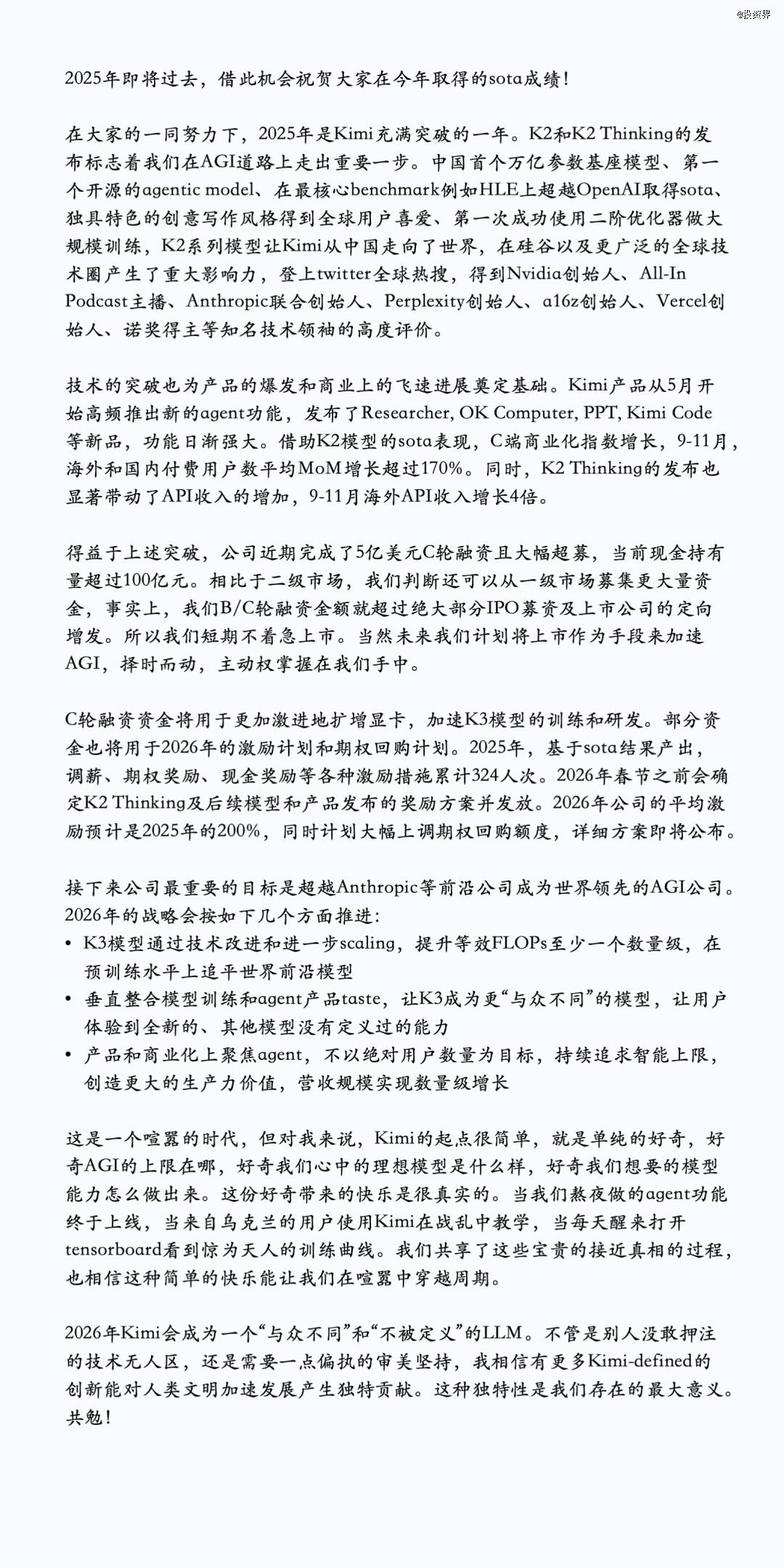
Core Insights - The founder and CEO of Kimi, Yang Zhilin, announced that the company currently holds over 10 billion yuan in cash and is not in a hurry to go public [1][2] - Kimi recently completed a $500 million Series C funding round, led by IDG with a $150 million investment, and the post-money valuation reached $4.3 billion [1][2] - Kimi's paid user base saw a month-over-month growth rate of 170% from September to November 2025, potentially reaching around 1.7 million users by the end of the year [2][5] Financial Performance - Assuming an initial paid user count of 100,000 at the beginning of 2025, the estimated monthly revenue could reach approximately 85 million yuan by year-end, with API revenue potentially bringing total monthly revenue close to 100 million yuan [2][5] - The company has a significant cash reserve, which allows it to avoid rushing into an IPO, indicating a strong financial position to face competition in 2026 [2][5] Product Development - Kimi plans to launch the K2 and K2 Thinking models in September and November 2025, focusing on explainability in reasoning processes and complex logical reasoning [1][2] - The company has been actively releasing new agent functionalities since May 2025, contributing to a substantial increase in commercial performance [5][6] Strategic Goals - Kimi aims to surpass leading companies like Anthropic to become a world leader in AGI, with plans to enhance the K3 model's capabilities significantly [6][7] - The company is focusing on vertical integration of model training and agent products, aiming for a unique user experience and substantial revenue growth [7][8] Future Plans - A reward scheme for the K2 Thinking model and subsequent products is expected to be established before the 2026 Spring Festival, with average incentives projected to be 200% of 2025 levels [2][6] - The company intends to utilize the Series C funding to aggressively expand GPU resources and accelerate the training and development of the K3 model [6][7]

Kimi账上100亿,杨植麟:我们不着急上市
Sou Hu Cai Jing· 2025-12-31 12:03
Core Insights - The company "月之暗面" (Kimi) has successfully completed a $500 million Series C funding round, significantly oversubscribed by existing investors including Alibaba, Tencent, and Wang Huiwen [2][4] - Following this funding round, the post-money valuation of Kimi has surged to $4.3 billion (approximately 30 billion RMB) [3][4] - Kimi's current cash reserves exceed 10 billion RMB, which is nearly equivalent to the combined cash reserves of its competitors, 智谱 (Zhiyu) and MiniMax [3][11] Funding and Valuation - The Series C funding round was notable for its scale, with Kimi's valuation having previously crossed the $3 billion mark [4] - The company has attracted significant interest from top-tier venture capital firms and major tech companies, indicating strong market confidence [4][6] - Kimi's funding success is attributed to its strong performance in the large model market, particularly with its K2 model, which has received critical acclaim [5][6] Product and Technology Development - Kimi's K2 model has achieved state-of-the-art (SOTA) results in key benchmarks, surpassing competitors like OpenAI [5][16] - The company has introduced new features such as the "OK Computer" agent, which enhances its commercial offerings by enabling users to perform various tasks [4][16] - The company plans to further develop its K3 model, aiming to improve its performance significantly and integrate more advanced capabilities [7][17] Commercialization and User Growth - Kimi has reported a substantial increase in its commercial metrics, with a month-over-month growth of over 170% in paid users from September to November [5][16] - The release of K2 Thinking has also led to a fourfold increase in overseas API revenue during the same period [5][16] - The company is focusing on enhancing its agent products rather than solely increasing user numbers, aiming for greater productivity and revenue growth [7][17] Strategic Outlook - Kimi's CEO has indicated that the company is not in a rush to go public, preferring to leverage its strong cash position to fund further growth and development [11][12] - The company plans to use part of the Series C funding for employee incentives and stock buyback programs, aiming to attract and retain top talent [17] - Kimi's long-term goal is to surpass leading companies in the AGI space, positioning itself as a world leader in artificial general intelligence [7][17]
Kimi完成5亿美元C轮融资,现金储备超百亿
Sou Hu Cai Jing· 2025-12-31 11:05
Core Insights - Kimi has recently completed a $500 million Series C funding round, led by IDG with $150 million, and has a post-funding valuation of $4.3 billion [2] - The company has over 10 billion RMB in cash reserves, comparable to post-IPO cash levels of competitors like Zhizhu and MiniMax [2][3] - Kimi's CEO revealed that the funding will be used to aggressively expand GPU resources and accelerate the training and development of the K3 model [8] Funding and Financials - The Series C funding was significantly oversubscribed, indicating strong investor confidence [7] - Kimi's cash reserves exceed 10 billion RMB, which is substantial compared to the expected IPO fundraising of competitors [3][7] - The company plans to utilize part of the funding for employee incentive programs and stock buybacks in 2026 [8] Product Development and Commercialization - Kimi launched the Multi-Agent product "OK Computer," which allows AI to autonomously complete complex tasks, marking a key step in its commercialization process [3] - The company reported a monthly growth rate of 170% in global paid users, driven by the K2 Thinking model, with a fourfold increase in overseas API revenue [3][7] - Kimi aims to focus on enhancing the capabilities of its products rather than merely increasing user numbers, targeting significant revenue growth [5][8] Strategic Goals - The company aims to make the K3 model a unique offering by integrating training technology and product design, enhancing user experience [4][9] - Kimi's strategic objectives for 2026 include achieving a significant increase in equivalent FLOPs for the K3 model and focusing on agent-based products to maximize productivity [8][9] - The company aspires to surpass leading firms like Anthropic and establish itself as a world leader in AGI [8]
Kimi账上100亿,杨植麟:我们不着急上市
投资界· 2025-12-31 10:47
Core Viewpoint - The company "月之暗面" (Kimi) has successfully completed a $500 million Series C financing round, significantly exceeding its target, with notable participation from existing investors such as Alibaba and Tencent. The post-financing valuation has reached $4.3 billion (approximately 300 billion RMB) [2][3]. Financing and Valuation - Kimi's recent financing round has attracted substantial investment, with existing shareholders like Alibaba, Tencent, and Wang Huiwen increasing their stakes. The post-money valuation has surged to $4.3 billion [2][3]. - The company currently holds over 10 billion RMB in cash reserves, which is nearly equivalent to the combined cash reserves of its competitors, 智谱 (Zhiyu) and MiniMax [7][8]. Technological Advancements - Kimi's K2 model has gained international recognition, being compared to significant breakthroughs in AI, such as DeepSeek. The K2 series has outperformed OpenAI in key benchmarks [3][4]. - The introduction of the Agent feature, OK Computer, allows users to perform various tasks, marking a critical step in Kimi's commercialization efforts. The number of paid users has seen a month-over-month growth of over 170% from September to November [4]. Strategic Plans for 2026 - Kimi aims to enhance its K3 model through technological improvements, targeting a significant increase in performance metrics. The focus will be on creating a unique user experience that differentiates K3 from other models [5][12]. - The company plans to concentrate on the Agent product line, prioritizing the pursuit of intelligence limits over sheer user numbers, with the goal of achieving substantial revenue growth [5][12]. Market Position and IPO Strategy - Despite the ongoing IPO wave among competitors, Kimi is not in a rush to go public, leveraging its strong cash position to fund growth and development. The company believes it can raise more capital in the primary market than through a secondary market IPO [8][9]. - Kimi's recent financing success indicates strong investor confidence, allowing the company to focus on its long-term goals without immediate pressure to list publicly [8][9].

Kimi狂揽5亿美元!账上现金超百亿,杨植麟豪言2026年冲击IPO
Sou Hu Cai Jing· 2025-12-31 10:20
Group 1 - The core point of the article is that Kimi, a prominent player in the AI sector, has successfully completed a $500 million Series C funding round, leading to a post-money valuation of $4.3 billion [1][3] - IDG Capital led the funding with a $150 million investment, while existing shareholders, including Alibaba, Tencent, and Meituan's co-founder Wang Huiwen, participated in the oversubscription [1][3] - Kimi's cash reserves have exceeded 10 billion RMB, positioning the company competitively against listed peers like Zhipu and MiniMax, which have significantly lower cash reserves post-IPO [1][3] Group 2 - The funding round was completed in less than two months, indicating strong enthusiasm in the primary market, with Wang Huiwen personally investing a total of $70 million [3] - Kimi plans to initiate an IPO in the second half of 2026, and with substantial cash on hand, the company can afford to be more strategic about its listing timeline [3][5] - The company reported a monthly growth rate of 170% in global paid users and a fourfold increase in overseas API revenue since November, driven by its K2 Thinking model [3][5] Group 3 - The new funding will primarily be used to aggressively expand GPU computing power in preparation for the K3 model launch in 2026, aiming to match the pre-training levels of top global competitors [5] - Kimi's team currently consists of 300 members, but the company has announced plans to double its incentive budget and significantly increase stock option buyback amounts, demonstrating a commitment to long-term leadership in the industry [5] - The competition in China's AI model sector is likened to an arms race, where financial resources may play a more critical role than technology itself [5]
蝴蝶效应:一场收购背后的中国AI创业“第二阶段”
3 6 Ke· 2025-12-31 09:45
Core Insights - Meta's acquisition of the startup "Butterfly Effect," which developed the AI application Manus, marks a significant milestone in the global tech landscape, highlighting the maturation of China's AI industry and its transition from a chaotic startup phase to a more structured and product-focused stage [1][8] Group 1: Industry Evolution - The Chinese AI industry is moving from a "first stage" characterized by numerous competing models to a "second stage" focused on product implementation, capital scrutiny, and global integration [1] - The emergence of a "6+2" structure in the AI startup landscape indicates a consolidation of key players, with six major unicorns and two unique companies carving out their niches [2][3] Group 2: Application and Capital Focus - The second phase of AI development emphasizes practical applications over mere technological advancements, as demonstrated by Butterfly Effect's successful product Manus, which achieved an annual recurring revenue (ARR) of over $100 million by 2025 [4][5] - The IPO processes of leading companies like Zhipu AI and MiniMax reveal the harsh realities of high growth, high investment, and significant losses, indicating a shift towards a more rigorous evaluation of business models and profitability in the AI sector [6] Group 3: Future Directions - The future of Chinese AI companies will see increased differentiation in paths, with some focusing on B2B infrastructure and others targeting consumer applications, reflecting diverse strategies in the evolving market [7] - The integration of state-owned and industrial capital into AI investments, along with the global expansion of companies like Butterfly Effect and MiniMax, signifies a new phase of "tech globalization" for Chinese AI startups [7]


大厂入场斗法,“AI六小龙”变“四小强”
Xin Jing Bao· 2025-12-31 08:54
Core Insights - 2025 is a pivotal year for the global economy and China's industries, marked by deep differentiation and value reconstruction, moving beyond mere trends to focus on substantial changes in sectors like AI, storage chips, and new energy vehicles [1] - The narrative of AI in China has shifted, with the emergence of DeepSeek capturing significant attention and altering the competitive landscape for the previously prominent "AI Six Dragons" [2][3] AI Industry Dynamics - The "AI Six Dragons" have seen their prominence wane as new players like DeepSeek gain traction, leading to a shift in focus from foundational models to application-oriented strategies [2][3] - Investment sentiment has changed, with investors now prioritizing application companies over foundational model developers, reflecting a more pragmatic approach to survival in the AI sector [3][4] - The cost of developing foundational models is high, with significant investments required for GPU resources and training, making it a challenging landscape for startups [4][5] Competitive Landscape - The rise of DeepSeek has prompted many AI startups to abandon foundational model development in favor of application-focused strategies, leading to a significant industry convergence [8][10] - The competition among foundational models is intensifying, with parameters reaching trillion-level scales and increasing training costs, raising the barriers to entry [11] - Companies like Zhiyuan and MiniMax are expected to go public soon, marking a new phase for the "AI Dragons" as they seek to establish themselves in the market [12][13] Market Positioning - The "AI Four Strong" have emerged as the new designation for companies that continue to focus on foundational model development while emphasizing practical applications [13][14] - The competitive landscape is dominated by major players like ByteDance, Alibaba, and Tencent, which have established significant user bases and market penetration, creating formidable barriers for smaller companies [16][17] - The shift towards application-oriented services is evident, with only a few leading players remaining committed to foundational models, indicating a strategic pivot in the industry [18]
回望2025|大厂入场斗法,“AI六小龙”变“四小强”
Bei Ke Cai Jing· 2025-12-31 08:48
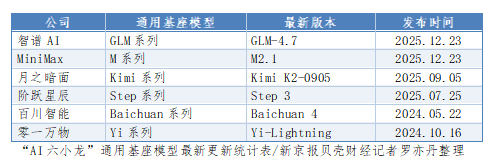
Core Narrative - 2025 is a pivotal year for the global economy and China's industries, marked by deep differentiation and value reconstruction after years of technological accumulation and market turbulence [2][3] - The focus has shifted from chasing trends to a more rational examination of changes occurring beneath the surface, with significant developments in sectors like storage chips, new energy vehicles, gold prices, AI models, and content consumption [2] AI Industry Dynamics - The narrative of 2025 has been characterized by differentiation and sedimentation, with true opportunities belonging to those who build intrinsic strength amidst cyclical noise [3] - The "AI Six Dragons" (智谱, MiniMax, 月之暗面, 阶跃星辰, 百川智能, 零一万物) have seen their prominence diminish as they witness the rise of DeepSeek, which has captured public attention and industry expectations [6][9] - The emergence of DeepSeek has led to a shift in focus from foundational models to application-oriented companies, as the market recognizes that foundational models are primarily the domain of tech giants [9][10] Market Trends and Strategic Shifts - The AI industry is experiencing a significant shift, with many companies moving away from the foundational model approach to focus on application and vertical integration [19][20] - Companies like 智谱 and MiniMax are expected to go public soon, with their valuations reflecting steady revenue growth despite increasing losses [21][22] - The competitive landscape is intensifying, with the need for models to solve real business problems becoming paramount, leading to a natural consolidation in the industry [19][29] Competitive Landscape - The "AI Six Dragons" are now referred to as the "AI Four Strong," indicating a shift in market perception and focus towards those who remain committed to foundational model development [22][23] - The competition is increasingly dominated by major players like ByteDance, Alibaba, and Tencent, making it challenging for smaller companies to find effective entry points in this resource-intensive race [28][29] - The rise of DeepSeek has prompted a reevaluation of strategies among the "AI Six Dragons," with many companies now prioritizing core technological innovation over rapid product releases [18][19] User Engagement and Market Position - In November, the monthly active user (MAU) data showed that ByteDance's AI applications significantly outperformed others, with its app reaching 309 million users, while 月之暗面 lagged behind with 3.06 million [24][27] - The competitive pressure from major players has led to a strategic pivot among smaller companies, focusing on enhancing model capabilities and application value [19][21]

月之暗面完成 5 亿美元新融资,杨植麟表态“不急于IPO”
Xin Lang Cai Jing· 2025-12-31 08:41
Group 1 - The company, Moonlight Dark Side, has recently completed a $500 million Series C financing round and currently holds over 10 billion RMB in cash reserves, indicating no urgency for an IPO [1][2] - In 2025, the company plans to implement various incentive measures based on SOTA results, including salary adjustments, stock options, and cash rewards, affecting a total of 324 individuals [2] - The average incentive for 2026 is expected to be 200% of that in 2025, along with a significant increase in the stock option repurchase quota [2] - The primary goal of the company is to surpass leading companies like Anthropic and become the world's leading AGI company [2]
晚点独家丨Kimi 完成 5 亿美元新融资,杨植麟:账上有超百亿元人民币
晚点LatePost· 2025-12-31 08:04
Core Insights - The article discusses the recent $500 million Series C funding round for Kimi, led by IDG with participation from Alibaba, Tencent, and other existing investors, resulting in a post-money valuation of $4.3 billion [2] - The company has over 10 billion RMB in cash reserves, indicating strong financial health and the ability to delay an IPO [2][6] - Kimi's recent product developments, including the Agent feature "OK Computer," have led to significant growth in paid user subscriptions and API revenue [4][9] Funding and Valuation - Kimi completed a $500 million Series C funding round, with IDG leading the investment of $150 million [2] - The post-funding valuation of Kimi reached $4.3 billion, reflecting strong market interest [2] - The company has accumulated a total investment of $70 million from investor Wang Huiwen [2] Product Development and Revenue Growth - Kimi launched the "OK Computer" feature, which allows users to perform various tasks such as website development and data analysis [4] - The company has initiated a membership fee structure with different pricing tiers, expecting to generate $100 million in revenue within a year from these features [4] - Kimi reported a monthly growth rate of 170% in global paid users and a fourfold increase in overseas API revenue since November [4][9] Strategic Focus and Future Plans - Kimi aims to focus on specific areas such as large models, logic layers, and productivity tasks, avoiding competition in entertainment and multimodal generation [5] - The Series C funding will be used to aggressively expand GPU resources and accelerate the training and development of the K3 model [10] - The company plans to enhance its incentive programs significantly for 2026, doubling the average incentives compared to 2025 [10] Competitive Positioning - Kimi's K3 model is expected to reach the forefront of pre-training capabilities, with plans to improve its performance significantly [7][10] - The company is not rushing to go public, as it believes it can raise more funds from the primary market compared to secondary market offerings [9] - Kimi's unique approach and innovations are positioned to contribute significantly to advancements in artificial general intelligence (AGI) [11]