稳定币

Search documents
瑞典Klarna:推出美元稳定币KlarnaUSD降成本
Sou Hu Cai Jing· 2025-11-25 14:12
Core Viewpoint - Klarna, a Swedish fintech company, is set to launch a USD stablecoin named KlarnaUSD, aiming to reshape global payments through this new financial product [1] Group 1: Company Overview - Klarna is known for its "buy now, pay later" services and is expanding its offerings by introducing a stablecoin [1] - The stablecoin will be deployed on Stripe's proprietary blockchain, indicating a partnership or technological collaboration [1] Group 2: Industry Impact - The introduction of KlarnaUSD is part of a broader trend where companies are betting on stablecoins to significantly reduce payment costs for consumers and merchants [1] - This move highlights the growing interest in stablecoins within the fintech industry as a means to enhance payment efficiency [1]

X @子布
子布· 2025-11-25 09:51
Fee Structure Update - Binance wallet fees are returning to 05% [1] - Users can save up to 30% on trading fees by using the provided invitation code, reducing fees to as low as 035% [1] - Binance App transaction fees will be determined by the token category involved in each transaction, starting November 26, 2025, at 16:00 (UTC+8) [1] - Zero fees are maintained on the App for designated stablecoins, native tokens of major blockchains, and Alpha token trading pairs [1] Invitation Program - Invitation code R73PIR88 can be used [1] - Invitation link: https://tco/ZNrf1zHYbl [1]
香港证监会梁凤仪:香港正就对数码资产交易及托管服务的监管制度敲定方案
智通财经网· 2025-11-25 07:56
Group 1: Digital Asset Regulation in Hong Kong - Hong Kong is working to establish a safe and reliable digital asset platform, with final regulatory frameworks for digital asset trading and custody services being developed [1] - The market size for tokenized financial products in Hong Kong is approximately $3 billion, with increasing adoption of products like green bonds and retail gold products [1] - Many tokenized pilot projects are still in early stages, with room for improvement in efficiency and cost reduction, although many products still rely on fiat currency for cash settlement [1] Group 2: Private Credit Market Insights - The financial landscape has significantly changed since the 2008 financial crisis, with the implementation of Basel III increasing capital and liquidity requirements for banks, leading to the rise of private credit [2] - Global private equity assets under management have grown several times to $14 trillion over the past decade, with leverage shifting from banks to non-bank institutions [2] - The increase in retail investor participation in private credit necessitates regulatory scrutiny of the private credit ecosystem and its connection to the financial system [2]
百亿私募大佬梁宏罕见致歉:深层次原因还是贪婪!20%回撤背后:三笔重仓“踩雷”真相曝光
Sou Hu Cai Jing· 2025-11-25 03:58
2025年以来,A股走出震荡慢牛格局,私募基金整体业绩亮眼。其中,股票策略以29.52%的平均收益率 领跑五大策略,92.73%的相关产品盈利。而市场近期的回调却让部分私募产品净值出现大幅回撤。百 亿私募希瓦投资董事长梁宏就因旗下基金大幅回撤而受到市场关注。 希瓦旗下最新周报显示,部分基金预估净值单波下跌约7%,从最高点累计回撤幅度达到20%。梁宏在 周报中向投资者郑重致歉,并深度剖析了回撤背后的三重失误。 梁宏,视频截图 20%回撤全景图:多只产品连续承压,10月以来跌势未止 "在牛市行情下,因业绩承压致歉并不常见。"梁宏坦言,此次回撤大幅跑输主要指数,核心问题出在个 股选择与仓位管理上,具体可归结为三笔关键投资的失误。 第一波回撤始于9月26日当周,因重仓的创新药板块个股下跌,直接导致基金净值回撤超4%。"高位没 有根据价值兑现大部分仓位,卖出决策不够果断。"梁宏将此次失误归结为对止盈信号的迟钝。 第二重打击来自硬件龙头股的持续大跌。梁宏自30元附近建仓该股,40元左右摊薄成本,因看好"人工 智能时代硬件入口"的逻辑,将仓位提升至30%的超重水平,目标价预估至60元。但事与愿违,该公司 负面因素缠身,股价 ...


【11月25日 财经信息差 】行业机会与风险预警全解析
Sou Hu Cai Jing· 2025-11-25 02:19
Group 1 - The Ministry of Industry and Information Technology of China has initiated the creation of national emerging industry development demonstration bases, covering nine major fields including new generation information technology and new energy, with a target of establishing 100 park-type and 1,000 enterprise-type bases by 2035, which will receive policy and resource support [2] - The Federal Reserve officials have signaled a potential interest rate cut in December, with an 82.9% probability of a 25 basis point cut according to CME FedWatch, leading to a 2.69% increase in the Nasdaq and a broad rise in technology stocks [2] - Former President Trump signed an executive order for the AI "Genesis Plan," opening federal scientific data sets, while Amazon plans to invest $50 billion to expand AI and supercomputing infrastructure for the U.S. government, benefiting AI-related companies [2] Group 2 - The European Union has approved a budget of €192.8 billion for 2026, focusing on defense and high-end manufacturing, with €716 million reserved for emergency funds, which will create procurement opportunities for related industries [3] - The Bank of Israel has lowered the benchmark interest rate from 4.5% to 4.25%, allowing businesses in the Middle East to optimize their capital allocation [3] Group 3 - The Nasdaq Golden Dragon China Index rose by 2.82%, with Hesai Technology increasing by over 12%, indicating strong capital interest in Chinese tech companies like Baidu and Alibaba, which will benefit their supply chain partners [4] - Spot gold has surpassed $4,140 per ounce, and WTI crude oil has risen above $59 per barrel, providing profit opportunities for energy and precious metals companies [4] Group 4 - The European Central Bank has warned about the risks of stablecoins diverting retail deposits in the Eurozone, urging companies involved in crypto assets to manage compliance costs [5] - The U.S. pressured the EU to amend digital regulations in exchange for lowering steel and aluminum tariffs, which was rejected, creating tariff volatility risks for related import-export businesses [6] - Bitcoin has surpassed $89,000, and Thailand's Bitkub plans to raise $200 million through a Hong Kong IPO in 2026, highlighting opportunities in the Hong Kong digital asset hub [6]

权益商品反弹在即 :申万期货早间评论-20251125
申银万国期货研究· 2025-11-25 00:55
Group 1 - The core viewpoint of the article emphasizes the importance of maintaining stable and positive Sino-U.S. relations, highlighting mutual benefits and cooperation as essential for both nations' prosperity [1][7] - The article discusses the recent phone call between Chinese President Xi Jinping and U.S. President Trump, where they acknowledged the positive trajectory of bilateral relations since the Busan meeting [1][7] - Xi reiterated China's stance on Taiwan, asserting that its return is a crucial part of the post-war international order, and called for joint efforts to uphold the achievements of World War II [1][7] Group 2 - In the financial market, U.S. stock indices showed a significant rebound, with small-cap stocks recovering after a period of adjustment, while sectors like defense and media led the gains [2][10] - The article notes a decrease in financing balance by 29.2 billion yuan to 2.445 trillion yuan, indicating cautious market sentiment as the year-end approaches [2][10] - The article suggests that the technology sector remains a long-term focus, with expectations for a more balanced market style if overseas tech performance stabilizes [2][10] Group 3 - The article reports on the weak performance of coking coal and coke futures, with total positions remaining stable, and highlights a recovery in supply as coal imports from Mongolia increase [3][20] - It mentions that the demand side shows improvement, particularly in construction materials, with significant inventory reductions observed [3][20] - The article discusses the impact of U.S. sanctions on Russian oil companies, which could affect global oil supply dynamics, and notes ongoing diplomatic efforts regarding the Ukraine conflict [12][13] Group 4 - The People's Bank of China is set to conduct a 1 trillion yuan MLF operation, marking a net injection of 100 billion yuan for the month, continuing a trend of increased liquidity support [8] - The article highlights the ongoing cautious approach in the market, with expectations for supportive monetary policies amid economic pressures [11]

国际金融市场早知道:11月25日
Xin Hua Cai Jing· 2025-11-24 23:59
Group 1 - The U.S. government shutdown has led to the cancellation of the scheduled release of the Q3 GDP estimate by the Bureau of Economic Analysis, which was set for October 30 [1] - President Trump signed an executive order to accelerate the development of artificial intelligence, mandating the creation of a national AI platform to integrate and open federal scientific data [1] - The European Council approved a budget for 2026 totaling €192.8 billion, focusing on defense, immigration control, and economic competitiveness, with €716 million reserved for emergency funds [2] Group 2 - The European Central Bank warned that stablecoins are diverting retail deposits in the Eurozone, which could pose a risk to global financial stability if a "run" occurs [2] - The Dallas Fed's business activity index for November recorded -10.4, significantly below the expected -2 and previous value of -5, indicating increased economic contraction pressure in the region [2] Group 3 - The Dow Jones Industrial Average rose by 0.44% to 46,448.27 points, the S&P 500 increased by 1.55% to 6,705.12 points, and the Nasdaq Composite climbed by 2.69% to 22,872.01 points [3] - COMEX gold futures increased by 1.33% to $4,133.8 per ounce, while COMEX silver futures rose by 2.49% to $51.155 per ounce [4] Group 4 - U.S. crude oil futures rose by 1.43% to $58.89 per barrel, and Brent crude oil futures increased by 1.28% to $62.73 per barrel [5] - The 2-year U.S. Treasury yield fell by 1.06 basis points to 3.495%, while the 10-year yield decreased by 3.66 basis points to 4.027% [5]
黄金格局生变?俄央行首次出售实物黄金“弥补预算”
Hua Er Jie Jian Wen· 2025-11-21 23:19
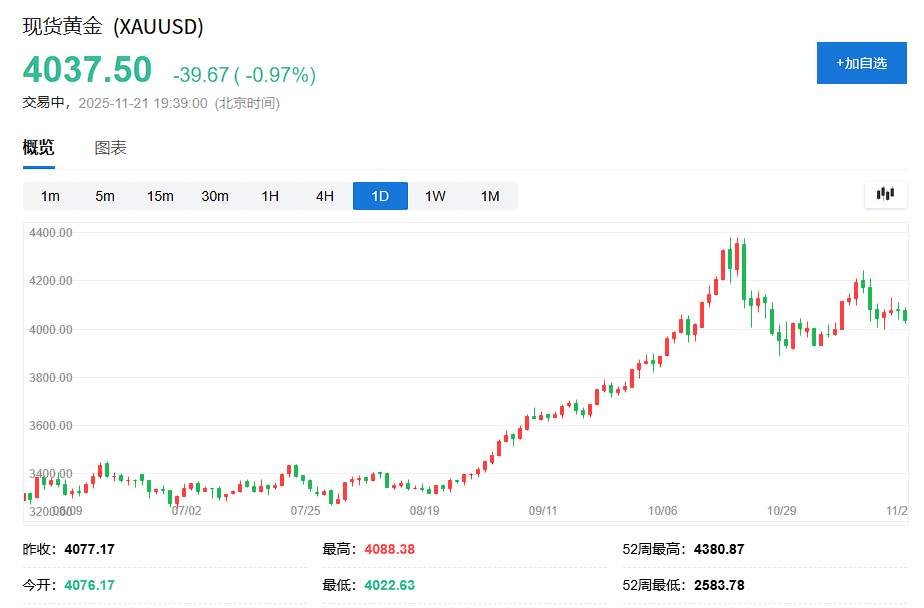
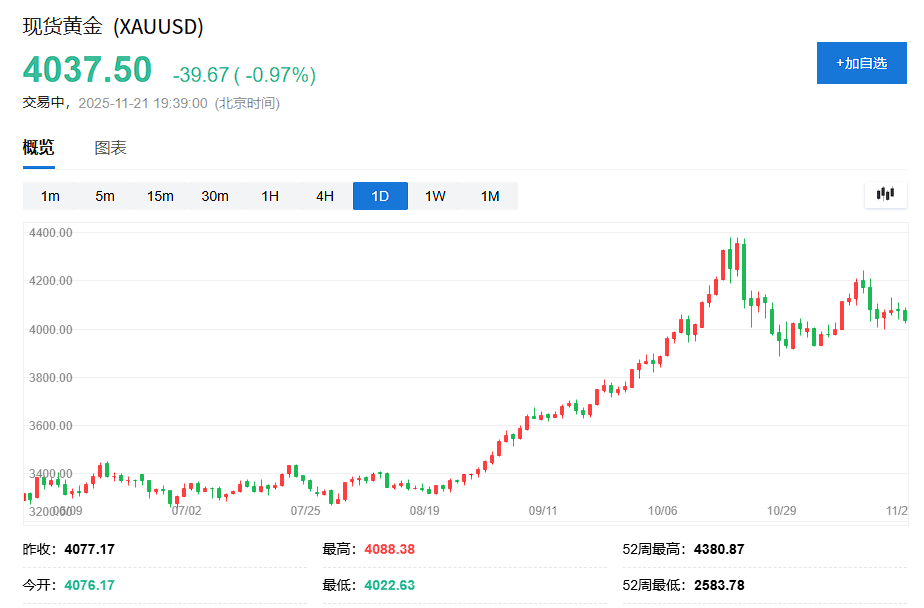
Core Insights - The global gold market is undergoing a historic restructuring, with Russia's central bank confirming the sale of physical gold reserves to address budget needs, marking a significant shift in its strategy [1][4] - Tether, the largest stablecoin issuer, has emerged as a major player in the gold market, accumulating gold reserves comparable to those of small central banks, which has contributed to rising gold prices [1][5][6] Group 1: Russia's Gold Sales - Russia's central bank has begun selling physical gold reserves for the first time, with over 2300 tons in reserves, to compensate for budgetary shortfalls due to Western sanctions [1][4] - Since the escalation of the Ukraine crisis in February 2022, Western sanctions have frozen nearly half of Russia's foreign exchange reserves, totaling approximately €300 billion [4] - Domestic demand for gold has surged, with retail purchases expected to reach 62.2 tons this year, reflecting a shift in savings preferences among Russian consumers [4] Group 2: Tether's Gold Accumulation - Tether has rapidly increased its gold holdings, with at least 116 tons by the end of Q3, including 12 tons backing its XAUt token and approximately 104 tons supporting USDT [5][6] - The company has been identified as a significant new buyer in the gold market, with a 26-ton increase in Q3 alone, representing about 2% of global demand [1][6] - Tether's CEO has indicated plans to continue increasing gold reserves, with projections suggesting potential annual increases of nearly 60 tons based on future profits [7][8] Group 3: Market Dynamics and Future Outlook - The rising gold prices, which have increased over 50% this year, are influenced by Tether's accumulation strategy and the ongoing sales from Russia [1][5] - Tether's broader investment strategy includes over $300 million in royalties and streaming companies, indicating a comprehensive approach to its gold market involvement [8] - The introduction of a new stablecoin, USAT, which does not require gold reserves, introduces uncertainty regarding the long-term demand for USDT and gold [8]
陆家嘴财经早餐2025年11月22日星期六
Wind万得· 2025-11-21 22:41
Group 1 - Japanese Prime Minister Kishi Nobuo expressed the desire to build constructive and stable Sino-Japanese relations, reiterating Japan's unchanged stance on the Taiwan issue [2] - Chinese Vice Premier He Lifeng met with former U.S. National Security Advisor Hadley, emphasizing the broad cooperation space and common interests between China and the U.S., with trade being a stabilizing factor in bilateral relations [3] - The China-Cambodia Free Trade Agreement Joint Committee held its second meeting, with China urging Cambodia to consider its long-term interests in trade agreements with other countries [3] Group 2 - The Ministry of Commerce reported that from January to October, actual foreign investment in China amounted to 621.93 billion yuan, a year-on-year decrease of 10.3%, while sectors like e-commerce services and medical equipment manufacturing saw significant growth [3] - The Ministry of Housing and Urban-Rural Development emphasized urban renewal as a comprehensive strategy for high-quality urban development, focusing on planning, funding, operations, and governance [3] Group 3 - The State-owned Assets Supervision and Administration Commission held a meeting on the professional integration of central enterprises, with 17 entities signing contracts for projects in new materials, AI, and logistics [4] - The People's Bank of China and the Central Bank of the UAE launched a payment cooperation project, marking the start of a digital currency bridge project [4] Group 4 - The A-share market saw a significant decline, with the Shanghai Composite Index dropping 2.45% and the Shenzhen Component Index falling 3.41%, amid a sell-off in lithium mining and semiconductor stocks [5] - The Hong Kong Hang Seng Index closed down 2.38%, with technology and semiconductor sectors experiencing deep corrections [5] - The Hang Seng Index Company announced its quarterly review results, adding new stocks to various indices [5] Group 5 - The Ministry of Finance and the China Securities Regulatory Commission announced the addition of two accounting firms to the H-share enterprise audit business list, aiming to enhance regulatory cooperation [6] - CK Hutchison is preparing for a dual listing of its Watsons Group in Hong Kong and the UK, with a fundraising target of up to $2 billion [7] Group 6 - The National Energy Administration reported that in October, total electricity consumption reached 857.2 billion kWh, a year-on-year increase of 10.4%, with significant growth in residential electricity consumption [9] - The Ministry of Agriculture and Rural Affairs approved a plan to strengthen the comprehensive regulation of pig production capacity, aiming to stabilize the livestock industry [10] Group 7 - The Hong Kong Monetary Authority received 37 applications for licenses since the implementation of the Stablecoin Regulation, but no licenses have been issued yet [11] - The Hong Kong Financial Services and the Treasury Bureau is working on the applicability of existing laws to tokenized bonds to promote the bond market [11] Group 8 - Huawei launched and open-sourced its AI container technology, Flex:ai, aimed at improving the utilization of AI computing resources [12] - OpenAI announced a partnership with Foxconn to advance AI infrastructure hardware design and manufacturing in the U.S. [12] Group 9 - The U.S. stock market saw all three major indices rise, with the Dow Jones up 1.08% and the S&P 500 up 0.98%, driven by expectations of potential interest rate cuts [16] - The Federal Reserve officials indicated a possibility of further interest rate cuts, with market expectations for a December rate cut exceeding 50% [16] Group 10 - The onshore RMB closed at 7.1103 against the USD, appreciating by 64 basis points, while the offshore RMB also saw gains [21] - The U.S. dollar index fell slightly, with most non-USD currencies appreciating against the dollar [21]

黄金格局生变?俄央行首次出售实物黄金“弥补预算”,“稳定币老大”囤金规模逼近小央行
Hua Er Jie Jian Wen· 2025-11-21 12:24
Core Insights - The global gold market is undergoing a historic restructuring, with Russia's central bank confirming the sale of physical gold reserves to address budget needs, marking the first such action from a country holding over 2300 tons of gold [1][4] - Tether, the largest stablecoin issuer, has emerged as a significant non-sovereign gold holder, accumulating at least 116 tons of gold by the end of Q3, which is comparable to the holdings of small central banks [1][5][6] Group 1: Russia's Gold Sales - The decision by the Russian central bank to sell gold reserves highlights the ongoing financial pressure from Western sanctions, which have frozen nearly half of Russia's foreign exchange reserves, totaling around €300 billion [4] - Since the escalation of the Ukraine crisis in February 2022, Russian gold bars have been banned from entering Western markets, prompting the country to stimulate domestic demand by removing VAT on retail gold purchases [4] - Russian consumers are expected to purchase approximately 62.2 tons of retail gold this year, reflecting a shift in savings preferences due to reduced convenience of Western currencies [4] Group 2: Tether's Gold Accumulation - Tether has rapidly become a key player in the gold market, with Jefferies reporting that the stablecoin issuer has significantly increased its gold holdings, contributing to rising gold prices [5][6] - Tether's CEO has indicated plans to purchase around 100 tons of gold this year, with the company holding gold worth approximately $8 billion in a dedicated vault in Switzerland [6] - The speed of Tether's gold accumulation is notable, with an increase of about 26 tons in Q3 alone, representing around 2% of global demand [7] Group 3: Future Projections and Strategies - Jefferies analysts predict that Tether will continue to increase its gold holdings, estimating that if half of its projected $15 billion profit in 2025 is invested in gold, it could add nearly 60 tons annually [7] - Tether's investments in the broader gold ecosystem, including over $300 million in royalty and streaming companies, indicate a strategic expansion in the gold sector [7] - The planned launch of a new stablecoin, USAT, which does not require gold reserves, introduces uncertainty regarding the long-term demand for USDT and gold [7]