通用人工智能(AGI)

Search documents
火线解析MiniMax招股书!全球领先大模型成本只有OpenAI 1%,果然拳怕少壮
量子位· 2025-12-21 15:10
Core Viewpoint - MiniMax, a leading AI model unicorn, has successfully passed the Hong Kong Stock Exchange hearing, signaling its IPO ambitions amidst discussions about the bubble in large AI models like OpenAI [1][3]. Group 1: Company Overview - MiniMax has raised over $1.5 billion in funding within four years, attracting investments from notable firms such as MiHoYo, Alibaba, Tencent, and others [3][62]. - The company has a global presence, serving over 200 countries, with 70% of its revenue coming from international markets [6][42]. - MiniMax aims to achieve Artificial General Intelligence (AGI) and views scalability as a core driver towards this goal [8][7]. Group 2: Technological Advancements - MiniMax is one of the few companies that invested in multimodal model development from its inception [10]. - The company has released several models, including the M1 and M2 text models, with M2 achieving top rankings in performance and cost efficiency [16][17]. - MiniMax has also developed leading models in voice, music, and video, with its video model Hailuo ranking in the top tier of international tests [20][25][26]. Group 3: Financial Performance - MiniMax's revenue surged from $346,000 in 2023 to $30.52 million in 2024, marking a 782.2% increase [39]. - By the first nine months of 2025, revenue reached $53.44 million, significantly surpassing the previous year's total [40]. - The company has achieved a gross margin improvement from -24.7% in 2023 to 23.3% in the first nine months of 2025 [45][46]. Group 4: Operational Efficiency - MiniMax's R&D expenses have increased significantly, but the efficiency of these investments has improved, with training-related cloud computing costs as a percentage of revenue decreasing from over 1365% in 2023 to 266.5% in 2025 [52][54]. - The company has a cash reserve of $1.102 billion, sufficient to sustain operations for over 53 months without additional fundraising [58][59]. - MiniMax's team is young, with an average age of 29, and a high proportion of R&D personnel, which contributes to its innovative and efficient operational model [70][71].


MiniMax 四年冲刺 IPO:烧钱仅 OpenAI 1%,营收增速 782.2%
Xin Lang Cai Jing· 2025-12-21 14:49
Core Insights - MiniMax, a leading AI technology company, is set to list on the Hong Kong Stock Exchange in January 2026, potentially marking the fastest IPO for an AI company globally since its establishment [4] - The company has demonstrated remarkable growth with a revenue increase of 782.2% and 70% of its income coming from overseas markets, challenging the notion that AI development requires massive capital infusion [6][12] - MiniMax's business model emphasizes a complete cycle of technology self-research, global deployment, and commercial monetization, showcasing its capability to redefine industry standards [6][21] Financial Performance - MiniMax's revenue surged from $3.5 million in 2022 to $30.5 million in 2024, reflecting a growth rate of 782.2% [7] - The company achieved a gross profit margin improvement from -24.7% in 2023 to 23.3% in the first nine months of 2025 [7] - As of September 30, 2025, MiniMax had over $1.1 billion in cash reserves, sufficient to sustain operations for over 53 months without additional fundraising [10] Revenue Structure - MiniMax has diversified its revenue streams through subscription services, in-app purchases, and enterprise APIs, with a significant portion of its income derived from consumer-facing products [9] - The company has seen a 181% year-on-year increase in consumer revenue, with over 71% of its income coming from the consumer segment [9] - MiniMax serves over 2.12 billion individual users and more than 100,000 enterprise clients globally, indicating strong international market penetration [9][12] Technological Advancements - MiniMax has positioned itself as one of the few companies in the top tier of multimodal AI, achieving significant breakthroughs in voice, video, and text models with minimal investment [14][19] - The company has developed advanced models such as Speech 2.6 and Hailuo 2.3, which have received recognition for their performance in global evaluations [16][17] - MiniMax's innovative approach to technology development, characterized by a lean organizational structure and a youthful workforce, has contributed to its rapid advancements and cost efficiency [19] Market Impact - MiniMax's upcoming IPO is expected to shift the focus of the AI industry from speculative investments to value creation and efficiency [21] - The company's success provides a replicable model for other Chinese AI firms, potentially leading to a maturation of the entire AI industry chain [21] - MiniMax's achievements highlight China's growing competitiveness in the global AI landscape, suggesting a significant shift in industry dynamics [20]
最快上市AI公司诞生?MiniMax通过港交所聆讯,成立不足四年
财联社· 2025-12-21 14:38
Core Viewpoint - MiniMax, a global AGI company, is set to become the fastest AI company from establishment to IPO, marking a significant step for Chinese enterprises in the international capital market [1] Group 1: Company Overview - MiniMax was founded in early 2022 and focuses on developing globally competitive general models [1] - The company has created a product matrix covering both C-end and B-end AI native products, including Hailuo AI, Talkie, and Xingye [1] - As of September 30, 2025, MiniMax has over 212 million individual users across more than 200 countries and regions, and 130,000 enterprise clients from over 100 countries [1] Group 2: Financial Performance - MiniMax's revenue grew by over 170% year-on-year in the first nine months of 2025, with over 70% of revenue coming from international markets [1] - The adjusted net loss remained nearly flat compared to the previous year, indicating effective loss reduction amid rapid growth [3] - The company spent approximately $500 million (around 3.5 billion RMB) since its inception, significantly less than OpenAI's cumulative expenditure of $40 billion to $55 billion [3] Group 3: Technological Advancements - In 2023, MiniMax launched the first domestic speech large model based on the Transformer architecture, Speech 01, and improved it to the top global performance with Speech 02 in 2024 [2] - The company released the Video-01 model in August 2024, achieving industry-leading standards, and the upgraded Hailuo-02 in June 2025 ranked second globally in video evaluation [2] - The new generation text model, MiniMax M2, was released in October 2025, ranking among the top five globally and first in open-source models [2] Group 4: Organizational Efficiency - As of September 30, 2025, MiniMax employed 385 people, with an average age of 29 and nearly 74% being R&D personnel [4] - The company operates with a flat management structure, achieving leading positions in text, video, and speech models within four years [4] - MiniMax has received investments from top institutions such as MiHoYo, Alibaba, Tencent, and Sequoia, positioning it as one of the fastest-growing and highest-valued AI tech companies [4]

MiniMax通过港交所聆讯:员工平均年龄29岁,2025年前九个月付费用户数超177万名
Mei Ri Jing Ji Xin Wen· 2025-12-21 12:41
每经上海12月21日电(记者 陈婷)12月21日,通用人工智能(AGI)公司MiniMax(稀宇科技)首次刊 发其聆讯后资料集(PHIP)版本的招股书。招股书显示,截至2025年9月30日止的九个月,MiniMax收 入为5343.7万美元。 截至2025年9月底,MiniMax员工385人,平均年龄29岁,研发人员占比近74%,董事会平均年龄32岁。 招股书提及,随着扩大运营规模,MiniMax的毛利率由2023年的-24.7%升至2024年的12.2%,并进一步 升至截至2025年9月30日止九个月的23.3%。此外,其AI(人工智能)原生产品的付费用户数从2023年 的约11.97万名增至2024年的约65.03万名,并于截至2025年9月30日止九个月进一步增至约177.16万名。 截至2025年9月30日,其AI原生产品累计为来自超过200个国家及地区的逾2亿名个人用户,以及来自超 过100个国家及地区的10万余名企业和开发者提供服务。 ...
智谱赴港冲刺“全球大模型第一股” 亏损额扩大速度快于收入增速
Mei Ri Jing Ji Xin Wen· 2025-12-21 12:17
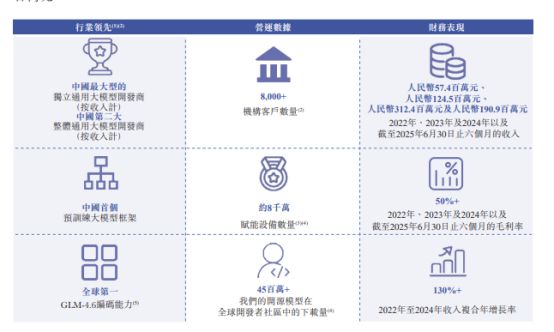
在AGI(通用人工智能)全球竞赛中,中国大模型"独角兽"企业的资本化进程终于迈出实质性一步。 12月19日晚间,北京智谱华章科技股份有限公司(以下简称智谱)披露招股书(申请版本,下同),宣布赴 港冲刺"全球大模型第一股"。 《每日经济新闻》记者注意到,成立于2019年的智谱,由清华大学技术成果转化而来。招股书显示,智 谱过去3年营收实现年均复合增长率超过130%。不过,在营收高歌猛进的同时,作为一家典型技术驱动 型企业,智谱也面临巨额研发投入带来的亏损挑战。 大模型热潮翻涌3年,这份招股书不仅是智谱自身的"体检表",更是观察大模型在"百模大战"后进入商 业化落地深水区的一个重要样本。 从行业地位看,招股书援引咨询公司弗若斯特沙利文的数据称,按2024年收入计,智谱在中国独立通用 大模型厂商中排名第一,但市场份额仅为6.6%。这意味着,即便其处于相对靠前的位置,行业整体的 市场份额分布仍高度分散。 与收入快速放大形成对照的是公司尚未明确看到规模化盈利拐点。2022~2024年各年度,智谱分别录得 净亏损1.44亿元、7.88亿元和29.58亿元,2025年上半年净亏损为23.58亿元,亏损额同比扩大91%。从亏 ...
MiniMax通过港交所聆讯,成立不足四年用户超2.12亿
Xin Lang Ke Ji· 2025-12-21 11:55
Group 1 - MiniMax, an AGI company, published its post-hearing prospectus, reporting over 212 million individual users and 130,000 enterprise clients across more than 200 countries and regions by September 30, 2025 [1] - The company achieved a revenue growth of over 170% year-on-year for the first nine months of 2025, with over 70% of its revenue coming from international markets, indicating strong global market expansion and diverse revenue structure [1] - MiniMax was established in early 2022 and has developed a range of AI-native products for both consumer and business sectors, including Hai Luo AI, Talkie, and Xing Ye, while also providing an open platform for enterprise users and developers [1] Group 2 - The adjusted net loss for MiniMax is nearly flat compared to the same period last year, reflecting effective loss reduction amid rapid growth, supported by a diversified revenue model and efficient cost management [1] - For the first nine months of 2025, while revenue increased by over 170%, R&D expenses grew by 30%, and sales and marketing expenses decreased by 26% [1] - Since its inception until September 2025, MiniMax has spent $500 million (approximately 3.5 billion RMB), in contrast to OpenAI's cumulative expenditure of $40 billion to $55 billion [2]
疯狂的筹码:OpenAI 1000亿美元融资背后的AI生死局
Xin Lang Cai Jing· 2025-12-21 06:21
Group 1 - OpenAI is seeking a $100 billion funding plan with a post-money valuation expectation of $830 billion, positioning itself close to the trillion-dollar club despite not being profitable yet [1][2] - The AI industry is undergoing a significant transformation from a "light asset software industry" to a "heavy asset heavy industry," necessitating massive computational resources for advanced models like GPT-5 and the Stargate project [2][3] - OpenAI's cash burn could exceed $200 billion by 2030, making the $100 billion funding critical to secure future computational supply against competition from Google, Meta, and Anthropic [3] Group 2 - Oracle's $300 billion cloud service agreement over five years is crucial for its financial stability, as it heavily invests in data centers, raising concerns about debt risk [4][5] - The funding from OpenAI would not only guarantee Oracle's revenue but also help stabilize its balance sheet by allowing OpenAI to sign more prepayment contracts [5] - CoreWeave, a new player in the computational power market, relies on high leverage to acquire GPUs, and OpenAI's funding would provide a credit backing for its contracts valued at $22.4 billion [5][6] Group 3 - The discussion around an "AI bubble" has resurfaced, with critics pointing out OpenAI's high price-to-sales ratio of over 40 despite annual revenues nearing $20 billion [6][7] - Historical parallels are drawn to the 1850s railroad boom, suggesting that current investments in AI infrastructure may lead to significant future advancements despite skepticism [7][8] - The funding represents a substantial investment in a potential productivity revolution, with implications for advancements in energy, chip, and cooling technologies [8] Group 4 - The funding sources for OpenAI include significant commitments from SoftBank and Amazon, while medium-sized venture capital firms have exited the game [9][10] - The involvement of sovereign wealth funds and major corporations indicates a shift in AI competition from a developer-centric model to a strategic confrontation at the national level [10][11] - This centralization of capital is reshaping global power structures, with economies possessing cheap energy, substantial funds, and top talent gaining dominance in the digital age [11]
遥遥无期的AGI是画大饼吗?两位教授「吵起来了」
机器之心· 2025-12-21 04:21
Core Viewpoint - The article discusses the limitations of achieving Artificial General Intelligence (AGI) due to physical and resource constraints, emphasizing that scaling alone is not sufficient for significant advancements in AI [3][20][32]. Group 1: Limitations of AGI - Tim Dettmers argues that AGI will not happen because computation is fundamentally physical, and there are inherent limitations in hardware improvements and scaling laws [8][10][12]. - The article highlights that as transistor sizes shrink, while computation becomes cheaper, memory access becomes increasingly expensive, leading to inefficiencies in processing power [11][17]. - The concept of "superintelligence" is critiqued as a flawed notion, suggesting that improvements in intelligence require substantial resources, and thus, any advancements will be gradual rather than explosive [28][29][30]. Group 2: Hardware and Scaling Challenges - The article points out that GPU advancements have plateaued, with significant improvements in performance per cost ceasing around 2018, leading to diminishing returns on hardware investments [16][17]. - Scaling AI models has become increasingly costly, with the need for linear improvements requiring exponential resource investments, indicating a nearing physical limit to scaling benefits [20][22]. - The efficiency of current AI infrastructure is heavily reliant on large user bases to justify the costs of deployment, which poses risks for smaller players in the market [21][22]. Group 3: Divergent Approaches in AI Development - The article contrasts the U.S. approach of "winner-takes-all" in AI development with China's focus on practical applications and productivity enhancements, suggesting that the latter may be more sustainable in the long run [23][24]. - It emphasizes that the core value of AI lies in its utility and productivity enhancement rather than merely achieving higher model capabilities [24][25]. Group 4: Future Directions and Opportunities - Despite the challenges, the article suggests that there are still significant opportunities for improvement in AI systems through better hardware utilization and innovative model designs [39][45][67]. - It highlights the potential for advancements in training efficiency and inference optimization, indicating that current models are not yet fully optimized for existing hardware capabilities [41][43][46]. - The article concludes that the path to more capable AI systems is not singular, and multiple avenues exist for achieving substantial improvements in performance and utility [66][69].

智谱冲刺“全球大模型第一股” AGI梦想背后 高增长与高投入并行
Mei Ri Jing Ji Xin Wen· 2025-12-20 15:00
在AGI(通用人工智能)的全球竞赛中,中国大模型独角兽企业的资本化进程终于迈出了实质性的一 步。 12月19日晚间,北京智谱华章科技股份有限公司(简称智谱)披露招股书(申请版本,下同),宣布赴 港冲刺"全球大模型第一股"。 这家成立于2019年的公司,由清华大学技术成果转化而来。招股书显示,智谱的营收在过去三年实现年 均复合增长率超过130%。不过,在营收高歌猛进的同时,作为一家典型技术驱动型企业的智谱也面临 着巨额研发投入带来的亏损挑战。 MaaS支撑下收入高速增长,毛利率高达50% 从财务数据看,近几年,智谱的收入增长呈现出明显的加速态势。 2022年至2024年,智谱收入分别为5740万元、1.25亿元和3.12亿元,年均复合增长率超130%。收入增速 在2025年上半年进一步放大,2025年上半年,智谱实现营收1.91亿元,较2024年同期的4490万元同比增 长325.39%。 毛利率层面,2022年至2024年,智谱的毛利率分别是54.6%、64.6%、56.3%,2025年上半年毛利率为 50.0%。 收入的扩张,与其商业模式高度相关。 招股书显示,智谱的商业模式以模型即服务(MaaS)平台为核 ...
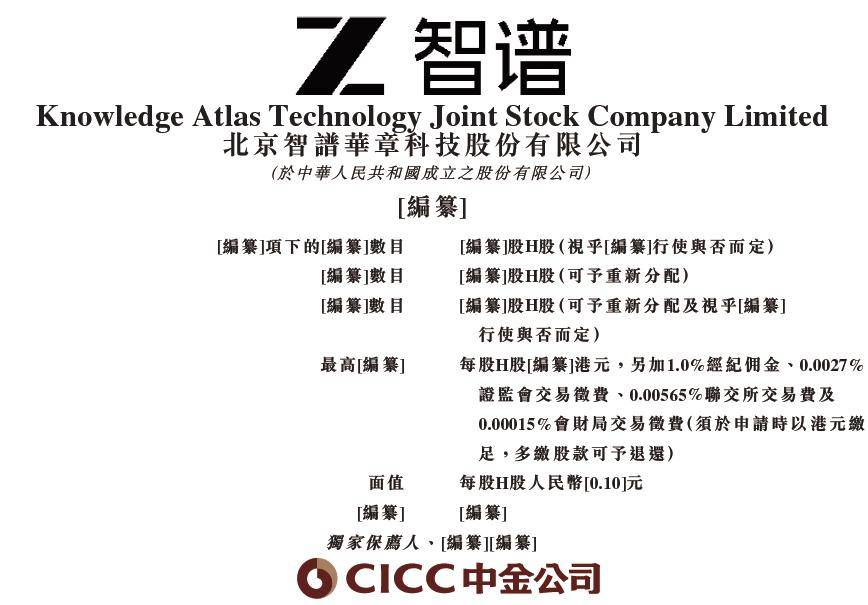
智谱,通过港交所IPO聆讯,或很快香港上市,中金公司独家保荐
Sou Hu Cai Jing· 2025-12-20 12:11
| 纂]項下的圖纂 數目 | [编纂]股H股(視乎[编纂]行使與否而定) | | --- | --- | | [编纂]數目 | [编纂]股H股(可予重新分配) | | [编纂]數目 | [編纂]股H股(可予重新分配及視乎[編纂] | | 行使與否而定) | | | 最高 编纂] | 每股H股[編纂]港元,另加1.0%經紀佣金、0.0027% | | | 證監會交易徵費、0.00565%聯交所交易費及 | | | 0.00015%會財局交易徵費(須於申請時以港元繳 | | 足,多繳股款可予退還) | | | 面值 | 每股H股人民幣[0.10]元 | | [編纂] | [編纂] | | CICC中金公司 | 獨家保薦人、 编纂] 编纂] | 2025年12月19日,来自北京海淀区的北京智谱华章科技股份有限公司Knowledge Atlas Technology Joint Stock Company Limited.(以下简 称"智谱")在港交所披露聆讯后的招股书,或很快在香港主板IPO上市。 智谱华章招股书链接: 主要业务 智谱 ,成立于2019年,作为中国领先的人工智能公司,追求通用人工智能( AGI) 创 ...