太空能源

Search documents
马斯克一句“愚蠢至极”,又得罪了整个硅谷
虎嗅APP· 2025-12-18 13:57
Core Viewpoint - Elon Musk criticized the pursuit of small nuclear fusion reactors on Earth, arguing that the sun serves as a free and efficient nuclear fusion reactor, and called for a halt to investments in such projects unless they are purely for scientific experimentation [5][7]. Group 1: Investment Landscape in Nuclear Fusion - In Silicon Valley, nuclear fusion is viewed as a long-term infrastructure investment rather than a fleeting trend, with nearly $10 billion in private capital expected to flow into the sector by July 2025 [9]. - Major tech figures, including Bill Gates and Jeff Bezos, have made significant investments in nuclear fusion, with Gates' Breakthrough Energy Ventures focusing on long-term clean energy strategies [9][10]. - Commonwealth Fusion Systems (CFS) has raised nearly $3 billion, emerging as a leading contender in the fusion startup space due to its high-temperature superconducting tokamak technology [10][11]. Group 2: The Narrative of Nuclear Fusion - Nuclear fusion is often framed as an "infinite energy" solution, promising abundant fuel sources and minimal carbon emissions, which is particularly appealing in the context of rising energy demands from AI [16]. - The International Energy Agency (IEA) projects that global data center electricity demand will approach 945 terawatt-hours (TWh) by 2030, with AI-specific loads increasing fourfold [16]. - 84% of fusion companies believe they can achieve grid connection by the 2030s, with over half targeting completion by 2035, driven by technological advancements like high-temperature superconductors [16]. Group 3: Challenges and Criticism of Nuclear Fusion - Musk highlighted significant engineering challenges facing terrestrial nuclear fusion, including the need for reactors to produce more energy than they consume, which remains unproven [18][19]. - The cost of building the first commercial fusion reactors is projected to be in the hundreds of billions, with construction timelines exceeding ten years, raising questions about economic viability [19]. - Musk argues that solar energy, which has seen a cost reduction of over 89% in the past decade, is a more practical and cost-effective solution compared to the uncertain future of nuclear fusion [19]. Group 4: Alternative Energy Strategies - Musk advocates for solar energy and storage technologies as the most viable and economically sound energy solutions, proposing that a solar panel area of 100 miles by 100 miles could power the entire United States [20]. - Tesla is actively working on solar products and energy storage systems to address the intermittency issues of traditional solar energy [20][21]. - Musk's vision includes deploying solar energy satellites in space, which would provide continuous power without atmospheric interference, further enhancing energy reliability for AI applications [21][22]. Group 5: Conclusion on Energy Transition - The debate between Musk and other tech leaders reflects differing philosophies on risk and return in energy technology, with fusion representing high-risk, high-reward potential, while solar energy offers more immediate and certain returns [25]. - The future of energy will require balancing the uncertainties of emerging technologies like nuclear fusion with the pressing need for reliable energy sources in the AI era [25].

航天宏图 × 众能光储 核心战略解读
2025-12-12 02:19
Summary of Key Points from the Conference Call Company and Industry Overview - **Company**:航天宏图 (Aerospace Hongtu) - **Industry**: Commercial Aerospace in China Core Insights and Arguments 1. **Rocket Development**: 航天宏图 plans to launch a 6-ton liquid oxygen-methane rocket by the end of 2026, which would be one of the largest liquid rockets among domestic private enterprises, enhancing commercial space launch capabilities [1][2] 2. **Collaboration with 众能光储**: The partnership aims to introduce flexible perovskite solar wing technology, which increases power generation by 50% while weighing only 1/5 of traditional solar wings, significantly extending satellite operational time and lifespan [1][2] 3. **女娲星座**: The company plans to launch the first batch of 6 satellites in 2026, which will feature computing and radar capabilities, utilizing laser communication for rapid data transmission and creating an interconnected data network [1][3] 4. **Perovskite Solar Cells**: These cells have a high conversion efficiency (over 27% in labs) and excellent radiation resistance, with abundant raw material availability, making them a potential replacement for gallium arsenide in space energy applications [1][4] 5. **Market Expansion**: 航天宏图 is actively expanding into international markets, with expectations that overseas business could contribute 20%-40% of revenue within the next 3-5 years [2][12][13] Additional Important Content 1. **Technical Challenges**: To compete globally, the company identifies three key technical challenges: reusable rockets, space energy, and inter-satellite communication [2][3] 2. **Future Plans for Reusable Rockets**: While the company is developing reusable rockets, the timeline remains uncertain due to challenges in engine research [14] 3. **Financial Support from Local Government**: The local government in 鹤壁 is providing significant support, including funding and credit assistance [16] 4. **Long-term Vision**: The company emphasizes the importance of long-term investment in key areas such as industrial technology and artificial intelligence, projecting a sustained focus on space exploration for the next 10-20 years [7][8] 5. **Investment Value**: 航天宏图 is positioned as a unique player in the market, with strong government support and a dual focus on satellite and rocket development, making it attractive for long-term investors [20][21] Conclusion - 航天宏图 is strategically positioned to enhance its capabilities in the commercial aerospace sector through innovative technology, international expansion, and strong government support, while addressing key technical challenges to achieve its long-term goals in space exploration and satellite deployment.

我国启动聚变领域国际科学计划;“国产GPU第一股”摩尔线程今日发行
Guan Cha Zhe Wang· 2025-11-24 02:32
Group 1: Nuclear Fusion Research - China has launched an international scientific program in the field of nuclear fusion, unveiling the BEST research plan aimed at igniting the "artificial sun" [1] - The BEST device, as the next-generation "artificial sun," is set to conduct deuterium-tritium burning plasma experiments by the end of 2027, with a goal of achieving fusion power output between 20 megawatts and 200 megawatts [1] - The research aims to demonstrate energy output exceeding energy consumption, showcasing the potential for fusion energy generation [1] Group 2: Domestic GPU Market - The company Moole Technology, known as the "first domestic GPU stock," has launched its IPO on the Sci-Tech Innovation Board at a price of 114.28 yuan per share, marking the highest IPO price in the A-share market this year [2] - Investors need to pay 57,140 yuan for a single lot of 500 shares, indicating strong market interest [2] Group 3: Autonomous Driving Industry - The autonomous driving company Haomo Technology, backed by Great Wall Motors, Hillhouse Capital, and Qualcomm, has reportedly ceased operations and notified employees not to report to work starting November 24 [3] - Established in November 2019, Haomo was the first in China to achieve mass production of autonomous driving technology, with its HPilot system deployed in over 20 vehicle models [3] - The company had projected to surpass 250 million kilometers of autonomous driving mileage by 2024 and was listed in the Hurun Global Unicorn List [3] Group 4: Social Media and Mental Health - Meta is facing a lawsuit from multiple school districts in the U.S. for allegedly concealing evidence of the negative impact of its social media platforms, Facebook and Instagram, on users' mental health [4] - The lawsuit claims that Meta halted internal research after discovering causal evidence linking its products to adverse mental health effects [4] Group 5: Space Energy Production - Elon Musk has announced plans for the Starship to potentially deliver around 300 gigawatts of solar-powered satellites annually, with a possibility of reaching 500 gigawatts [5] - Musk stated that with lunar manufacturing combined with mass drivers, an energy output exceeding 100 terawatts per year could be achieved [5]

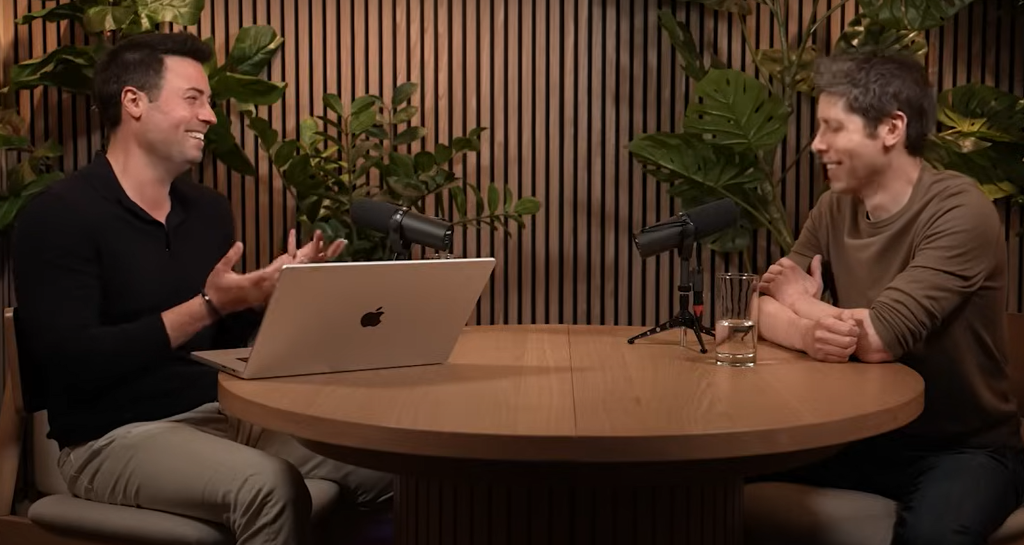
Sam Altman最新访谈:AI将发现新科学,未来AI伴侣无处不在,人形机器人街头漫步
Hua Er Jie Jian Wen· 2025-06-18 04:18
Core Insights - OpenAI CEO Sam Altman predicts that AI will discover new scientific knowledge in the next 5-10 years, which will overshadow other applications [3][6] - Altman expresses concern over the "superintelligence paradox," suggesting that even with advanced AI, societal changes may be minimal [5][6] - The competition in the AI space is intensifying, with Meta viewing OpenAI as a major threat and offering substantial financial incentives to recruit talent [6][27] AI Advancements - Altman states that the O3 model has reached a level comparable to a PhD student in specific fields, indicating significant advancements in AI reasoning capabilities [3][6] - He predicts that astrophysics may be the first field where AI can autonomously make new discoveries due to the abundance of data [3][6] - The development of humanoid robots is anticipated within 5-10 years, marking a significant milestone in AI's physical applications [5][6] OpenAI's Vision - OpenAI aims to create a ubiquitous "AI companion" ecosystem that integrates across various devices and platforms to assist users continuously [6][21] - Altman emphasizes the importance of platform integration for seamless user experience across different environments [6][21] Competitive Landscape - Meta is reportedly offering over $100 million in signing bonuses to attract OpenAI's top talent, highlighting the fierce competition in the AI sector [6][27] - Altman critiques Meta's focus on financial incentives rather than mission-driven work, suggesting it may hinder cultural development [6][28] Energy and Sustainability - Altman asserts that energy consumption will increase with AI advancements, advocating for fusion and advanced nuclear energy as necessary solutions [6][7] - He expresses confidence in the potential for fusion energy and advanced fission technologies to meet future energy demands [7][20] Cultural and Societal Implications - Altman raises concerns that even with the creation of superintelligent AI, societal conditions may not improve significantly, reflecting a disconnect between technological advancement and social change [5][6] - He notes that many jobs will be transformed or eliminated due to AI, but believes that new opportunities will emerge as society adapts [19][20]