开源大模型

Search documents
从开源最强到挑战全球最强:DeepSeek新模型给出了解法
Guan Cha Zhe Wang· 2025-12-02 11:38
Core Insights - DeepSeek has released two official models: DeepSeek-V3.2 and DeepSeek-V3.2-Speciale, with the former focusing on balancing reasoning ability and output length for everyday use, while the latter enhances long-form reasoning and mathematical proof capabilities [1][2][4] - The open-source large model ecosystem has seen significant growth, with DeepSeek's advancements posing a challenge to closed-source models, particularly in light of the recent release of Google Gemini 3.0, which has raised the competitive bar [2][15] - DeepSeek's models are positioned to bridge the gap between open-source and closed-source models through innovative architecture and training strategies, despite limitations in computational resources compared to industry giants [8][15][16] Model Performance - DeepSeek-V3.2 has achieved performance levels comparable to GPT-5 and is slightly below Google’s Gemini 3 Pro, demonstrating its effectiveness in reasoning tasks [6][7] - The Speciale version has outperformed Gemini 3 Pro in several reasoning benchmarks, including the American Mathematics Invitational Exam (AIME) and the Harvard-MIT Mathematics Tournament (HMMT) [7][8] - Speciale's design focuses on rigorous mathematical proof and logical verification, making it a specialized tool for complex reasoning tasks [6][8] Technological Innovations - DeepSeek employs a novel DSA (DeepSeek Sparse Attention) mechanism to optimize computational efficiency, allowing for effective long-context processing without sacrificing performance [8][12] - The concept of "Interleaved Thinking" has been integrated into DeepSeek's models, enhancing the interaction between reasoning and tool usage, which is crucial for AI agents [9][12] - The focus on agent capabilities signifies a strategic shift towards creating actionable AI, moving beyond traditional chat-based interactions to more complex task execution [13][14] Industry Context - The competitive landscape is shifting, with DeepSeek acknowledging the widening gap between open-source and closed-source models, particularly in complex task performance [15][16] - DeepSeek aims to address its limitations by increasing pre-training computational resources and optimizing model efficiency, indicating a clear path for future improvements [16][19] - The release of DeepSeek-V3.2 has been seen as a significant achievement in the open-source community, suggesting that the gap with leading closed-source models is narrowing [16][19]




第三届全国工业和信息化技术技能大赛举办,首设生成式AI应用赛
Xin Jing Bao· 2025-11-28 04:55
Group 1 - The third National Industrial and Information Technology Skills Competition was held in Chongqing from November 26 to 28, featuring 408 teams and 834 participants competing in six advanced categories [1][2] - This year's competition introduced a new category for Generative Artificial Intelligence System Application, focusing on practical problem-solving skills in humanoid robot navigation and precise grasping [1] - The event is co-hosted by multiple government bodies, emphasizing the theme of "integration of industry and talent" and targeting key areas such as new energy vehicles, industrial robots, smart chips, industrial big data, digital transformation of manufacturing, and industrial internet [1][2] Group 2 - The competition expanded the number of categories to six, nearly doubling the previous editions, with new categories like Mixed Integrated Circuit Assembly Worker focusing on RISC-V architecture [2] - The event reflects three key improvements: alignment with technological frontiers, enhanced industry characteristics, and a more robust management system [2] - The competition serves as a platform for talent discovery, practical skills training, and promoting the integration of industry and talent, contributing to the goal of new industrialization [3]
AI产业跟踪:阿里首款AI眼镜塞满硬核技术,我国已经成为全球开源AI大模型的最大提供者
GUOTAI HAITONG SECURITIES· 2025-11-24 08:15
Investment Rating - The report does not explicitly state an investment rating for the AI industry Core Insights - The AI industry is witnessing significant advancements, with China emerging as the largest provider of open-source AI models globally, as highlighted by a statement from an academic expert [16] - Major companies like Alibaba and BMW are making strides in AI technology, with Alibaba launching the Qwen App and BMW introducing its self-developed AI platform "GAIA" in China [7][15] - The AI sector is experiencing a surge in applications, including AI-powered educational tools and digital assistants, indicating a trend towards commercialization of AI technologies [10][14] Summary by Sections AI Industry Dynamics - Zhejiang Commercial Bank has formed a strategic partnership with Alibaba to enhance financial services through AI and cloud technology [6] - BMW has launched its self-developed AI platform "GAIA" in China, aiming to democratize AI capabilities across its organization [7] - The Kimi K2 Thinking model has been integrated into the Perplexity AI search application, marking a significant achievement for domestic AI models [8] - The "2025 AI+" conference was held in Beijing, leading to the establishment of the Beijing AI Association to foster collaboration and innovation in the AI sector [9] AI Application Insights - Shanghai Steel Union has developed the "Xiao Gang" digital assistant using AIGC technology, marking a step towards the commercialization of AI models [10] - Youdao has upgraded its audio and video translation capabilities with a new AI workflow system [11] - The "HKChat" app has been launched in Hong Kong, providing comprehensive AI-driven life services [13] - Zebra has introduced its first AI foreign teacher product, enhancing English learning for children [14] AI Large Model Insights - Alibaba's Qwen App has been launched, achieving over 600 million downloads and showcasing competitive performance against top global AI models [15] - China is recognized as the largest provider of open-source AI models, with notable models like Qwen and DeepSeek ranking highly in evaluations [16] - Gartner's report indicates that Huya Engine leads the global challengers quadrant in AI application development platforms, with Alibaba Cloud and Tencent Cloud also recognized [17] Technology Frontiers - Alibaba's first AI glasses, the Quark AI Glasses S1, have been pre-sold over 6,000 units, featuring advanced optical technologies [20] - Ant Group has open-sourced the Awex framework for high-performance reinforcement learning, addressing key challenges in parameter synchronization [22] - The launch of the "Hongjun" humanoid robot by Yifei Technology showcases advancements in robotics with multi-modal capabilities [23] - The CHASING L1 Ultra, a smart pool cleaning robot, represents a significant technological leap in the cleaning industry by integrating AI vision and laser radar [24]

阿里千问公测一周下载量突破1000万,新一轮中国AI冲击波来袭?
Feng Huang Wang· 2025-11-24 06:27
Core Insights - Alibaba's AI assistant Qwen App has surpassed 10 million downloads within a week of its public testing, making it the fastest-growing AI application in history, outpacing competitors like ChatGPT and Sora [1] - The Qwen model has become one of the strongest and most widely applicable open-source large models globally, with a cumulative download of over 600 million since its full open-source release in 2023 [1] - The flagship model Qwen3-Max has achieved a performance ranking among the top three globally, surpassing international competitors such as GPT-5 and Claude Opus 4 [1] - Qwen models have gained significant traction in the Silicon Valley market, with Airbnb's CEO stating that the company heavily relies on Qwen due to its superior speed and performance compared to OpenAI's models [1] - Nvidia's CEO noted that Qwen has captured a substantial share of the global open-source model market and continues to show growth [1] Company Strategy - Alibaba's management views Qwen as a critical player in the "AI era future battle," positioning the large model capabilities in the Agentic AI era as an optimal time to establish a consumer-facing AI entry point [2] - The Qwen App is designed as a "chatting and task-performing personal AI assistant," with plans to deeply integrate it with e-commerce, mapping, and local life services, enhancing its Agentic capabilities to not only understand and generate but also to collaborate across scenarios and execute tasks [2]
阿里千问App公测一周下载破1000万,成为增长最快的AI应用
Guan Cha Zhe Wang· 2025-11-24 04:08
Core Insights - Alibaba's AI assistant Qianwen App has achieved over 10 million downloads within a week of its public release, making it the fastest-growing AI application in history [1][2] - The app surpassed the initial download figures of competitors like ChatGPT and Sora, which had 606,000 and 627,000 downloads respectively in their first week [1] - The Qwen model, which powers the Qianwen App, has become a leading open-source model globally, with over 600 million downloads since its launch [1] Group 1 - Qianwen App is positioned as a personal AI assistant capable of both conversation and task execution, integrating deeply with Alibaba's ecosystem including e-commerce and local services [2] - The app's rapid rise in popularity is reflected in its quick ascent to the top three of the Apple App Store's free chart within three days of launch [1] - Alibaba views the development of Qianwen as a critical move in the "AI era future battle," aiming to enhance its Agentic AI capabilities [2] Group 2 - The flagship Qwen3-Max model has ranked among the top three globally, outperforming international competitors like GPT-5 and Claude Opus 4 [1] - Industry experts believe that the continuous evolution of open-source models and the rapid iteration of Agent capabilities position Qianwen App as a potential "trump card" for China in the global AI competition [2]
中国AI冲击波!刚刚,阿里重大发布!
券商中国· 2025-11-24 03:57
11月24日,阿里巴巴方面最新披露,其自主研发的AI助手千问APP自11月17日开启公开测试以来,一周内应用下载量已突破1000万次。 受此影响,阿里巴巴股价直线拉升,截至11时,股价涨超5%。 7天破千万下载,阿里千问APP刷新了AI应用增长纪录。 责编: 战术恒 排版:罗晓霞 校 对:姚远 百万用户都在看 直线飙涨!人工智能,重磅传来! | | 卖3 155,400 10.5万(25 卖2 155,300 8,6万(26 | | --- | --- | | | 卖1 155,200 11.4万(52 | | | 买1 155,100 10,4万(21 | | 138.900 | 5,000 22 155,000 7,97 (37 | | | 买3 154,900 4.1万(20 | | 成交量 ▼ 9110万股 分时量:95.67万股↑ 现量:100股 | | | | 买4 154.800 8.5万(40 | | 445万 | 买5 154.700 6.4万(27 | | | 买6 154.600 6.7万(34 | | | 买7 154,500 5,5万(34 | | | 买8 154.400 3.5万 ...

阿里千问App公测一周下载量破千万 成为增长最快的AI应用
Ge Long Hui· 2025-11-24 02:32
Core Insights - Alibaba's Qianwen App has achieved over 10 million downloads within a week of its public testing, making it the fastest-growing AI application in history, surpassing competitors like ChatGPT and DeepSeek [1][2] - The rapid growth of Qianwen App is attributed to Alibaba's Qwen model technology and its open-source influence, which has established Qwen as a leading open-source large model globally [1][2] - The Qwen series models have accumulated over 600 million downloads globally, gaining a strong reputation in the industry, with the flagship Qwen3-Max model ranking among the top three globally [1][2] Market Impact - The launch of Qianwen App has sparked significant interest in the consumer market, quickly reaching the top three in the Apple App Store free category within three days [2] - The term "Qianwen Panic" has emerged as a trending topic on overseas social media, indicating the app's impact on the global AI landscape [2] - Alibaba views Qianwen as a critical player in the "AI era future battle," positioning it as an ideal entry point for consumer AI [2] Strategic Positioning - Qianwen App is designed as a personal AI assistant capable of conversation and task execution, integrating deeply with Alibaba's ecosystem, including e-commerce and local services [2] - The app aims to enhance its Agentic capabilities, allowing AI to not only understand and generate but also to collaborate across different scenarios and complete tasks [2] - Industry experts believe that the public testing success of Qianwen App is just the beginning, with potential to become a national-level application in the AI era, supporting China's competitive edge globally [2]
阿里千问App公测一周用户破千万 成为增长最快的AI应用
Ge Long Hui· 2025-11-24 02:17
Core Insights - The explosive growth of Qwen APP is attributed to Alibaba's Qwen model technology strength and open-source influence [2] - Since its full open-source launch in 2023, the Qwen model has surpassed competitors like Llama and Deepseek, becoming a leading open-source large model globally [3] - The Qwen series models have achieved over 600 million downloads worldwide, establishing a strong reputation in the industry [3] - Alibaba's flagship model Qwen3-Max ranks among the top three globally, outperforming international competitors such as GPT-5 and Claude Opus 4 [3] - The Qwen series has rapidly captured the Silicon Valley market, with Airbnb's CEO stating the company heavily relies on Qwen due to its superior performance compared to OpenAI's models [3] - NVIDIA's CEO noted that Qwen has captured a significant share of the global open-source model market, showing continuous growth [3] - On November 17, Alibaba launched the public beta of Qwen APP, which quickly gained popularity, reaching the top three in the Apple App Store free chart within three days and surpassing 10 million downloads in a week [3] - The term "Qwen Panic" has become a trending topic on overseas social media, indicating a significant impact on the global AI landscape [3] - Alibaba views Qwen as a critical player in the "AI era future battle," positioning it as an ideal time to create a consumer-facing AI entry point [4] - The Qwen APP is designed as a "chatting and task-performing personal AI assistant," integrating deeply with e-commerce, maps, and local life services to enhance its Agentic capabilities [4] - Industry experts believe the public beta success of Qwen APP is just the beginning, with potential to become a national-level application in the AI era, supporting China's competitive edge globally [4]

开源鸿蒙、开源欧拉“毕业” 中国数字生态崛起
Zheng Quan Ri Bao· 2025-11-21 16:15
Core Insights - The graduation of the open-source Hongmeng and Euler projects marks a significant milestone in China's open-source ecosystem, indicating a transition from technical incubation to ecological maturity [1][2][3] - The number of active open-source projects in China is projected to exceed 3 million by the end of 2024, with active developers reaching 2.27 million, showcasing a robust and diverse talent pool [1][2] - The graduation signifies that these projects have met rigorous standards in code quality, community engagement, and ecological scale, thus enhancing their sustainability and value creation potential for global developers and users [2][3] Project Development - The open-source Hongmeng project has undergone 10 major iterations since its contribution to the foundation in September 2020, accumulating over 9,700 core code contributors and producing more than 130 million lines of code [2] - The open-source Euler community has over 2,100 member organizations, with global contributors exceeding 23,000 and user numbers surpassing 5.5 million, indicating its widespread application across various industries [2][3] Strategic Significance - The graduation of these projects reflects China's core capabilities in sustainable development within the foundational software sector, positioning the country as a leader in the open-source large model field [3] - The open-source ecosystem is expected to drive collaborative innovation in AI computing power, chip architecture, and industrial ecology, contributing to global digital technology transformation [3] Industry Impact - The thriving open-source ecosystem has attracted significant participation from listed companies such as Inspur Software, Softcom Power, and Jiangsu Runhe Software, indicating a growing interest in foundational software development [5] - The involvement of listed companies in the open-source ecosystem is characterized by focused technological investment, systematic ecological construction, and deep integration of talent cultivation with industry applications [5] - The collective efforts of 2.27 million active open-source developers and the participation of market entities signal a new phase in China's digital economy, enhancing its role in the global open-source innovation landscape [5]
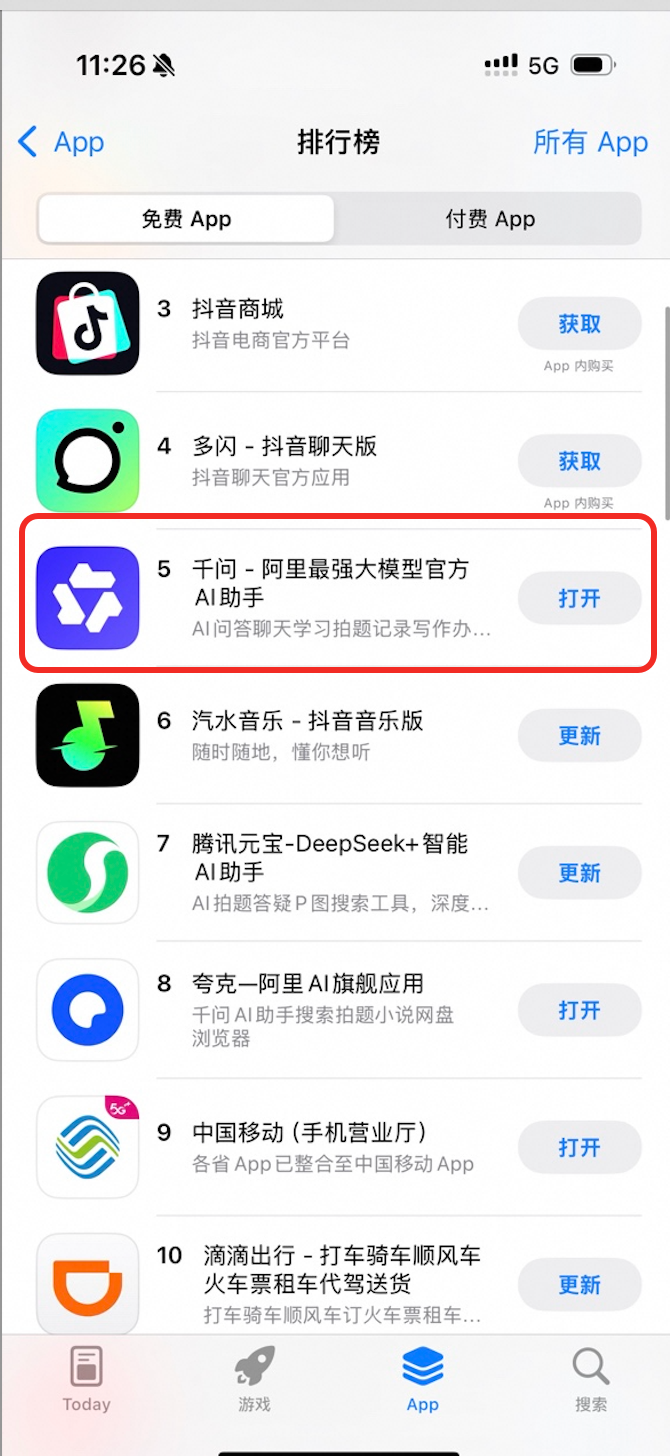
阿里千问APP上线一天即冲入总榜前五
Yang Zi Wan Bao Wang· 2025-11-18 06:32
Core Insights - Alibaba's newly launched AI application, Qianwen APP, quickly rose to the fifth position in the Apple App Store's free app rankings shortly after its public testing, surpassing competitors like DeepSeek [1] - The launch signifies Alibaba's aggressive entry into the AI to C (consumer) market, with Qianwen positioned as a key player in the "future battle of the AI era" [4] - Qianwen APP aims to become a personal AI assistant that not only engages in intelligent conversation but also performs complex tasks, such as generating PPTs [5] Group 1 - Qianwen APP's public testing led to server congestion, indicating high user demand and interest [1] - The app is designed to integrate deeply with various life scenarios within Alibaba's ecosystem, targeting competition with ChatGPT [4] - The Qwen series of open-source models has achieved over 600 million downloads globally since its full release in 2023, with the flagship Qwen3-Max model outperforming top international models like GPT-4 and Claude 3 Opus [4] Group 2 - Alibaba's strategic goal for Qianwen APP is to create a future "AI life portal" that can handle various tasks beyond simple conversation [5] - The app plans to incorporate functionalities related to maps, food delivery, ticket booking, and office tasks, enhancing its service capabilities [5] - Qwen models are becoming foundational technology for Silicon Valley startups, with notable endorsements from industry leaders like Airbnb's CEO [4]