投资者适当性管理

Search documents
工行宣布,1月12日起个人购买积存金需C3级以上
Zhong Guo Ji Jin Bao· 2026-01-07 02:15
Group 1 - Industrial and Commercial Bank of China (ICBC) announced an increase in the risk tolerance level for personal customers to C3-balanced and above for its accumulation gold business starting January 12, 2026, making it the first major state-owned bank to raise the entry threshold this year [1][3] - Customers must complete a risk assessment through ICBC's channels and obtain a C3 or higher rating to engage in new accumulation gold business, while existing customers can continue operations without re-assessment [1][3] - Other banks, such as CITIC Bank and Zhongyuan Bank, have also raised their risk tolerance levels for accumulation gold business, requiring customers to meet similar C3 or higher ratings for transactions [4] Group 2 - The increase in risk tolerance levels by banks is seen as a protective measure for investors amid rising gold price volatility, aligning with regulatory requirements for investor suitability management [5] - As of January 5, 2026, international gold prices have rebounded, with spot and futures prices exceeding $4,400 per ounce, indicating a positive market trend [5] - Analysts predict continued support for rising gold prices, with Goldman Sachs forecasting a price of $4,900 per ounce by December 2026, and UBS projecting a potential rise to $5,000 per ounce by September 2026 [7]


国有大行出手,上调!
中国基金报· 2026-01-06 09:47
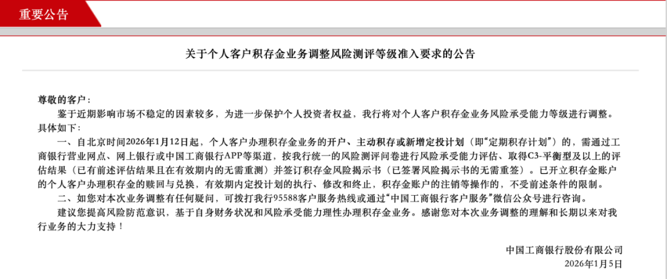
【导读】工行宣布, 1 月 12 日起个人购买积存金需 C3 级以上 中国基金报记者 忆山 1 月 5 日,工商银行发布公告称,个人客户积存金业务风险承受能力准入等级即将提升至 C3- 平衡型及以上,成为开年以来首家提高个人积存金业务准入门槛的国有大行。 风险评级 C3 及以上方可办理积存金业务 公告显示,鉴于近期影响市场不稳定的因素较多,为进一步保护个人投资者权益,工商银行 将对个人客户积存金业务风险承受能力等级进行调整。 自 2026 年 1 月 12 日起,个人客户办理积存金业务的开户、主动积存或新增定投计划(即 " 定期积存计划 " )的,需通过工商银行营业网点、网上银行或中国工商银行 App 等渠道, 按该行统一的风险测评问卷进行风险承受能力评估、取得 C3- 平衡型及以上的评估结果(已 有前述评估结果且在有效期内无需重测)并签订积存金风险揭示书(已签署风险揭示书的无 需重签)。 已开立积存金账户的个人客户办理积存金的赎回与兑换,有效期内定投计划的执行、修改和 终止,积存金账户的注销等操作的,不受前述条件的限制。 多家上调准入门槛 金价仍有望上涨 除工商银行外,去年下半年以来,还有部分股份行相继提高 ...

2025年海外成熟ETF市场的发展历程和经验启示
Sou Hu Cai Jing· 2025-12-29 04:00
Core Insights - The report discusses the development history and experience implications of the mature ETF market overseas, particularly focusing on the US market as a benchmark for the rapidly growing Chinese ETF market [1][3]. Group 1: US ETF Market Overview - The US ETF market has surpassed $10 trillion in assets under management, accounting for approximately 70% of the global market share [1][3]. - Since its inception in 1993, the US ETF market has evolved through various stages, expanding from simple index-tracking products to a diverse range of categories including industry, thematic, fixed income, commodities, and alternative assets [1][3]. - Key factors driving the growth of the US ETF market include a unique physical subscription and redemption mechanism that offers tax advantages, low fee strategies that significantly reduce investor costs, a stable funding source from pension systems, and a transformation in investment advisory models that promote widespread ETF usage [1][3]. Group 2: Challenges in the US ETF Market - The rapid growth of the US ETF market has also revealed issues such as underperformance of thematic ETFs designed to cater to market sentiment, high fees, and concentrated holdings that may affect actual investor returns [2]. - Complex ETFs based on derivatives can amplify volatility in extreme market conditions, potentially leading to cascading sell-offs [2]. - Non-market-cap-weighted ETFs may cause price disruptions for small-cap component stocks during rebalancing [2]. Group 3: Implications for the Chinese ETF Market - Despite rapid growth, the Chinese ETF market faces challenges such as significant product homogeneity, insufficient derivative support, and low participation from individual investors [3][4]. - To promote healthy market development, China can learn from the US experience by establishing a more inclusive and efficient regulatory framework, encouraging long-term capital allocation through pension system reforms, and fostering innovation in products, tools, and services [3][4]. - Enhancing financial technology to improve investor education and service capabilities can lower investment barriers and promote ETF adoption among residents [3][4].
个股场外期权被暂停新增下单,期货风险子公司严查“532通道”
Sou Hu Cai Jing· 2025-12-18 07:25
智通财经记者 | 邹文榕 散户借通道公司下单个股场外期权的"玩法"要变天了。 为全面、穿透地落实投资者适当性管理要求,防范业务"通道化"风险,智通财经记者了解到,12月以来,多家期货风险管理子公司应中国期货业协会(下 称:协会)要求,暂停新增个股场外期权业务下单。 "主要是审查期货子公司对接的532公司是否有在面向自然人收单。"多位532公司的从业人员向智通财经记者表示,"目前只允许平仓,新增的532公司不能向 期货风险子公司下单。期货风险子公司反馈暂定自查到12月底,但估计到时候也比较麻烦,要一个一个去解冻。" "几个月前,券商就曾集中倒查过一波532公司资质,近期伴随期货风险子公司开启自查,现在能下单的券商已越来越少。"一位专注办理场外资质的三方机 构人士向智通财经记者反馈,"现在应该还有五家券商可以,但报价蛮贵。" 期货风险子暂停"532机构"新户开单 110 10 - x LI 1 智通财经记者了解到,业内最早流传的期货风险子公司暂停下单始于一张落款为银河德睿资本管理有限公司(下称:银河德睿)向532公司发送的自查通 知。 图片源自网络 智通财经了解到,有投资者致电银河德睿求证上述暂停接单的消息是否属 ...

港股通投资需满足哪些条件?
Jin Rong Jie· 2025-12-18 02:08
Group 1 - Individual investors participating in the Hong Kong Stock Connect must meet an asset threshold of at least 500,000 RMB in their securities and funds accounts over the 20 trading days prior to application [1] - Investors are required to pass a knowledge test related to Hong Kong Stock Connect trading, ensuring they understand the basic rules, processes, and risks involved [1] - Investors must hold a regular RMB common stock account (A-share account) and their risk assessment results must match the risk level of Hong Kong Stock Connect trading, typically requiring a conservative risk tolerance or higher [1] Group 2 - Institutional investors do not have an asset threshold but must be legally established and in good standing as qualified entities, with no prohibitions on participating in Hong Kong Stock Connect [2] - Institutional investors must follow internal decision-making procedures to ensure participation aligns with their business scope and risk management requirements, and must undergo suitability assessments through securities firms [2] - Both individual and institutional investors must sign a risk disclosure statement when opening Hong Kong Stock Connect permissions, which outlines potential risks such as exchange rate risk and market volatility [2]
银行杠杆炒金告别“个人时代”
Bei Jing Shang Bao· 2025-12-17 15:42
Core Viewpoint - The recent announcements from banks regarding personal precious metals trading indicate a significant shift in the market, marking the end of leveraged gold trading for individual investors [1][2]. Group 1: Regulatory Changes and Bank Actions - Several major banks, including Industrial and Commercial Bank of China, have announced the cleaning of inactive "three-no" clients in their personal precious metals trading business, reflecting a broader trend among state-owned and joint-stock banks to withdraw from this market [1]. - The tightening of personal leveraged gold trading is a response to regulatory requirements established at the end of 2021, which mandated financial institutions to conduct derivative trading with individual clients cautiously [1]. - The previous incidents, such as the "oil treasure" event, highlighted the risks associated with leveraged trading, prompting regulators to enforce stricter investor suitability management [1]. Group 2: Market Dynamics and Investor Behavior - Leveraged gold trading was once seen as a shortcut to wealth for individual investors, but the risks associated with such trading have become more apparent as banks withdraw from this business [2]. - While the closure of leveraged trading channels may limit some investment opportunities, banks still offer alternatives like gold accumulation plans, gold ETFs, and physical gold bars, which provide lower barriers to entry and high liquidity [2]. - This shift encourages a change in investment philosophy from short-term speculation to long-term asset allocation, prompting investors to reassess their risk tolerance and view precious metals as a hedging tool rather than a means for quick wealth [2]. Group 3: Industry Implications - The exit of personal leveraged gold trading will likely lead to a concentration of market participants among professional institutions, which possess better risk pricing capabilities and liquidity management experience [2]. - This transition is expected to stabilize market fluctuations and enhance pricing efficiency in the gold market, signaling an increase in market maturity over the long term [2].
银行密集清理个人杠杆炒金业务,贵金属投资转向长期配置
Bei Jing Shang Bao· 2025-12-17 15:22
Core Viewpoint - The era of individual leveraged gold trading through banks is coming to an end as banks tighten regulations and clean up inactive accounts, reflecting a shift towards more cautious investment practices in the precious metals market [1][2]. Group 1: Regulatory Changes - Major banks, including Industrial and Commercial Bank of China, have announced adjustments to their personal precious metals trading services, targeting inactive "three-no" customers and returning margin account balances to settlement accounts [1]. - This trend follows a series of "stop new" announcements from various banks since 2022, indicating a broader contraction in personal leveraged gold trading services [1]. - The tightening of personal leveraged gold trading is driven by regulatory requirements established at the end of 2021, which mandate financial institutions to conduct derivative trading with individual clients cautiously [1]. Group 2: Market Dynamics - Leveraged gold trading was once seen as a shortcut to wealth for individual investors, but the risks associated with such trading have become more apparent, leading to a reassessment of investment strategies [2]. - While banks are closing leveraged trading channels, they continue to offer alternative investment products such as gold accumulation plans, gold ETFs, and physical gold bars, which provide lower barriers to entry and high liquidity [2]. - The exit of individual leveraged gold trading is expected to shift the market structure towards professional institutions, which possess better risk pricing capabilities and liquidity management, ultimately enhancing market stability and pricing efficiency [2].

【西街观察】银行杠杆炒金告别“个人时代”
Bei Jing Shang Bao· 2025-12-17 14:45
Core Viewpoint - The recent announcements from banks regarding personal precious metals trading indicate a significant shift in the market, with a focus on curbing leveraged trading by individual investors [1][2]. Group 1: Bank Actions - Industrial and Commercial Bank of China (ICBC) announced adjustments to its personal precious metals trading business, including the cleaning of inactive "three-no" customers and returning margin account balances to settlement accounts [1]. - Other state-owned banks, joint-stock banks, and city commercial banks have also issued similar announcements, with some even ceasing to offer personal precious metals trading services [1]. - The trend of banks withdrawing from personal leveraged gold trading began in 2022, marking a significant contraction in this business area [1]. Group 2: Regulatory Environment - The tightening of personal leveraged gold trading is driven by regulatory requirements established at the end of 2021, which mandate financial institutions to conduct derivative trading with individual clients cautiously [1]. - Previous incidents, such as the "oil treasure" event, highlighted the need for stricter investor suitability management to protect investor rights [1]. Group 3: Market Implications - The closure of leveraged trading channels does not eliminate opportunities for individual investors in the precious metals market, as banks continue to offer gold accumulation accounts, gold ETFs, and physical gold bars [2]. - This shift encourages a change in investment philosophy from short-term speculation to long-term asset allocation, prompting investors to reassess their risk tolerance [2]. - The exit of individual leveraged gold trading is expected to concentrate market participants among professional institutions, which possess better risk pricing capabilities and liquidity management experience, ultimately enhancing market stability and pricing efficiency [2].
重磅规范来了!事关基金销售
中国基金报· 2025-12-12 10:48
Core Viewpoint - The article discusses the issuance of a draft regulation aimed at standardizing the sales behavior of publicly offered securities investment funds in China, focusing on investor protection and the prevention of misleading practices [2]. Group 1: Fund Sales Behavior Regulations - The draft regulation prohibits excessive promotion of fund managers for the purpose of rapid fundraising and requires clear differentiation between a fund manager's years of service and actual investment management experience [2][6]. - Fund managers and sales institutions must adopt a long-term sales philosophy centered on the best interests of investors and fulfill obligations related to risk preference and capacity identification [2]. Group 2: Fund Performance and Promotion Standards - Fund performance must be presented objectively and comprehensively, with specific requirements such as a minimum performance display period of six months and the use of data from recognized evaluation agencies for rankings [4]. - The use of terms like "positive return" or "probability of positive return" is prohibited to prevent investors from overlooking risks, although some industry experts suggest allowing objective displays of past performance with appropriate risk disclosures [5]. Group 3: Live Streaming Regulations - The draft outlines compliance requirements for fund managers and sales institutions conducting live streaming, including the necessity for qualified personnel and agreements with streaming platforms to ensure compliance with sales regulations [8][10]. - Live streaming personnel must have relevant qualifications and adhere to advertising laws, while platforms must disable tipping features to prevent conflicts of interest [9]. Group 4: Disclosure of Fees and Costs - Fund managers and sales institutions are required to ensure that investors can access and understand fund product information, including various fees such as subscription, redemption, and service fees [13]. - Different share classes must have their fee structures disclosed, and sales institutions must clarify the definition and collection methods of service fees [13]. Group 5: Performance Assessment Optimization - The draft aims to shift the focus of performance assessments away from short-term aggressive sales towards long-term value creation, incorporating factors like compliance and risk management into the evaluation criteria [15][16]. - Sales performance metrics should include long-term investor outcomes and avoid prioritizing sales revenue or scale as primary indicators [16].

银河证券卷入雷根资产违约风波!
Xin Lang Cai Jing· 2025-12-12 09:14
Core Viewpoint - The article discusses the ongoing legal and financial repercussions faced by investors and the brokerage firm Galaxy Securities due to the collapse of the Regan Asset Management Company, which has been implicated in a payment crisis and suspected fundraising fraud. Group 1: Investor Experiences - A 62-year-old investor, Ms. Cai, invested 5 million yuan in the "Regan All-Weather Fund" through Galaxy Securities, only to face a payment crisis in 2023, leading to legal actions against the fund's management [1][25] - Reports indicate that 52 investors purchased the Regan fund through Galaxy Securities, totaling nearly 100 million yuan in investments, with many seeking legal recourse [1][25][37] Group 2: Regulatory Violations - Galaxy Securities is accused of multiple violations, including allowing unqualified investors to purchase funds and making misleading promises of capital protection and guaranteed returns [1][25][29] - The firm received warnings for inadequate due diligence in its private fund sales, which may have led to high-risk products being sold to low-risk investors [1][25][29] Group 3: Legal Proceedings and Settlements - Ms. Cai reported Galaxy Securities for illegal activities in fund sales and was offered a settlement of 92% of her principal, contingent on withdrawing her complaint, which she later found was not honored [1][31] - Another investor, Mr. Huang, faced similar issues, having been misled about the fund's risk level and the existence of a "white list" of approved products, which Galaxy Securities later denied [1][33][35] Group 4: Financial Performance of Galaxy Securities - Despite the ongoing crisis, Galaxy Securities reported significant financial growth, with revenues of 22.75 billion yuan in the first three quarters of 2025, a 44.39% increase year-on-year, and a net profit of 10.97 billion yuan, up 57.51% [1][40][42] - The firm’s total assets reached 861.09 billion yuan, reflecting a 16.76% increase from the previous year, and it has expanded its client base to over 18 million [1][40][42] Group 5: Fund Management and Investment Strategy - The Regan fund did not adhere to its initial investment strategy, which was supposed to focus on Hong Kong IPOs, instead diverting funds to other private equity products [1][29] - The fund's management has been accused of using various channels to mislead investors about the true nature of their investments, which has raised concerns about the integrity of the investment process [1][29][39]