核心通胀

Search documents
国泰海通 · 晨报1110|宏观、海外策略、交运、机械
国泰海通证券研究· 2025-11-09 14:48
Group 1: Inflation Trends - The core inflation continues to rise steadily, with October CPI increasing by 0.2% year-on-year and 0.2% month-on-month, while PPI shows a year-on-year decline of 2.1% but a month-on-month recovery to 0.1% [3][5] - The main drivers for the recent rise in core CPI include anti-involution governance, fiscal stimulus, and rising gold prices, while long-term recovery relies on improving consumer capacity and high-quality consumption scenarios [3][5] - Food price drag has lessened, with core service prices rising seasonally, reaching the highest level since March 2024 [3][5] Group 2: Market Dynamics - The strong dollar has led to outflows of foreign capital from Hong Kong stocks, with a net outflow of 791.8 million HKD since the end of September [9][10] - The dollar's strength is attributed to U.S. government shutdowns, hawkish Fed statements, and weakness in non-dollar currencies, impacting liquidity in Hong Kong [8][9] - Despite short-term pressures, the Hong Kong market is expected to reach new highs in the medium term, driven by inflows of incremental capital and high-quality assets [10] Group 3: Aviation Sector Outlook - The Chinese aviation sector is entering a "super cycle," with a significant rise in profitability expected as supply and demand recover, leading to higher ticket prices [14][15] - The supply side is constrained by airspace bottlenecks, while demand is supported by a growing aviation population and recovery in customer structure [14] - The long-term logic of the aviation sector suggests a strategic increase in positions, particularly in high-quality networks, as demand continues to strengthen [15] Group 4: Machinery Industry Performance - The machinery industry is projected to see overall improvement by 2025, with significant revenue growth and profit increases reported in the first three quarters of 2025 [17] - Key growth areas include humanoid robots and engineering machinery, driven by advancements in AI manufacturing and increased orders from overseas markets [18] - The energy equipment sector is also recovering, with a focus on rational competition and price recovery in the photovoltaic equipment market [18]


布米普特拉北京投资基金管理有限公司:杰斐逊表态支持降息,指出劳动力市场降温风险增加
Sou Hu Cai Jing· 2025-11-09 14:48
杰斐逊强调,在未来的利率决策过程中,他将采取逐次会议的方式进行评估。他特别指出,在当前情况下这种审慎做法尤为必要,因为美国的政府停摆导致 经济数据的发布受到影响。原定于近期公布的十月非农就业报告已被推迟,这将是连续第二个月无法按时获得关键就业数据。 根据现有信息分析,杰斐逊 认为过去几个月美国整体经济形势保持相对稳定,经济继续以温和速度扩张,同时劳动力市场正在逐步降温。在通胀方面,他表示年度通胀率与一年前水平 相近,这主要受到外部因素影响,但同时也有迹象显示核心通胀可能正朝着百分之二的政策目标稳步靠拢。 在讨论经济前景时,杰斐逊还谈及人工智能技术发展的影响。他表示目前要准确评估AI对劳动力市场和价格水平的实际影响还为时过早。他指出,近期在 招聘模式、生产率增长和通胀变化中观察到的部分现象,可能反映了人工智能技术推动的变革,但具体影响程度仍难以确定。 美联储副主席杰斐逊近日表示,随着货币政策逐渐接近中性水平,美联储在未来的决策中应当保持谨慎态度。这一表态发生在美联储上周决定降息二十五个 基点之后,引发市场对后续政策路径的广泛关注。 在出席德国央行一场活动时,杰斐逊指出当前货币政策立场已从明显紧缩转向接近中性水平 ...

10月物价数据解读:核心通胀稳步回升
Yin He Zheng Quan· 2025-11-09 10:22
CPI Analysis - In October, the CPI increased by 0.2% month-on-month (previous value: 0.1%) and turned from a year-on-year decline of 0.3% to an increase of 0.2%[4] - The core CPI rose by 0.2% month-on-month and 1.2% year-on-year, marking the sixth consecutive month of expansion[4] - The rise in food CPI was primarily driven by weather-related increases in fresh vegetables and fruits, with a year-on-year increase of 4.3%[6] PPI Insights - The PPI increased by 0.1% month-on-month (previous value: flat) and the year-on-year decline narrowed to -2.1% (previous value: -2.3%) in October[16] - Sector analysis shows that coal prices rose due to increased heating demand in northern regions, while non-ferrous metals also saw price increases[18] Future Outlook - The CPI is expected to continue rising in November due to improved tailing factors and the ongoing recovery in core inflation[21] - Key challenges include the pace of pork production capacity reduction and the balance between supply surplus and weak demand, which may pressure oil prices[21] - The M1 money supply growth is rebounding, which could support PPI improvement, but overall economic momentum remains insufficient[21]
10月物价前瞻:CPI同比或回升,核心通胀有望延续复苏态势
Sou Hu Cai Jing· 2025-11-07 23:57
Group 1: CPI Insights - The National Bureau of Statistics will release October's consumer price index (CPI) data on November 9 at 9:30 AM [1] - In September, the national CPI decreased by 0.3% year-on-year and increased by 0.1% month-on-month, while the core CPI rose by 1.0%, marking the first return to 1% in nearly 19 months [2] - Multiple institutions predict a rebound in October's CPI, with estimates ranging from -0.1% to 0.1% [2] - Pork prices continue to negatively impact the CPI, with wholesale prices declining year-on-year from -26.3% to -27.2% in October [2] - Prices for 28 monitored vegetables and 7 monitored fruits are expected to improve, with year-on-year declines narrowing from -18.7% and -5.3% to -10.0% and -2.7%, respectively [2] Group 2: PPI Insights - Institutions anticipate a slight increase in the year-on-year decline of the Producer Price Index (PPI) for October, reflecting weak short-term economic performance [4] - In September, the national PPI decreased by 2.3% year-on-year and remained flat month-on-month [4] - Forecasts for October's PPI year-on-year change range from -2.2% to -2.6% [4] - The PMI for major raw material purchase prices and factory prices fell by 0.7 percentage points compared to September, indicating a potential month-on-month PPI decline [5] - The fluctuation in PPI is influenced by international commodity prices and domestic industry competition, with expectations of a year-on-year PPI decline of -2.6% and a month-on-month decline of -0.6% [5]
美国经济:服务业仍有韧性
Zhao Yin Guo Ji· 2025-11-06 10:37
Economic Indicators - The US services PMI rose to 52.4 in October, up from 50 in September, indicating economic expansion and surpassing market expectations of 50.8[2] - The services PMI corresponds to an annualized GDP growth rate of 1.2%[2] - The manufacturing PMI decreased to 48.7 in October from 49.1 in September, below the expected 49.5, indicating contraction[2] Employment and Inflation - ADP private sector employment increased by 42,000 in October, recovering from a loss of 29,000 in September, suggesting a slowdown in job losses[1] - The price index for services rose to 70, the highest since 2022, indicating persistent inflation pressures in the services sector[2] - Core inflation is beginning to stabilize due to tariff transmission and reduced labor supply[1] Federal Reserve Outlook - The Federal Reserve is expected to implement two rate cuts this year, with a potential pause in December, targeting a year-end federal funds rate around 3.8% (target range 3.75%-4%) [1] - Further rate cuts may occur next year, with a target federal funds rate of 3.25%-3.5% by year-end as economic growth stabilizes and inflation recedes[1]
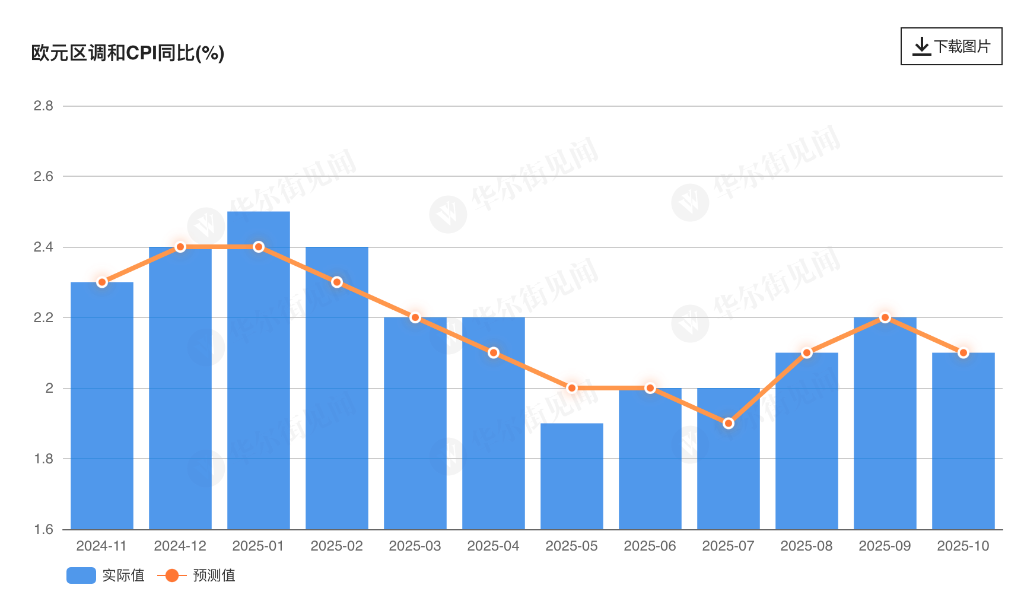
欧元区10月调和CPI初值2.1%,核心同比意外维持2.4%,服务业加速上涨
Hua Er Jie Jian Wen· 2025-10-31 12:55
Core Insights - Eurozone inflation has slightly decreased to 2.1% in October from 2.2% in September, still above the 2% target, indicating persistent price stickiness, particularly in the services sector [1][3] - Core inflation remains unchanged at 2.4%, slightly above the market expectation of 2.3%, highlighting ongoing concerns about underlying price pressures [3] - The European Central Bank (ECB) has maintained interest rates at 2% for the third consecutive meeting, with President Lagarde noting that the assessment of inflation prospects has not significantly changed, although uncertainties remain high [3] Inflation Trends - The decline in overall inflation is attributed to a slowdown in food price increases and a notable decrease in industrial goods prices, which offset a slight acceleration in service prices [1] - France's inflation rate for October is reported at 0.9%, down from 1.1% in September, driven by a 5.6% drop in energy prices, while food price growth has slowed from 1.7% to 1.3% [4] - Germany's inflation rate for October stands at 2.3%, continuing to exceed the ECB's target, indicating persistent price pressures in the Eurozone's largest economy [5] Divergence Among Member States - There is significant divergence in inflation levels among Eurozone member states, with France consistently below the ECB's target for over a year, while Germany remains above the target [4][5] - The ECB's upcoming quarterly forecast in December will include projections for 2028, potentially reigniting discussions on the need for further monetary policy easing [3]
日本东京核心通胀走高 短期内加息预期得以维持
Xin Hua Cai Jing· 2025-10-31 00:43
Group 1 - The core CPI in Tokyo for October increased by 2.8% year-on-year, remaining above the Bank of Japan's inflation target of 2%, which sustains market expectations for a potential interest rate hike in the short term [1] - The Tokyo core CPI, excluding volatile fresh food prices, was higher than market expectations of 2.6%, with a previous value of 2.5% [1] - The Tokyo CPI year-on-year, which excludes both fresh food and energy prices, was reported at 2.8%, also exceeding the September figure of 2.5% [1] Group 2 - Despite consumer inflation being above the 2% target for over three years, the Governor of the Bank of Japan emphasized the need for caution in considering further interest rate hikes due to uncertainties surrounding the impact of U.S. tariff policies on the Japanese economy [1]
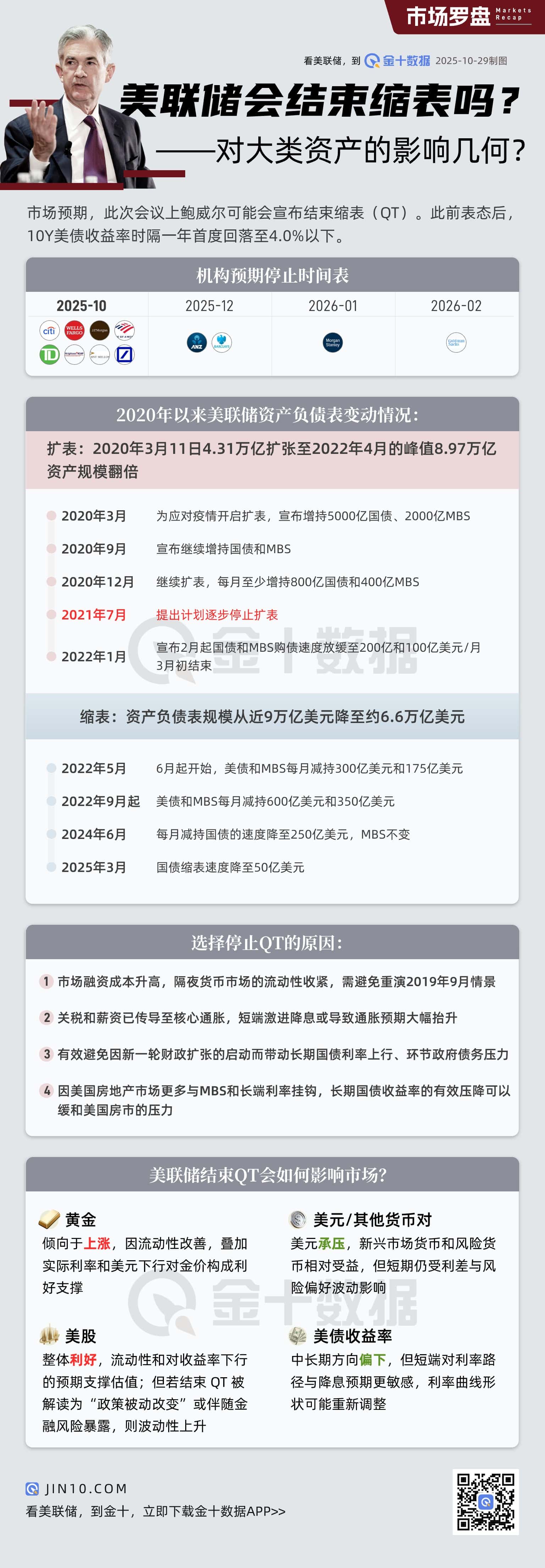
美联储缩表拐点临近,流动性变化对市场影响几何?| 市场罗盘
Jin Shi Shu Ju· 2025-10-29 10:06
Core Viewpoint - The Federal Reserve is expected to announce the end of its balance sheet reduction (QT) during the upcoming meeting, which has led to a decline in the 10-year U.S. Treasury yield below 4.0% for the first time in a year [2]. Summary by Sections Federal Reserve's Balance Sheet Changes - Since March 2020, the Federal Reserve's balance sheet expanded from $4.31 trillion to nearly $9 trillion by April 2022, effectively doubling in size [4]. - The Fed initiated asset purchases in March 2020, announcing a $500 billion increase in Treasury securities [4]. - In December 2020, the Fed committed to purchasing at least $800 billion in Treasury securities and $400 billion in mortgage-backed securities (MBS) monthly [5]. - The tapering of asset purchases began in July 2021, with a gradual reduction in the pace of buying [5]. - The balance sheet reduction started in June 2022, with monthly reductions of $30 billion in Treasuries and $17.5 billion in MBS, increasing to $60 billion and $35 billion respectively by September 2022 [5]. - By March 2025, the reduction pace for Treasuries is expected to slow to $5 billion per month [5]. Reasons for Ending QT - The need to avoid increased market financing costs and tightening liquidity in the overnight money market [7]. - Core inflation has been affected by tariffs and wages, and aggressive rate cuts could exacerbate inflation [7]. - To prevent long-term Treasury yields from rising due to a new round of fiscal expansion [7]. - The U.S. housing market is closely linked to MBS and long-term rates, necessitating a careful approach to avoid destabilizing the housing market [7]. Market Impact of Ending QT - Gold prices are likely to rise due to improved liquidity, alongside declining real interest rates and a weaker dollar [8]. - U.S. Treasury yields are expected to trend downward in the medium to long term, influenced by rate cut expectations [8]. - Overall, the end of QT could support equity valuations due to improved liquidity and lower yield expectations, although it may also lead to increased volatility if interpreted as a reactive policy change [8].
美国9月CPI数据速评
Sou Hu Cai Jing· 2025-10-24 12:45
Core Insights - The core inflation rate in the U.S. for September rose less than expected, indicating a potential for the Federal Reserve to continue lowering interest rates next week [1] - The core Consumer Price Index (CPI) increased by 0.2% month-over-month, marking the slowest growth in three months, and rose by 3% year-over-year [1] - The lower-than-expected data may encourage policymakers to consider another rate cut in December, especially in light of the ongoing government shutdown and the inability to release other official data [1]
STARTRADER星迈:非农数据不确定性致美国私营部门就业岗位疲软?
Sou Hu Cai Jing· 2025-10-02 12:30
Group 1 - Eurozone's unemployment rate is expected to remain at 6.2% in August, indicating a strong labor market but with a slowdown in job growth, raising risks of future unemployment increases as labor force expands [2] - Eurozone's inflation rate rose from 2.0% to 2.2% in September, driven by energy price base effects, aligning with expectations and potentially reaffirming the European Central Bank's outlook [3] - The manufacturing PMI in the Eurozone was slightly adjusted from 49.5 to 49.8 in September, indicating weakened manufacturing momentum, with expectations of further economic softening by year-end [3] Group 2 - In the US, the ADP report indicated a decrease of 32,000 private sector jobs in September, significantly below the expected increase of 50,000, suggesting overall labor market weakness [4] - The ISM manufacturing index rose from 48.7 in August to 49.1 in September, slightly above expectations, but production and employment growth were offset by declines in new and export orders [4] - The Swedish manufacturing PMI increased from 55.3 to 55.6 in September, supported by job and new order growth, with no significant impact from tariffs on production plans or supply chains [4][5] Group 3 - Norwegian manufacturing PMI rose from 49.6 to 49.9 in September, indicating a continued moderate slowdown, with mixed data on new orders and improvements in production and employment [5] - European stock markets saw significant gains, with the Stoxx 600 index rising by 1.2%, driven by investor confidence amid US government issues, while the S&P 500 index also reached a historical high [5] - Pfizer and the US government reached an agreement on tariff reductions, benefiting pharmaceutical and biotech stocks, while EU steel manufacturers' stocks rose due to potential cuts in steel import quotas [5]