生命科学

Search documents
任泽平:自动驾驶将在未来1-2年爆发,大模型可统一驾驶标准
Xin Lang Cai Jing· 2026-01-26 07:30
Group 1: Key Trends in Technology and Industry - The first major trend is the explosion of autonomous driving, which is expected to solve urban traffic congestion, air pollution, and safety issues within the next 1-2 years. A unified driving standard through large models will enable millions of vehicles to reach or exceed the skill level of experienced drivers, representing a trillion-dollar market opportunity [2][14]. - The second trend involves the significant rise of humanoid robots, which will first take over dangerous and repetitive tasks in factories, then transition into homes as companions, and eventually evolve into silicon-based life forms that deeply understand human society [3][15]. - The third trend highlights breakthroughs in life sciences, where AI will dramatically enhance drug development, potentially curing diseases like cancer and ALS within 5-10 years, and extending human lifespan to 120 years [4][16]. - The fourth trend is the anticipated explosion of AI super applications, with AI assistants expected to become personal secretaries for everyone, covering all aspects of daily life, leading to the replacement of over 90% of existing apps [5][17]. - The fifth trend indicates the rise of China's strength in various sectors such as photovoltaics, electric vehicles, and power batteries, leveraging a strong supply chain and a market of 1.4 billion people for rapid commercialization [6][19]. - The sixth trend is the emergence of a new energy system characterized by "green electricity + energy storage," with China's installed capacity of green electricity surpassing coal, driving a surge in energy storage demand [7][20]. Group 2: Societal and Economic Trends - The seventh trend points to intensified geopolitical competition and a global arms race, with modern warfare evolving towards aerospace, information, and intelligence, focusing on aerospace, communication satellites, and high-end equipment [8][21]. - The eighth trend discusses the revolution in the food industry driven by biotechnology, where essential nutrients will be produced on a large scale in factories, significantly reducing land use and air pollution, aiding carbon neutrality and ecological restoration [9][22]. - The ninth trend indicates the arrival of a post-real estate era, where the housing market will see a bifurcation: property prices in core areas with 20% population inflow may bottom out or even reach new highs, while areas with 80% population outflow will experience prolonged price declines [11][23]. - The tenth trend highlights the acceleration of aging and declining birth rates, with the baby boomer generation entering old age, creating opportunities in the silver economy and health industries, while declining birth rates will boost markets related to pets, single living, emotional well-being, and cost-effectiveness [12][24].
任泽平:未来十大新趋势
Xin Lang Cai Jing· 2026-01-26 07:30
Group 1: Key Trends in Technology and Innovation - The first major trend is the explosion of autonomous driving, which is expected to solve urban traffic congestion, air pollution, and safety issues within the next 1-2 years. A unified driving standard through large models will enable millions of vehicles to reach or exceed the skill level of experienced drivers, representing a trillion-dollar market opportunity [2][14]. - The second trend involves the significant rise of humanoid robots, which will first take over dangerous and repetitive tasks in factories, then transition into homes as companions, and eventually evolve into silicon-based life forms that deeply understand human society [3][15]. - The third trend highlights breakthroughs in life sciences, where AI will dramatically enhance drug development, potentially curing diseases like cancer and ALS within 5-10 years, and extending human lifespan to 120 years [4][16]. - The fourth trend is the anticipated explosion of AI super applications, with AI assistants expected to become personal secretaries for everyone, covering all aspects of daily life, leading to the replacement of over 90% of existing apps [5][17]. Group 2: Energy and Environmental Trends - The sixth trend is the emergence of a new energy system characterized by "green electricity + energy storage." China's installed capacity of green electricity (solar and wind) has surpassed that of coal, driving a surge in energy storage demand. Solid-state batteries are becoming mainstream due to their high energy density, long range, and safety, leading to a boom in demand for new energy minerals like copper and lithium [7][20]. - The eighth trend indicates that biotechnology will revolutionize the food industry, with large-scale production of proteins, starches, fruits, and vitamins in factories, replacing traditional agriculture and significantly reducing land use and air pollution, thus aiding carbon neutrality and ecological restoration [9][22]. Group 3: Demographic and Economic Trends - The ninth trend points to the arrival of a post-real estate era, where the housing market will experience a bifurcation. In the long term, real estate prices in core areas, which will see a 20% population inflow, are expected to bottom out and potentially reach new highs in the medium term, while areas with an 80% population outflow will face prolonged price declines [11][23]. - The tenth trend addresses the accelerating aging and declining birth rates, with the baby boomer generation (born between 1962-1976) rapidly aging. This demographic shift will create significant opportunities in the silver economy and health industries, while declining birth rates will drive the rise of pet economies, single-person economies, emotional economies, and cost-effective economies [12][24].
世界加速“去美元化”,2026年黄金还会继续涨吗?| 视界新年特辑
Sou Hu Cai Jing· 2026-01-26 06:13
1月26日,现货黄金价格达到历史性高位,首次突破5000美元/盎司。面对外部冲击与政策调整预期,接下来金价是否还会强势上行?美元走向会发生什么 变化,人民币汇率将在何处找到稳定锚点?本期"视界",小管邀请复旦大学管理学院财务与金融学系李达三讲席教授李隽业展望2026年中国金融市场走 向。 委内瑞拉政局动荡、俄乌冲突依旧胶着、中美经贸摩擦持续博弈……回望2025年,全球政治经济舞台出现了更多不可预测的风险点。与此同时,避险资产 需求明显抬升,黄金价格持续攀升,货币与资本流向也在地缘政治与宏观政策的双重作用下频繁波动。 复旦管院金融与财务学系李达三讲席教授 研究方向:实证资产定价,衍生产品定价,金融计量,金融数据分析 例如,2022年俄罗斯对乌克兰发起军事行动后,美国及其盟友对俄罗斯实施了一系列制裁,包括剔除出环球银行金融电信协会(SWIFT),冻结俄罗斯央 行约3000亿美元外汇储备,明确禁止俄罗斯进行黄金与美元的互换交易,禁止任何实体接收俄罗斯以美元计价的主权债券利息付款等。这些制裁举措充分 展现了美元的"武器化"程度,所蕴含的战略影响也极为深远。它向其他国家,尤其是中国这样的全球经济大国,传递了一个明确信号 ...


4100点以上,科技基金“风”朝哪里吹?
Sou Hu Cai Jing· 2026-01-22 16:30
Group 1 - The A-share market has quietly risen above 4100 points at the beginning of 2026, leading to regrets among investors who took profits at the end of the previous year [1] - The year 2025 was marked as a pivotal moment for China's technology industry, showcasing significant breakthroughs and a strong market response, pushing the market above 4000 points [5] - The technology sector is expected to continue its dynamic growth in 2026, with advancements in artificial intelligence, space economy, commercial aerospace, life sciences, and renewable energy [4][6] Group 2 - The technology narrative remains compelling, with concerns about potential bubbles in tech stocks being addressed by market performance, showing over 10% growth in tech stocks at the start of 2026 [8][10] - The current AI wave is not seen as an irrational bubble but rather a result of national strategic planning and market sentiment, with domestic demand supporting a more controllable bubble risk compared to overseas tech giants [10] - Active fund managers with the ability to select stocks in the technology sector will be increasingly important as the market shifts towards more selective and structural growth in 2026 [11][12] Group 3 - Investment opportunities in AI are expected to focus on the integration of AI with existing ecosystems and the enhancement of productivity across various sectors [19][20] - The commercial aerospace sector is projected to see significant developments, particularly in satellite networking and reusable rocket technology, which could drastically reduce launch costs [21] - The pharmaceutical sector is anticipated to shift from speculative pricing to more data-driven valuations as policies and payment structures become clearer [21]
大批知名投资人集聚深圳,2026机遇在哪?
Xin Lang Cai Jing· 2026-01-22 13:38
Core Insights - The Chinese private equity investment industry has reached a historic turning point in 2025, with a total fundraising amount exceeding 1.16 trillion yuan, a year-on-year increase of 8%, and the number of new funds surpassing 3,500, up 18% from the previous year [1][35] - A significant structural change is observed, with state-owned limited partners (LPs) contributing 89% of the funding, and hard technology investments accounting for over 60% of the total [1][36] Group 1: Dominance of State Capital - The role of state capital has been further strengthened, with local guiding funds and state-owned enterprises contributing over 50% of the funding, while the proportion of RMB funds exceeds 99% [2][36] - State-owned LPs are integrating national strategies and regional economic development goals into their investment decisions, focusing 70% of their funds on early-stage technology companies [2][36] - The investment strategy of VC/PE has shifted from broad-based approaches to more targeted investments, with a noticeable decrease in the concentration of large funds exceeding 5 billion yuan [2][36] Group 2: Focus on Hard Technology - Hard technology is identified as the primary investment focus for 2025 and the coming years, encompassing areas such as artificial intelligence, robotics, semiconductors, and renewable energy [3][37] - The establishment of key platforms like the Sci-Tech Innovation Board and the Hong Kong Stock Exchange has created critical windows for capitalizing on hard technology investments [3][37] - Early-stage financing transactions (A-round and earlier) accounted for 62% of total deals, with small investments under 100 million yuan making up over 67% [3][37] Group 3: Diversification of Exits - The exit landscape has improved significantly, particularly in the IPO market, with the number of IPOs in mainland China and Hong Kong accounting for 16% and 33% of the global total, respectively [4][38] - The number of IPO cases for invested companies in Hong Kong increased by 148.1% year-on-year, while A-share IPO cases rose by 26.5% [4][38] - Mergers and acquisitions (M&A) have also seen a surge, with a year-on-year increase of 84% in exit cases, highlighting the growing importance of M&A strategies for VC/PE [4][38] Group 4: Long-term Vision and Future Opportunities - Despite the positive performance in investment and exits, the private equity market faces numerous challenges, necessitating a long-term vision to navigate policy directions and market demands [5][39] - The 15th China Capital Annual Conference, themed "Visionaries Win," aims to gather industry leaders to discuss emerging trends and strategies in the investment landscape [5][39] - The conference will also unveil the "2025 Private Equity Investment Annual Series Rankings," recognizing outstanding institutions and individuals in various sectors [6][40]

海尔生物:海外市场收入占比已超过35%
Zheng Quan Ri Bao Wang· 2026-01-22 13:12
Core Viewpoint - Haier Biomedical aims to become a world-class brand in life sciences trusted by global users, with a focus on expanding its business internationally and enhancing its industry presence [1] Group 1: Business Expansion - The company has expanded its operations to over 150 countries and regions worldwide [1] - Localized deployments have been established in 18 countries [1] - Revenue from overseas markets now accounts for more than 35% of total income [1] Group 2: Strategic Focus - Haier Biomedical is committed to a strategy of both organic growth and external acquisitions within the life sciences sector [1] - The company plans to identify high-quality targets in the life sciences industry to strengthen its existing operations and broaden its business scope [1] - There is an emphasis on entering high-potential market segments [1]

普华永道:建议港府优化研发税收优惠政策 以推动科技进步
智通财经网· 2026-01-19 05:59
Group 1 - PwC suggests that the Hong Kong government optimize existing R&D tax incentives to promote technological advancement, particularly for outsourced R&D activities in the Greater Bay Area, proposing a 150% tax deduction for companies investing in AI technology to foster innovation and digital transformation [1] - The firm recommends tax incentives for global traders, including e-commerce and gaming industries, to strengthen Hong Kong's competitive edge [1] - PwC advises the government to expedite the granting of Hong Kong residency to qualified family office heads and their families, simplifying visa application processes and providing non-tax incentives such as education allowances and cash rewards to attract and retain family office professionals [1] Group 2 - PwC emphasizes the need for the government to quickly implement optimized shipping tax incentives to enhance Hong Kong's competitiveness as an international shipping center, particularly against jurisdictions like Singapore, and to accelerate the proposed half-tax incentives for commodity trading [2] - To attract global talent and investors, it is suggested to raise the investment threshold for the "New Capital Investor Entry Scheme" from HKD 10 million to HKD 15 million, aligning it with non-residential properties [2] - PwC economists highlight that while operating accounts are expected to return to surplus, structural pressures remain, urging strict control of recurrent expenditures and continued efforts to strengthen fiscal consolidation plans [2] Group 3 - The budget should prioritize growth driven by innovative technology, accelerating the development of the Northern Metropolis as a hub for AI, life sciences, low-altitude economy, and advanced manufacturing, while promoting broader application of AI in public services to enhance efficiency and reduce costs [3]
安永中国主席陈凯:借力粤港澳大湾区独特优势 把握“一带一路”全新投资机遇
Zhong Guo Ji Jin Bao· 2026-01-16 12:55
Core Viewpoint - The article emphasizes the importance of leveraging the unique advantages of the Guangdong-Hong Kong-Macao Greater Bay Area to seize new investment opportunities presented by the Belt and Road Initiative, especially in the context of the evolving global geopolitical landscape [1][3]. Investment Opportunities - Chinese enterprises are increasingly deepening investment cooperation with countries along the Belt and Road, with non-financial direct investments maintaining rapid growth [3]. - The investment direction of Chinese capital is shifting from traditional sectors like energy and infrastructure to emerging fields such as green energy, advanced manufacturing, digital economy, artificial intelligence, and life sciences [3][6]. - The asset management industry must adapt to a more complex market environment, requiring refined asset allocation across different countries, industries, and financial instruments [3][6]. Risk Management - The article identifies three main risks in cross-border asset allocation: 1. **Compliance Risk**: With tightening global financial regulations, asset management firms must maintain high compliance standards across different jurisdictions, necessitating a flexible and forward-looking compliance management framework [5]. 2. **Capital Risk**: Fluctuations in exchange rates, capital controls, and market liquidity can significantly impact investment returns, prompting the need for diversified asset allocation to mitigate single market risks [5]. 3. **Political and Regulatory Uncertainty**: Some Belt and Road countries present uncertainties in political environments, legal frameworks, and cultural contexts, requiring targeted due diligence and risk assessments [5]. Role of Hong Kong - Hong Kong serves as a "super connector" and "super value adder," linking domestic resources with international markets, thereby enhancing the Greater Bay Area's competitiveness in global resource allocation [6][7]. - Under the "One Country, Two Systems" framework, Hong Kong has established a common law system and international regulatory rules, making it a crucial international financial hub for Belt and Road investments [6]. Technological Innovation in the Greater Bay Area - The Greater Bay Area is positioned as one of China's three major international technology innovation centers, with the "14th Five-Year Plan" emphasizing its strategic role in the national innovation system [7]. - Investment opportunities in the Greater Bay Area are increasingly focused on strategic emerging industries such as artificial intelligence, life sciences, high-end manufacturing, new energy, and digital economy [7]. - Asset management firms are encouraged to shift from traditional short-term financial investments to a long-term investment logic that combines industry understanding with strategic allocation [7].
安永中国主席陈凯:借力粤港澳大湾区独特优势 把握“一带一路”全新投资机遇
中国基金报· 2026-01-16 11:21
Core Viewpoint - The article emphasizes the importance of leveraging the unique advantages of the Guangdong-Hong Kong-Macao Greater Bay Area to seize new investment opportunities presented by the Belt and Road Initiative, especially in the context of the uncertain international geopolitical landscape [2]. Group 1: Investment Opportunities - Chinese enterprises are deepening investment cooperation with countries along the Belt and Road, with non-financial direct investment maintaining rapid growth [5]. - The investment direction of Chinese capital is shifting from traditional energy and infrastructure to emerging fields such as green energy, advanced manufacturing, digital economy, artificial intelligence, and life sciences [6]. - The asset management industry must enhance its understanding of emerging industries and frontier technologies while establishing a robust investment framework to balance risk management and returns [6]. Group 2: Risks in Investment - The article identifies three main risks in cross-border asset allocation: compliance risk, funding risk, and uncertainty in political, legal, and cultural environments of some Belt and Road countries [8]. - Compliance risk arises from stricter global financial regulations, requiring asset management institutions to maintain consistent compliance standards across different jurisdictions [8]. - Funding risk is influenced by exchange rate fluctuations, capital controls, and market liquidity changes, necessitating diversified asset allocation to mitigate single market risks [8]. Group 3: Role of Hong Kong - Hong Kong serves as a "super connector" and "super value creator," linking domestic resources with international markets, thereby enhancing the Greater Bay Area's competitiveness in global resource allocation [9]. - Under the "One Country, Two Systems" framework, Hong Kong has established a common law system and international regulatory rules, making it a crucial international financial hub for Belt and Road investments [9]. Group 4: Technological Innovation in the Greater Bay Area - The Greater Bay Area is positioned as one of China's three major international technology innovation centers, with the "14th Five-Year Plan" marking a critical period for its development [10]. - The focus of technological innovation will be on strategic emerging industries such as artificial intelligence, life sciences, high-end manufacturing, new energy, and the digital economy, which require long-term capital and cross-regional collaboration [10]. - Asset management institutions are encouraged to adopt a long-term investment logic that combines industry understanding with strategic allocation, enhancing overall investment efficiency [10].
长三角融资占了全国的近半,京津冀屈居第2 梯队
3 6 Ke· 2026-01-13 12:16
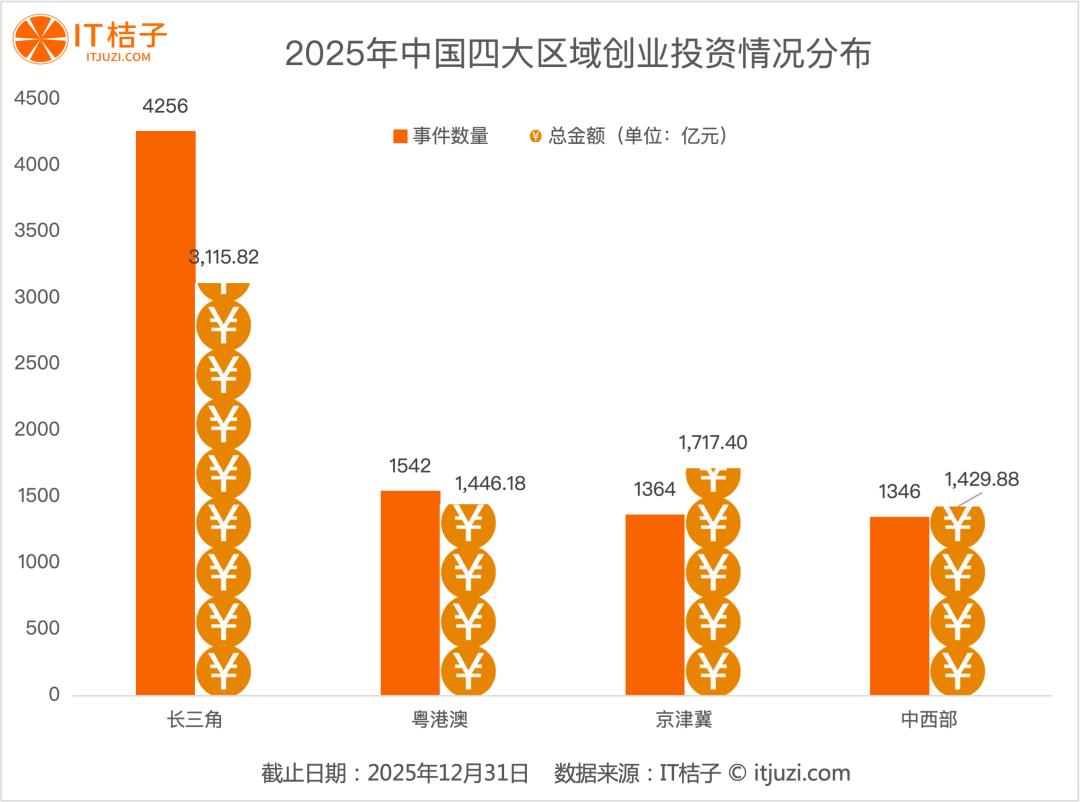
Core Insights - The investment landscape in China's venture capital is characterized by a "one strong, many strong" and "similarity with differences" pattern, with the Yangtze River Delta leading significantly [1] - The article analyzes four major economic regions, highlighting their scale, investment consensus, and unique sectors, creating a comprehensive view of capital flow [1] Regional Investment Landscape - The primary market in China has formed a clear tiered structure, with the Yangtze River Delta as the most active venture capital center, recording 4,256 investment events and attracting 311.58 billion yuan [2][4] - The second tier includes the Beijing-Tianjin-Hebei, Guangdong-Hong Kong-Macau, and Central-Western regions, with investment events close in number: 1,364, 1,542, and 1,346 respectively, indicating increasing competition among these regions [4] Core Investment Consensus - Despite regional differences, there is a strong national consensus on seven key investment sectors: artificial intelligence applications, pharmaceuticals, biotechnology, medical devices, new energy, integrated circuits, and robotics [5][7] - Integrated circuits have the highest consensus, ranking among the top two investment hotspots in the Yangtze River Delta (597 events), Guangdong-Hong Kong-Macau (160 events), and Central-Western regions (110 events) [5] Unique Regional Advantages - Each region has developed differentiated sectors based on local resources, creating unique competitive advantages: - **Beijing-Tianjin-Hebei**: Notable for aerospace (76 events), AIGC (60 events), and AI foundational technologies (52 events), showcasing its role as a national technology innovation center [8][10] - **Yangtze River Delta**: Strong industrial chain collaboration, with new materials (332 events) as a significant sector, complementing the leading integrated circuit industry [10][13] - **Guangdong-Hong Kong-Macau**: Focus on intelligent equipment (88 events), reflecting a deep foundation in precision manufacturing and the integration of cutting-edge technology with industry [15] - **Central-Western Regions**: Actively converting local resource advantages into industrial momentum, with new materials (104 events) emerging as a key growth area [18] Conclusion - The 2025 venture capital landscape in China illustrates a dynamic picture of "concentration with dispersion, consensus with uniqueness," defining the direction of capital flow and presenting opportunities for entrepreneurs and investors [19]