
美元信用弱化

Search documents
现货白银一度突破93美元关口,有色金属ETF(159871)盘初快速走强,机构:银价长期中枢抬升
2 1 Shi Ji Jing Ji Bao Dao· 2026-01-15 02:15
Group 1 - Precious metal prices continue their recent strong upward trend, with spot silver rising over 7% to surpass $93, reaching a new historical high, while spot gold also hit a record high of $4643 per ounce [1] - On January 15, both spot gold and silver experienced a decline, with gold falling below $4610 per ounce and silver dropping below $92 per ounce [1] - The A-share market opened lower on January 15, but the non-ferrous metal index saw a sharp rise, with stocks like Huayou Cobalt and Zhongjin Rare Metal increasing over 6% [1] Group 2 - Ping An Securities suggests that uncertainties from the U.S. government, ongoing U.S. debt issues, and the weakening dominance of the tech industry are expected to further weaken U.S. dollar credit, which may drive silver's monetary attributes [2] - Industrial attributes of silver are expected to amplify its price elasticity, with the long-term upward trend in gold and silver prices remaining intact as the dollar cycle sets the direction [2] - The decline in foreign investors' holdings of U.S. Treasury bonds indicates that the dollar may not maintain long-term stability, which will continue to elevate the price center of gold and silver [2]


非美央行加速储备多元化有何深意?
Zheng Quan Ri Bao· 2026-01-14 15:40
Core Viewpoint - The global reserve asset landscape is undergoing a significant transformation, with non-U.S. countries' official gold reserves nearing parity with their holdings of U.S. Treasury securities, indicating a shift towards diversification in reserve assets [1][2]. Group 1: Gold Reserves and U.S. Treasury Holdings - As of November 2025, non-U.S. countries' official gold reserves exceeded 900 million troy ounces, valued at approximately $3.82 trillion based on gold prices [1]. - Non-U.S. countries held $3.88 trillion in U.S. Treasury securities as of October 2025, showing a close alignment with gold reserves [1]. - The trend of increasing gold reserves is driven by central banks' sustained and significant purchases, with a net purchase of 1,045 tons in 2024, marking the third consecutive year above 1,000 tons [1]. Group 2: Price Dynamics and Market Sentiment - The price of gold has entered a strong upward cycle, with the London spot gold price increasing over 60% in 2025 and reaching historical highs, including a peak near $4,640 per ounce in January 2026 [2]. - The increase in gold prices and the accumulation of reserves signal a declining risk appetite for dollar-denominated assets, suggesting a shift in global capital preferences [2]. Group 3: Strategic Implications of Gold Accumulation - Expanding gold reserves offers multiple strategic advantages for non-U.S. central banks, including effective hedging against the weakening of dollar credit and enhancing financial security through diversified asset allocation [3]. - Gold's properties as a safe-haven asset help countries withstand geopolitical conflicts and inflationary pressures, contributing to the stable growth of national wealth [3]. - Strengthening gold reserves can enhance the stability and resilience of national financial systems, supporting local currency settlements and aiding in the internationalization of currencies, thereby increasing countries' influence in global financial governance [3].
新刊速读 | 如何看待宏大叙事对资产定价的重塑
Xin Hua Cai Jing· 2026-01-14 15:01
Core Viewpoint - The narrative economy is increasingly influencing global asset pricing, with themes such as weakening dollar credit, gold as a monetary anchor, supply chain restructuring, AI infrastructure, and the new role of non-ferrous metals driving market performance [1][2][3] Group 1: Popular Narratives in 2025 - The five main narratives shaping the financial market include: 1. Long-term weakening of dollar credit, driven by a U.S. interest rate cut cycle [2] 2. Concerns over U.S. economic sustainability due to new policy frameworks, including tax increases and deficit expansion [2] 3. Gold becoming a new anchor for the monetary system, with central banks increasing gold reserves to mitigate dollar risk [2] 4. Restructuring of global supply chains due to geopolitical risks and rising tariffs, leading to increased value in key raw materials [2] 5. AI becoming a foundational infrastructure for industry transformation, impacting demand for non-ferrous metals [2] Group 2: Impact of Narratives on Asset Pricing - The five narratives are interconnected, forming a narrative constellation that influences asset pricing through: 1. Weakening dollar credit prompting a shift from credit currencies to physical assets like gold [3] 2. Supply chain restructuring emphasizing safety and resilience over efficiency [3] 3. AI infrastructure driving demand for non-ferrous metals, elevating their status from cyclical commodities to essential resources [3] Group 3: Mechanisms of Narrative Influence - Narratives affect asset pricing through various channels: 1. Reshaping reasonable price ranges by altering investor perceptions of asset safety and scarcity premiums [4] 2. Amplifying cyclical trends through risk premiums and volatility, leading to narrative premiums in related asset classes [4] 3. Reconstructing price relationships across assets based on thematic connections rather than independent fundamentals [4] Group 4: Recent Trends in Narratives - Since October 2025, mainstream narratives have shown signs of weakening, with: 1. A rebound in the dollar reflecting a technical correction and hawkish monetary policy [7] 2. A break in the upward trend of gold prices due to changing geopolitical and trade dynamics [7] 3. A cooling of supply chain narratives amid trade negotiations [7] 4. A shift in market sentiment regarding large tech companies, indicating a potential break in their positive cycle [7] 5. Increased divergence in demand for non-ferrous metals, with both long-term growth expectations and oversupply pressures [7] Group 5: Future Narratives - Potential new narratives for the next five years include: 1. Industrialization in developing countries, providing investment opportunities for companies [9] 2. The second wave of globalization for Chinese companies, with a focus on global orders outpacing domestic ones [9] 3. The acceleration of AI applications, leading to new industry transformations [9] 4. An upgrade in service consumption, with a long-term trend towards increased service sector contributions [9] Group 6: Challenges and Responses in Research Methodology - The influence of narratives challenges traditional investment research methodologies, necessitating: 1. Incorporating narratives as identifiable variables alongside fundamentals and valuations [10][11] 2. Differentiating narrative levels to align funding duration and risk-return profiles [11] 3. Adopting momentum strategies during narrative popularity phases [11] 4. Establishing objective indicators for narrative validation, ensuring data-driven decision-making [11] 5. Maintaining awareness of valuation constraints to prevent excessive risk exposure [11]
历史新高!金价飙升的背后:全球银行为何仍在疯狂买进?
Sou Hu Cai Jing· 2026-01-09 01:03
Core Insights - Gold prices have surpassed $4,100, marking the highest annual increase since 1979, with significant speculative inflows while global central banks adopt a more cautious accumulation strategy [1] - Over 95% of surveyed central banks anticipate continued gold purchases in the next 12 months, the highest level since 2019 [1] Central Bank Gold Reserves - The proportion of gold in global central bank reserves has increased from 15% three years ago to 22% currently, but remains below historical levels of 29% in 1990 and 58% in 1980 [1] - Central bank gold purchases have risen significantly, with quarterly purchases increasing from an average of 100-200 tons before Q3 2022 to 200-400 tons thereafter [5] - In a 2025 survey, 76% of central banks indicated that their gold reserves would continue to rise moderately over the next five years, up from 46% in 2022 [5] Investment Demand - The primary drivers of increased gold demand are investor risk aversion and central bank purchases, with gold seen as a low-drawdown asset that is essential for portfolio diversification [7] - In Q2, global gold ETF inflows reached 170 tons, contrasting with outflows in the same period of 2024, while physical gold investment rose by 11% to 307 tons [11] - Chinese investors led global demand for gold bars and coins, with a 44% year-on-year increase to 115 tons [11] Market Outlook - International institutions are optimistic about the gold market, with predictions of gold prices exceeding $5,100 per ounce by the end of 2026 based on expectations of U.S. monetary and fiscal easing [14] - Analysts expect gold prices to remain significantly above historical averages, approximately 150% higher than the average from 2015-2019, despite potential fluctuations [16] - Central banks are increasingly storing gold domestically, with 59% of surveyed banks indicating that their gold reserves are held within their own countries, up from 41% in 2024 [7]
COMEX金重构全球储备货币底层逻辑
Jin Tou Wang· 2026-01-08 06:05
在全球去美元化趋势不断深化的背景下,黄金的战略地位持续上升。自2022年俄乌冲突爆发以来,美 元"武器化"促使各国加快减少对单一货币依赖的步伐,黄金由此进入重新定价阶段。此后三年,金价单 边上行,接连突破3000、4000美元整数关口,屡创历史新高。 目前,美元信用弱化周期仍在延续,全球央行增持黄金的需求依旧强劲,加之地缘政治紧张局势持续、 美债规模不断扩大,黄金的货币与避险属性共同支撑价格中枢稳步上移。分析认为,在多重结构性利好 推动下,黄金期货的长期上涨趋势难以根本改变。 从市场节奏看,2025年四季度金价波动较过去三年明显收窄,显示高位市场趋于理性。尽管多数机构对 2026年金价目标仍持乐观态度,甚至有预期指向5000美元,但从当前价格中枢测算,潜在涨幅已有所缩 小。 今日周四(1月8日)亚盘时段,COMEX 黄金期货最新报价 4424.80美元 / 盎司,较前一交易日下跌42.30 美元,跌幅 0.94%,成功站稳 4400美元 / 盎司关口。当日开盘价 4467.10美元 / 盎司,最高价 4475.20美 元 / 盎司,最低价 4423.60美元 / 盎司。 打开APP,查看更多高清行情>> 【要 ...
紫金矿业(601899):公告点评:业绩符合预期,2026年预计矿产金、铜产量增长17%、10%
EBSCN· 2025-12-31 15:38
Investment Rating - The report maintains an "Accumulate" rating for the company [5] Core Views - The company is expected to achieve a net profit attributable to shareholders of approximately 510-520 billion yuan in 2025, representing a year-on-year increase of about 59%-62% [1] - The company anticipates significant growth in mineral production for 2025, with gold production expected to increase by 23% and copper production by 2% [2] - The report highlights a favorable outlook for gold and copper prices due to a weakening US dollar and supply-demand dynamics, supporting the company's profitability [3] Summary by Sections Financial Performance - The company forecasts a net profit of approximately 475-485 billion yuan after excluding non-recurring gains and losses for 2025, which is a year-on-year increase of about 50%-53% [1] - For Q4 2025, the estimated net profit attributable to shareholders is around 136 billion yuan, reflecting a year-on-year increase of 77% but a quarter-on-quarter decrease of 6.4% [1] Production Outlook - The company projects mineral production for 2026 to grow by 17% for gold, 10% for copper, 19% for silver, and 380% for lithium carbonate [2] - The planned production for 2026 includes 105 tons of gold, 1.2 million tons of copper, 12,000 tons of lithium carbonate, and 520 tons of silver [2] Price Trends - The average spot price of gold in London from October 1, 2025, to December 29, 2025, is expected to be 4,164 USD/ounce, a 56% increase from Q4 2024 and a 19% increase from Q3 2025 [2] - The average price of copper on the LME is projected to be 11,048 USD/ton, marking a 19% increase from Q4 2024 and a 12% increase from Q3 2025 [2] Profitability and Valuation - The report adjusts the company's profit forecast based on rising gold and copper prices, estimating net profits of 515.1 billion yuan, 755.0 billion yuan, and 815.6 billion yuan for 2025, 2026, and 2027 respectively, with year-on-year growth rates of 61%, 47%, and 8% [3] - The current stock price corresponds to a P/E ratio of 17, 12, and 11 for the years 2025, 2026, and 2027 respectively [3]

霸榜前五,有色金属2025年表现最佳,2026年怎么看?
3 6 Ke· 2025-12-31 12:39
Group 1 - The capital markets in Hong Kong and A-shares experienced significant growth in 2025, with the non-ferrous metals sector, including precious metals like gold and silver, leading the way with an annual increase of 94.73% [1] - Silver and gold futures saw price increases of over 130% and 40% respectively, with multiple instances of extreme price surges, which also positively impacted other industrial metals [4][5] - The copper sector in the Hong Kong market surged over 261%, significantly outperforming other sectors, while gold and precious metals also saw increases exceeding 170% [4][5] Group 2 - Major companies in the non-ferrous metals sector, such as Zijin Mining and China Hongqiao, reported substantial stock price increases, with Zijin Mining's stock rising over 163% and China Hongqiao's stock increasing by 203.7% [9][11] - Zijin Mining achieved a revenue of 254.2 billion RMB in the first three quarters of 2025, marking a 10.33% year-on-year increase, while net profit rose by 55.45% [17][19] - China Hongqiao's revenue for the first half of the year reached 81.04 billion RMB, a 10.12% increase, with net profit growing by 35.02% [24][26] Group 3 - The non-ferrous metals sector is expected to continue its upward trajectory in 2026 due to favorable monetary conditions and a tight supply-demand balance [4][28] - Global economic factors, such as the restructuring of global order and the weakening of the US dollar, are driving precious metal prices higher [27] - Analysts from major financial institutions, including Goldman Sachs and Morgan Stanley, express optimism about the non-ferrous metals sector, highlighting structural supply-demand gaps in metals like copper and aluminum [28][29]

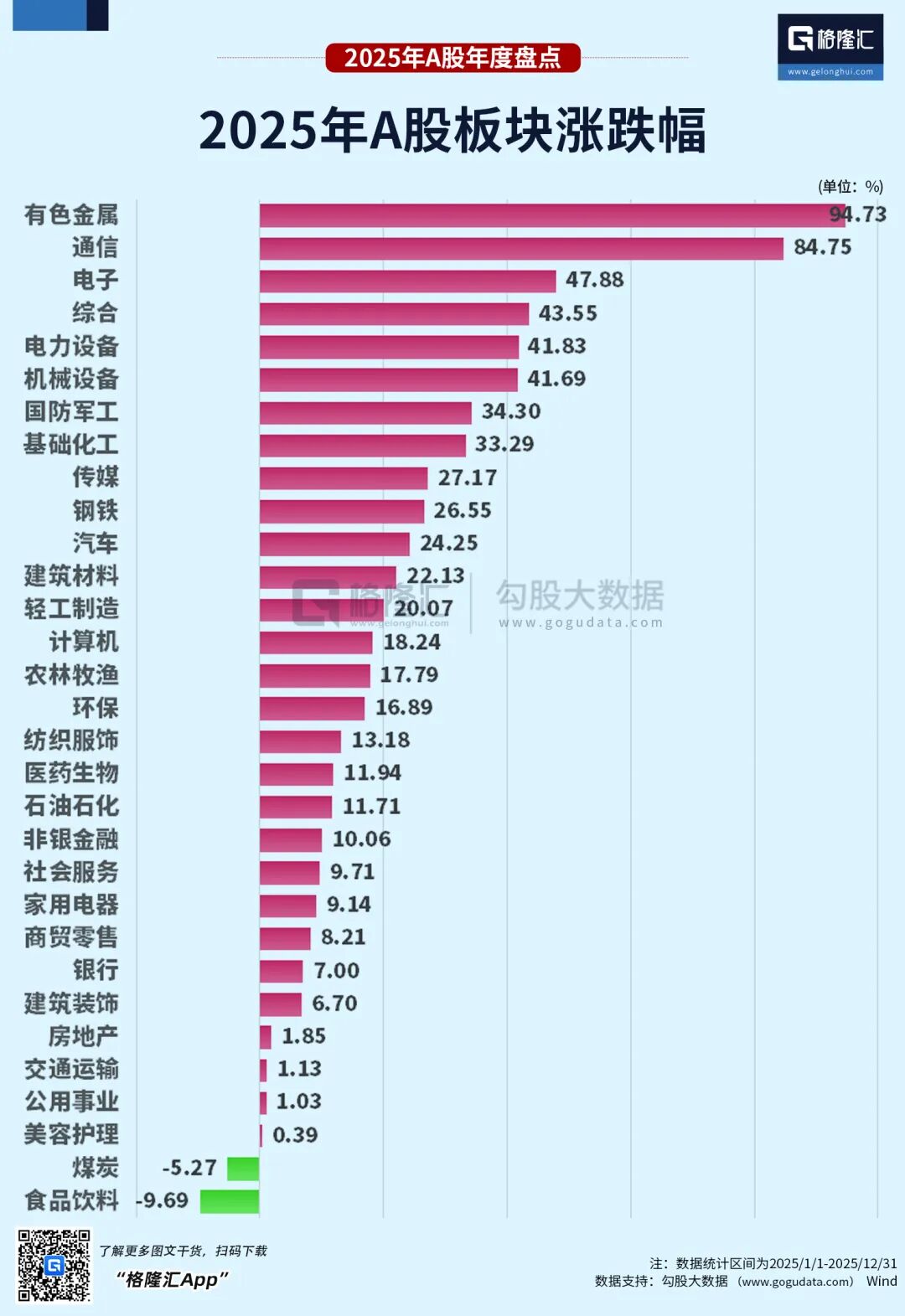
霸榜前五!有色金属2025年表现最佳,2026年怎么看?
Ge Long Hui A P P· 2025-12-31 10:46
Core Viewpoint - The capital markets in 2025 experienced significant activity, with the metals sector, particularly precious metals, leading the gains, showcasing a remarkable annual increase of 94.73% by year-end [1][4]. Group 1: Market Performance - The precious metals sector, including silver and gold, saw year-to-date price increases of over 130% and 40%, respectively, despite regulatory interventions causing a pullback in silver prices [4][5]. - In the Hong Kong stock market, the copper sector surged over 261%, significantly outperforming other sectors, while gold and precious metals also saw increases exceeding 170% [4][5]. - The top five performing sectors in the Hong Kong market were all dominated by non-ferrous metals, marking a historical first [7]. Group 2: Company Performance - Zijin Mining (02899.HK) saw its stock price increase by over 163%, with a market capitalization exceeding 940 billion HKD, outperforming its A-share counterpart [7][9]. - China Molybdenum (03993.HK) experienced a stock price increase of over 287%, with a market cap reaching 410 billion HKD [9]. - China Hongqiao (01378.HK), the largest integrated electrolytic aluminum producer, recorded a stock price increase of 203.7%, with a market cap surpassing 320 billion HKD [9][11]. Group 3: Financial Performance - Zijin Mining reported a revenue of 254.2 billion RMB for the first three quarters of 2025, a year-on-year increase of 10.33%, with a net profit of 37.86 billion RMB, up 55.45% [18][20]. - China Hongqiao's revenue for the first half of the year reached 81.04 billion RMB, a 10.12% increase, with a net profit of 12.36 billion RMB, up 35.02% [20][23]. - China Molybdenum's net profit for the first three quarters reached 14.28 billion RMB, a 72.61% increase, despite a revenue decline of 5.99% [24][26]. Group 4: Future Outlook - The non-ferrous metals sector is expected to continue its upward trajectory in 2026, driven by favorable monetary conditions and a tight supply-demand balance [4][28]. - Global structural supply constraints in copper and aluminum are anticipated to maintain high prices, with projections indicating a significant copper concentrate deficit in 2025 [29]. - Major institutions, including Goldman Sachs and Morgan Stanley, have expressed positive outlooks on the non-ferrous metals sector, highlighting the growth potential of leading companies like Zijin Mining and China Hongqiao [28][30].
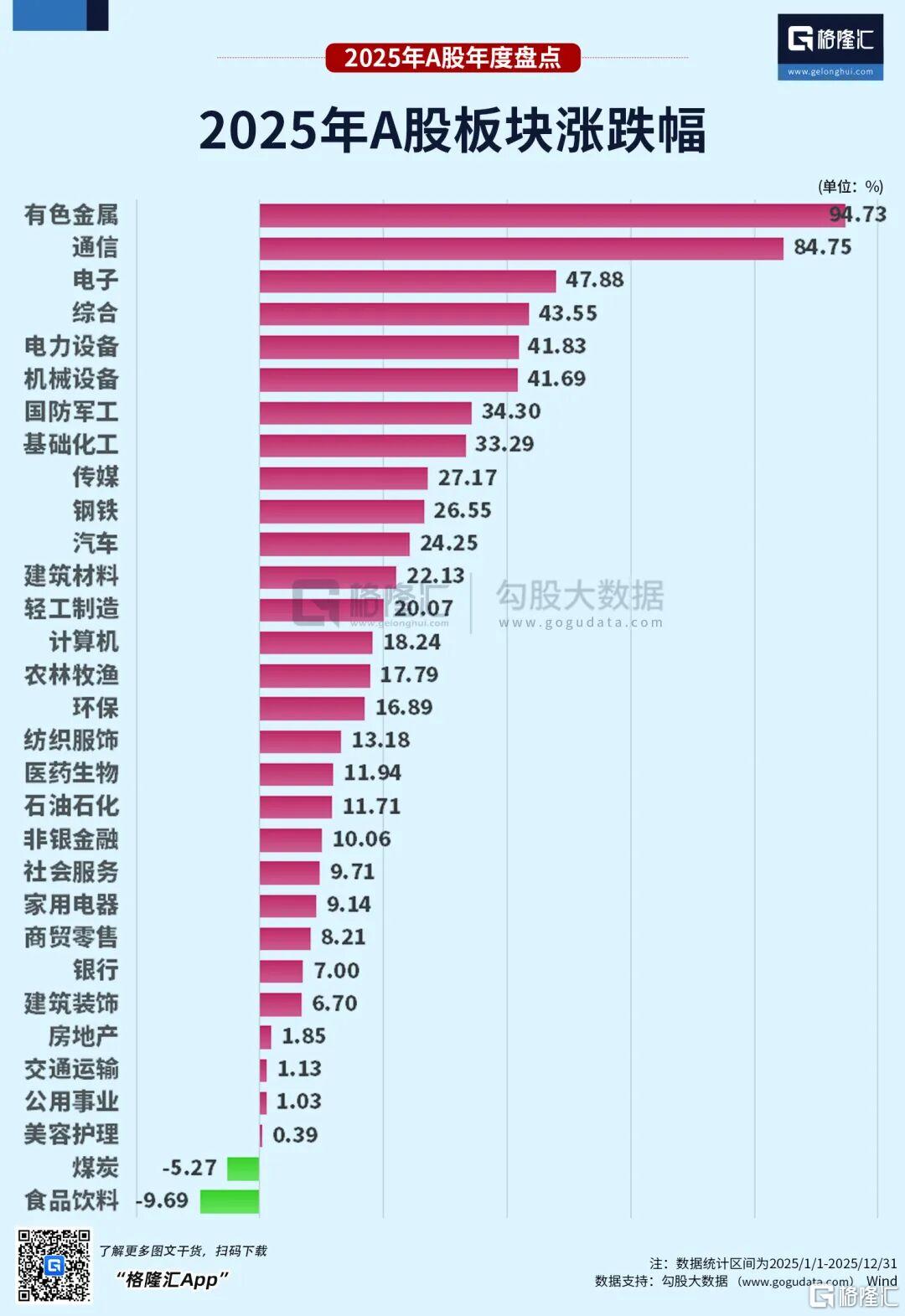
霸榜前五!有色金属2025年表现最佳,2026年怎么看?
格隆汇APP· 2025-12-31 10:35
Core Viewpoint - The article highlights the significant performance of the non-ferrous metal sector, particularly precious metals like gold and silver, which have outperformed other sectors in 2025, with non-ferrous metals rising by 94.73% throughout the year [2]. Group 1: Market Performance - Precious metals, including silver and gold, saw price increases of over 130% and 40% respectively, with silver experiencing extreme volatility due to regulatory interventions [5]. - In the stock market, non-ferrous metals such as copper, aluminum, cobalt, lithium, and rare earths also entered a strong upward cycle, with leading companies in the sector seeing their stock prices double [5]. - The Hong Kong stock market's non-ferrous sector outperformed other industries, with copper stocks soaring over 261%, and gold and precious metals rising by 197.85% [7][8]. Group 2: Company Performance - Zijin Mining (02899.HK) saw its stock price increase by over 163%, outperforming its A-share counterpart, with a current market capitalization exceeding 940 billion HKD [9]. - Luoyang Molybdenum (03993.HK) surged by over 287%, while China Hongqiao (01378.HK) recorded a 203.7% increase, with both companies showing strong earnings growth [11][22]. - China Hongqiao's revenue for the first half of the year reached 81.04 billion RMB, a 10.12% increase, with net profit rising by 35.02% [22]. Group 3: Future Outlook - Institutions expect the non-ferrous metal sector to continue its upward trajectory in 2026 due to favorable monetary conditions and a tight supply-demand balance [6]. - The article discusses the structural supply-demand gap in copper, with a projected global copper concentrate deficit of 848,000 tons in 2025, indicating a tightening market [32][33]. - The performance of leading companies like Zijin Mining and China Hongqiao is expected to remain strong, supported by their resource reserves and integrated industrial chains [34].
有色金属行业双周报(2025、12、12-2025、12、25):国际金价首次突破4500美元,白银价格刷新历史高位-20251226
Dongguan Securities· 2025-12-26 11:31
Investment Rating - The report maintains a "Market Weight" rating for the non-ferrous metals industry, indicating that the industry index is expected to perform within ±10% of the market index over the next six months [64]. Core Insights - As of December 25, 2025, the non-ferrous metals industry has seen a 5.71% increase over the past two weeks, outperforming the CSI 300 index by 3.73 percentage points, ranking third among 31 industries [4][16]. - The gold price has surpassed $4500 per ounce for the first time, with significant increases in both gold and silver prices due to factors such as weakened dollar credit and geopolitical tensions [9][59]. - Industrial metals, particularly copper and aluminum, have also reached historical highs, driven by improved macroeconomic sentiment and supply-demand dynamics [9][28][59]. Summary by Sections Industry Performance - The non-ferrous metals industry has increased by 9.20% in December, outperforming the CSI 300 index by 6.64 percentage points [16]. - Year-to-date, the industry has risen by 87.05%, surpassing the CSI 300 index by 69.07 percentage points [16]. Subsector Performance - Among the subsectors, the small metals sector increased by 7.51%, energy metals by 6.89%, and industrial metals by 4.82% over the past two weeks [20][22]. - Year-to-date performance shows small metals up 93.29%, energy metals up 99.62%, and industrial metals up 88.13% [22]. Price Movements - As of December 24, 2025, LME copper was priced at $12,133 per ton, aluminum at $2,956.50 per ton, and nickel at $15,660 per ton [28][60]. - Gold prices reached $4,515 per ounce, with silver at $71.61 per ounce, marking significant year-to-date increases [9][38]. Company Recommendations - The report suggests monitoring companies such as Western Mining (601168) and Luoyang Molybdenum (603993) due to their strong performance and market positioning [60][62]. - Xiamen Tungsten (600549) is also highlighted for its robust growth in revenue and profit, driven by rising tungsten and rare earth prices [62].


