新发展格局

Search documents
深刻揭示新时代发展规律——习近平经济思想引领新时代经济工作述评之二
Xin Hua She· 2025-10-14 15:06
Group 1 - China's foreign trade showed resilience in the first three quarters, with a year-on-year increase of 4% in goods trade, and high-tech product exports rising by 11.9% [3][4] - The foundation of the real economy is becoming increasingly solid, with China now being the world's largest manufacturing power, showcasing a diverse range of industrial capabilities [4][5] - The transition to a new development stage marks a significant leap in China's socialist development, emphasizing the importance of recognizing historical development patterns and seizing opportunities [6][7] Group 2 - The new development stage is characterized by high-quality development, with a focus on innovation, green growth, and the integration of domestic and international markets [8][9] - The new development concept introduced by Xi Jinping emphasizes innovation as a core driver of economic growth, alongside green development as a fundamental principle [9][10] - The need for structural reforms is highlighted, particularly in enhancing the quality and efficiency of resource allocation and addressing systemic barriers to factor mobility [14][15] Group 3 - The ongoing reforms aim to optimize the economic structure and promote the transition from old to new growth drivers, with a focus on supply-side structural reforms [18][19] - The relationship between market forces and government intervention is crucial for achieving optimal resource allocation and maximizing efficiency [17][20] - The emphasis on enhancing domestic demand and building a robust internal circulation system is seen as essential for mitigating external shocks and fostering sustainable growth [13][22] Group 4 - Food and energy security are prioritized as fundamental aspects of national stability and development, with significant measures taken to ensure grain production and energy supply [26][27] - The importance of risk management and proactive measures to address potential economic challenges is underscored, with a focus on maintaining economic stability and social order [28][29] - The commitment to high-quality development is reinforced through coordinated fiscal and monetary policies, aimed at stabilizing expectations and boosting confidence in the economy [30][31]
坚持党的全面领导 为实现高质量发展提供根本保证——“十四五”时期经济社会发展实践与启示述评之一
Xin Hua She· 2025-10-14 14:49
Core Viewpoint - High-quality development is the primary task for building a modern socialist country, and the comprehensive leadership of the Party is the fundamental guarantee for achieving this goal [1][2]. Economic Performance - During the "14th Five-Year Plan" period, China's GDP has successively surpassed 110 trillion, 120 trillion, and 130 trillion yuan, with an expected reach of around 140 trillion yuan this year, contributing approximately 30% to global economic growth [2]. Strategic Direction - The Party has maintained strategic determination over the past five years, adhering to a consistent blueprint for development, as outlined in the "14th Five-Year Plan" and the long-term goals for 2035 [4][5]. Innovation and Development - New concepts and strategies have been introduced to guide economic and social development, emphasizing the seamless integration of innovation and industrial chains [6][7]. Leadership and Reform - The Party's leadership is crucial for implementing reforms and ensuring that decisions translate into effective policies across various sectors [9][10][11]. Future Planning - The upcoming "15th Five-Year Plan" emphasizes the need for high-quality development and strategic alignment across regions, with specific goals set for various provinces [13][14]. Organizational Strength - The integration of Party organizations into various industries and sectors is aimed at enhancing development and ensuring that political advantages translate into developmental benefits [15].
人民日报丨加快建设全国统一电力市场
国家能源局· 2025-10-14 11:58
电力市场是全国统一大市场的重要组成部分。2021年,习近平总书记在中央全面深化改革委员会第二十二次会议上指 出:"要遵循电力市场运行规律和市场经济规律,优化电力市场总体设计,实现电力资源在全国更大范围内共享互济和优化 配置,加快形成统一开放、竞争有序、安全高效、治理完善的电力市场体系。"这是构建现代能源体系、推动能源高质量发 展的重大部署,同时也为构建全国统一大市场提供了重要基础。我们要以习近平经济思想为指引,加快建设全国统一电力 市场,促进电力资源优化配置、构建现代能源体系、推动能源高质量发展,为以中国式现代化全面推进强国建设、民族复 兴伟业提供有力支撑。 建设全国统一电力市场是建设全国统一大市场、推动高质量发展的探索实践 建设全国统一大市场是发挥我国超大规模市场优势的内在要求。习近平总书记在《关于构建新发展格局》中指出:"从供给 看,我国基于国内大市场形成的强大生产能力,能够促进全球要素资源整合创新,使规模效应和集聚效应最大化发挥。"电 力是经济社会发展的基础性支撑,电力资源的优化配置关乎能源安全与高质量发展大局。建设全国统一电力市场是深化电 力体制改革的重要举措,有利于促进电力资源优化配置、保障电力供应 ...

加快建设全国统一电力市场
Ren Min Ri Bao· 2025-10-14 02:03
Core Viewpoint - The construction of a unified national market is essential for establishing a new development pattern, as emphasized by General Secretary Xi Jinping in various writings, highlighting the need for a high-standard market system and effective market rules [1][2]. Group 1: Importance of a Unified National Market - The unified national market is a fundamental requirement for leveraging China's large-scale market advantages, facilitating resource integration and maximizing scale and agglomeration effects [2][3]. - A unified electricity market is a critical component of the national unified market, promoting the optimization of electricity resource allocation and ensuring energy security [2][3]. Group 2: Support for Domestic Circulation - The new development pattern is centered around domestic circulation, supported by a unified national market, which enhances the accumulation of social wealth and national strength [3][4]. - Electricity is vital for smooth domestic circulation; a fragmented electricity market can increase resource allocation costs and hinder the effectiveness of the unified market [3][4]. Group 3: Energy Security and Economic Stability - Accelerating the construction of a unified electricity market is crucial for maintaining energy security and economic stability amid complex international environments [4][5]. - The unified electricity market will enhance the resilience of the energy system and support the development of strategic emerging industries [4][5]. Group 4: Green and Low-Carbon Transition - The electricity sector plays a key role in achieving China's dual carbon goals, and a unified market is necessary for large-scale consumption of green electricity [6][7]. - The construction of a unified electricity market will facilitate the integration of carbon and electricity markets, promoting a green and low-carbon transition [6][7]. Group 5: Progress in Electricity Market Construction - The electricity market has seen significant growth, with market transactions increasing from 1.1 trillion kWh in 2016 to 6.2 trillion kWh by 2024, representing a rise from 17% to 63% of total electricity consumption [8]. - The market structure is evolving, with over 800,000 market participants and a growing number of new business models emerging [7][8]. Group 6: Future Directions for Market Development - The construction of a unified electricity market requires the establishment of unified rules, infrastructure, and regulatory mechanisms to ensure efficient operation and coordination [9][10]. - Expanding market openness and enhancing international cooperation in energy will strengthen China's position in global energy governance [11].
统筹供需的实践成效与理论创新
Jing Ji Ri Bao· 2025-10-14 01:02
Core Viewpoint - The article emphasizes the importance of balancing total supply and total demand in China's macroeconomic governance to achieve high-quality development and a stable economic cycle [1][3][6]. Summary by Sections Understanding Total Supply and Demand - Total supply refers to the total amount of final products and services that a country or region can provide within a certain period, reflecting optimal production capacity under specific conditions [2]. - Total demand encompasses the overall demand for products and services in society, including domestic and foreign demand, influenced by factors such as consumer spending, investment, net exports, government spending, and monetary and fiscal policies [2]. Historical Context and Policy Evolution - Historically, China has prioritized the balance between total supply and total demand, as seen in various economic plans since the "Eighth Five-Year Plan" [3]. - The focus has shifted towards achieving both short-term stability and long-term growth, with an increasing emphasis on the coordination of supply and demand in response to changing economic conditions [3]. Supply-Side Structural Reform - Supply-side structural reform is identified as a key strategy to optimize total supply and better adapt to changes in total demand, initiated by President Xi Jinping in 2015 [4]. - The goal is to enhance the quality of the supply system, reduce ineffective supply, and increase effective and high-end supply to improve adaptability and flexibility [4]. Demand-Side Management - Demand-side management has been emphasized as a complementary approach to supply-side reforms, particularly in light of insufficient domestic demand and weak consumption [5]. - The strategy includes expanding domestic demand as a critical focus for constructing a new development pattern [5]. Coordinated Efforts for Dynamic Balance - The article highlights the need for coordinated efforts between supply-side and demand-side management to achieve a dynamic balance, with a focus on enhancing the adaptability and balance of supply and demand [6][14]. - It stresses the importance of using various macroeconomic policies, including stability, growth, and structural policies, to achieve this balance [16]. Breakthroughs in Macroeconomic Theory - The article discusses the limitations of Western macroeconomic theories, which primarily focus on demand management, and contrasts this with China's approach of integrating supply and demand considerations [7][10]. - It argues that the new understanding of balancing total supply and total demand provides a theoretical foundation for improving macroeconomic governance and addressing challenges in the digital economy [11][12]. Future Directions - The article calls for a systematic approach to ensure that supply and demand are dynamically balanced at a higher level, emphasizing the need for continuous supply-side structural reforms and the expansion of domestic demand [14][15]. - It also highlights the importance of improving the quality of investments and enhancing the overall investment structure to support sustainable economic growth [15].
加快建设全国统一电力市场(深入学习贯彻习近平新时代中国特色社会主义思想·学习《习近平经济文选》第一卷专家谈)
Ren Min Ri Bao· 2025-10-13 22:20
建设全国统一大市场是构建新发展格局的基础支撑和内在要求。习近平总书记高度重视全国统一大市场 建设,《习近平经济文选》第一卷中的多篇著作都对此作出重要论述。比如,《加快构建新发展格局, 把握未来发展主动权》指出:"要深化要素市场化改革,建设高标准市场体系,加快构建全国统一大市 场";《确保我国经济航船乘风破浪、行稳致远》指出:"政府要有所为、有所不为,解决好缺位、越位 问题。有所为,就是要不断建设法治经济、信用经济,完善市场规则并带头遵守规则,通过坚决惩治腐 败、保障公共安全等优化市场环境,着力矫正市场失灵,规范竞争秩序,使全国统一大市场成为各类经 营主体公平竞争的大舞台";等等。习近平总书记的重要论述,为我们以全国统一大市场建设支撑构建 新发展格局提供了科学指引。 电力市场是全国统一大市场的重要组成部分。2021年,习近平总书记在中央全面深化改革委员会第二十 二次会议上指出:"要遵循电力市场运行规律和市场经济规律,优化电力市场总体设计,实现电力资源 在全国更大范围内共享互济和优化配置,加快形成统一开放、竞争有序、安全高效、治理完善的电力市 场体系。"这是构建现代能源体系、推动能源高质量发展的重大部署,同时也为 ...
领航定向驾驭发展全局——习近平经济思想引领新时代经济工作述评之一
Xin Hua She· 2025-10-13 15:48
共识,愈加深刻:中国经济之所以能够翻山越岭、克难前进,最根本的原因在于以习近平同志为核 心的党中央领航掌舵,在于习近平经济思想的科学指引。 思想的波涛卷起巨澜,时间在量变的积累中孕育质变。 行进在新时代航程上,以科学理论为炬,以发展实践为帆,中国共产党领导14亿多人民共同执笔的 奋斗史诗,正成章于星海、运笔于山河,铺展开充满信心和希冀的瑰丽画卷。 (一) "十四五"收官在即,在前四年5.5%的平均增速基础上,2025年中国经济总量有望达到140万亿元。 成绩,世界瞩目:在这么大体量的基础上,在各种风险挑战的冲击下,中国经济保持这样的增速, 在经济发展史上前所未有。 新华社北京10月13日电 题:领航定向驾驭发展全局——习近平经济思想引领新时代经济工作述评 之一 新华社记者 金秋的中国大地,硕果盈枝。 巍巍太行山,风光无限好。 2025年7月,习近平总书记来到这里,访企业、听汇报,为山西经济社会发展指明方向: "要扎实推进传统产业转型升级,围绕发展新质生产力因地制宜布局新兴产业和未来产业""要用好 多元发展条件,优化营商环境,激发经营主体活力"。 山西的转型发展,是中国经济砥砺前进的一个缩影。党的十八大以来,习 ...
新华全媒头条|领航定向驾驭发展全局——习近平经济思想引领新时代经济工作述评之一
Xin Hua She· 2025-10-13 14:45
共识,愈加深刻:中国经济之所以能够翻山越岭、克难前进,最根本的原因在于以习近平同志为 核心的党中央领航掌舵,在于习近平经济思想的科学指引。 思想的波涛卷起巨澜,时间在量变的积累中孕育质变。 行进在新时代航程上,以科学理论为炬,以发展实践为帆,中国共产党领导14亿多人民共同执笔 的奋斗史诗,正成章于星海、运笔于山河,铺展开充满信心和希冀的瑰丽画卷。 (一) 巍巍太行山,风光无限好。 领航定向驾驭发展全局——习近平经济思想引领新时代经济工作述评之一 新华社记者 金秋的中国大地,硕果盈枝。 "十四五"收官在即,在前四年5.5%的平均增速基础上,2025年中国经济总量有望达到140万亿元。 成绩,世界瞩目:在这么大体量的基础上,在各种风险挑战的冲击下,中国经济保持这样的增 速,在经济发展史上前所未有。 2025年7月,习近平总书记来到这里,访企业、听汇报,为山西经济社会发展指明方向: 山西的转型发展,是中国经济砥砺前进的一个缩影。党的十八大以来,习近平总书记多次考察三 晋大地,对一省的发展把脉,映射出对全局的深刻把握—— 2017年,强调"贯彻新发展理念""以深化供给侧结构性改革推动经济转型发展"; 2020年,要求 ...
中欧班列(武汉)双节开出12列
Chang Jiang Ri Bao· 2025-10-09 08:05
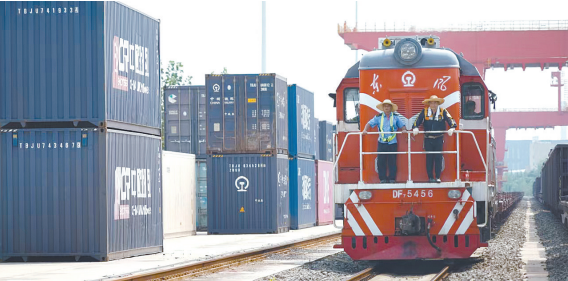
Group 1 - The core point of the article highlights the successful operation of the China-Europe Railway Express (Wuhan) during the National Day and Mid-Autumn Festival, with multiple trains departing carrying various goods, including auto parts and LCD TV components [2][3] - During the holiday period, a total of 12 trains were dispatched from the Wujiashan Station, with goods including automotive parts, textiles, machinery, hardware tools, LCD displays, home appliances, daily necessities, toys, and clothing [2] - The return trains transported raw materials and consumer goods such as pulp board, flour, and kraft paper, meeting domestic production needs and enriching market supply during the holiday [2] Group 2 - Wujiashan Station collaborated with various entities to enhance transportation organization and optimize operational processes, ensuring 24-hour uninterrupted operations for safe and punctual train departures [3] - The China-Europe Railway Express (Wuhan) has established a network covering 40 countries and 120 cities in Eurasia, expanding its cargo types from initially single electronic products to now include new energy vehicles, lithium batteries, and photovoltaic products [3] - The service capability of the railway express has significantly improved, supporting local economies and export-oriented industries [3]
四中全会前,人民日报连发八篇钟才文,传递什么信号
21世纪经济报道· 2025-10-07 23:56
Group 1 - The core viewpoint of the article emphasizes the long-term stability and resilience of China's economy under the guidance of Xi Jinping's economic thought, highlighting the significant achievements and transformations since the 18th National Congress of the Communist Party of China [3][4][8] - China's GDP is projected to grow from 54 trillion yuan in 2012 to nearly 135 trillion yuan by 2024, with an average annual growth rate of 6%, nearly double the global average of 3.1% [3][4] - The shift from traditional factor-driven growth to innovation-driven growth is evident, with the contribution of consumption to economic growth expected to reach around 63% during the 14th Five-Year Plan period [4][5] Group 2 - The article discusses the deep transformation of development dynamics, with innovation becoming the primary driving force, as evidenced by China's rise in the global innovation index from 34th in 2012 to 10th by 2025 [4][5] - The rural income growth rate has consistently outpaced urban income growth, with nearly 100 million rural poor lifted out of poverty, marking a significant achievement in poverty alleviation [5][6] - China's commitment to green transformation is highlighted, with a focus on ecological protection and sustainable development, as reflected in the significant improvements in environmental quality [6][31] Group 3 - The article outlines the importance of coordinated regional development strategies, such as the integration of the Beijing-Tianjin-Hebei region and the Yangtze River Delta, which have led to notable economic improvements [5][6] - China's foreign trade has remained robust, with the total volume of goods trade consistently ranking first globally, and the country has become a major trading partner for over 150 countries [6][32] - The article emphasizes the enhancement of people's well-being, with improvements in public services and social security systems contributing to increased life satisfaction and security among citizens [7][30] Group 4 - The article highlights the significant investment opportunities arising from China's economic transformation, particularly in traditional industries transitioning to high-end, intelligent, and green production [19][20] - The rapid growth of the consumer market is noted, with expectations for retail sales to exceed 50 trillion yuan by 2025, solidifying China's position as the world's second-largest consumer market [21][22] - The ongoing urbanization and infrastructure development present substantial investment opportunities, especially in less developed regions [22][23] Group 5 - The article discusses the certainty of China's development strategy, which ensures a stable direction for economic growth, contrasting with the policy fluctuations seen in some Western countries [23][24] - China's macroeconomic policies are characterized by stability and adaptability, allowing for effective responses to both domestic and international challenges [24][25] - The article emphasizes the resilience of China's economy, which has demonstrated the ability to withstand external pressures and maintain growth despite global uncertainties [25][26] Group 6 - The article underscores China's commitment to high-level openness and its role as a contributor to global economic stability, with a focus on multilateralism and cooperation [32][33] - The Belt and Road Initiative is highlighted as a significant platform for international cooperation, enhancing connectivity and economic collaboration with numerous countries [35][36] - China's market offers vast opportunities for foreign investment, with a focus on creating a favorable business environment and expanding market access [36][40]