
隐含波动率

Search documents
运用期权偏度策略应对突发风险
Qi Huo Ri Bao Wang· 2025-06-15 22:53
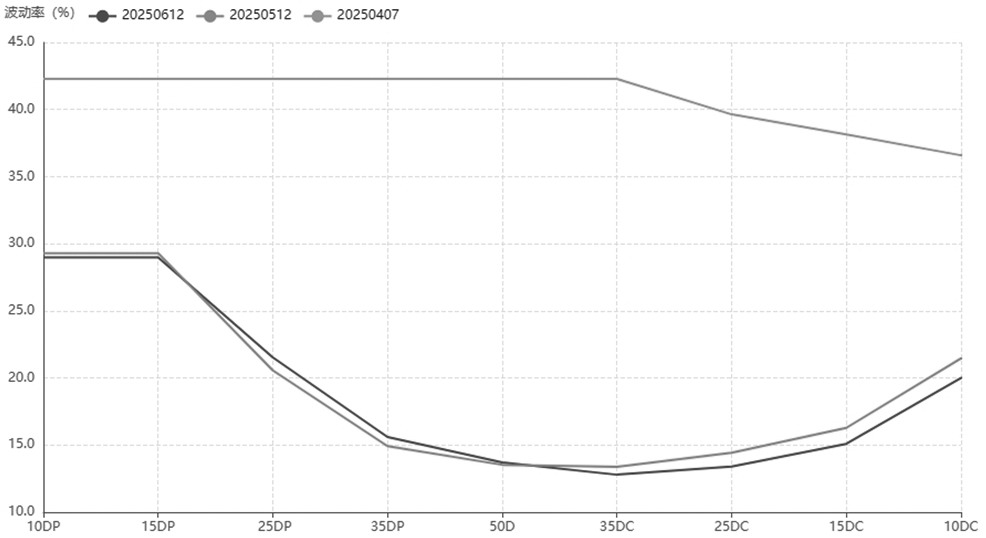
Core Viewpoint - The article discusses the impact of significant unexpected events on market volatility and the asymmetrical effects on call and put options, leading to substantial changes in skewness. As the effects of these events dissipate, skewness tends to revert to normal levels, presenting opportunities for delta and vega neutral skewness strategies to capture returns from this reversion [1][12]. Group 1: Market Behavior and Volatility - During major unexpected events, the market experiences sharp short-term fluctuations, which asymmetrically affect call and put options, resulting in significant skewness changes [1][12]. - The implied volatility is a crucial parameter in option pricing, reflecting market expectations of future asset price volatility, characterized by mean reversion and clustering effects [1]. - In normal conditions, the implied volatility curve typically resembles a "smile curve," but during certain risks, it can tilt in one direction, indicating a shift in market sentiment [2][3]. Group 2: Skewness Strategy Principles - Skewness can be quantified to describe the degree of tilt in the implied volatility curve, with specific definitions for out-of-the-money call and put options [3]. - The skewness strategy aims to evaluate the extent of skewness deviation from normal levels and construct corresponding option combinations to capture trading opportunities [4]. - The strategy is fundamentally a mean reversion arbitrage, requiring the construction of positions that are delta and vega neutral to minimize sensitivity to price and volatility changes [4]. Group 3: Historical Backtesting and Results - On April 7, 2025, the escalation of Trump's "reciprocal tariffs" policy led to a significant rise in implied volatility, altering the curve from a "smile" to a "monotonically decreasing" structure [5]. - Historical data indicates that during significant market events, the implied volatility of out-of-the-money put options surged, creating opportunities for skewness strategies [9]. - The skewness strategy demonstrated good returns shortly after its construction, with the potential for profit-taking as skewness returned to normal levels [11]. Group 4: Future Outlook - The market is currently focused on key factors such as half-year reports from listed companies, export data, and the evolving U.S.-China tariff dispute, which will unfold in June and July [13]. - Positive unexpected policy signals could lead to a "positive skew," while uncertainties surrounding tariff disputes could result in a "negative skew" [13]. - There is potential for implied volatility skewness to deviate from normal levels again in June and July, providing opportunities for skewness strategies [13].

永安期货波动率数据日报-20250612
Yong An Qi Huo· 2025-06-12 08:20
Group 1: Index Explanation - The financial options implied volatility index reflects the 30 - day implied volatility trend as of the previous trading day. The commodity options implied volatility index is obtained by weighting the implied volatilities of the two - strike options above and below the at - the - money option of the main contract month, reflecting the implied volatility change trend of the main contract [3] - The difference between the implied volatility index and historical volatility, with a larger difference indicating a higher implied volatility relative to historical volatility, and a smaller difference indicating a lower implied volatility relative to historical volatility [3] Group 2: Implied Volatility and Historical Volatility Charts - There are multiple charts showing the implied volatility (IV), historical volatility (HV), and their differences (IV - HV) for various financial and commodity options, including 300股指, 50ETF, 1000股指, 500ETF, EB, 豆粕, 玉米, 橡胶, PTA, 原油, 铝, 甲醇, 铁矿石, PVC, 螺纹钢, 尿素, 锌, 采租, etc. [4][6][7][8] Group 3: Implied Volatility and Volatility Spread Quantiles - The implied volatility quantile represents the current implied volatility level of a variety in history. A high quantile means the current implied volatility is high, and a low quantile means it is low. The volatility spread is the difference between the implied volatility index and historical volatility [18] - The document provides implied volatility quantile rankings for different varieties such as PVC, 天殿, 甲醇, 300股指, 铜, 50ETF, 白糖, 玉米, etc. [19]
金属期权策略早报-20250612
Wu Kuang Qi Huo· 2025-06-12 06:49
1. Report Industry Investment Rating No relevant content provided. 2. Core Viewpoints of the Report - The metal sector is divided into non - ferrous metals, precious metals, and black metals. Different option strategies are proposed for various metal varieties based on their fundamentals, market trends, and option factors [2][8]. - For non - ferrous metals, strategies such as bull spreads, bear spreads, and short - volatility strategies are recommended according to the market conditions of each metal [7][9][10]. - For precious metals, strategies like short - volatility option seller combinations and spot hedging strategies are suggested [12]. - For black metals, strategies including bear spreads, short - volatility strategies, and spot hedging or covered call strategies are put forward [13][14][15]. 3. Summary by Relevant Catalogs 3.1 Futures Market Overview - The report provides the latest prices, price changes, trading volumes, and open interest changes of various metal futures contracts, including copper, aluminum, zinc, etc. For example, the latest price of copper (CU2507) is 78,570, with a decline of 610 and a decrease rate of 0.77% [3]. 3.2 Option Factor - Volume and Open Interest PCR - It shows the volume and open interest PCR of different metal options, which are used to describe the strength of the option underlying market and the turning point of the market. For instance, the volume PCR of copper options is 0.56, with a change of 0.10, and the open interest PCR is 0.95, with a change of - 0.05 [4]. 3.3 Option Factor - Pressure and Support Levels - The pressure and support levels of each metal option are analyzed from the perspective of the strike prices with the largest open interest of call and put options. For example, the pressure point of copper is 80,000, and the support point is 70,000 [5]. 3.4 Option Factor - Implied Volatility - The implied volatility data of different metal options are presented, including at - the - money implied volatility, weighted implied volatility, and the difference between implied and historical volatility. For example, the at - the - money implied volatility of copper is 12.60, and the weighted implied volatility is 17.17, with a change of - 0.10 [6]. 3.5 Strategy and Recommendations 3.5.1 Non - Ferrous Metals - **Copper**: Directional strategy - construct a bull spread of call options; volatility strategy - construct a short - volatility option seller combination; spot long - hedging strategy - hold spot long + buy put options + sell out - of - the - money call options [7]. - **Aluminum/Alumina**: Directional strategy - none; volatility strategy - construct a short - neutral call + put option combination; spot long - hedging strategy - construct a spot collar strategy [9]. - **Zinc/Lead**: Directional strategy - none; volatility strategy - construct a short - bearish call + put option combination; spot long - hedging strategy - construct a spot collar strategy [9]. - **Nickel**: Directional strategy - none; volatility strategy - construct a short - bearish call + put option combination; spot long - hedging strategy - hold spot long + buy put options [10]. - **Tin**: Directional strategy - none; volatility strategy - construct a short - volatility strategy; spot long - hedging strategy - construct a spot collar strategy [10]. - **Lithium Carbonate**: Directional strategy - construct a bear spread of put options; volatility strategy - construct a short - bearish call + put option combination; spot long - covered call strategy - hold spot long + sell call options [11]. 3.5.2 Precious Metals - **Gold/Silver**: Directional strategy - none; volatility strategy - construct a short - bullish volatility option seller combination; spot hedging strategy - hold spot long + buy put options + sell out - of - the - money call options [12]. 3.5.3 Black Metals - **Rebar**: Directional strategy - construct a bear spread of put options; volatility strategy - construct a short - bearish call + put option combination; spot long - covered call strategy - hold spot long + sell at - the - money call options [13]. - **Iron Ore**: Directional strategy - none; volatility strategy - construct a short - neutral call + put option combination; spot long - hedging strategy - construct a long collar strategy [13]. - **Ferroalloys**: For manganese silicon, directional strategy - construct a bear spread of put options; volatility strategy - construct a short - volatility strategy; spot hedging strategy - none. For industrial silicon/polysilicon, directional strategy - none; volatility strategy - construct a short - neutral call + put option combination; spot covered call strategy - hold spot long + sell call options [14]. - **Glass**: Directional strategy - construct a bear spread of put options; volatility strategy - construct a short - volatility call + put option combination; spot long - hedging strategy - construct a long collar strategy [15].
金属期权策略早报-20250611
Wu Kuang Qi Huo· 2025-06-11 08:08
1. Report Industry Investment Rating No relevant content provided. 2. Core Viewpoints of the Report - For non - ferrous metals in a range - bound consolidation, construct short - volatility strategies; for black metals in a weak oscillation, construct bear - spread portfolios and short - option portfolios; for precious metals, with gold at a high - level consolidation and silver breaking through and rising, construct short - volatility strategies and spot hedging strategies [2] - Each metal variety is analyzed from aspects of fundamentals, market trends, option factors, and corresponding option strategies and suggestions are given [7][9][10] 3. Summary by Related Catalogs 3.1 Futures Market Overview - **Copper**: The latest price of CU2507 is 79,030, down 100 with a decline of 0.13%. Trading volume is 8.61 million lots, up 1.08 million lots, and open interest is 20.87 million lots, up 0.64 million lots [3] - **Aluminum**: The latest price of AL2507 is 20,050, up 50 with an increase of 0.25%. Trading volume is 14.92 million lots, up 1.60 million lots, and open interest is 18.43 million lots, up 0.26 million lots [3] - Other metals such as zinc, lead, nickel, etc. also have detailed price, trading volume, and open - interest data provided [3] 3.2 Option Factors - Volume and Open Interest PCR - **Copper**: Volume PCR is 0.46, down 0.16; Open interest PCR is 1.00, down 0.07 [4] - **Aluminum**: Volume PCR is 1.02, down 0.21; Open interest PCR is 1.41, up 0.05 [4] - Each metal option has corresponding volume and open - interest PCR data and their changes [4] 3.3 Option Factors - Pressure and Support Levels - **Copper**: Pressure point is 80,000, support point is 70,000 [5] - **Aluminum**: Pressure point is 20,200, support point is 19,000 [5] - Each metal option has corresponding pressure and support levels [5] 3.4 Option Factors - Implied Volatility - **Copper**: At - the - money implied volatility is 12.17%, weighted implied volatility is 17.27%, down 0.12 [6] - **Aluminum**: At - the - money implied volatility is 9.34%, weighted implied volatility is 11.25%, down 1.06 [6] - Each metal option has corresponding implied - volatility data [6] 3.5 Strategies and Suggestions 3.5.1 Non - Ferrous Metals - **Copper**: Construct bull - spread call option strategies and short - volatility short - option portfolios, and also construct spot hedging strategies [7] - **Aluminum**: Construct short - neutral call + put option portfolios and spot collar strategies [9] - Other non - ferrous metals such as zinc, nickel, etc. also have corresponding strategies and suggestions [9][10] 3.5.2 Precious Metals - **Gold**: Construct short - volatility short - option portfolios and spot hedging strategies [12] - **Silver**: Similar to gold, construct relevant strategies [12] 3.5.3 Black Metals - **Rebar**: Construct bear - spread put option strategies, short - bearish call + put option portfolios, and spot covered - call strategies [13] - **Iron Ore**: Construct short - neutral call + put option portfolios and spot collar strategies [13] - Other black metals such as ferroalloys, industrial silicon, etc. also have corresponding strategies and suggestions [14][15]
Walt Disney Stock Could Extend Rally After Buyout
Schaeffers Investment Research· 2025-06-10 19:38
Group 1 - Walt Disney Co has finalized a $439 million deal with Comcast to fully acquire Hulu [1] - Disney's stock is currently trading at $118.75, up 2.6%, marking its third consecutive gain and a new 52-week peak [2] - Over the last nine months, Disney shares have increased by 34% and are on track to extend a 6.5% year-to-date gain [2] Group 2 - The recent peak in Disney's stock price coincides with low implied volatility, with a Schaeffer's Volatility Index (SVI) of 18%, in the 1st percentile of its annual range [3] - Historically, similar low volatility conditions have led to a 10.4% gain in the stock one month later [3] - If this trend continues, Disney's stock could surpass $131 for the first time since April 2022 [3] Group 3 - There is a potential for additional upward momentum due to a decrease in pessimism among short-term options traders, as indicated by the Schaeffer's put/call open interest ratio (SOIR) in the 84th percentile of annual readings [6] - This suggests an unusual appetite for bearish bets recently [6] - The current market conditions present a favorable opportunity for options trading, with Disney's Schaeffer's Volatility Scorecard (SVS) scoring 94 out of 100, indicating it has exceeded options traders' volatility expectations over the past year [7]


Is the Options Market Predicting a Spike in Advance Auto Parts Stock?
ZACKS· 2025-06-10 14:03
Core Viewpoint - Investors in Advance Auto Parts, Inc. (AAP) should closely monitor stock movements due to significant implied volatility in the options market, particularly the June 20, 2025 $90.00 Put option [1] Group 1: Implied Volatility - Implied volatility indicates the market's expectation of future price movements, with high levels suggesting potential significant price changes or upcoming events that could lead to a rally or sell-off [2] - The current high implied volatility for Advance Auto Parts options may signal a developing trading opportunity, as options traders often seek to sell premium on such options to capture decay [4] Group 2: Analyst Sentiment - Advance Auto Parts holds a Zacks Rank 2 (Buy) in the Automotive - Retail and Wholesale - Parts industry, which is in the top 29% of the Zacks Industry Rank [3] - Over the past 60 days, three analysts have raised their earnings estimates for the current quarter, while five have lowered theirs, resulting in a decrease in the Zacks Consensus Estimate from earnings of 71 cents per share to 55 cents [3]


金属期权策略早报-20250610
Wu Kuang Qi Huo· 2025-06-10 07:55
金属期权 2025-06-10 金属期权策略早报 | 卢品先 | 投研经理 | 从业资格号:F3047321 | 交易咨询号:Z0015541 | 邮箱:lupx@wkqh.cn | | --- | --- | --- | --- | --- | | 黄柯涵 | 期权研究员 | 从业资格号:F03138607 | 电话:0755-23375252 | 邮箱:huangkh@wkqh.cn | 金属期权策略早报概要:(1)有色金属区间盘整震荡,构建做空波动率策略策略;(2)黑色系弱势震荡,适合构 建熊市价差组合策略和卖方期权组合策略;(3)贵金属黄金高位盘整,白银多头突破上行,构建做空波动率策略 和现货避险策略。 表1:标的期货市场概况 | 期权品种 | 标的合约 | 最新价 | 涨跌 | 涨跌幅 | 成交量 | 量变化 | 持仓量 | 仓变化 | | --- | --- | --- | --- | --- | --- | --- | --- | --- | | | | | | (%) | (万手) | | (万手) | | | 铜 | CU2507 | 79,330 | 660 | 0.84 | 7.53 | ...
农产品期权策略早报-20250610
Wu Kuang Qi Huo· 2025-06-10 03:48
农产品期权 2025-06-10 农产品期权策略早报 | 卢品先 | 投研经理 | 从业资格号:F3047321 | 交易咨询号:Z0015541 | 邮箱:lupx@wkqh.cn | | --- | --- | --- | --- | --- | | 黄柯涵 | 期权研究员 | 从业资格号:F03138607 | 电话:0755-23375252 | 邮箱:huangkh@wkqh.cn | 农产品期权策略早报概要:油料油脂类农产品区间盘整,油脂类,豆类偏弱行情,农副产品维持震荡行情,软商品 白糖延续偏弱,棉花反弹后高位盘整形态,谷物类玉米和淀粉逐渐回暖上升后窄幅盘整。 策略上:构建卖方为主的期权组合策略以及现货套保或备兑策略增强收益。 表1:标的期货市场概况 | 期权品种 | 标的合约 | 最新价 | 涨跌 | 涨跌幅 | 成交量 | 量变化 | 持仓量 | 仓变化 | | --- | --- | --- | --- | --- | --- | --- | --- | --- | | | | | | (%) | (万手) | | (万手) | | | 豆一 | A2507 | 4,145 | 4 | 0 ...
能源化工期权策略早报-20250610
Wu Kuang Qi Huo· 2025-06-10 03:48
1. Report Industry Investment Rating No relevant content provided. 2. Core Viewpoints of the Report - The energy and chemical sector includes energy, alcohols, polyolefins, rubber, polyesters, alkalis, and others. The recommended strategy is to construct option combination strategies mainly as sellers, along with spot hedging or covered strategies to enhance returns [2]. 3. Summary by Related Catalogs 3.1 Futures Market Overview - **Crude Oil**: The latest price of SC2507 is 479, up 6 with a 1.16% increase. Trading volume is 12.06 million lots, up 1.14 million, and open interest is 2.25 million lots, up 0.14 million [3]. - **Liquefied Petroleum Gas (LPG)**: The latest price of PG2507 is 4,088, down 17 with a 0.41% decrease. Trading volume is 5.34 million lots, down 0.76 million, and open interest is 5.50 million lots, down 0.24 million [3]. - **Methanol**: The latest price of MA2509 is 2,273, up 3 with a 0.13% increase. Trading volume is 59.02 million lots, down 1.75 million, and open interest is 81.91 million lots, up 1.94 million [3]. - **Ethylene Glycol**: The latest price of EG2509 is 4,256, down 11 with a 0.26% decrease. Trading volume is 20.86 million lots, down 2.43 million, and open interest is 28.48 million lots, up 0.40 million [3]. - **Polypropylene**: The latest price of PP2509 is 6,918, down 17 with a 0.25% decrease. Trading volume is 22.95 million lots, up 0.23 million, and open interest is 51.63 million lots, down 0.15 million [3]. - **Polyvinyl Chloride (PVC)**: The latest price of V2509 is 4,782, down 23 with a 0.48% decrease. Trading volume is 92.03 million lots, down 18.30 million, and open interest is 99.14 million lots, down 1.23 million [3]. - **Plastic**: The latest price of L2509 is 7,072, down 7 with a 0.10% decrease. Trading volume is 24.95 million lots, down 9.28 million, and open interest is 54.54 million lots, up 0.14 million [3]. - **Styrene**: The latest price of EB2507 is 7,240, up 80 with a 1.12% increase. Trading volume is 48.34 million lots, up 4.87 million, and open interest is 27.49 million lots, down 1.20 million [3]. - **Rubber**: The latest price of RU2509 is 13,670, up 30 with a 0.22% increase. Trading volume is 35.26 million lots, down 6.86 million, and open interest is 16.84 million lots, down 0.37 million [3]. - **Synthetic Rubber**: The latest price of BR2507 is 11,225, down 10 with a 0.09% decrease. Trading volume is 10.41 million lots, down 5.54 million, and open interest is 2.30 million lots, down 0.19 million [3]. - **Para - xylene**: The latest price of PX2509 is 6,486, down 54 with a 0.83% decrease. Trading volume is 27.81 million lots, up 2.11 million, and open interest is 13.83 million lots, up 0.01 million [3]. - **Purified Terephthalic Acid (PTA)**: The latest price of TA2509 is 4,602, down 36 with a 0.78% decrease. Trading volume is 128.77 million lots, up 0.38 million, and open interest is 122.53 million lots, up 1.63 million [3]. - **Short - fiber**: The latest price of PF2508 is 6,294, down 44 with a 0.69% decrease. Trading volume is 9.83 million lots, up 3.78 million, and open interest is 10.57 million lots, up 1.99 million [3]. - **Bottle Chip**: The latest price of PR2508 is 5,830, down 46 with a 0.78% decrease. Trading volume is 1.62 million lots, up 0.21 million, and open interest is 1.64 million lots, up 0.04 million [3]. - **Caustic Soda**: The latest price of SH2508 is 2,337, down 13 with a 0.55% decrease. Trading volume is 3.42 million lots, up 0.22 million, and open interest is 2.02 million lots, up 0.42 million [3]. - **Soda Ash**: The latest price of SA2509 is 1,195, down 18 with a 1.48% decrease. Trading volume is 174.66 million lots, up 7.84 million, and open interest is 151.34 million lots, up 11.76 million [3]. - **Urea**: The latest price of UR2509 is 1,697, down 31 with a 1.79% decrease. Trading volume is 27.55 million lots, up 7.93 million, and open interest is 26.59 million lots, up 2.11 million [3]. 3.2 Option Factors - Volume and Open Interest PCR - Different option varieties have different volume and open interest PCR values and their changes, which are used to describe the strength of the option underlying market and the turning point of the underlying market [4]. 3.3 Option Factors - Pressure and Support Levels - Each option variety has corresponding pressure and support levels, which are determined by the strike prices of the maximum open interest of call and put options [5]. 3.4 Option Factors - Implied Volatility - The implied volatility of each option variety includes at - the - money implied volatility, weighted implied volatility, and their changes, as well as the difference between implied and historical volatility [6]. 3.5 Strategy and Recommendations 3.5.1 Energy - related Options (Crude Oil) - **Fundamentals**: US non - SPR oil inventory is 1.235 billion barrels, up from last week. European crude and refined product inventories are down year - on - year [7]. - **Market Analysis**: Since May, crude oil has shown a short - term bullish upward trend with resistance [7]. - **Option Factor Research**: Implied volatility is at a relatively high historical level. The open interest PCR is around 1.00, indicating a balanced game between bulls and bears. The pressure level is 570 and the support level is 400 [7]. - **Strategies**: No directional strategy. For volatility, construct a neutral short call + put option combination. For spot hedging, use a long collar strategy [7]. 3.5.2 Energy - related Options (LPG) - **Fundamentals**: International LPG prices are moving down. Domestic production is increasing, and imports are concentrated. Inventory in South China has increased [9]. - **Market Analysis**: Since April, LPG has shown a weak bearish trend [9]. - **Option Factor Research**: Implied volatility is around the historical average. The open interest PCR is below 0.80, indicating a weak market. The pressure level is 4500 and the support level is 3800 [9]. - **Strategies**: No directional strategy. For volatility, construct a bearish short call + put option combination. For spot hedging, use a long collar strategy [9]. 3.5.3 Alcohol - related Options (Methanol) - **Fundamentals**: Port demand is weak, and inventory has accumulated. Some plants have undergone maintenance and restart [9]. - **Market Analysis**: Since January, methanol has shown a weak bearish trend with a recent rebound [9]. - **Option Factor Research**: Implied volatility is around the historical average. The open interest PCR is around 1.00, indicating weakening bearish pressure. The pressure level is 2500 and the support level is 1975 [9]. - **Strategies**: No directional strategy. For volatility, construct a neutral short call + put option combination. For spot hedging, use a long collar strategy [9]. 3.5.4 Alcohol - related Options (Ethylene Glycol) - **Fundamentals**: The spot contract price has moved down, and inventory has increased [10]. - **Market Analysis**: Since May, ethylene glycol has shown a short - term bullish trend followed by a decline [10]. - **Option Factor Research**: Implied volatility is at a relatively high historical level. The open interest PCR is around 1.00, indicating a strong - side consolidation. The pressure level is 4500 and the support level is 4300 [10]. - **Strategies**: No directional strategy. For volatility, construct a short - volatility strategy. For spot hedging, use a long collar strategy [10]. 3.5.5 Polyolefin - related Options (Polypropylene) - **Fundamentals**: Domestic production capacity is increasing, and there is a supply - demand contradiction [10]. - **Market Analysis**: Since May, polypropylene has shown a bearish trend [10]. - **Option Factor Research**: Implied volatility is above the historical average. The open interest PCR is below 1.00. The pressure level is 7500 and the support level is 6800 [10]. - **Strategies**: For direction, construct a bearish put spread. For spot hedging, use a long collar strategy [10]. 3.5.6 Rubber - related Options - **Fundamentals**: Qingdao's rubber inventory is down [11]. - **Market Analysis**: Rubber has shown a bearish downward trend with a low - level rebound [11]. - **Option Factor Research**: The open interest PCR is below 0.60. The pressure level is 21000 and the support level is 13500 [11]. - **Strategies**: For direction, construct a bearish put spread. For volatility, construct a bearish short call + put option combination [11]. 3.5.7 Polyester - related Options (PTA) - **Fundamentals**: PX and PTA production and operating rates are up, and PTA inventory is down [12]. - **Market Analysis**: Since April, PTA has shown a high - level consolidation with a decline [12]. - **Option Factor Research**: Implied volatility is at a relatively high historical level. The open interest PCR is above 1.00, indicating a strengthening market. The pressure level is 5000 and the support level is 3800 [12]. - **Strategies**: No directional strategy. For volatility, construct a neutral short call + put option combination [12]. 3.5.8 Alkali - related Options (Caustic Soda) - **Fundamentals**: Supply pressure is high, and new production capacity is expected [13]. - **Market Analysis**: After a bearish decline, caustic soda has shown a rebound followed by a decline [13]. - **Option Factor Research**: Implied volatility is below the average. The open interest PCR is below 0.60, indicating a weak market. The pressure level is 2520 and the support level is 2320 [13]. - **Strategies**: For direction, construct a bearish put spread. For volatility, construct a bearish short strangle. For spot hedging, use a covered call strategy [13]. 3.5.9 Alkali - related Options (Soda Ash) - **Fundamentals**: Production and capacity utilization are up, and inventory is slightly up [13]. - **Market Analysis**: Soda ash has shown a weak bearish trend [13]. - **Option Factor Research**: Implied volatility is below the historical average. The open interest PCR is below 0.50, indicating a weak consolidation. The pressure level is 1400 and the support level is 1180 [13]. - **Strategies**: For direction, construct a bearish put spread. For volatility, construct a bearish short call + put option combination. For spot hedging, use a long collar strategy [13]. 3.5.10 Urea - related Options - **Fundamentals**: Supply pressure is high, and demand is weakening [14]. - **Market Analysis**: Since May, urea has shown an inverted "V" shape [14]. - **Option Factor Research**: Implied volatility is below the historical average. The open interest PCR is above 1.00. The pressure level is 1900 and the support level is 1700 [14]. - **Strategies**: For direction, construct a bearish put spread. For volatility, construct a bearish short call + put option combination. For spot hedging, use a long collar strategy [14].
金属期权策略早报-20250609
Wu Kuang Qi Huo· 2025-06-09 03:44
金属期权 2025-06-09 金属期权策略早报 | 卢品先 | 投研经理 | 从业资格号:F3047321 | 交易咨询号:Z0015541 | 邮箱:lupx@wkqh.cn | | --- | --- | --- | --- | --- | | 黄柯涵 | 期权研究员 | 从业资格号:F03138607 | 电话:0755-23375252 | 邮箱:huangkh@wkqh.cn | 金属期权策略早报概要:(1)有色金属区间盘整震荡,构建做空波动率策略策略;(2)黑色系弱势反弹,适合构 建熊市价差组合策略和卖方期权组合策略;(3)贵金属黄金高位盘整,白银多头突破上行,构建做空波动率策略 和现货避险策略。 表1:标的期货市场概况 | 期权品种 | 标的合约 | 最新价 | 涨跌 | 涨跌幅 | 成交量 | 量变化 | 持仓量 | 仓变化 | | --- | --- | --- | --- | --- | --- | --- | --- | --- | | | | | | (%) | (万手) | | (万手) | | | 铜 | CU2507 | 78,620 | -190 | -0.24 | 12.8 ...