国产化替代

Search documents
井下装载机市场调研报告:全球市场规模及行业动态
QYResearch· 2025-11-11 02:10
Core Viewpoint - The underground loader industry is experiencing steady growth driven by the rigid demand for mineral resources and advancements in automation and technology [3][11]. Market Demand - The demand for underground loaders is increasing due to the rigid demand for mineral resources such as copper, gold, lithium, and nickel [3]. - The automation level in domestic metal and non-metal mining is improving, leading to equipment upgrades [3]. - Diesel power remains the mainstream power system, but electric options are expected to rise in the future [3]. - Remote control and automation technologies are becoming more prevalent, enhancing safety and efficiency [3]. - The product structure includes small machines (1-3 tons) for narrow tunnels and stable demand, and medium machines (3.1-5 tons) widely used in both metal and non-metal mining [3]. Industry Development Trends - Domestic manufacturers are gradually closing the gap with international counterparts [4]. - Demand for underground loaders is increasing in non-metal mining sectors such as salt and gypsum [4]. - The future direction includes smart and unmanned operations, with remote control and automated navigation improving safety, especially in hazardous environments [4]. Global Market Analysis - The global underground loader market sales reached $51.53 million in 2024 and is projected to reach $69.68 million by 2031, with a CAGR of 4.01% from 2025 to 2031 [6]. - Major manufacturers like XCMG, Liugong, and Epiroc hold about 49% of the international market share [8]. - The 1-3 ton category is significant, expected to account for 75.80% of the market share by 2031, with metal mining holding approximately 83.66% of the market share in 2024 and a CAGR of 6.43% [9]. Industry Opportunities and Drivers - The replacement demand and the need for upgrading old equipment are driving the procurement of new underground loaders [13]. - There is potential for market expansion in developing regions like South America, Africa, and Southeast Asia, where Chinese manufacturers can leverage cost advantages and localized service capabilities [14]. - The push for smart mining is promoting the adoption of remote control and automated systems, which can reduce human exposure to risks and enhance production efficiency [14]. Policy and Safety Standards - The government is accelerating the construction of smart mines and promoting the use of intelligent equipment to replace hazardous manual operations, positively impacting the demand for automated underground equipment [17][18]. - Stricter safety and environmental standards are guiding the procurement of low-emission or electric equipment to reduce ventilation and safety costs [17][18].

研判2025!中国便携式辐射巡测仪行业产业链、市场规模及重点企业分析:技术赋能国产化加速,政策护航核能环保双驱动行业未来增长新空间[图]
Chan Ye Xin Xi Wang· 2025-11-11 01:16
Core Insights - The portable radiation survey meter industry in China is experiencing steady growth, with a market size projected to reach 484 million yuan in 2024, reflecting a year-on-year increase of 6.84% [1][4][5] - The industry is supported by strong demand in key sectors such as nuclear energy and environmental safety, bolstered by favorable national policies [1][4] Industry Overview - Portable radiation survey meters are handheld devices used for rapid detection of radioactive material concentrations or radiation intensity, suitable for various applications including nuclear facilities, research institutions, and environmental monitoring [2] - The industry is characterized by a concentrated market structure, with leading companies holding significant market shares [5] Industry Value Chain - The upstream of the industry includes essential raw materials and components such as GM counting tubes, NaI(Tl) scintillators, and microprocessors [2] - The midstream involves the manufacturing of portable radiation survey meters, while the downstream applications span nuclear industry, healthcare, and environmental monitoring [2] Market Size - The market for portable radiation survey meters is projected to grow to 484 million yuan in 2024, indicating a robust demand and strong industry momentum [4][5] Key Companies - Major players in the industry include China Nuclear Control Systems Engineering Co., Ltd., which has achieved significant technological breakthroughs and holds over 35% market share in domestic markets [6] - Other notable companies include West China Nuclear Instrument Co., Ltd., which focuses on radiation monitoring systems and has developed advanced detection technologies [8] Industry Development Trends 1. **Technological Innovation**: The industry is expected to integrate AI, IoT, and quantum dot detector technologies, enhancing precision and intelligence in devices [9] 2. **Policy and Demand Drivers**: The dual push from policies and increasing demand in nuclear energy and healthcare sectors is anticipated to expand market opportunities [9] 3. **Accelerated Domestic Replacement**: The self-sufficiency of core materials is expected to rise, reshaping the global competitive landscape [10]

茂莱光学不超5.63亿可转债获批 销售规模扩大前三季扣非增109%
Chang Jiang Shang Bao· 2025-11-10 23:48
Core Viewpoint - Maolai Optical (688502.SH) is advancing its financing and expansion plan, having received approval for the issuance of convertible bonds totaling up to 563 million yuan, aimed at enhancing precision optical production and R&D [1][2]. Financing and Investment - The company plans to raise up to 563 million yuan through the issuance of convertible bonds, with net proceeds allocated to ultra-precision optical production, R&D projects, and working capital [2][4]. - The ultra-precision optical production project has a total investment of 417 million yuan, with up to 417 million yuan sourced from the bond proceeds, accounting for approximately 74% of the total fundraising [2][3]. - The ultra-precision optical technology R&D center project has a total investment of 125 million yuan, with up to 123 million yuan from the bond proceeds, representing about 22% of the total [3]. Financial Performance - For the first three quarters of 2025, Maolai Optical reported revenue of 503 million yuan, a year-on-year increase of 34.05%, and a net profit attributable to shareholders of 45.69 million yuan, up 86.57% [1][7]. - The company’s net profit excluding non-recurring items reached 38.92 million yuan, reflecting a growth of 109.45% [1][7]. - Revenue growth is primarily driven by the semiconductor sector and AR/VR testing fields, with the semiconductor sector accounting for 58.80% of total revenue [7]. R&D and Technological Capabilities - Maolai Optical emphasizes R&D, with investments increasing steadily from 54.40 million yuan in 2022 to 62.32 million yuan in the first three quarters of 2025, maintaining a high investment ratio relative to revenue [6]. - The company has developed five core technologies, including precision optical coating and high-precision optical assembly techniques, enhancing its competitive edge [6]. Strategic Partnerships and Market Position - The company has established long-term strategic partnerships with leading global tech firms and research institutions, including Google’s Waymo and Microsoft, enhancing its market position [7]. - New subsidiaries in Shenzhen and Beijing aim to focus on standard product development and local semiconductor industry support, respectively [4].
机构称工业软件自主可控已上升到战略高度,软件ETF(159852)盘中微涨0.22%,最新规模达54.32亿元
Sou Hu Cai Jing· 2025-11-10 02:47
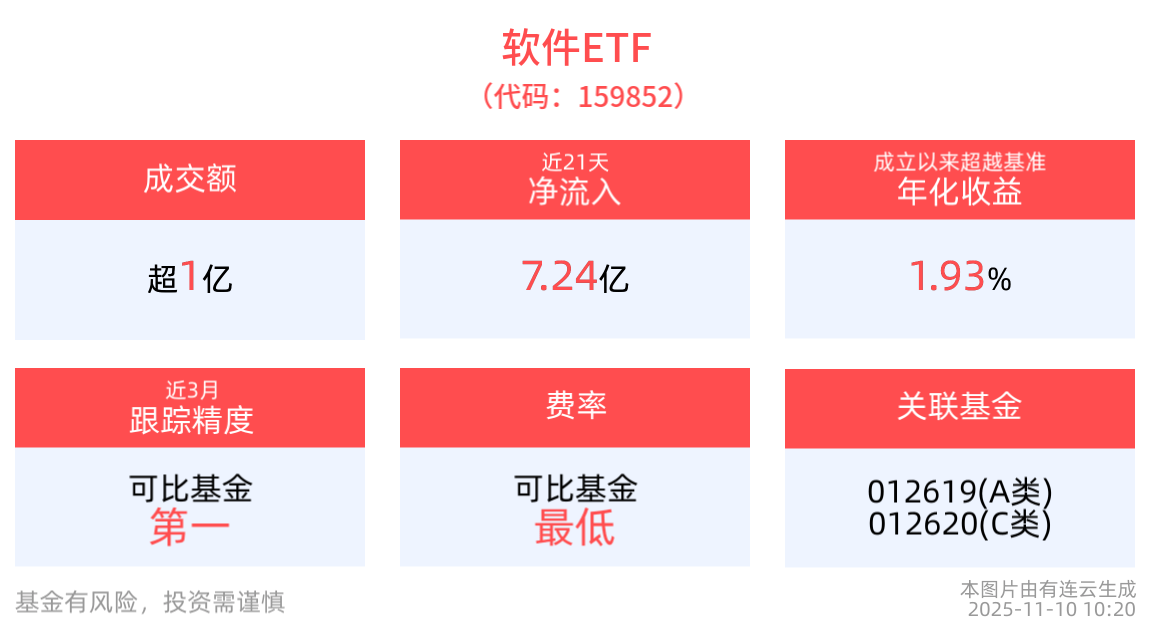
Core Insights - The software ETF has shown significant trading activity with an intraday turnover of 3.03% and a transaction volume of 165 million yuan, leading in average daily trading volume over the past month at 537 million yuan [3] - The latest scale of the software ETF reached 5.432 billion yuan, also ranking first among comparable funds [3] - Despite a recent net outflow of 4.5123 million yuan, the software ETF has attracted a total of 724 million yuan over the past 21 trading days [3] - Over the past three years, the net value of the software ETF has increased by 5.55%, with a maximum monthly return of 39.35% since inception [3] - The current international environment has elevated the strategic importance of domestic industrial software, particularly in the EDA sector, as U.S. restrictions accelerate the push for domestic alternatives [3][4] - The Ministry of Industry and Information Technology has set a clear target for the industry, aiming to complete the update of approximately 2 million sets of industrial software by 2027, providing strong support for industry development [3] Industry Trends - Since 2018, U.S. technology blockades have intensified the urgency for domestic industrial software independence, particularly in EDA and other R&D design products [4] - The policy environment is increasingly supportive, with the Ministry of Industry and Information Technology outlining industrial software update goals for 2024 and the National Development and Reform Commission including industrial software in the "two new" policy support framework for 2025 [4] - The industry is expected to experience rapid growth driven by both domestic production and intelligent technology advancements [4] Key Stocks - The top ten weighted stocks in the CSI Software Service Index as of October 31, 2025, include iFlytek, Kingsoft Office, and Tonghuashun, collectively accounting for 63.09% of the index [4] - The individual weightings of key stocks are as follows: iFlytek (13.80%), Tonghuashun (8.49%), Kingsoft Office (7.78%), and others [6]
半导体设备概念股走强,相关ETF涨超3%
Sou Hu Cai Jing· 2025-11-10 02:25
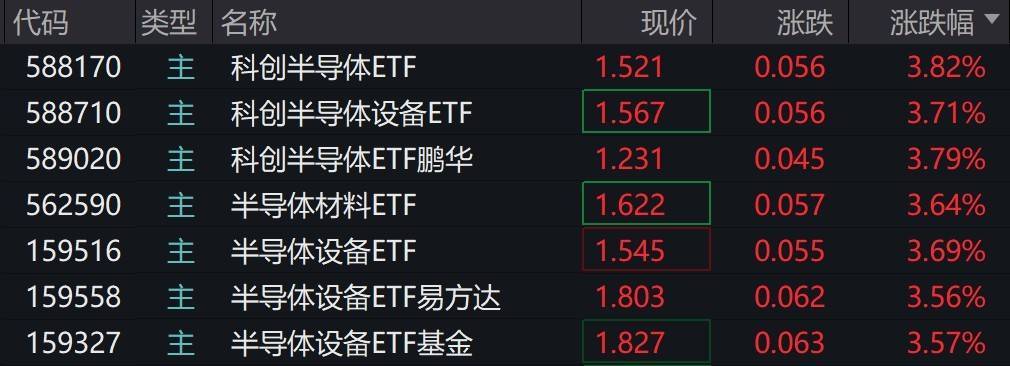
Group 1 - Semiconductor equipment stocks have strengthened, with Zhongwei Company rising over 6%, Huahai Qingshi and Tuo Jing Technology increasing over 4%, and Xinyuan Micro also showing gains [1] - Semiconductor-related ETFs have risen by more than 3% due to market influences [1] Group 2 - Various semiconductor ETFs have shown positive performance, with the following notable changes: - Kexin Semiconductor ETF at 1.521, up 3.82% - Kexin Semiconductor Equipment ETF at 1.567, up 3.71% - Kexin Semiconductor ETF Penghua at 1.231, up 3.79% - Semiconductor Materials ETF at 1.622, up 3.64% - Semiconductor Equipment ETF at 1.545, up 3.69% - E Fund Semiconductor Equipment ETF at 1.803, up 3.56% - Semiconductor Equipment ETF Fund at 1.827, up 3.57% [2] Group 3 - Analysts indicate that under the backdrop of the AI wave and domestic substitution, there is a continuous demand for expansion in domestic advanced production lines, making semiconductor equipment a cornerstone for wafer foundry expansion and an important link for achieving self-control in the industrial chain, presenting development opportunities for domestic semiconductor equipment manufacturers [2]



联域股份(001326):主业有望迎来拐点 前瞻布局机器人高壁垒领域
Xin Lang Cai Jing· 2025-11-09 06:37
Group 1: LED Lighting Business - The company focuses on the outdoor and industrial LED lighting segments, establishing a global production base to enhance delivery capabilities [1] - The company has formed stable business partnerships with well-known brands such as Longdawans, Signify, RAB Lighting, and Hubbell [1] - The company has production bases in Shenzhen and Zhongshan, China, with an intelligent manufacturing base in Zhongshan expected to be operational by Q3 2024, and has also established overseas production bases in Vietnam and Mexico [1] - The gross margin of the lighting business has declined in the first three quarters of 2025 due to overseas tariff policies, but a turnaround is expected with the delivery of new overseas factories [1] Group 2: Thin-Wall Cross Roller Bearings - Thin-wall cross roller bearings are critical components in industrial robots, offering high rigidity, precision, and load capacity compared to standard bearings [2] - The demand for harmonic reducers, which utilize thin-wall cross roller bearings, is projected to reach approximately 800,000 units in China in 2024, growing to about 1.21 million units by 2028 [2] - The market for thin-wall cross roller bearings is expected to continue expanding due to the rapid development of the industrial robot industry [2] Group 3: Strategic Investments and Future Outlook - The company is strategically investing in the domestic production of thin-wall cross roller bearings to replace imports, leveraging the technical expertise and production capacity of its partner, Luoyang Ovit Precision Bearings [3] - The company anticipates revenue of 1.504 billion, 1.755 billion, and 1.905 billion yuan for the years 2025 to 2027, with net profits of 23 million, 120 million, and 169 million yuan respectively, and EPS of 0.31, 1.64, and 2.31 yuan [3] - The company is initiating coverage with a "recommended" rating, considering the stable development of its lighting business and its proactive entry into the core components of robotics [4]
计算机行业11月投资策略展望:海外AI算力维持高景气,关注信创产业投资机遇
BOHAI SECURITIES· 2025-11-07 10:35
Industry Overview - The "14th Five-Year Plan" emphasizes the comprehensive implementation of the "Artificial Intelligence +" initiative, aiming to integrate AI with various sectors to enhance productivity and innovation [15][43] - Recent performance from North American cloud computing companies shows strong capital expenditure in Q3 2025, with optimistic projections for AI investments in 2026, indicating sustained high demand for AI computing power [43][45] - The urgency for self-sufficiency in critical software areas like EDA and operating systems is increasing due to international tensions, highlighting the importance of key technology breakthroughs for national security [5][43] Industry Data - In September 2025, the Producer Price Index (PPI) for the computer industry remained flat month-on-month but decreased by 1.3% year-on-year [18][21] - From January to September 2025, China's software industry generated revenue of CNY 111,126 billion, a year-on-year increase of 13.0%, with total profits reaching CNY 14,352 billion, up 8.7% [21][26] - The cumulative production of electronic computers in China from January to September 2025 was 261.907 million units, reflecting a 0.4% year-on-year growth [20][21] Company Announcements - Kingsoft Office reported a 13.32% year-on-year increase in net profit for the first three quarters of 2025, driven by strong performance in its WPS product line [33] - Zhongke Shuguang achieved a 25.55% year-on-year increase in net profit for the same period, supported by its innovative hardware and software solutions [36] Market Performance - From October 1 to October 31, 2025, the Shenwan Computer Industry Index fell by 2.28%, with varying performances across sub-sectors [37][41] - As of October 31, 2025, the price-to-earnings ratio for the Shenwan Computer Industry was 58.30 times, with a valuation premium of 361.50% compared to the CSI 300 index [38][40] Investment Strategy - The report maintains a "positive" outlook for the computer industry, suggesting that the ongoing effects of AI industry growth and the deepening process of domestic substitution will continue to enhance industry prosperity [6][45] - It is recommended to focus on leading companies that possess the capability to implement AI technologies effectively and adapt to various application scenarios [5][43]
利好引爆直线拉升,20%涨停
Zhong Guo Ji Jin Bao· 2025-11-07 05:13
Market Overview - On November 7, A-shares opened lower but rebounded, with the Shanghai Composite Index and Shenzhen Component Index both down by 0.16%, and the ChiNext Index down by 0.37%. In contrast, the North Star 50 Index rose nearly 1% [1][2] - The total market turnover for the half-day was 1.27 trillion yuan, slightly lower than the previous day, with over 2,300 stocks rising [2] Sector Performance - The basic chemical, petroleum and petrochemical, and retail sectors saw gains, while lithium battery, fluorine chemical, phosphorus chemical, and photovoltaic stocks experienced significant surges [2][5] - The fluorine chemical sector rose by 4.00%, while lithium battery-related stocks also saw substantial increases, with individual stocks like Dongyue Silicon Materials and Zhaoyuan New Energy hitting the daily limit [3][5] Notable Stocks - Key stocks in the lithium battery sector included: - Dongyue Silicon Materials: 20.04% increase - Zhaoyuan New Energy: 20.01% increase - Haineng Technology: 19.95% increase [6][10] - In the photovoltaic sector, stocks like Hongyuan Green Energy and Yijing Photovoltaic also saw significant gains, with Hongyuan Green Energy rising by 10.01% [7] Storage Chip Sector - The storage chip sector was active, with stocks like Demingli hitting the daily limit and reaching a new historical high of 271.85 yuan per share [11][12] - The supply-demand situation for storage chips is tight, with SK Hynix completing negotiations for HBM4 supply with Nvidia, leading to price increases [14][15] AI Sector - The AI application sector faced declines, with stocks related to operating systems, servers, and ChatGPT all underperforming. Notable declines included Kingsoft Office and 360, both dropping over 3% [16][17] - Concerns about high valuations in the AI sector have intensified, with discussions around the potential for an "AI bubble" emerging [16]



创业板Q3业绩增速领跑A股
21世纪经济报道· 2025-11-07 04:00
Core Viewpoint - The ChiNext companies demonstrated strong resilience in the third quarter of 2025, showcasing their role as a driving force in the new economy with significant revenue and profit growth [1]. Financial Performance - In the first three quarters of 2025, 1,388 ChiNext companies reported a total revenue of 3.25 trillion yuan, a year-on-year increase of 10.69%, and a net profit of 244.66 billion yuan, up 18.69% [1]. - In Q3 2025, total revenue reached 1.18 trillion yuan, with a quarter-on-quarter growth of 7.13%, and net profit was 93.26 billion yuan, showing a substantial quarter-on-quarter increase of 18.32% [1]. Structural Highlights - Large-cap companies maintained a solid "ballast" position, with the top 100 companies achieving a total revenue of 1.54 trillion yuan, a year-on-year increase of 17.72%, and a net profit of 170.84 billion yuan, up 26.78% [3]. - New companies under the registration system contributed significantly, with 589 newly listed companies reporting a total revenue of 1.08 trillion yuan, a year-on-year increase of 12.69%, and a net profit of 55.23 billion yuan, up 8.80% [3]. Profitability and Investment - The average gross margin of ChiNext companies increased by 0.87 percentage points, while the period expense ratio decreased by 0.93 percentage points, indicating improved operational efficiency [5]. - Long-term asset investments totaled 273.77 billion yuan in the first three quarters, a year-on-year increase of 9.46%, with Q3 investments reaching 90.62 billion yuan, up 8.99% [5]. - R&D expenditures totaled 147.35 billion yuan, a year-on-year increase of 6.20%, with 271 companies having R&D intensity greater than 10% [5][6]. Industry Performance - The electronics and communication sectors experienced significant growth, with the electronics industry reporting a revenue increase of 21.65% year-on-year and a net profit increase of 36.29% [8]. - The communication industry saw a revenue increase of 24.82% year-on-year and a net profit increase of 94.10% [8]. - The power equipment sector benefited from explosive growth in energy storage and solar inverter profitability, with a revenue increase of 12.90% year-on-year [10].

全球存储市场供需失衡加剧,数字经济ETF(560800)调整蓄势,机构:国产化替代进程加速
Sou Hu Cai Jing· 2025-11-07 02:20
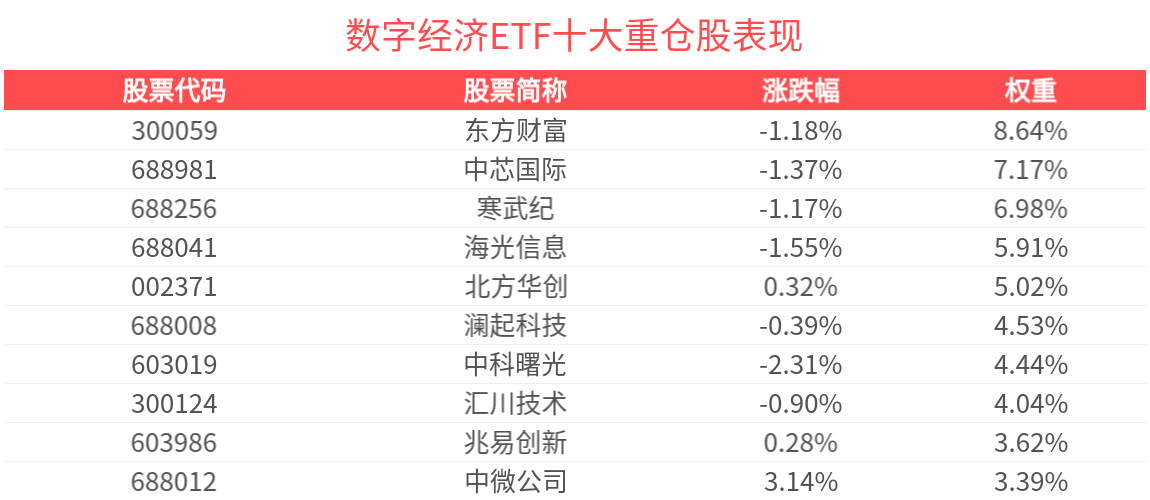
Group 1: Digital Economy Index Performance - The China Securities Digital Economy Theme Index (931582) decreased by 0.90% as of November 7, 2025 [1] - Among the constituent stocks, Tuojing Technology (688072) led with a gain of 3.60%, while Junsheng Electronics (600699) experienced the largest decline [1] - The Digital Economy ETF (560800) underwent a downward adjustment [1] Group 2: ETF Trading and Liquidity - The Digital Economy ETF had a turnover rate of 0.74% during the trading session, with a transaction volume of 5.022 million yuan [1] - Over the past week, the Digital Economy ETF's scale increased by 12.0977 million yuan, and its shares grew by 8 million [1] - The latest net inflow of funds into the Digital Economy ETF was 4.1193 million yuan, with a total net inflow of 16.4576 million yuan over the last five trading days [1] Group 3: Industry Developments - During the World Internet Conference in Wuzhen on November 6, 2025, Zhongke Shuguang launched the world's first single-cabinet 640-card super node scaleX640, capable of supporting large-scale cluster expansion [1] - The global storage market is experiencing a supply-demand imbalance, with DRAM DDR5 prices increasing by 30% this week due to heightened demand driven by AI [2] - Longxin Storage has begun mass production of LPDDR5X products, aligning its technical specifications with international competitors, which opens new growth opportunities for the domestic industry [2] Group 4: Major Stocks in the Index - As of October 31, 2025, the top ten weighted stocks in the China Securities Digital Economy Theme Index accounted for 53.93% of the index [3] - The top stocks include Dongfang Caifu (300059), Cambricon (688256), and SMIC (688981), with respective weights of 8.64%, 7.17%, and 6.98% [3][5]