
合成生物学

Search documents
川宁生物,半年净利4.55亿!生物发酵项目总投资已逾80亿元
合成生物学与绿色生物制造· 2025-08-27 13:38
Core Viewpoint - The financial performance of Chuaning Bio for the first half of 2025 shows significant declines in revenue and net profit, indicating challenges in the current market environment [2][3]. Financial Performance Summary - The company reported a revenue of 2.35 billion yuan, a decrease of 26.50% compared to the same period last year [3]. - Net profit attributable to shareholders was 455 million yuan, down 40.64% year-on-year [3]. - The net profit after deducting non-recurring gains and losses was 456 million yuan, reflecting a 40.38% decline [3]. - Basic earnings per share were 0.20 yuan, a decrease of 41.18% from the previous year [3]. - Cash flow from operating activities decreased by 49.32%, amounting to 391 million yuan [3]. - Total assets at the end of the reporting period were 10.16 billion yuan, down 3.74% from the previous year [3]. Strategic Focus and Future Directions - The company plans to enhance its core competitiveness through four strategic directions: 1. Reforming traditional antibiotic intermediates and Q10 through synthetic biology, utilizing gene editing and metabolic engineering to improve product efficacy and reduce production costs [4]. 2. Enhancing and cost-reducing existing products like red myrtle alcohol and squalene through optimization of strains and fermentation processes [4]. 3. Efficient biological utilization of C1/C2 resources, focusing on sustainable production of single-cell proteins and specialty chemicals [4]. 4. Developing larger-scale amino acids and vitamins [5]. Main Business and Product Overview - Chuaning Bio operates in the pharmaceutical manufacturing sector, focusing on "biological fermentation" and "synthetic biology" as dual driving strategies [5]. - The company has invested over 8 billion yuan in its fermentation projects, with a total production capacity of approximately 16,000 tons per year [6]. - Key products include thiocyanate erythromycin, cephalosporin intermediates, penicillin intermediates, and coenzyme Q10 [6]. - The synthetic biology project, with an investment of 1 billion yuan, has multiple products in production, making the company one of the few in the industry to complete the entire process from selection to large-scale production [6].


华熙生物(688363):Q2业绩拐点已现,科技实力构建业务护城河
Shenwan Hongyuan Securities· 2025-08-27 11:59
Investment Rating - The report maintains an "Outperform" rating for the company [2] Core Views - The company has shown signs of a performance turnaround in Q2 2025, with a revenue of 1.183 billion yuan, a year-on-year decline of 18.44%, but a net profit of 119 million yuan, reflecting a year-on-year increase of 20.89% [7] - The company is focusing on building a business moat through technological strength, with a strategic shift towards high-quality product offerings and optimized cost structures [7] - The company is expected to achieve a net profit of 451 million yuan in 2025, with a corresponding PE ratio of 62 [7] Financial Data and Profit Forecast - Total revenue for 2025 is projected at 5.68 billion yuan, with a year-on-year growth rate of 5.7% [6] - The net profit for 2025 is estimated at 451 million yuan, showing a significant year-on-year increase of 159.1% [6] - The gross margin is expected to be 74.8% in 2025, with a gradual increase in ROE from 6.3% in 2025 to 7.5% in 2027 [6][9] Business Segments - The skincare innovation segment reported a revenue of 912 million yuan in H1 2024, a decline of 33.97%, as the company halted price promotion strategies [7] - The raw materials business generated 626 million yuan, a slight decline of 0.58%, while the medical terminal business reported 673 million yuan, down 9.44% [7] - The nutrition science innovation segment saw a revenue increase of 32.40% to 38 million yuan, driven by effective food components [7]

川宁生物(301301)2025年中报简析:净利润同比下降40.64%
Zheng Quan Zhi Xing· 2025-08-27 11:50
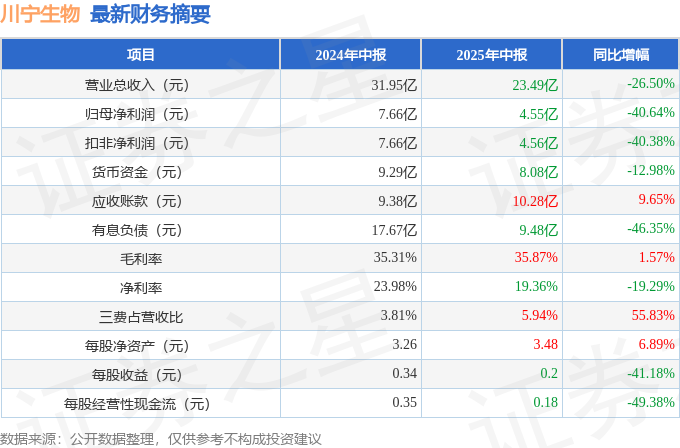
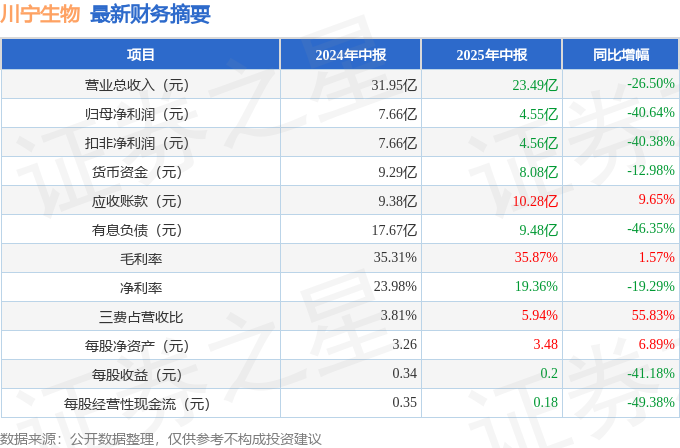
Core Viewpoint - The financial performance of Chuaning Bio (301301) for the first half of 2025 shows significant declines in revenue and net profit, indicating challenges in the market and operational efficiency [1]. Financial Performance Summary - Total revenue for the first half of 2025 was 2.349 billion yuan, a decrease of 26.5% year-on-year [1]. - Net profit attributable to shareholders was 455 million yuan, down 40.64% compared to the previous year [1]. - The gross profit margin improved slightly to 35.87%, an increase of 1.57% year-on-year, while the net profit margin fell to 19.36%, a decrease of 19.29% [1]. - Total expenses (selling, administrative, and financial) amounted to 139 million yuan, representing 5.94% of revenue, an increase of 55.83% year-on-year [1]. - Earnings per share decreased to 0.20 yuan, down 41.18% year-on-year [1]. Cash Flow and Investment Summary - The net cash flow from operating activities decreased by 49.32%, attributed to lower product prices and reduced collections [5]. - The net cash flow from investing activities increased by 35.87%, due to reduced payments for fixed assets and investments [2]. - The net increase in cash and cash equivalents dropped significantly by 274.54%, primarily due to decreased collections and increased dividend payments [5]. Market and Product Insights - The overall demand for the company's main products has declined, impacting sales and pricing [3]. - The price of the main intermediate products has remained stable, with slight increases in some areas, while others have seen price drops due to reduced market demand [3]. - The company is focusing on enhancing its core competencies in traditional antibiotic intermediates and exploring new product lines in synthetic biology [6][7][8]. Future Outlook - The company anticipates a challenging year due to the impact of declining penicillin prices, but expects improvements in the fourth quarter with increased market demand [14]. - The release of synthetic biology products is expected to enhance overall performance and profitability in 2026 [14].
川宁生物2025年中报简析:净利润同比下降40.64%
Zheng Quan Zhi Xing· 2025-08-26 23:41
Core Viewpoint - The recent financial report of Chuaning Bio (301301) indicates a significant decline in both revenue and net profit for the first half of 2025, with net profit down by 40.64% year-on-year and total revenue down by 26.5% year-on-year, reflecting challenges in the market and operational performance [1]. Financial Performance Summary - Total revenue for the first half of 2025 was 2.349 billion yuan, a decrease of 26.5% compared to 3.195 billion yuan in the same period of 2024 [1]. - Net profit attributable to shareholders was 455 million yuan, down 40.64% from 766 million yuan in the previous year [1]. - Gross margin improved slightly to 35.87%, up 1.57% year-on-year, while net margin fell to 19.36%, down 19.29% year-on-year [1]. - Total expenses (selling, administrative, and financial) amounted to 139 million yuan, representing 5.94% of revenue, an increase of 55.83% year-on-year [1]. - Earnings per share decreased to 0.20 yuan, down 41.18% from 0.34 yuan in the previous year [1]. Cash Flow and Asset Management - Cash and cash equivalents decreased by 25.71%, attributed to reduced collections and increased dividend payments [1]. - Operating cash flow per share fell to 0.18 yuan, a decline of 49.38% year-on-year [1]. - Accounts receivable increased by 65% to 1.028 billion yuan, indicating challenges in cash collection [1][2]. Cost and Expense Analysis - Sales expenses rose by 16.59% due to increased promotional costs for new products [9]. - Management expenses increased by 33.51% as a result of trials for new product lines [9]. - Financial expenses decreased by 42.84% due to reduced interest payments [9]. Investment and R&D Focus - R&D investment surged by 138.47%, reflecting a commitment to new product development [9]. - The company plans to focus on enhancing traditional antibiotic intermediates and developing new biomanufacturing processes utilizing C1/C2 resources [13][14]. Market Outlook and Product Strategy - The company anticipates a challenging year due to the impact of declining prices in the penicillin market, but expects improvement in the fourth quarter with increased demand [20]. - The sales of synthetic biology products are projected to grow as production capacity is adjusted and released [11]. - The company is also exploring opportunities in Kazakhstan but has decided to postpone expansion due to various risks [11].
育种、牧海、强农机!三院士为岭南特色现代农业出谋划策
Nan Fang Du Shi Bao· 2025-08-26 20:16
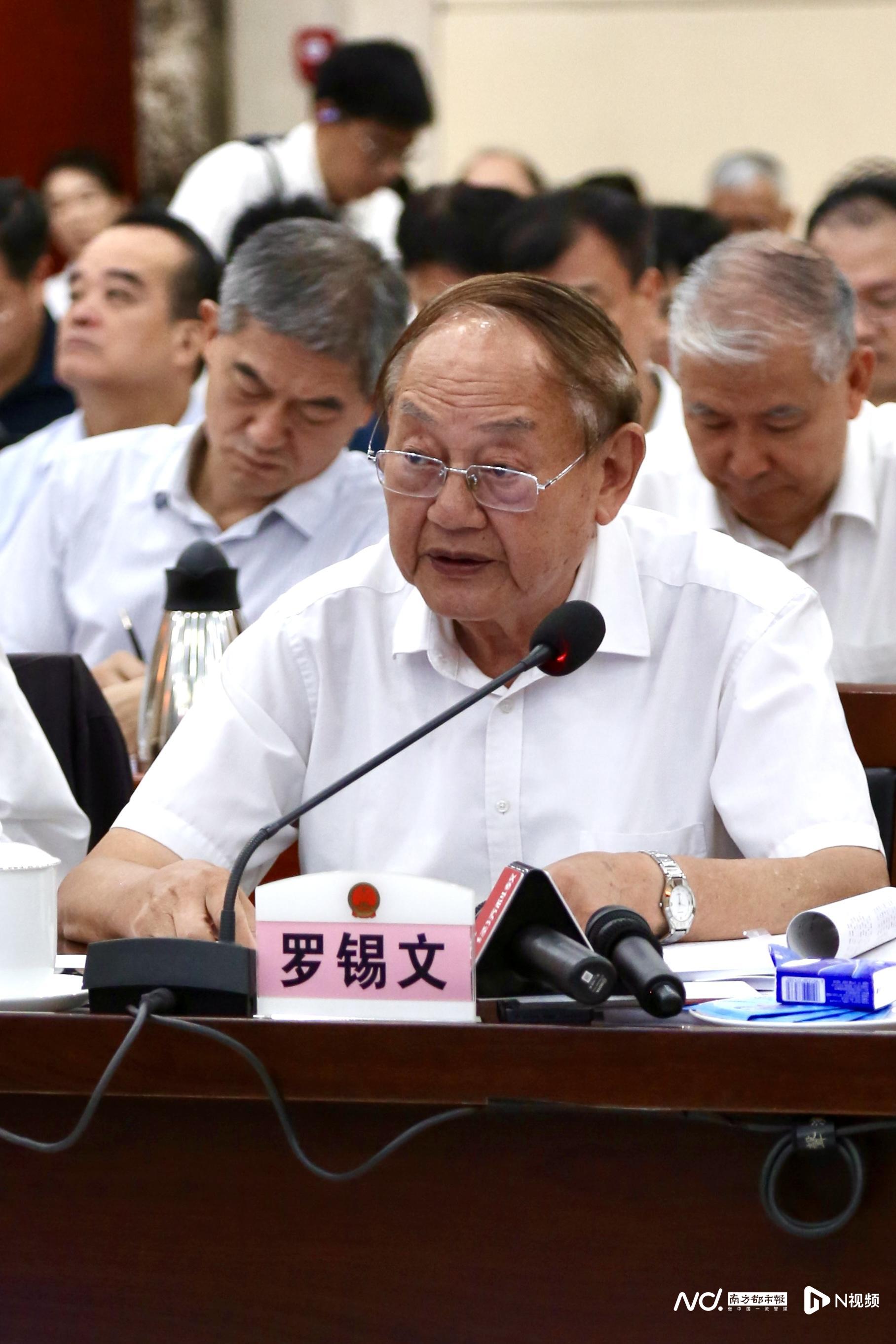
Core Insights - In 2024, Guangdong Province's total agricultural output value reached 970.12 billion yuan, ranking among the top in the country, with significant production in fruits, vegetables, meat, and aquatic products [1] Group 1: Agricultural Mechanization - There is a pressing need to strengthen the manufacturing of small and medium-sized agricultural machinery in Guangdong to support agricultural mechanization [2][5] - Current challenges include a weak agricultural machinery manufacturing industry, a lack of well-known brands, and a limited number of manufacturing enterprises [5] - Recommendations include focusing on the development of small and medium-sized agricultural machinery tailored to local agricultural needs, such as power machinery and crop production equipment [5] Group 2: Marine Economy - Guangdong, as a major marine province, has the largest marine area in the country, and there is an urgent need to establish a "Guangdong Seafood" brand and strengthen marine ranching [6][9] - Emphasis on deep processing and market development is crucial for enhancing marine ranching, with a potential market expansion for high-quality fish species estimated at 500,000 tons [9] - Development of both nearshore and deep-sea species is recommended, including high-quality seed varieties like triploid oysters and tuna [9] Group 3: Biotechnology and Breeding - Guangdong is a leading province in agricultural resources and has made significant achievements in breeding, which is vital for national food security [10][13] - A full-chain approach is suggested to overcome key technological challenges in biotechnology, focusing on areas like gene editing and synthetic biology [13] - Collaboration among government, research institutions, and enterprises is encouraged to enhance innovation and international competitiveness in the seed industry [13]
科技制造持续走热 芯擎科技完成超10亿元新融资|投融资周报
2 1 Shi Ji Jing Ji Bao Dao· 2025-08-26 19:14
Group 1 - The core focus of investment remains on artificial intelligence and the chip sector, with significant activity in the healthcare field as well [1][3] - Hubei Chipking Technology Co., Ltd. completed a B round financing exceeding 1 billion RMB, while Dream Sky Technology (Suzhou) Co., Ltd. announced over 100 million RMB in Pre-A++ and strategic round financing [1][30][51] - In the healthcare sector, Yingshi Biotechnology (Nanjing) Co., Ltd. secured over 34 million USD in C round financing led by Rehabilitation Capital [1][18] Group 2 - The technology and manufacturing sectors saw the highest number of financing events, with the chip sector completing 4 financing rounds totaling 1.24 billion RMB, and the AI sector completing 3 rounds exceeding 59 million RMB [3][4] - The financing activities were primarily concentrated in Jiangsu Province, Beijing, and Shanghai, with 12, 6, and 5 financing events respectively [5][6] Group 3 - Qiming Venture Partners and Yunze Capital were notably active, each completing 2 financing rounds mainly in the healthcare and technology sectors [7][8] - Notable financing events include: - Beijing Huimei Cloud Technology Co., Ltd. raised nearly 200 million RMB [9] - Jiaxing Zhitong Technology Co., Ltd. completed several million RMB in A+ round financing [10] - Kegong Biotechnology (Hangzhou) Co., Ltd. raised several million RMB in A round financing [11] Group 4 - Other significant financing events include: - Microfar Biotechnology (Hangzhou) Co., Ltd. completed nearly 100 million RMB in Pre-A round financing [12] - Yixi Biotechnology (Suzhou) Co., Ltd. raised nearly 200 million RMB in A round financing [13] - Weicheng Medicine (Suzhou) Co., Ltd. secured several million USD in seed round financing [15] Group 5 - The financing landscape indicates a strong trend towards AI-driven solutions and advanced manufacturing technologies, with companies like Shenzhen Green Cloud Technology Co., Ltd. and Shanghai Kaibo Cloud Information Technology Co., Ltd. also securing significant funding [21][23] - The overall financing scale in the domestic primary market during the reported period reached approximately 4.486 billion RMB across 34 events [1][2]

海正药业上半年扣非净利润3.21亿,业务持续向好
Quan Jing Wang· 2025-08-26 11:39
Core Viewpoint - Haizheng Pharmaceutical reported steady growth in its business performance for the first half of 2025, focusing on business growth and efficiency improvement, achieving operating revenue of 5.25 billion yuan and a net profit attributable to shareholders of 299 million yuan, with a 23.92% year-on-year increase in net profit after deducting non-recurring gains and losses [1] Financial Performance - The company generated a net cash flow from operating activities of 1.211 billion yuan, representing a year-on-year increase of 54.98% [1] - The net profit after deducting non-recurring gains and losses reached 321 million yuan [1] Business Segments - The formulation sales business maintained steady growth, with products such as Saismei, Ximeixin, and Niuzaili showing sales revenue increases of over 30% [2] - Saismei, as the first domestically developed innovative drug in the cholesterol absorption inhibitor category, is highly recommended in national guidelines [2] - The company is focusing on chronic disease management, particularly in cardiovascular and metabolic diseases, and has initiated several health promotion projects [2] Product Development - Haizheng Pharmaceutical continues to deepen its presence in various disease areas, with Ximeixin leading in the market for cholestatic liver disease treatments and Niuzaili becoming a new standard for community-acquired infections [3] - The pet medicine sector showed strong growth, with overall sales increasing by over 60%, and the pet e-commerce business achieving sales exceeding 100 million yuan [3] - The company launched several new products in the pet healthcare market, including a new antibiotic for dogs and cats and a vaccine for cats [3] Strategic Initiatives - The establishment of a joint venture focused on synthetic biology marks a significant step into the high-end synthetic biology industry [4] - The company is enhancing internal operational efficiency through refined management of sales expenses and continuous technological innovation in production [4] - Looking ahead, Haizheng Pharmaceutical aims to leverage cutting-edge technologies such as synthetic biology and AI in drug development to enhance long-term value creation [4]

调研速递|伊犁川宁生物接受国联民生等70余家机构调研,透露多项业务要点
Xin Lang Zheng Quan· 2025-08-26 11:16
Product Prices and Market Performance - Overall demand has decreased due to the pharmaceutical environment, but the three main intermediate products of the company have shown varied performance. The price of thiocyanate erythromycin has risen slightly, with a single-digit increase since the beginning of the year, and is expected to remain stable in the second half of the year. The price of cephalosporin products is stable and is expected to maintain the current situation in the second half. The price of penicillin has decreased since the beginning of the year, but with increasing industry concentration, it is becoming more difficult for small companies to enter the market. An increase in demand is expected in the fourth quarter, which may improve the situation [1]. Synthetic Biology and Project Progress - Sales of synthetic biology products are steadily advancing, with the company achieving a revenue of 22.32 million yuan in the first half of the year. With adjustments and releases in production capacity, future sales are expected to increase. The methanol protein project has undergone trials in a 30m³ fermentation tank, with initial results available and samples sent to downstream manufacturers for testing. The company is also actively applying for qualifications from the Ministry of Agriculture and Rural Affairs [2]. Overseas Capacity and Domestic Planning - After assessment, the company has decided to postpone its entry into Kazakhstan due to several uncontrollable risks. The first phase of the company is in a rapid development stage, and the second phase will be determined based on the R&D progress of the Shanghai Research Institute and the release of first-phase capacity [3]. Order Expectations and Capital Expenditure - The company anticipates growth in orders with Kelun Yongnian Company for ergotamine. There are no significant capital expenditures expected in the short term, with fixed asset depreciation for the first half of 2025 amounting to 273 million yuan, an increase of 22 million yuan year-on-year. Starting in 2026, the main equipment depreciation is expected to decrease significantly, with a projected reduction of tens of millions if no new fixed assets are added by the end of 2027 [4]. R&D and Product Selection Planning - Future R&D will focus on four main areas: traditional product synthesis and biological modification; technology enhancement and cost reduction for delivered products; efficient biological utilization of C1/C2 resources; and the development of amino acids and vitamin products [5]. Cost Trends and Import-Export Situation - The price of the main raw material, corn, is expected to rise to 1.8 - 1.9 yuan/kg in November. Energy costs, particularly coal prices, have decreased compared to 2024 and are expected to remain stable in the coming years. The export amount has increased by approximately 25% compared to the same period last year, mainly due to increased exports of thiocyanate and 6-APA, while cephalosporin exports have slightly decreased. Exports are primarily directed towards India and Hong Kong, with tariffs having minimal impact on the company's exports [6]. Gross Margin and Production Efficiency - With the increase in synthetic biology product volume and the application of AI technology, the company has room for improvement in gross margin. AI-controlled fermentation tank output exceeds the control group by 3% - 5%, reducing production fluctuations and enhancing R&D efficiency. The overall gross margin for the company in the first half of 2025 was 35.90%, a year-on-year increase of 0.55%, while the gross margin for pharmaceutical intermediates was 38.64%, a year-on-year increase of 1.37% [7]. Expenses and Performance Outlook - The sales expense ratio for the first half of 2025 was 0.58%, an increase of 0.21% year-on-year, and is expected to remain stable in the second half. The management expense ratio was 3.37%, an increase of 0.13% year-on-year, while the financial expense ratio was 0.67%, a decrease of 0.19% year-on-year. The company is facing performance pressure this year due to the impact of penicillin prices, with expectations of a decline compared to last year. However, in 2026, with the increase in synthetic biology product volume and the recovery of penicillin prices, performance and profits are expected to improve [8].

川宁生物(301301) - 伊犁川宁生物技术股份有限公司投资者关系活动记录表
2025-08-26 10:52
Group 1: Market and Product Performance - The overall demand for the company's three main intermediates has decreased due to the pharmaceutical environment, with the price of erythromycin thiocyanate showing a slight increase of single digits since the beginning of the year, expected to remain stable in the second half [2][3] - The sales revenue for synthetic biology products reached CNY 22.32 million in the first half of the year, with future sales expected to improve as production capacity is gradually released [3][4] - The export value increased by approximately 25% compared to the same period last year, mainly due to higher exports of erythromycin and 6-APA, while cephalosporin exports slightly decreased [9] Group 2: Financial Performance and Projections - The gross profit margin for the first half of 2025 was 35.90%, an increase of 0.55% year-on-year, driven by cost reductions and production efficiency improvements [11][12] - The company anticipates a decline in overall performance for the year due to pressure from cephalosporin prices, but expects improvement in the fourth quarter with increased market demand [12] - Fixed asset depreciation for the first half of 2025 was CNY 273 million, a year-on-year increase of CNY 22 million, primarily due to the depreciation of the subsidiary [6] Group 3: Strategic Developments - The company has decided to postpone its expansion plans into Kazakhstan due to various political and management risks identified during assessments [4] - Future research and development will focus on four strategic areas, including the synthesis of antibiotic intermediates and the efficient biological utilization of C1/C2 resources [7][8] - The company plans to enhance its core competitiveness through technology upgrades and cost reductions in existing products [7][10]
中国科学院院士刘耀光:实施育种全链条攻关,加快生物育种产业化应用
Nan Fang Nong Cun Bao· 2025-08-26 07:06
Core Viewpoint - The emphasis is on accelerating the industrial application of biological breeding through comprehensive innovation and addressing key technological challenges in the breeding sector [2][12][22]. Group 1: Current Situation and Challenges - Global competition in the seed industry is intensifying, with China achieving basic self-sufficiency in staple crops like rice and wheat [6][7]. - Guangdong province is a major agricultural region with a leading number of preserved germplasm resources, but it faces weaknesses in germplasm protection and utilization, as well as in foundational research and cutting-edge technology [8][9][22]. Group 2: Recommendations for Advancement - Implement a full-chain approach to tackle "bottleneck" technologies, focusing on intelligent design breeding, gene editing, and synthetic biology, while establishing an integrated innovation chain from germplasm protection to variety selection [12][13][14]. - Build high-level platforms to enhance collaborative innovation by integrating resources from universities, research institutes, and enterprises, and creating national key laboratories in the field of biological breeding [16][17][18]. - Deepen the integration of government, research, and enterprises to accelerate the transformation of research results, supporting leading companies in forming innovation consortia and establishing testing and demonstration bases for new varieties and technologies [19][20][21]. Group 3: Strategic Importance - Biological breeding is a strategic support for ensuring national food security, and Guangdong has the foundation, conditions, and responsibility to lead in this field nationally [22][23]. - The goal is to revitalize the seed industry in Guangdong, contributing significantly to building a strong agricultural province and ensuring national food security [24].
