
数字孪生

Search documents
重大突破!这一万亿级市场,要来了→
证券时报· 2025-11-30 07:35
Core Viewpoint - The article discusses the advancements and future potential of 6G technology in China, highlighting its role in transforming industries and enabling smart factories through ultra-low latency and high reliability [1][5][6]. Group 1: 6G Technology Development - China has completed the first phase of 6G technology trials, establishing over 300 key technology reserves [1][5]. - The goal for 6G is to achieve air interface transmission latency as low as 100 microseconds, with reliability reaching 99.99999% [3][4]. - The second phase of 6G development will focus on technical solution trials, while the third phase will involve system networking trials and pre-commercial equipment testing [7]. Group 2: Industrial Applications - 6G technology will enable machines in factories to coordinate with microsecond precision, transforming factories into cohesive "organisms" [3]. - The technology aims to replace critical industrial control buses, laying the foundation for fully automated factories [4]. Group 3: Market Potential and Growth - The global 6G technology market is projected to grow from $1.66 billion in 2024 to $14.94 billion by 2030, with a compound annual growth rate of 43.98% [11]. - By 2040, the number of global smart terminal connections is expected to exceed 12.16 billion, marking a significant increase compared to the current 5G era [12]. Group 4: Policy and Strategic Initiatives - The Chinese government has included 6G in its future industry development plans, emphasizing the need for large-scale application demonstrations and innovation in related technologies [8][9]. - Various local governments are promoting the development of 6G and related technologies, supporting innovation and market validation [9][10].


智能制造,主城何以“慧”聚未来
Yang Zi Wan Bao Wang· 2025-11-28 14:43
Group 1 - The 2025 World Intelligent Manufacturing Conference was held in Nanjing, focusing on "data intelligence driving new quality leadership" and showcasing the transformation path of the Xuanwu District [1] - The conference highlighted advancements in AI and smart manufacturing, with companies like Baidu and Dassault Systems showcasing their innovative products and solutions [2][3] - Xuanwu District is positioning itself as a hub for data and large model industries, aiming to build a robust ecosystem for digital transformation and innovation [6][7] Group 2 - Baidu established its East China headquarters in Xuanwu, focusing on smart tourism, elderly care, and AI talent development, with a market share of 40% in home scenarios and over 90% in hotel scenarios for its products [2] - Dassault Systems is setting up its China headquarters in Xuanwu, offering SaaS services and solutions for small and medium enterprises, with a focus on digital twin systems for the entire product lifecycle [3] - Local companies in Xuanwu are enhancing their smart capabilities, with Nanjing Telecom showcasing its transition to a comprehensive intelligent information service provider and demonstrating various innovative technologies [4][5] Group 3 - The Xuanwu District is set to construct the Jiangsu International Data Port, aimed at addressing data flow challenges, and the Xuanwu Large Model Factory to create an efficient model generation ecosystem [6] - The district has launched a three-year action plan for AI development and established the "Xuanwu·Model and Digital Teacher Academy" to cultivate AI talent [6] - Xuanwu is attracting major enterprises and aims to develop the data industry into a fourth trillion-level industrial cluster, with significant support from central enterprises and industry leaders [7]
51WORLD港股IPO及境内未上市股份“全流通”获中国证监会备案
Zhi Tong Cai Jing· 2025-11-28 13:53
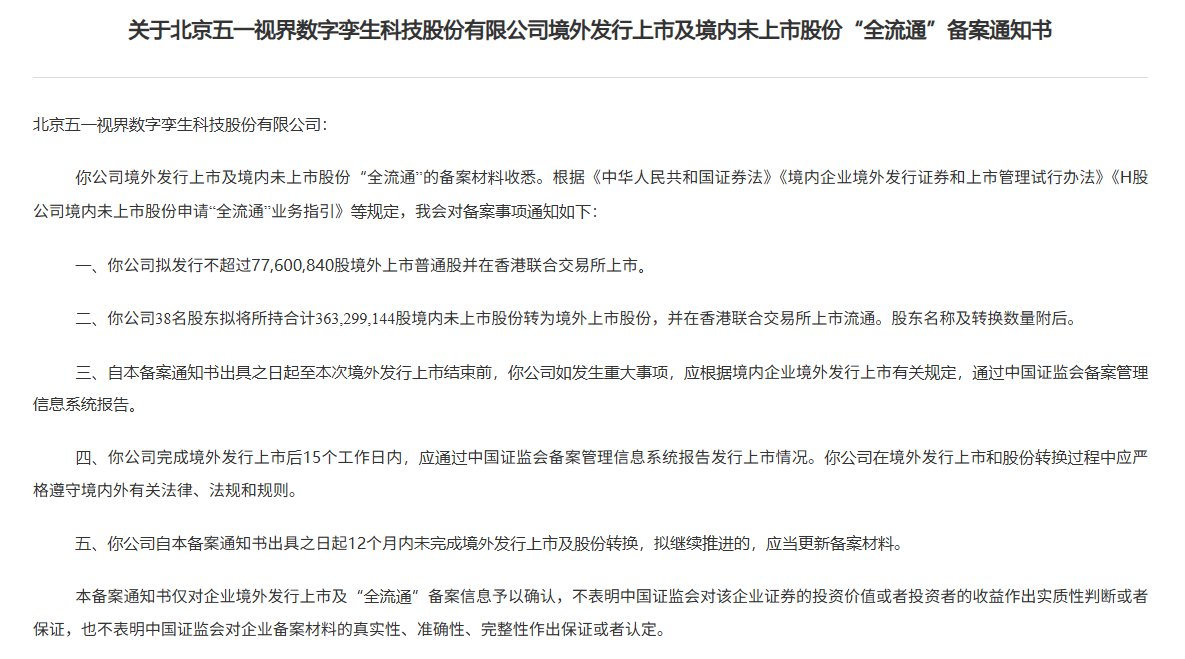
Group 1 - The China Securities Regulatory Commission has issued a notice regarding the overseas issuance and domestic unlisted shares "full circulation" filing for Beijing May Day Vision Digital Twin Technology Co., Ltd [1] - The company plans to issue no more than 77,600,840 overseas listed ordinary shares and list them on the Hong Kong Stock Exchange [1] - A total of 38 shareholders intend to convert their combined 363,299,144 domestic unlisted shares into overseas listed shares for circulation on the Hong Kong Stock Exchange [1] Group 2 - 51WORLD is a technology company focused on cloning Earth's 5.1 million square kilometers, operating within the digital twin industry [3] - The company has made significant investments in three key areas: 3D graphics, simulation, and artificial intelligence, to develop its core competencies [3] - The goal of the company is to provide access and build digital twin solutions for ecosystem partners, including enterprises, consumers, and developers, ultimately creating a real, complete, and enduring "digital twin Earth" [3]
新股消息 | 51WORLD港股IPO及境内未上市股份“全流通”获中国证监会备案
智通财经网· 2025-11-28 12:54
Group 1 - The China Securities Regulatory Commission has issued a notice regarding the overseas issuance and listing of Beijing May Day Vision Digital Twin Technology Co., Ltd, allowing the company to issue up to 77,600,840 overseas listed ordinary shares for listing on the Hong Kong Stock Exchange [1] - The company has 38 shareholders who plan to convert a total of 363,299,144 shares of unlisted domestic shares into overseas listed shares for circulation on the Hong Kong Stock Exchange [1] Group 2 - 51WORLD is a technology company focused on creating a digital twin of Earth, covering an area of 5.1 million square kilometers, and operates within the digital twin industry [3] - The company has made significant investments in three key areas: 3D graphics, simulation, and artificial intelligence, to develop its core competencies [3] - The company's goal is to provide solutions for ecosystem partners, including enterprises, consumers, and developers, to access and build digital twins, ultimately aiming to create a real, complete, and enduring "digital twin Earth" [3]
三星存储,成立新部门
半导体芯闻· 2025-11-28 10:46
Group 1 - Samsung Electronics has established a new organization within its Device Solutions (DS) division to oversee the overall development of storage semiconductors, including DRAM and NAND flash [1] - The new "Memory Semiconductor Development Division" aims to enhance the storage semiconductor solutions and packaging capabilities by integrating operations, with the DRAM development team leader, Hwang Sang-jun, appointed to lead this organization [1] - The high bandwidth memory (HBM) development team will be incorporated into the design team under the DRAM development team, following a previous organizational adjustment aimed at improving technical competitiveness after being surpassed by SK Hynix in the HBM market [1] Group 2 - The reassignment of HBM personnel back to the memory development department reflects the company's confidence in its technological strength for next-generation products like HBM4 [2] - Samsung Electronics has also established a Digital Twin Center under its Global Manufacturing Infrastructure division, which is interpreted as a preparation for building an "AI factory" for semiconductors [2] - The company plans to apply artificial intelligence to semiconductor design and processes, incorporating 50,000 GPUs provided by NVIDIA [2]

首届安全物联网五常论坛在杭州举办 共筑物联安全底座
Zhong Guo Xin Wen Wang· 2025-11-28 06:36
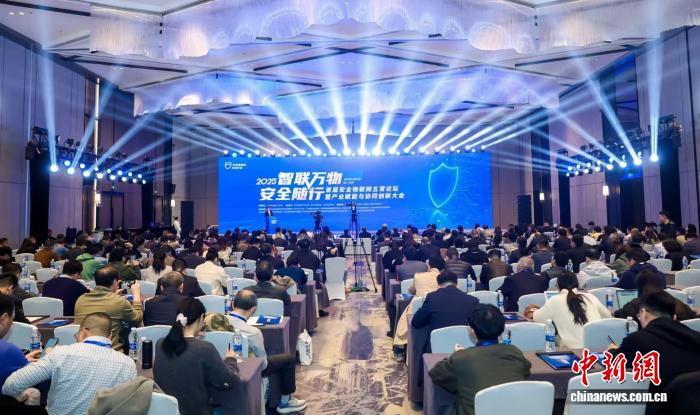
Core Insights - The development of "Safe IoT" is becoming a critical foundation for the advancement of the digital era, emphasizing the importance of security in the Internet of Things (IoT) [1][4] Group 1: Event Overview - The first "Safe IoT" forum was held in Hangzhou, Zhejiang, focusing on the collaboration of government, industry, academia, and research to enhance urban resilience and high-quality industry development [1] - The forum aims to solidify the foundation for building a "Safe China" through discussions on the empowerment of safe IoT technologies [1] Group 2: Technological Advancements - The advancement of cutting-edge technologies such as artificial intelligence and quantum encryption is providing strong support for IoT security [1] - Safe IoT technologies are rapidly being implemented in various fields, including environmental monitoring, infrastructure safety, and risk prevention in agriculture and industry, showcasing vast application potential [1] Group 3: Industry Impact - In the construction sector, safe IoT technologies are proving to be valuable, with China's self-developed NPR-DDA software system enhancing the resilience of construction projects [4] - In water conservancy, a highly coordinated intelligent water management system utilizing digital twin and AI technologies can significantly improve disaster simulation, risk warning, and operational optimization [4] Group 4: Regional Development - Zhejiang province is actively promoting the integration of "City Brain" and safe IoT, with a notable concentration of AI core industry enterprises in the region [4] - In Yuhang District, there are 154 core AI enterprises, with projected revenue of 95.58 billion yuan in 2024, reflecting a year-on-year growth of 27.6%, accounting for approximately 27% of Hangzhou's total [4] Group 5: Philosophical Approach - The importance of trust and credit in data and device interactions is emphasized as a prerequisite for all applications in the interconnected world [5] - The integration of "safety genes" and "integrity genes" into urban development and industrial systems is advocated to contribute to the construction of a "Safe China" and the modernization of the nation [5]
深桑达A涨2.04%,成交额2.08亿元,主力资金净流入126.64万元
Xin Lang Zheng Quan· 2025-11-28 06:02
Core Viewpoint - The stock of Shenzhen Sanda Industrial Co., Ltd. (深桑达A) has shown fluctuations in trading activity, with a notable increase in price and trading volume recently, despite a significant decline in revenue and profit year-on-year [1][2]. Group 1: Stock Performance - On November 28, 深桑达A's stock rose by 2.04%, reaching a price of 19.97 yuan per share, with a trading volume of 208 million yuan and a turnover rate of 0.97%, resulting in a total market capitalization of 22.725 billion yuan [1]. - Year-to-date, 深桑达A's stock price has increased by 13.98%, with a 6.62% rise over the last five trading days, a 3.62% decline over the last 20 days, and a 28.50% drop over the last 60 days [1]. - The stock has appeared on the "龙虎榜" (a stock trading list) six times this year, with the most recent appearance on August 1, where it recorded a net buy of 193 million yuan [1]. Group 2: Company Overview - 深桑达A, established on December 4, 1993, and listed on October 28, 1993, is located in Shenzhen, Guangdong Province, and operates in logistics, warehousing, electronic manufacturing, and real estate [2]. - The company's main business revenue composition includes high-tech industry engineering services (92.43%), digital heating and new energy services (4.70%), digital and information services (2.26%), and other industrial services (0.61%) [2]. - 深桑达A is categorized under the "建筑装饰-专业工程-其他专业工程" (Construction Decoration - Professional Engineering - Other Professional Engineering) sector and is associated with concepts such as intelligent transportation, DeepSeek, low-altitude economy, metaverse, and digital twin [2]. Group 3: Financial Performance - For the period from January to September 2025, 深桑达A reported a revenue of 33.019 billion yuan, representing a year-on-year decrease of 31.81%, and a net profit attributable to shareholders of -299 million yuan, a decline of 136.01% year-on-year [2]. - The company has distributed a total of 911 million yuan in dividends since its listing, with 353 million yuan distributed over the past three years [3]. - As of September 30, 2025, the number of shareholders of 深桑达A was 69,800, an increase of 4.54% from the previous period, with an average of 15,608 circulating shares per person, a decrease of 4.34% [2][3].

中国地质大学(武汉)创新成果亮相2025中国5G+工业互联网大会
Zhong Guo Jing Ji Wang· 2025-11-28 03:01
Core Insights - The China University of Geosciences (Wuhan) showcased multiple innovative achievements in the integration of industry and academia at the 2025 China 5G + Industrial Internet Conference, attracting significant attention from professional audiences [1] - Key government officials, including the Minister of Industry and Information Technology and the Governor of Hubei Province, visited the university's exhibition area, focusing on the reports of intelligent surveying robots and live working robots [1] - The university emphasizes the importance of practical application in scientific research to ensure that research outcomes contribute to local development and national strategies [1] Group 1 - The first domestic intelligent surveying robot, developed in collaboration with the China Metallurgical Geology Bureau, was demonstrated, capable of autonomous operation in complex outdoor terrains, performing tasks such as environmental perception, navigation, and rock sample collection [1][2] - The intelligent surveying robot significantly enhances geological surveys and mineral exploration efficiency in high-altitude and remote areas, addressing long-standing challenges in the field [2] - The first domestic high-voltage electrical equipment live working robot, developed by Professor Chen Xin's team in collaboration with the State Grid Electric Power Research Institute, was also presented, focusing on the critical need for "machine replacement" in power grid operations [2] Group 2 - The live working robot integrates multi-source information perception and digital twin technology to model unstructured environments and plan operations in unknown spaces, facilitating human-machine interaction [2] - The robot addresses electromagnetic compatibility and shielding issues in high-voltage environments, enabling it to perform tasks such as dry ice cleaning, laser stripping, and grounding installation with high precision [2] - The live working robot has already been applied in various power operation scenarios across cities like Wuhan, Huangshi, and Xianning [2]
阿尔特涨2.17%,成交额1823.45万元,主力资金净流入189.32万元
Xin Lang Cai Jing· 2025-11-28 01:55
Core Points - The stock price of Alter rose by 2.17% on November 28, reaching 10.38 CNY per share, with a trading volume of 18.23 million CNY and a market capitalization of 5.17 billion CNY [1] - The company has experienced a year-to-date stock price decline of 8.14%, with a 3.80% increase over the last five trading days, a 9.27% decrease over the last 20 days, and a 17.49% decline over the last 60 days [1] - The main business of Alter includes the design of fuel and new energy vehicles, with revenue composition being 87.68% from new energy vehicle design, 11.73% from fuel vehicle design, and 0.59% from other services [1] Financial Performance - As of September 30, 2025, Alter reported a revenue of 736 million CNY, representing a year-on-year growth of 19.30%, while the net profit attributable to shareholders was -151 million CNY, a significant decrease of 12,246.62% year-on-year [2] - The number of shareholders increased to 31,500, up by 6.69%, while the average circulating shares per person decreased by 6.27% to 15,400 shares [2] Shareholder Information - As of September 30, 2025, Hong Kong Central Clearing Limited and the China Europe Innovation Theme Mixed Fund (LOF) A (501081) have exited the list of the top ten circulating shareholders [2]

2025世界智能制造大会在南京举行 中国首批15家领航级智能工厂名单公布
Zheng Quan Shi Bao· 2025-11-27 19:32
Core Insights - The 2025 World Intelligent Manufacturing Conference was held in Nanjing, Jiangsu Province, focusing on "Digital Intelligence Driving New Quality Leadership" [1] - The conference established a new National Intelligent Manufacturing Expert Committee and released initiatives for national leading intelligent factories and the top ten technological advancements in intelligent manufacturing for 2025 [1] Industry Developments - China's intelligent manufacturing has transitioned from "point breakthroughs" to "system collaboration," with over 7,000 advanced and 500 excellent intelligent factories established nationwide, and the total industry scale exceeding 4.5 trillion yuan [1] - The first batch of 15 leading intelligent factories was unveiled, marking a critical leap from digitization and networking to intelligence in China's manufacturing sector [2] Company Highlights - Nanjing Steel Group was recognized for its personalized smart factory for special steel, aiming to enhance its transformation through AI and digital twin technologies [2] - SAIC-GM-Wuling received unanimous approval for its "Smart Island Manufacturing System," which allows for efficient production of 24 vehicle models through a flexible production system [2] - Hikvision's smart factory for IoT perception products has facilitated digital collaboration with over 2,000 suppliers and 800,000 channel partners, enhancing digitalization across various industries [3] - Zoomlion was acknowledged for its shared manufacturing smart factory for excavators, achieving global firsts in several manufacturing processes [3] - Haier's central air conditioning interconnected factory leads the home appliance sector by providing AI-driven, customized manufacturing solutions [3] Additional Recognitions - Other companies recognized as leading intelligent factories include Baosteel, Weichai Power, Longfly Fiber, Gree Electric, Shanghai Aerospace Equipment Manufacturing Factory, and others, contributing to the global intelligent manufacturing landscape [4]